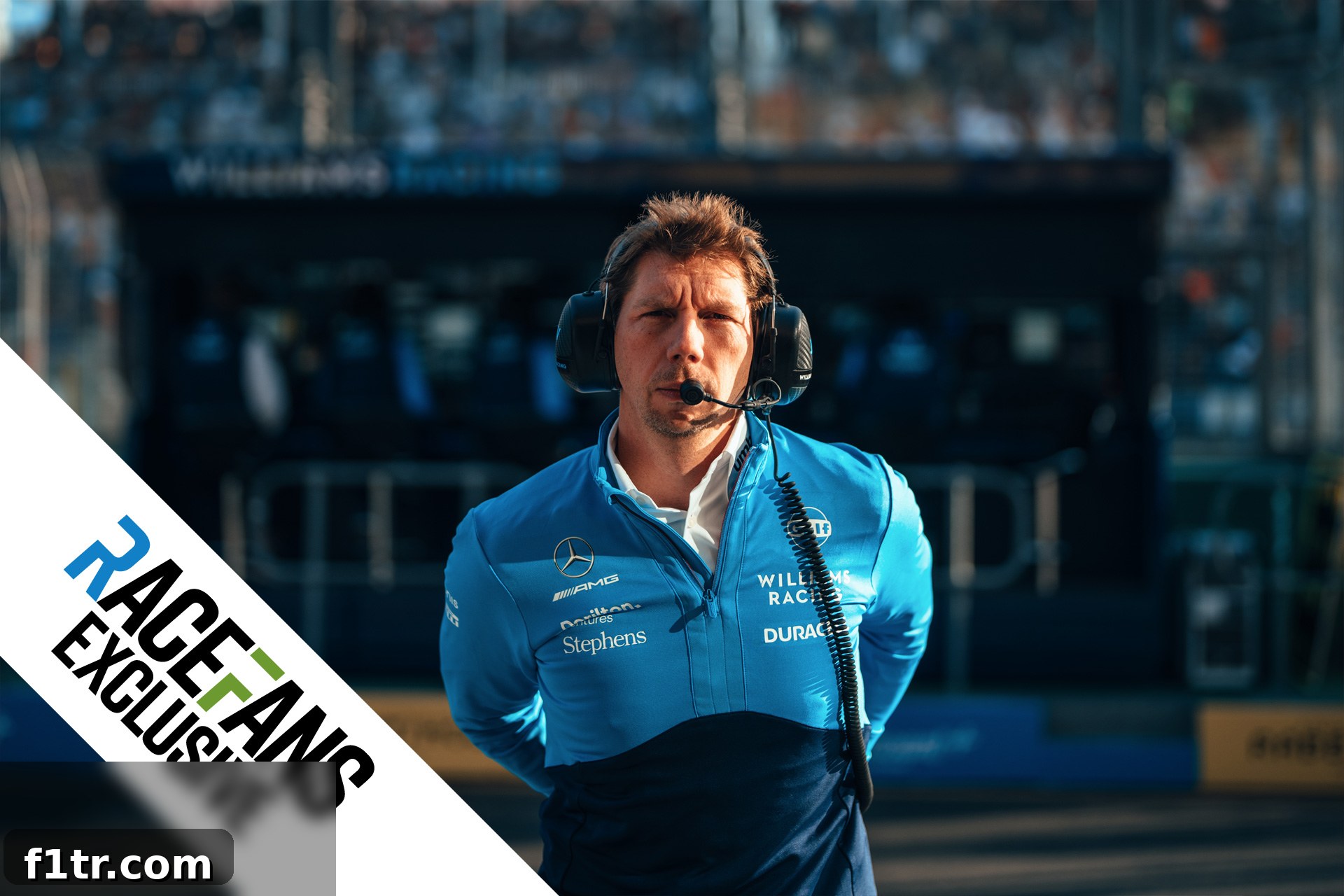
“I have a theory…”
In the bustling Williams Racing motorhome, moments after a cordial morning greeting with a team member, James Vowles leaned in to share his profound hypothesis on the extraordinary talent that congregates within the Formula 1 paddock.
“Formula 1 attracts the absolute best of the best, without exception. Whether it’s engineers, marketing specialists, or any other discipline, you find individuals who are at the very pinnacle of their respective fields,” Vowles began, his voice reflecting years of experience in the sport’s highest echelons. “And then, there are all the failed racing drivers…”
This statement, coming from a team principal, would ordinarily be quite startling. However, Vowles wasn’t making a veiled reference to any of the twenty elite athletes who currently command a coveted spot on the F1 grid. He was, with characteristic humility and a touch of self-deprecating humor, speaking about himself.
In a unique turn for a motorsport interview, the subject sitting across the table also happened to be a driver from the competitive Asian Le Mans Series, albeit technically speaking.
Last February, over two intense back-to-back weekends, Vowles found himself strapping into the cockpit of a McLaren 720S GT3 car. Operated by the highly respected Garage 59 team, he competed in both rounds of the sportscar series held at the challenging Dubai Autodrome and the iconic Yas Marina circuit. This venture was more than just a fleeting passion; it was the fulfillment of a deeply personal promise he had made to himself way back in 2001. That year marked his initial foray into the world of Formula 1, entering in an engineering capacity at the Brackley factory when it operated under the BAR banner, a team that would eventually evolve into the mighty Mercedes-AMG F1 team.
“My primary intention was always to grow and develop within this sport that I have loved unconditionally for so long,” he explained, reflecting on his journey. “The men and women who become Formula 1 drivers are truly exceptional. It’s incredibly difficult to articulate just how phenomenal their abilities are. Their driving at the absolute limit of these highly sophisticated machines is instinctive, almost a natural extension of themselves.”
“However, I always knew I wanted to be intimately involved with these elite athletes, to share in that high-performance environment. That aspiration was precisely why F1 became my ultimate goal; it was the driving force and motivation behind my career path. But once I had accumulated sufficient experience and, critically, the financial means within the sport, I was determined to place myself back in a position where I could actively compete and race again.”
His stint in the Asian Le Mans Series involved four races packed into an intense eight-day period. The then-Mercedes motorsport strategy director managed to secure a best finish of 13th in class, earning two valuable points alongside his co-drivers, Nicolai Kjaergaard and Manuel Maldonado – a cousin to Williams’ last grand prix winner, Pastor Maldonado.
“It was a genuine trial by fire!” he admitted with a wry smile. “While I had some prior experience with GT3 racing, I had never before competed in a multi-class event involving LMP2, LMP3, and GT3 cars all on track simultaneously. I’d never executed a mid-race driver change under pressure, nor had I ever experienced night racing. To compound the challenge, the car we were driving was brand new to the team, and its lights, unfortunately, were definitely not calibrated the way they should have been. So, yes, that was certainly an unforgettable endurance race experience.”
Such challenges, however, are not entirely unfamiliar territory for Vowles. He is rapidly acclimatizing to the complexities of motorsport when things are far from optimal. As he sat down for this interview, just weeks before the Williams team would achieve an impressive seventh-place finish in the Canadian Grand Prix, the Grove-based outfit was languishing in tenth and last position in the constructors’ championship, with only a solitary point to its name.
The stark contrast to what Vowles had grown accustomed to could hardly be more profound. Over two decades at the Brackley base, encompassing their evolution from BAR to Honda, the remarkable championship win as Brawn GP in 2009, and their ultimate transformation into what is arguably the most dominant team F1 has ever witnessed in Mercedes-AMG, Vowles’ career tally stood at an astonishing 123 Grand Prix victories, nine constructors’ championships, and eight world titles for his team’s drivers. Now, he finds himself at the helm of a Williams Formula 1 team that has collectively scored fewer points over the past six seasons than his former Mercedes team achieved in just their last six rounds alone.
As only the third permanent team principal in the storied history of Williams Grand Prix Engineering—a count that deliberately excludes Claire Williams’ period acting as the public face of the team her father so famously founded—James Vowles has arrived at Grove not merely to lead Williams but with the formidable mandate to fundamentally transform it. The hundreds of dedicated staff at the team’s historic factory had, in recent years, operated in a state of suspended animation, awaiting a new direction as owners Dorilton Capital meticulously sought to forge a renewed path for what has recently become one of F1’s most under-achieving teams. They have specifically tasked the 44-year-old Vowles with this monumental responsibility.
But with fewer than five months having elapsed since he formally took charge, how have his new staff responded to their new leader?
“First and foremost, everyone has been incredibly welcoming from day one,” he replied, his tone genuinely warm and appreciative.
“The inherent fear you often carry into these high-pressure environments is always whether or not the team will truly open their arms to you. Will they be apprehensive about the impending change, or, even worse, will they outright reject you as the catalyst for that change? I can confidently say that the overwhelming sentiment within the team is one of readiness for evolution, a genuine appetite for transformation. The entire organization implicitly understands that we simply cannot continue operating as we have been.”
Vowles is acutely aware that he has taken over a team that has already endured significant change in recent memory. However, far from encountering resistance, he asserts that he has discovered a wealth of talented personnel who are not only willing but eager to embrace new ideas, adopt fresh methodologies, and channel renewed energy into the team’s revival.
“Williams has, regrettably, experienced multiple directional changes in the past. However, everything we have discussed and planned so far in terms of our long-term objectives—not just for this year, but crucially for the next several years—which entails a complete ground-up re-evaluation, digging deep, dismantling old structures, and implementing profound systemic changes—has been met with an incredibly open-minded attitude,” he explained, emphasizing the team’s receptiveness.
“That openness is the single most important factor. I would say that probably over the recent weeks, we’ve successfully started to put in place a solid core of management team elements. There is undoubtedly more to come. We anticipate several more significant signings that will be announced publicly over the next few months, and from those, you will begin to discern the precise structure I envision. But that is precisely what is currently missing – the team doesn’t yet possess the comprehensive structure required to efficiently run and operate on a day-to-day basis, let alone effectively develop and propel itself forward. That essential framework will, without question, materialize over time.”
Given his extensive technical background, it came as no surprise when Vowles immediately directed his focus towards Williams’ technical department. He quickly identified the significant void created by the departure of multiple key figures, including their former technical director, Francois-Xavier Demaison, among others. While Demaison’s specific role has not yet been permanently filled, the team has successfully brought in a new chief operating officer, Frederic Brousseau, who brings invaluable experience from the highly demanding aerospace industry.
“You absolutely still need to establish the correct technical structure, and I can confirm that I am very, very clear in my mind about what that ideal structure looks like now,” Vowles affirmed. “Actionable steps will be taken very shortly to implement this vision.”
“We now have a Chief Operating Officer who is exceptionally capable. While he comes from a different arena – the aerospace industry – and there’s a substantial amount of work required to ensure he fully grasps the unique intricacies of Formula 1, he is truly outstanding. He serves as my crucial eyes and ears back at the factory, providing vital insights into our operational capabilities.”
“It’s imperative to understand that it’s not just the technical department that requires change. It’s not merely design, or the wind tunnel, or solely aerodynamics – it is quite literally everything. Some of our production methodologies and underlying philosophies are conservatively 20 years out of date, and describing them as ‘a little bit all over the place’ is probably the most diplomatic way to put it. Ultimately, the singular metric that drives everything in Formula 1 is performance, and that’s precisely why our focus must predominantly be on that aspect. However, every time you push one element, you inevitably uncover another limitation, another bottleneck, another logjam that you then have to systematically address and clear. At this current stage, you often don’t discover these issues until you truly stress the organization, which is precisely what we are actively doing in various strategic ways right now.”
This is undeniably not an enviable challenge. It would be daunting for any potential team principal, let alone someone taking on the most crucial seat on the pit wall for the very first time in their career. Through the initial eight rounds under his strategic direction, Williams has indeed savored moments of genuine triumph – but these have also been interspersed with periods of bitter frustration. Crucially, at this nascent stage, Vowles can neither claim sole credit for the successes nor shoulder full blame for the setbacks. Instead, he remains a team principal meticulously learning on the job, continuing to lay the fundamental groundwork for what he fervently hopes will become sustained future success for the historic team.
“I believe that even now, we are continuously discovering – and I anticipate this will continue for at least the next six months – where the truly fundamental problems lie,” Vowles elaborated. “And often, these problems are not necessarily where one might initially expect them to be.”
“However, I feel that this initial phase of problem identification is progressing rather well. But I implore you to adjudicate or judge me more definitively by what you observe in a year’s time, once the true transformation begins to manifest, rather than by our current situation today. Nevertheless, I am fairly content and comfortable with the fact that we are at least starting to rigorously test and push various components of our system to pinpoint precisely where they falter.”
“It’s vital to remember that this is an organization that has achieved incredible things in the past. They constructed a Formula 1 car, comprising over 17,000 individual components, entirely without the aid of any digitized system whatsoever. I honestly didn’t even believe that was still possible in modern-day Formula 1. This anecdote alone provides a profound insight into just how hard-working and utterly dedicated some of the individuals within this organization truly are. But you don’t achieve sustained success by operating in that manner indefinitely. Now, if you try to imagine the immense cultural change required to take individuals who might say, ‘I’ve always done it that way for 20 years,’ and then show them a completely different, more efficient pathway – that profound shift doesn’t happen overnight. And similarly, the sophisticated new systems don’t simply appear overnight.”
What makes Vowles so uniquely qualified to orchestrate Williams’ turnaround is his integral role as a core element of the meticulously engineered machine that delivered Mercedes win after win and title after title for so many dominant years. However, Formula 1 is not like football, or the NFL, or basketball. A leader cannot simply arrive and instantaneously reverse fortunes through sheer personnel management or raw charisma alone. The complex process of designing, meticulously running, and continuously developing an F1 car demands an intricate combination of robust resources, cutting-edge facilities, and advanced systems, alongside exceptional talent. Vowles fully understands that it will take considerable time for the neo-Williams to arise and reclaim its full, rightful glory.
“I have been consistently very open and honest about the precise timeline this transformation will necessitate,” he stated unequivocally. “There are simply certain things that I, personally, cannot fix overnight, and they will invariably require a specific duration to implement.”
“For instance, if you decide to replace just the simulator, you are realistically looking at a timeframe of approximately 20 months before a new, state-of-the-art simulator is fully operational within the building. If you intend to upgrade your composites facility, you’re looking at around 24 months. And if your objective is to completely reconfigure and redesign your existing factory buildings to optimize their layout, that process will likely take about 36 months. These timelines are based on pressing the necessary buttons today to initiate and organize these complex projects – that’s simply how long it takes to establish such critical structures and systems within an F1 operation.”
“If you aim to fundamentally change a culture, it typically requires, in my extensive experience, about three years. And from the very outset, what I have communicated to everyone involved is that this ambitious timeline might even extend beyond my own tenure here in the sport. I sincerely hope that isn’t the case, but what I am unequivocally putting in place are robust structures and resilient systems that are designed to outlast me, enduring for a very, very long time to ultimately bring this esteemed team back to where it truly belongs.”
However James Vowles aims to meticulously rebuild one of Formula 1’s most famous and historically successful teams, everyone within the organization – from the diligent factory staff to the talented drivers Alexander Albon and Logan Sargeant – can at least be certain that their leader is, at his core, a true racer. Already over the initial eight rounds, he has proven to be one of the most vocal and hands-on team principals on the grid, quick to offer either praise or a calming word to his two young drivers over the team’s radio waves whenever he perceives it necessary. It all traces back to that fierce competitive spirit coursing through him – even if he candidly describes himself as a “failed racing driver.”
“I personally believe that the connection I share with both of these drivers, and indeed the rapport I cultivated at my previous team, is significantly more cemented by the fact that I understand, to a certain extent, what they are truly experiencing,” he elaborated. “Nowhere near the same unparalleled level, of course; I am certainly not comparing our respective skill sets or achievements. But I do possess a genuine empathy and understanding for the pressures and challenges they face.”
Yet, while racing drivers are inherently hard-wired to want to accomplish everything as swiftly and efficiently as humanly possible, that is simply not a luxury that Williams, or Vowles himself, can afford in their determined pursuit of climbing up the competitive Formula 1 grid. So, for the foreseeable future, Vowles is approaching his monumental mission to transform Williams not like a rapid sprint, but rather like a strategic and demanding endurance race.
“That fundamental transformation simply cannot be achieved in a single year,” he stated firmly as the metaphorical chequered flag fell on our time with him. “In fact, worse still, if you attempt to rush and cram it into one year, we will undoubtedly find ourselves having to undo much of that rushed work in the subsequent two years. That’s why I don’t feel any undue stress or pressure; I am immensely confident and comfortable in my conviction that what we are systematically implementing will ultimately provide the correct, long-term solutions for this storied organization.”
Supporting Quality Motorsport Journalism
This publication thrives in part due to the generous support of its dedicated readers. By contributing, you help cover the essential costs of creating, hosting, and developing high-quality motorsport content today and into the future.
Consider supporting independent journalism and enjoy an ad-free browsing experience. More information can be found via the links below:
- Explore Support Options
- Frequently Asked Questions
Related Motorsport Articles
- Motorsport Governing Body Clears President in Recent Report
- Popular Motorsport Documentary Series Sees Viewing Figures Decline
- Reflecting on the Previous Formula 1 Season
- Top Drivers Who Made Significant Gains Through the Field
Browse all articles from the past F1 season