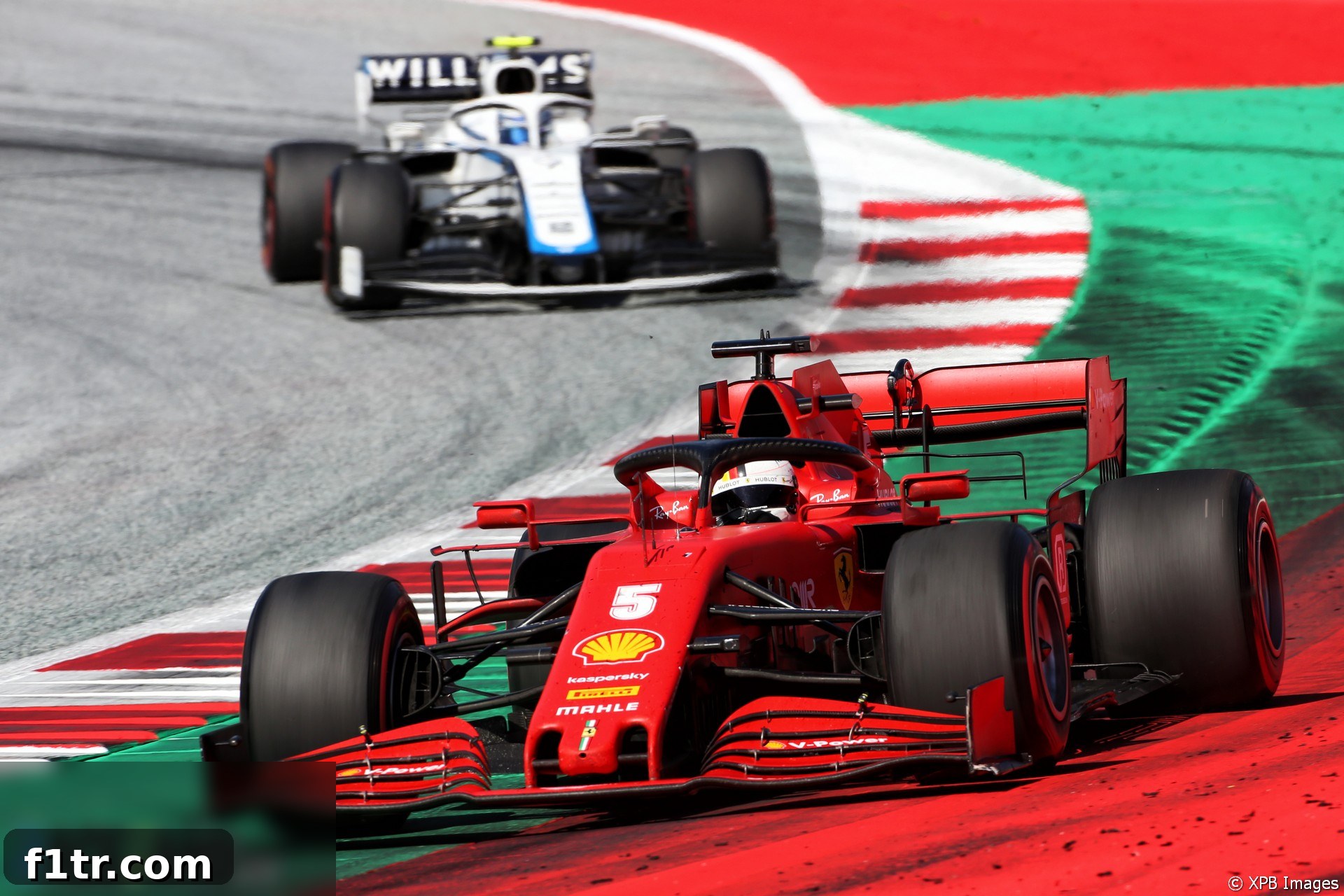
Sebastian Vettel Reflects on Challenging Austrian Grand Prix: ‘Happy I Only Spun Once’ Amid Ferrari Struggles
Sebastian Vettel openly admitted his relief at having spun only once during a particularly demanding Austrian Grand Prix, a race where he grappled significantly with the handling characteristics of his Ferrari. The four-time world champion’s comments underscored a challenging start to what would become a difficult season for both him and the Scuderia.
The race at the Red Bull Ring saw Vettel finish a hard-fought tenth, securing a single championship point. However, this result came after an early, pivotal moment in the race where he lost control of his car at Turn 3 while attempting an overtake on Carlos Sainz Jnr. This incident not only cost him valuable track position but also highlighted the underlying issues he was facing with his SF1000 throughout the weekend.
Vettel’s Struggle with the Unpredictable Ferrari SF1000
Following the race, Vettel was candid about the difficulties encountered. “To be honest, I’m happy that I spun only once,” he stated, a remark that painted a vivid picture of the car’s lack of stability. His sentiment conveyed a sense of battling an unpredictable machine rather than a finely tuned racing instrument. He elaborated, “It was very difficult. It got very tight. I think Carlos, one of the McLarens turned in and I was just on the edge because I wanted to be as close as possible and lost the rear.”
This wasn’t an isolated moment of instability for the German driver. He revealed a more profound struggle with the car’s balance: “But to be honest, I lost the rear a couple of times today. So as I said I’m happy that it happened only once.” Such an admission from a driver of Vettel’s caliber, renowned for his precise driving style and ability to master complex machinery, spoke volumes about the inherent flaws of the 2020 Ferrari challenger. The car, later identified as lacking both aerodynamic stability and engine power, proved to be a formidable adversary even for the most experienced hands.
The persistent issue of “losing the rear” suggested a critical lack of confidence, especially under pressure. High-speed corners and braking zones, typically areas where drivers push the limits, became minefields for Vettel. This instability directly impacted his ability to attack and defend, forcing him into a more cautious approach than his aggressive instincts preferred. The constant battle with the car’s rear end meant he couldn’t extract maximum performance, leading to frustrating scenarios like the one witnessed at Turn 3.
The Costly Spin at Turn 3: A Detailed Account
The incident that defined Vettel’s early race occurred during a crucial phase. At the time of his spin, Carlos Sainz was strategically positioned behind Vettel’s teammate, Charles Leclerc. Leclerc, in the sister Ferrari, was already demonstrating a more comfortable relationship with the SF1000, ultimately navigating it to a remarkable second-place finish, a stark contrast to Vettel’s struggles.
Vettel’s detailed explanation provided insight into the chaotic nature of the midfield battle and the fine margins at play. “Charles, I think, was trying to defend his position and Carlos in the last second was turning in fairly aggressive to I guess line up for the next straight,” Vettel recounted. This sequence of events placed Vettel in a compromised position. He found himself “locked in,” with limited options to avoid contact or loss of control.
“I didn’t really have a place to go to avoid contact. I tried the kerb as much as I could, I locked the rears and basically spun around,” he continued. The attempt to utilize the kerb, a common tactic to gain an advantage or avoid a collision, backfired due to the car’s unstable rear. The subsequent locking of the rear wheels was the final trigger for the spin, sending him momentarily out of contention. “Once I was sort of committing to trying to get as close as possible for the next great straight then suddenly I found myself not having any place to go,” Vettel lamented, describing the sudden and unavoidable nature of the incident.
The immediate consequence of the spin was a significant drop down the order, turning an already difficult race into an uphill battle. “So it was obviously a shame that I had that lost the car there because it was quite costly,” he admitted. Beyond the immediate time loss and loss of positions, the incident likely further eroded his confidence, making the rest of the race an even greater psychological and physical challenge. His subsequent struggles with “car feeling and confidence also under braking” were likely exacerbated by this early setback, illustrating a vicious cycle of instability and diminished performance.
A Race of Contrasts: Vettel’s Ordeal vs. Leclerc’s Triumph
The Austrian Grand Prix served as a stark demonstration of the differing experiences between Ferrari’s two drivers in 2020. While Sebastian Vettel wrestled with an unpredictable car, ultimately recovering to a solitary point in tenth, Charles Leclerc defied expectations by masterfully guiding his SF1000 to an impressive second-place finish. This disparity in results, particularly given the car’s widely acknowledged limitations, cast a spotlight on the challenges Vettel faced in adapting to Ferrari’s latest creation.
Leclerc’s ability to extract a podium finish from a car that his teammate described as “very difficult” was a testament to his unique driving style and perhaps a better synergy with the SF1000’s characteristics. Some analysts suggested that Leclerc’s aggressive, front-end-focused driving style might have suited the car’s inherent instability slightly better, allowing him to manage the rear more effectively through throttle input. Conversely, Vettel, known for preferring a stable rear end to maximize corner entry speed, found himself constantly fighting the car’s tendencies.
This contrast highlighted a critical internal dynamic within Ferrari during a trying season. While the team struggled collectively, the individual performances underlined the significant impact of driver-car harmony. For Vettel, who had already been informed that his contract would not be renewed beyond 2020, such a performance gap only added to the pressure and frustration, painting a clearer picture of the uphill battle he faced not just against rivals, but also, it seemed, against his own machinery.
Broader Context of Ferrari’s Challenging 2020 Season
The difficulties experienced by Sebastian Vettel at the Austrian Grand Prix were symptomatic of Ferrari’s broader struggles throughout the 2020 Formula 1 season. The SF1000 proved to be a significant step backward from its predecessors, particularly after rule clarifications regarding engine power units limited their previous competitive edge. This left Ferrari with a car that lacked both straight-line speed and consistent aerodynamic performance.
The car’s inherent instability, particularly at the rear, was a recurring theme. Drivers require immense confidence in their car’s rear end to push to the limits, especially in braking and cornering phases. When this confidence is lacking, as Vettel frequently expressed, it leads to a more tentative approach, compromised entry speeds, and a constant battle to keep the car on track. This problem was compounded by the car’s general lack of downforce, which meant that even if a driver could manage the rear, the overall grip levels were insufficient to challenge the front-running Mercedes and Red Bull teams.
For a driver like Vettel, who thrives on consistency and confidence from the car, the SF1000’s unpredictable nature was particularly challenging. It required a complete recalibration of his driving style, which is notoriously difficult for any seasoned professional. The struggle to adapt to a fundamentally flawed package, coupled with the immense pressure of leading one of F1’s most iconic teams, created a perfect storm of disappointment and underperformance for the German champion. The Austrian GP served as an early indicator of the long and arduous season that lay ahead, a season where Ferrari would rarely compete at the sharp end of the grid.
Battling Through Adversity: A Point Scored
Despite the early spin and the consistent struggles with the car’s handling, Sebastian Vettel’s eventual tenth-place finish should not be entirely overlooked. Securing a single championship point from such an adverse situation demonstrates his enduring professionalism and resilience. After falling to the back of the pack, Vettel meticulously worked his way back through the field, making crucial overtakes and minimizing further errors.
This point, while modest, was hard-earned. It reflected a driver who, despite being profoundly uncomfortable with his car and facing intense scrutiny, refused to give up. In a season where points would be hard to come by for Ferrari, every single point contributed to the Constructors’ Championship standings. While the narrative surrounding his performance was dominated by the spin and his struggles, the ability to recover and salvage a point underscored his fighting spirit, even when the odds were stacked heavily against him.
Looking Ahead: A Season of Uphill Battles
The Austrian Grand Prix set a clear precedent for Sebastian Vettel’s 2020 season: it would be an uphill battle against a challenging car and increasingly competitive rivals. His candid reflections highlighted a disconnect between driver and machine that would persist throughout the year. For Ferrari, the race was a mixed bag, with Leclerc’s podium offering a glimmer of hope amidst the evident struggles of their lead driver and the overall performance deficit of the SF1000. Ultimately, Vettel’s experience at the Red Bull Ring underscored the fundamental difficulties that would define his final year with the Scuderia, marking a stark contrast to his earlier championship-winning campaigns.
2020 F1 season
- Grosjean to make F1 test return tomorrow for first time since Bahrain horror crash
- Pictures: Wrecked chassis from Grosjean’s Bahrain fireball crash to go on display
- Bottas vs Rosberg: Hamilton’s Mercedes team mates compared after 78 races each
- F1 revenues fell by $877 million in Covid-struck 2020 season
- Hamilton and Mercedes finally announce new deal for 2021 season
Browse all 2020 F1 season articles