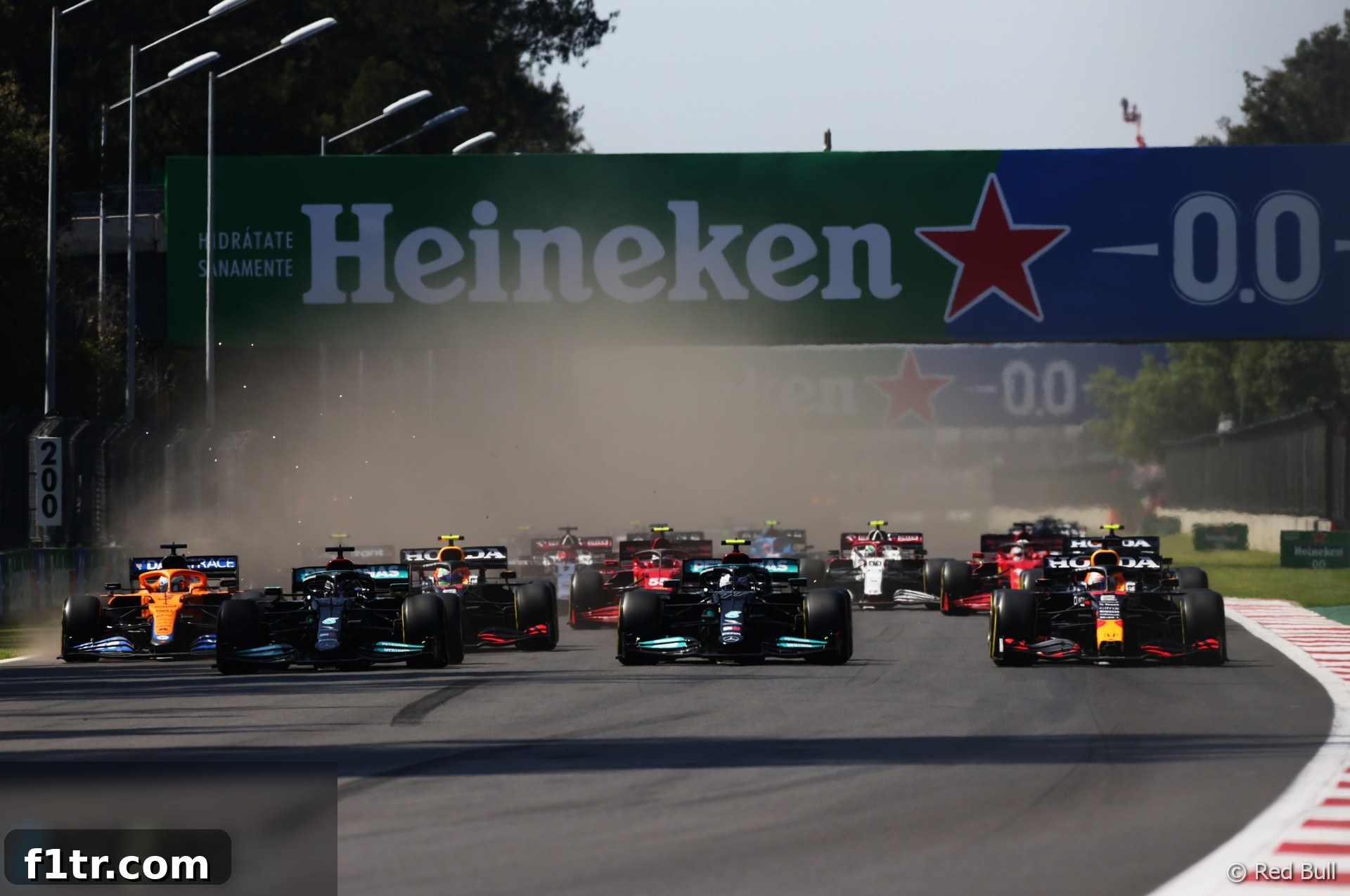
In the high-stakes environment of Formula 1, every millisecond and every tactical decision can shape the outcome of a race, and indeed, a championship. The start of the Mexico City Grand Prix proved to be a pivotal moment in the intense 2021 season, particularly for Mercedes-AMG Petronas F1 Team. Despite securing a crucial front-row lockout, the Silver Arrows found themselves outmaneuvered by Red Bull Racing’s Max Verstappen within mere seconds of the lights going out. This incident sparked a significant internal discussion within Mercedes, with driver Valtteri Bottas later acknowledging that, in hindsight, he might have been able to adopt a different approach to defend his pole position.
The immediate aftermath of the start saw Lewis Hamilton, Bottas’s teammate and championship rival to Verstappen, openly suggest that Bottas had “left the door open” for the Dutchman. This sentiment was quickly echoed by Mercedes Team Principal Toto Wolff, underscoring the team’s collective disappointment at relinquishing control so early in what promised to be a strategically complex race. Verstappen, starting third, capitalized on the slipstream effect and a clear line into the first corner, sweeping past both Mercedes cars with formidable speed and precision to seize a lead he would ultimately maintain comfortably until the checkered flag.
Reflecting on the critical opening moments of the race, Valtteri Bottas offered a candid assessment of his actions. “If I’m very honest to myself, if I look back, I say it again, it’s easy to say afterwards, probably I could have done things differently,” he admitted when pressed on the specifics of the start. This self-critical introspection is a hallmark of top-tier athletes continually striving for perfection. Bottas further elaborated on the immediate pressure and instinctive decision-making inherent in an F1 start. “But in that moment, I felt I was making the right decisions.”
The Finnish driver pondered the hypothetical scenario of a do-over, acknowledging the fine margins that define such moments. “If I could re-live the moment, maybe there was a way to block Max or prevent him going outside. Maybe he would have had a chance to go inside, I don’t know. It’s one of these things,” Bottas mused. He emphasized that in the heat of the moment, his focus was on giving his utmost. “At the moment I tried my best, and that’s all I can do. I’ve obviously watched the videos, and if I would be in a same situation again, maybe I could do a better job, maybe not.” This nuanced perspective highlights the immense difficulty of real-time tactical choices when battling for position with milliseconds to react, where the consequences of even minor errors are magnified exponentially.
The challenges of the Mexico City Grand Prix circuit, particularly its exceptionally long run to the first braking zone at the Autodromo Hermanos Rodriguez, were a known factor for all teams. Mercedes’ head of trackside engineering, Andrew Shovlin, provided valuable insight into the complexities faced by drivers during a race start, often exceeding initial expectations. “It’s a very long run,” Shovlin explained, outlining the team’s pre-race anxieties. “Of all the circuits we’ve got a front-row lock-out, we were worried about all the things that might go wrong at the start with tows.”
Shovlin elaborated on the discrepancy between planned strategies and the unpredictable reality of an F1 start. “The drivers talk about how they can choreograph themselves,” he noted, referring to the meticulous planning that goes into optimizing grid positions and initial trajectories. “But the reality is, once the lights go out, it’s very difficult to stick to your plan because it’s never quite as you might imagine.” This statement underscores the dynamic and chaotic nature of the opening lap, where multiple cars are vying for the same piece of tarmac, making rigid pre-set strategies often obsolete within seconds.
Adding another layer of complexity to the Mercedes’ predicament, Shovlin suggested an almost ironic twist of fate regarding Hamilton’s launch. Starting second, just behind Bottas, Hamilton’s superior start inadvertently contributed to the Red Bull’s ability to capitalize. “It was almost unfortunate for us that Lewis got a better jump than Valtteri,” he commented. While both Mercedes drivers had good initial launches, Hamilton’s stronger getaway positioned him alongside Bottas rather than directly behind, disrupting the potential for a combined slipstream strategy against Verstappen.
Shovlin further clarified the impact of Hamilton’s strong start: “None of the actual launches were bad at all, but Lewis got a good jump and that put him alongside, so he was then unable to tow off Valtteri.” This spatial arrangement meant that instead of a potential double tow working to consolidate the Mercedes 1-2, it created a scenario where Verstappen found a clear path. “Then obviously if you watch it and you’re watching from an overhead shot, it’s very easy to look at what they could have done differently to prevent Max having that opening on the left side. But the reality is we knew that lap one would be one of vulnerabilities and it wasn’t really for bad starts, it was just the way that it all shook out. They weren’t able to block him.” This analysis paints a picture of a confluence of factors, rather than a singular mistake, that allowed Verstappen to snatch the lead.
Beyond the launch and tactical positioning, Shovlin also pointed to a specific performance advantage held by Red Bull at the critical Turn 1 braking zone. The ability to brake later and more effectively played a significant role in Verstappen cementing his position. “I don’t think we’re as good as them braking for turn one, Max does a very good job of that,” Shovlin admitted. This advantage, stemming potentially from Red Bull’s car philosophy, aerodynamic setup, or even Verstappen’s innate feel for the limit, allowed him to carry more speed deeper into the corner before turning in, effectively widening his margin over the Mercedes cars.
The engineering chief elaborated on this crucial deficit: “And ultimately, that was another area where we were a bit weak. We weren’t able to brake deep enough.” In a championship battle as finely poised as 2021, such marginal differences in performance, especially at key points like the first corner of a race, can prove decisive. The combination of a long run to Turn 1, the dynamics of the tow, and Red Bull’s superior braking performance created a perfect storm for Mercedes, transforming a promising front-row lockout into an immediate loss of control.
The implications of this start extended far beyond the immediate disappointment. Losing the lead so early in Mexico City, a circuit where overtaking can be challenging, severely hampered Mercedes’ strategic options and allowed Verstappen to dictate the pace of the race unchallenged. It highlighted the relentless pressure of the 2021 championship, where every team was pushed to its absolute limits, and even minor missteps had amplified consequences. The incident served as a stark reminder of how quickly fortunes can turn in Formula 1 and the critical importance of optimizing every single phase of a race, especially the opening seconds.
In conclusion, while Valtteri Bottas displayed commendable self-awareness in reviewing his performance, the events at the Mexico City Grand Prix start were a complex interplay of driver decision-making, team strategy, and car performance characteristics. The combined insights from Bottas, Hamilton, Wolff, and Shovlin reveal a multifaceted scenario where a strong front-row lockout could not withstand Max Verstappen’s aggressive and perfectly executed opening lap. It was a testament to Red Bull’s preparedness and Verstappen’s opportunism, and a valuable, albeit painful, learning experience for Mercedes as the 2021 Formula 1 World Championship battle intensified towards its thrilling conclusion.
2021 Sao Paulo Grand Prix
- Red Bull and Mercedes summoned to FIA hearing on review of Sao Paulo incident
- McLaren must “get back to scoring the results that are on the table” – Seidl
- Hamilton makes his second-biggest climb to victory from 10th on the grid
- F1 releases missing video footage from Verstappen’s car of Hamilton incident
- How Alonso and Ocon “pushed team tactics to the ultimate limit” to delay Gasly
Browse all 2021 Sao Paulo Grand Prix articles