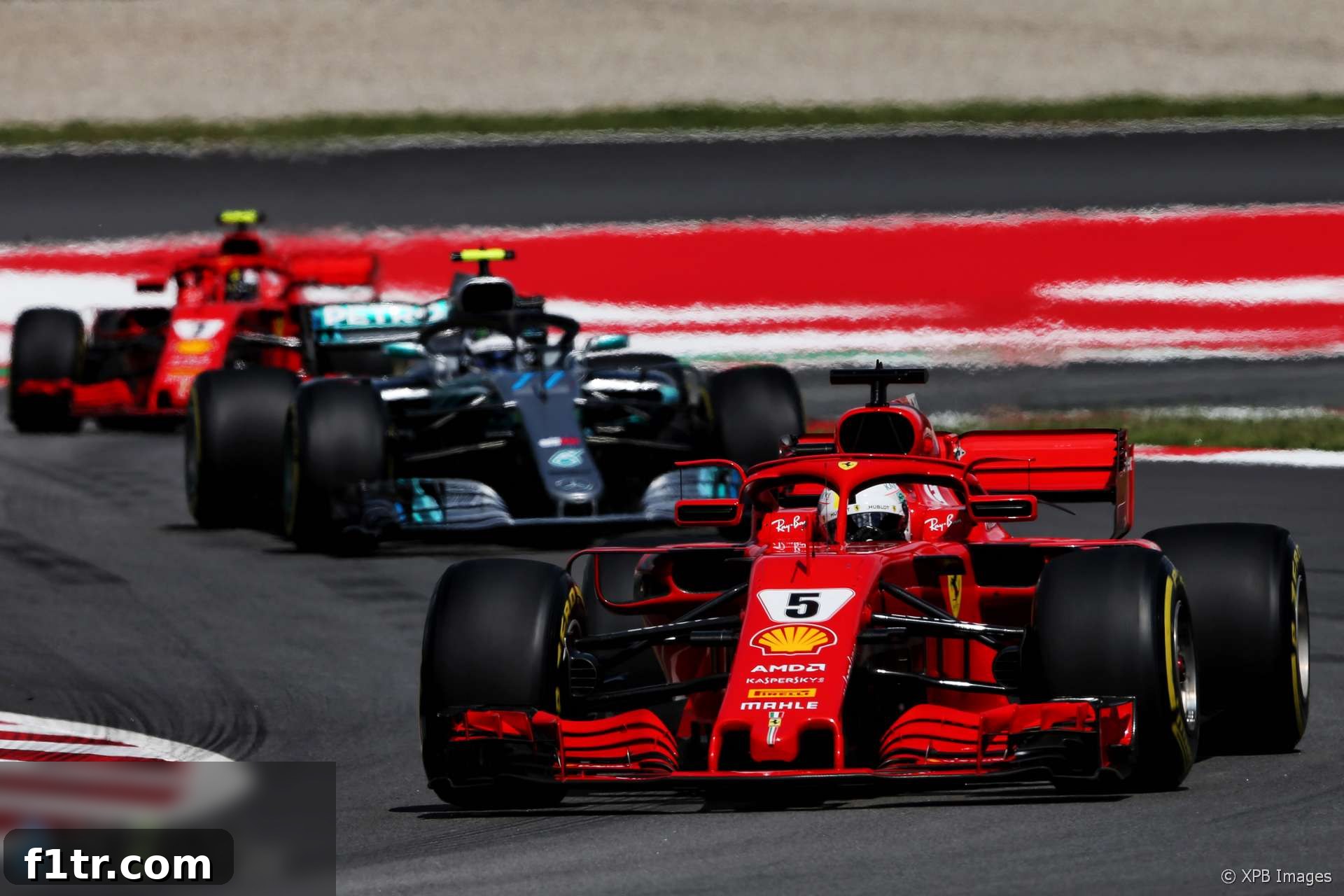
Sebastian Vettel Defends Controversial Spanish GP Pit Stop Strategy Amid Ferrari’s Performance Woes
Sebastian Vettel found himself under intense scrutiny following the 2018 Spanish Grand Prix, where a contentious two-stop strategy left him outside the podium positions. While pundits and fans questioned the decision, Vettel steadfastly maintained that he had no alternative, citing severe and unmanageable tyre degradation as the primary factor dictating his race plan.
Advert | Become a RaceFans Supporter & Go Ad-Free
The Unavoidable Two-Stop: A Tyre Management Conundrum
The German driver’s race in Barcelona saw him forced to make a second pit stop, a move that ultimately cost him valuable track position and dropped him behind competitors like Valtteri Bottas and Max Verstappen, both of whom successfully executed a one-stop strategy. Vettel’s explanation was direct and unequivocal: the tyres simply couldn’t endure the required stint length.
“We couldn’t make the tyres last, so for us, it was clear we had to come in again,” Vettel explained after the race. “I think it was the right thing to do. Obviously, if you look from the outside, it’s easy to criticize. But inside the car, we were going through the tyres too quick, and therefore we were not able to stay out for another 23 laps.”
This statement highlights the challenging reality faced by drivers and strategists in the heat of a Formula 1 race. While a single pit stop is generally the faster option on paper, it’s only viable if the tyres maintain sufficient performance. For Vettel, the degradation was so pronounced that continuing on the same set would have resulted in an even greater loss of pace, leaving him vulnerable and significantly slower.
The Spanish Grand Prix, held at the Circuit de Barcelona-Catalunya, is notoriously demanding on tyres, particularly the front left. High-speed corners like Turn 3 and Turn 9 put immense lateral loads on the rubber, leading to rapid wear and thermal degradation. While Pirelli had introduced new, thinner tread tyres for some races, including Spain, to combat blistering, Ferrari appeared to struggle more than their rivals in managing these conditions effectively.
Vettel’s struggle extended even to the fresher set of tyres he received after his second stop. “Even in the end with the fresher set, I wasn’t able to attack until the end,” he admitted, indicating that the fundamental issue wasn’t just old tyres, but perhaps the car’s inherent characteristics or setup contributing to excessive tyre wear regardless of age. This suggests a deeper performance deficit that wasn’t merely about strategic execution but the underlying package.
A Tale of Two Strategies: Vettel vs. Raikkonen
Adding another layer of intrigue to Ferrari’s Spanish GP performance was the revelation that Vettel’s teammate, Kimi Raikkonen, had been planning to make only one pit stop before his unfortunate retirement from the race. This divergence in intended strategies between the two Ferrari drivers raises questions about potential differences in car setup, driving styles, or perhaps a lack of clear understanding within the team regarding the optimal tyre management for their SF71H.
Raikkonen’s early exit due to an engine issue meant his strategy could not be fully tested, but the fact that he was aiming for a one-stop race suggests that Ferrari might have had conflicting data or different approaches to tyre management on either side of the garage. This internal disparity can sometimes lead to suboptimal overall team performance if a unified understanding of the car’s behaviour is not achieved.
Ferrari’s Triple Threat: Unpacking the Performance Deficit
Beyond the immediate strategic debate, Vettel candidly pointed out three fundamental issues that plagued Ferrari’s Spanish Grand Prix weekend, painting a clearer picture of their struggles compared to their dominant rivals, Mercedes-AMG Petronas Motorsport.
1. Lack of Raw Pace
The first and most critical observation from Vettel was a straightforward admission: Ferrari simply wasn’t quick enough. “One, we were not quick enough. If we are not able to see that then we are more than blind because we didn’t have the pace in the first stint,” he stated. This lack of inherent speed, particularly evident in the initial phase of the race, put them on the back foot from the outset. Mercedes demonstrated superior pace, allowing them to dictate the race from the front and manage their tyres with greater comfort. This deficit in raw performance pointed towards challenges with the car’s aerodynamic efficiency, engine performance, or overall setup at a circuit that often exposes any weaknesses.
2. Persistent Tyre Management Issues
Vettel highlighted Ferrari’s struggles with tyre management throughout the weekend as the second major concern. He acknowledged that the tyres had changed, referring to the thinner tread specifications introduced by Pirelli to curb blistering, but crucially added, “they changed for everyone.” This emphasizes that the challenge was universal, yet Ferrari seemed to be on the back foot in adapting to these changes compared to rivals. While other teams, particularly Mercedes, seemed to master the new tyre characteristics, Ferrari struggled with excessive degradation. This suggests that their car’s design, setup, or operating window for the tyres was not optimized for the specific demands of the Catalunya circuit and the revised Pirelli compounds, leading to an inability to extract consistent performance over a full stint.
3. Reliability Headaches
The third critical issue for Ferrari was a troubling lack of reliability. Kimi Raikkonen’s weekend was marred by mechanical issues, starting with an engine problem on Friday. This forced an engine change, incurring potential penalties and adding pressure. His eventual retirement from the race due to another engine-related issue was a significant blow, costing the team valuable points and highlighting a worrying trend. “Third, it was a poor weekend in terms of reliability. Obviously, Kimi had an issue with the engine yesterday, had to change the engine today, and obviously retired in the race, I don’t know what happened. So I think overall there are three things that we must be able to see. If we don’t see those, there are no excuses,” Vettel asserted. Reliability issues can cripple a championship challenge, eroding confidence and diverting resources from performance development.
Implications for the Championship Battle
The Spanish Grand Prix represented a significant setback for Ferrari in their championship battle against Mercedes. While Vettel managed to salvage some points, the dominant performance by Lewis Hamilton and Mercedes underscored the gap that Ferrari needed to close. The combination of a pace deficit, tyre struggles, and reliability concerns suggested that Ferrari had fundamental issues to address quickly if they wanted to mount a sustained challenge for both the Drivers’ and Constructors’ titles.
The meticulous nature of Formula 1 means that every race weekend offers crucial data and lessons. For Ferrari, Barcelona provided a stark reminder that even minor weaknesses can be magnified under competitive pressure, turning a potential victory into a damage limitation exercise.
Ferrari’s Path Forward: Addressing Imperfections with Urgency
Vettel’s candid assessment serves as a clear call to action for the Scuderia. His insistence that there are “no excuses” implies an urgent need for the team to conduct a thorough analysis, identify the root causes of their underperformance, and implement effective solutions. This involves a comprehensive review of their aerodynamic package, engine performance, tyre management strategies, and overall reliability protocols.
The pressure on Ferrari to react swiftly was immense. With a long season ahead, understanding and rectifying these issues before the championship momentum shifted irrevocably was paramount. Success in Formula 1 is a continuous process of improvement, and the Spanish Grand Prix highlighted critical areas where Ferrari needed to elevate their game to truly challenge for the ultimate prize.
In conclusion, Sebastian Vettel’s defense of his Spanish Grand Prix pit stop strategy was more than just an explanation of a single tactical decision; it was a symptom of deeper challenges faced by Ferrari. His articulate breakdown of the team’s lack of pace, tyre management difficulties, and reliability woes provided a sobering insight into the demanding world of Formula 1, where every element must function flawlessly to compete at the pinnacle of motorsport.
Advert | Become a RaceFans supporter andgo ad-free
More from the 2018 F1 Season
- F1 feared “death knell” for Drive to Survive after Ferrari and Mercedes snub
- McLaren staff told us we were “totally crazy” to take Honda engines in 2018 – Tost
- ‘It doesn’t matter if we start last’: How Red Bull’s junior team aided Honda’s leap forward
- Honda’s jet division helped F1 engineers solve power unit problem
- McLaren Racing losses rise after Honda split
Browse all 2018 F1 season articles