Ferrari’s 2020 F1 Nightmare: Teammate Collision Plunges Scuderia into Deeper Crisis at Styrian Grand Prix
The 2020 Formula 1 season proved to be one of the most challenging periods in Ferrari’s illustrious history, marked by a perplexing lack of pace and a series of operational missteps. While expectations were tempered even before the season began due to disappointing pre-season testing results and whispers about their engine performance, few could have predicted the depth of their struggles. The nadir of this early-season turmoil arrived dramatically at the Styrian Grand Prix, the second race held at Austria’s Red Bull Ring, where an unthinkable scenario unfolded: both Ferrari drivers, Sebastian Vettel and Charles Leclerc, collided on the very first lap, forcing a double retirement and sending shockwaves through the Maranello team.
The Ill-Fated First Lap: A Devastating Internal Clash
The Styrian Grand Prix, a unique addition to the revised 2020 calendar, offered Ferrari a chance at redemption following a dismal opening weekend. However, hopes were dashed in a matter of seconds. As the field jostled for position into the challenging Turn 3, a critical corner known for tight overtaking opportunities and potential congestion, Charles Leclerc, starting further back on the grid after a penalty, attempted an ambitious move up the inside. The car, the SF1000, which was already struggling for grip and lacking in overall performance, proved difficult to manage in such a high-pressure, close-quarters situation.
In a moment of misjudgment that would have profound implications, Leclerc’s car made contact with Sebastian Vettel’s. The impact was significant, though initially, the full extent of the damage was not immediately clear to those watching. Vettel’s SF1000 sustained catastrophic damage to its rear wing, effectively rendering the car undriveable due to the loss of aerodynamic stability. Leclerc’s car, while appearing less damaged at first glance, suffered severe floor damage, compromising its downforce and overall handling.
Immediate Aftermath and Double Retirement
Sebastian Vettel, the four-time world champion, managed to limp his extensively damaged car back to the pits. During his slow return, his radio communication revealed a degree of bewilderment. “I don’t know what that was,” he reported to his team, clearly unaware that it was his own teammate who had initiated the contact. “I was taking it easy into Turn 3 and then someone went completely up the inside.” The grim reality soon dawned as the team assessed the damage: retirement was immediate and unavoidable. Vettel’s race, and effectively his weekend, was over before it had truly begun.
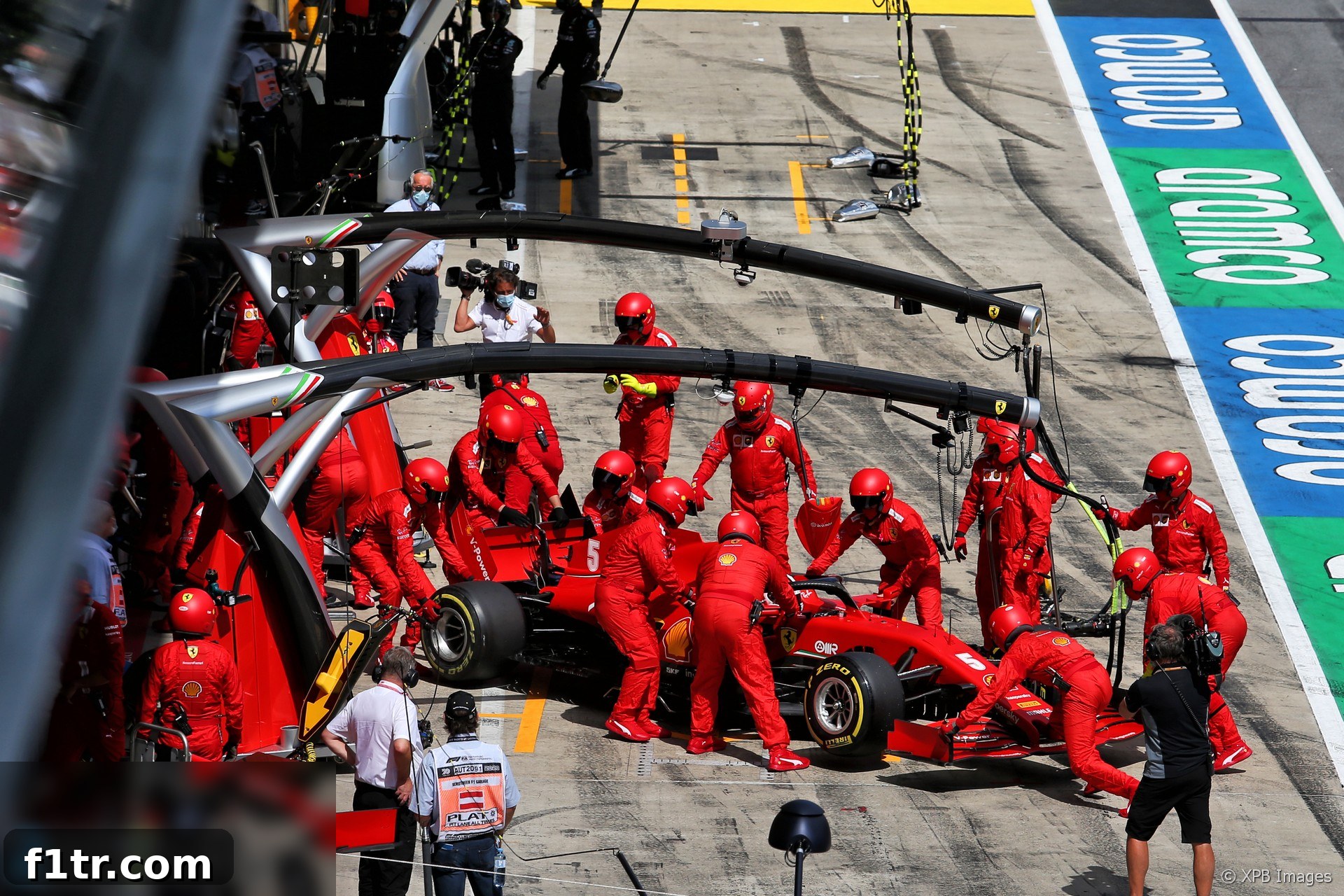
Leclerc, despite sustaining significant damage to his car’s front wing and floor, initially attempted to continue. He pitted for a new front wing, hoping that the car might still be salvageable. However, it quickly became apparent that the damage was more extensive than initially assessed. Over the team radio, a dejected Leclerc reported that the car “was very difficult to drive,” lacking balance and stability. With no realistic prospect of competitive racing and the risk of further damage, he too returned to the pits shortly afterwards, joining Vettel in a humiliating double retirement for the Scuderia. The sight of both iconic red cars out of the race within minutes of the start was a stark and painful symbol of Ferrari’s deep-rooted problems.
Drivers’ Perspectives: Accountability and Profound Disappointment
In the aftermath of the collision, both drivers offered their perspectives, shedding light on the intensity of the moment and the weight of its consequences. Sebastian Vettel, visibly frustrated and disappointed, spoke about the lack of space for Leclerc’s attempted manoeuvre. “I was very surprised because I was at the inside and I wasn’t expecting Charles to try something,” Vettel explained. “I don’t think there was space.” His words underscored the feeling that the move was overly ambitious and unnecessary, especially given their positions and the early stage of the race.
Charles Leclerc, however, was quick to accept full responsibility for the incident, offering an unreserved apology to his teammate and the entire Ferrari outfit. His candour and genuine remorse were palpable. “Obviously excuses are not enough in times like this,” Leclerc stated, acknowledging the severity of his error. His self-criticism was sharp and unflinching: “I’m just disappointed in myself. I’ve done a very bad job today. I let the team down. I can only be sorry even though I know it’s not enough. I hope I will learn from this and come back stronger for the next races.”
Leclerc further emphasized the immense pressure the team was under, and how his actions had exacerbated their already dire situation. “But it’s a tough time for the team. We don’t need that, the team doesn’t need that. And I put all the efforts of the team in the bin. I’m very sorry but it’s not enough again.” His words highlighted not just a personal error, but also the broader struggle within Ferrari, where every point and every trouble-free race was crucial for morale and development. The incident was a bitter pill for a young driver often hailed as the future of the team, showcasing the brutal learning curve at the pinnacle of motorsport.
The Broader Context: Ferrari’s Deepening Woes in 2020
The collision at the Styrian Grand Prix was not an isolated incident but rather a dramatic manifestation of Ferrari’s broader struggles in the 2020 F1 season. The SF1000 chassis was inherently flawed, suffering from a significant lack of straight-line speed and poor aerodynamic efficiency. This deficiency was widely attributed to the impact of the FIA’s technical directives concerning engine legality, which had effectively curtailed a previous advantage Ferrari was believed to have held. Without its powerful engine, the car’s aerodynamic shortcomings became glaringly apparent, leaving both drivers frequently battling for midfield positions rather than podiums.
The psychological toll on the team, already grappling with these fundamental performance issues, was immense. Engineers and strategists worked tirelessly, often under immense scrutiny, to extract any ounce of performance from a recalcitrant car. A double retirement, especially one caused by an internal collision, delivered a crushing blow to morale, undermining weeks of preparation and development work. The incident highlighted the intense pressure cooker environment of Formula 1, where the smallest mistake can have monumental consequences, particularly for a team already teetering on the brink of a full-blown crisis.
A Season of Unprecedented Challenges for Maranello
The 2020 season was unique due to the global COVID-19 pandemic, which forced a condensed calendar, back-to-back races at the same venues, and strict health protocols. These unprecedented challenges added another layer of complexity for teams, testing their adaptability and resilience. For Ferrari, a team already struggling with car performance and internal dynamics, these conditions amplified their difficulties. The double retirement at the Styrian Grand Prix, happening just one week after the opening Austrian Grand Prix where both cars also struggled, heaped more pressure on team principal Mattia Binotto and his entire organization.
Speculation about Binotto’s leadership and the future direction of the team intensified following this low point. While the immediate focus was on addressing the car’s deficiencies, the collision served as a stark reminder that even the best intentions and individual talents could be undone by internal friction or a lack of cohesive performance. It underscored the critical need for absolute precision and teamwork, even when battling for minor points, especially for a team with the storied legacy and expectations of Ferrari.
Teammate Collisions in F1 History: A Recurring Nightmare
While rare, incidents of teammates colliding are etched into the annals of Formula 1 history, often becoming defining moments of rivalry or team crisis. From the legendary battles between Ayrton Senna and Alain Prost at McLaren, which dramatically escalated into deliberate contact, to more recent flashpoints like Mark Webber and Sebastian Vettel’s “Multi-21” incident at Malaysia in 2013, or the intense Mercedes rivalry between Lewis Hamilton and Nico Rosberg, these moments underscore the razor-thin line between competitive spirit and destructive contact. However, the Ferrari incident at the Styrian Grand Prix stood out for its context: it was not a clash between two drivers fighting for a championship or even a podium, but a self-inflicted wound suffered by a team already deep in crisis, battling at the lower end of the points. This added a layer of pathos to an already dire situation, highlighting the systemic problems rather than just individual error.
Impact on Driver Dynamics and Future Trajectories
The Styrian Grand Prix collision occurred under unique circumstances for both drivers. Sebastian Vettel was in his final season with Ferrari, having already been informed that his contract would not be renewed for 2021. This added an extra layer of complexity to his situation; he was driving for pride and professionalism, but the impending departure could have subtly altered dynamics. For Charles Leclerc, positioned as the long-term future of the Scuderia, the incident was a painful learning experience. While his talent was undeniable, the mistake highlighted the importance of maturity and judgment, especially when representing a team with Ferrari’s legacy and expectations. The harmony within any F1 team is crucial, but it becomes even more vital when a team is struggling to find form and build a sense of unity. The incident served as a stark reminder of the fragile balance between individual ambition and collective responsibility, a lesson that would undoubtedly shape Leclerc’s approach in subsequent races and seasons.
Conclusion: A Defining Low Point in a Forgettable Season
The double retirement at the Styrian Grand Prix undoubtedly stands as one of the lowest points in Ferrari’s ignominious 2020 Formula 1 season. It was a race that encapsulated all of the team’s struggles: a slow car, strategic difficulties, and ultimately, a devastating internal error that cost them valuable track time and any chance of salvaging points. The incident served as a powerful, symbolic representation of an annus horribilis for the Maranello outfit.
While Charles Leclerc’s immediate acceptance of responsibility and profound apology were commendable, the incident underscored deeper systemic issues within Ferrari that extended beyond driver error. It highlighted the immense pressure on drivers to perform with a difficult car, the consequences of aggressive maneuvers when operating on the limit, and the critical importance of team cohesion. The road to recovery for Ferrari would be long and arduous, requiring not just technical improvements but also a renewed sense of unity and purpose to reclaim its rightful place at the pinnacle of motorsport. The Styrian Grand Prix 2020 will forever be remembered as a dark chapter in the Scuderia’s illustrious history, a stark lesson in the unforgiving nature of Formula 1.
Related Articles: The 2020 F1 Season & Beyond
Explore more insights and updates from the challenging 2020 Formula 1 season and its lasting impact on the sport and its drivers.
- Grosjean to make F1 test return tomorrow for first time since Bahrain horror crash
- Pictures: Wrecked chassis from Grosjean’s Bahrain fireball crash to go on display
- Bottas vs Rosberg: Hamilton’s Mercedes team mates compared after 78 races each
- F1 revenues fell by $877 million in Covid-struck 2020 season
- Hamilton and Mercedes finally announce new deal for 2021 season
Browse all 2020 F1 season articles