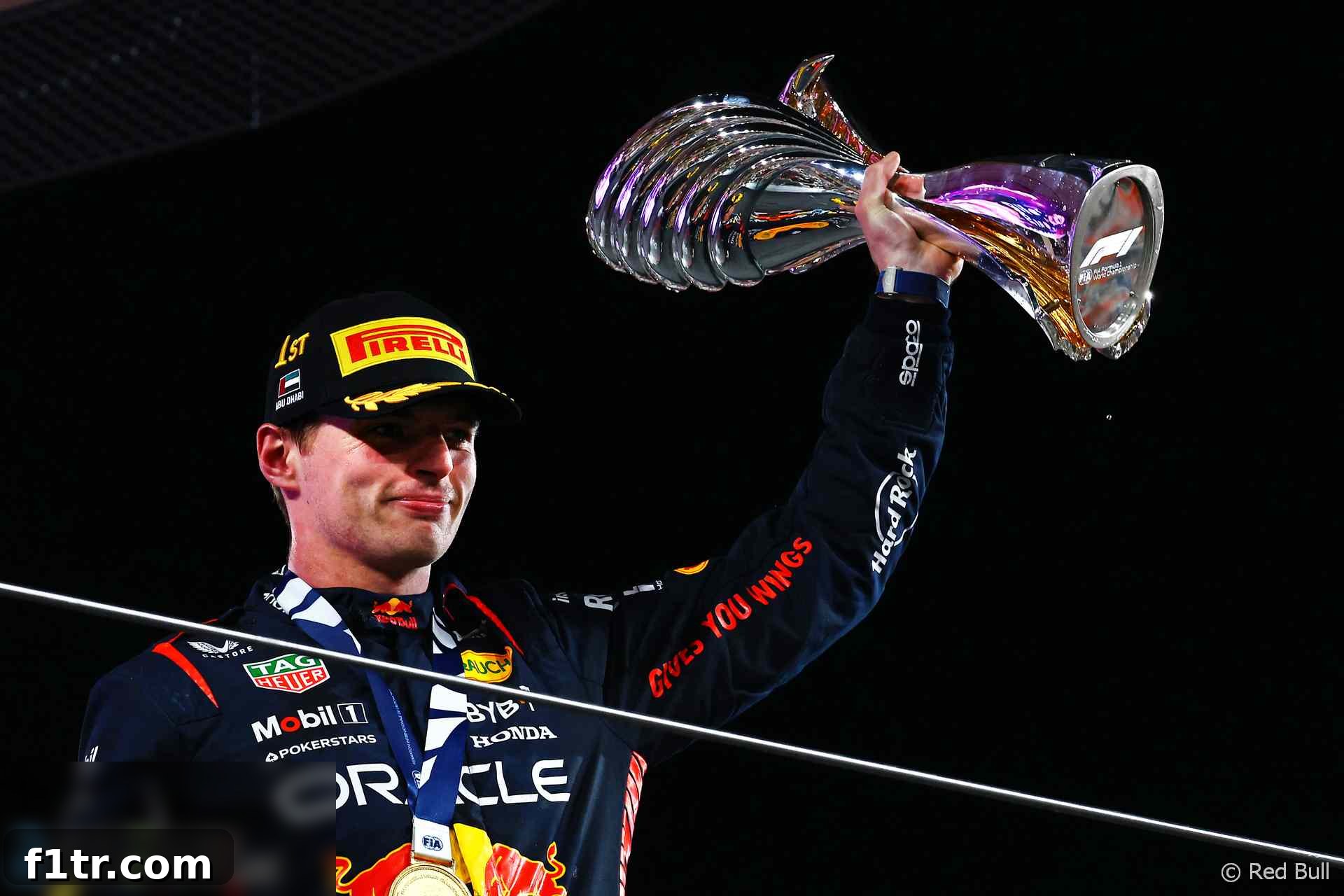
In the annals of Formula 1 history, few seasons have etched themselves into memory with the sheer, unadulterated dominance witnessed in 2023. Describing Max Verstappen’s achievement as merely ‘dominance’ feels almost an understatement; ‘annihilation’ better captures the comprehensive nature of his second consecutive world championship triumph. The Dutchman, alongside his formidable Red Bull Racing team, delivered a performance that wasn’t just record-breaking but fundamentally redefined the benchmarks for success in modern Grand Prix racing.
The 2023 Formula 1 calendar, tying for the longest season ever with 22 Grands Prix, was further intensified by the inclusion of six sprint races, culminating in a record total of 28 points-paying contests. Yet, even across this expanded championship, Verstappen’s margin over his competitors was nothing short of extraordinary, highlighting a masterful display of driving prowess, strategic execution, and engineering excellence.
This article delves into the staggering statistics that underpin Verstappen’s unparalleled 2023 season, examining the records he shattered and the historical context that elevates his achievements to legendary status. From outright victories to an astounding winning percentage and an unprecedented points haul, we explore the depth of his command over the pinnacle of motorsport.
Max Verstappen: Shattering the Record for Most Wins in a Single Season
Max Verstappen didn’t just break the record for most Grand Prix victories in a single season in 2023; he utterly recalibrated it. Having already elevated the benchmark from 13 to 15 wins in 2022, Verstappen took his own record and pushed it to an astonishing 19 victories out of 22 rounds in 2023. This means he won all but three races on the calendar, a feat that speaks volumes about his consistency and the formidable package he commanded.
To put this into perspective, legends like Michael Schumacher and Sebastian Vettel previously held the record with 13 wins each in shorter seasons. While the modern era benefits from a longer race calendar, Verstappen’s 19 victories far outstrip any competitor, historical or contemporary, in absolute terms. His ability to consistently deliver top-tier performances, week after week, across diverse tracks and conditions, underscored a level of concentration and skill rarely seen. Each win wasn’t merely a testament to raw speed but a demonstration of precise strategy, impeccable tire management, and an uncanny ability to navigate changing race dynamics flawlessly. The scale of this achievement is further amplified by the fact that he consistently outperformed his rivals, securing victories by significant margins, often controlling races from start to finish.
| Rank | Year | Driver | Wins | Races |
|---|---|---|---|---|
| 1 | 2023 | Max Verstappen | 19 | 22 |
| 2 | 2022 | Max Verstappen | 15 | 22 |
| 3 | 2004 | Michael Schumacher | 13 | 18 |
| 4 | 2013 | Sebastian Vettel | 13 | 19 |
| 5 | 2002 | Michael Schumacher | 11 | 17 |
| 6 | 2011 | Sebastian Vettel | 11 | 19 |
| 7 | 2014 | Lewis Hamilton | 11 | 19 |
| 8 | 2018 | Lewis Hamilton | 11 | 21 |
| 9 | 2019 | Lewis Hamilton | 11 | 21 |
| 10 | 2020 | Lewis Hamilton | 11 | 17 |
Unprecedented Efficiency: Highest Winning Rate in a Season
While winning the most races in 2022 was impressive, Max Verstappen’s winning rate that year (68.1%) still fell short of the historical record. However, in 2023, he comprehensively addressed this, ending Alberto Ascari’s remarkable 71-year reign as the driver with the highest percentage of Grand Prix victories in a single season. Verstappen’s 2023 winning rate of 86.3% represents an almost unimaginable level of success, surpassing Ascari’s 75% from 1952.
Ascari’s 1952 season, though dominant, was contested over only 8 races, where he won 6. Verstappen’s achievement comes in a significantly longer and more demanding 22-race season, making his 86.3% winning rate a testament to sustained excellence under far greater pressure and competition. This metric, arguably more than raw win totals, provides a truer picture of a driver’s dominance within their respective era, normalizing for varying season lengths. It underscores that Verstappen wasn’t just winning often; he was winning almost every time he took to the track, a testament to both his driving brilliance and the formidable capabilities of the Red Bull RB19. This unparalleled consistency across a grueling schedule underlines the mental fortitude and physical conditioning required at the pinnacle of motorsport.
Comparing his 2023 performance to other F1 legends further highlights its distinctiveness. Michael Schumacher’s best was 72.2% in 2004, and Jim Clark reached 70% in 1963. Even in their most dominant years, these titans of the sport couldn’t quite match the sheer efficiency Verstappen demonstrated in 2023. This record is a clear indicator that the 2023 season wasn’t just about winning, but about a relentless, almost flawless pursuit of victory at nearly every turn, establishing a new benchmark for peak performance.
| Rank | Year | Driver | Winning rate (%) |
|---|---|---|---|
| 1 | 2023 | Max Verstappen | 86.3 |
| 2 | 1952 | Alberto Ascari | 75 |
| 3 | 2004 | Michael Schumacher | 72.2 |
| 4 | 1963 | Jim Clark | 70 |
| 5 | 2013 | Sebastian Vettel | 68.4 |
| 6 | 2022 | Max Verstappen | 68.1 |
| 7 | 1954 | Juan Manuel Fangio | 66.6 |
| 8 | 2020 | Lewis Hamilton | 64.7 |
| 8 | 2002 | Michael Schumacher | 64.7 |
| 10 | 1965 | Jim Clark | 60 |
Accumulating a Colossal Score: Most Points in a Season
Another record Verstappen absolutely obliterated in 2023, building upon his own 2022 benchmark, was the most points scored in a single season. While it’s true that the 2023 season offered an increased potential points haul due to the expanded number of sprint races (six, up from three in 2022, each worth up to eight points), Verstappen’s points tally surged by more than five times that additional potential. He amassed an astounding 575 points, eclipsing his 2022 total of 454 points by a significant margin.
However, the real indicator of his overwhelming superiority lies in the percentage of total available points he secured. Out of the 620 points up for grabs in 2023 (including Grand Prix wins, sprint race points, and fastest lap bonuses), Verstappen collected an incredible 575 points, translating to an astonishing 92.7%. This figure is profoundly significant, especially when contextualized against the history of Formula 1’s evolving points systems.
In earlier eras, some drivers, such as Alberto Ascari in 1952 and Jim Clark in 1963 and 1965, achieved a ‘perfect’ 100% of available points. However, this was in seasons where drivers could only count their best results from a portion of all races towards their final total. This “dropped scores” system meant that a driver could miss races or perform poorly in some and still achieve a perfect score by only counting their strongest performances. Since 1991, with the introduction of a system where every point scored in every race contributes to the final championship total, achieving such a high percentage has become immensely more challenging, as it demands unyielding consistency and top finishes in every event.
Under this modern “all points count” rule, the highest proportion any driver had managed before Verstappen’s 2023 season was Michael Schumacher’s 84.7% in 2002 (144 out of 170 points). Verstappen’s 92.7% therefore stands as an unprecedented achievement in the modern era of Formula 1, showcasing not just an ability to win, but an almost flawless consistency in scoring maximum points at virtually every opportunity. It underlines a championship performance that leaves no room for doubt about his comprehensive command over the competition, demonstrating a relentless pursuit of every possible point, from race wins to fastest laps.
| Rank | Year | Driver | Points | Races | Notes |
|---|---|---|---|---|---|
| 1 | 2023 | Max Verstappen | 575 | 22 | Six sprint races worth up to eight points each, point for fastest lap |
| 2 | 2022 | Max Verstappen | 454 | 22 | Three sprint races worth up to eight points each, point for fastest lap |
| 3 | 2019 | Lewis Hamilton | 413 | 21 | Point for fastest lap |
| 4 | 2018 | Lewis Hamilton | 408 | 21 | |
| 5 | 2013 | Sebastian Vettel | 397 | 19 | |
| 6 | 2021 | Max Verstappen | 396 | 22 | Three sprint races worth up to three points each, point for fastest lap |
| 7 | 2011 | Sebastian Vettel | 392 | 19 | |
| 8 | 2021 | Lewis Hamilton* | 388 | 22 | Three sprint races worth up to three points each, point for fastest lap. |
| 9 | 2016 | Nico Rosberg | 385 | 21 | |
| 10 | 2014 | Lewis Hamilton | 384 | 19 |
*Did not win championship
The Hypothetical Title: Summer Break Champion
Perhaps the most compelling illustration of Max Verstappen’s 2023 dominance is the astounding hypothetical scenario: what if he had simply stopped racing after the summer break? After just 12 races, Verstappen had already accumulated more points than any driver would ultimately manage across the entire 2023 season, excluding himself. The truly astonishing part is that even if he had decided to forgo the remaining 10 rounds, and his rivals continued to race, finishing in the order they did each weekend in his absence, no one would have amassed enough points to catch him.
Imagine Verstappen opting for an extended vacation, effectively retiring for the second half of the season. In this scenario, he would have missed nine more victories (Carlos Sainz notably winning in Singapore anyway). These nine wins would have been distributed among six other drivers: Lando Norris would have gained three victories, Charles Leclerc two, and Lewis Hamilton, Fernando Alonso, Oscar Piastri, and his teammate Sergio Perez would each pick up one. With all other positions and points redistributed accordingly, the championship chase would have become a nail-biting affair amongst the rest of the field, a scenario F1 fans could only dream of for excitement.
Crucially, Verstappen’s closest rival, Sergio Perez, would have gained one more fastest lap bonus point, two additional sprint race points, and 25 more points from Grand Prix races. The season would have culminated in a dramatic finale, with Perez hypothetically crossing the line first in the Abu Dhabi Grand Prix. However, even in this heightened reality, a five-second time penalty would have relegated him to third place. The outcome? Perez would have lost the championship to his long-absent teammate, Max Verstappen, by a mere single point (314 to 313). This incredible thought experiment vividly underlines the sheer, unassailable lead Verstappen had built by mid-season, a testament to a level of dominance that allowed him to be a “summer break champion” in all but literal terms, showcasing the unprecedented gap between him and the competition.
Championship Top 10 if Verstappen Stopped After 12 Races
| Position | Driver | Points | Actual points |
|---|---|---|---|
| 1 | Max Verstappen | 314 | 575 |
| 2 | Sergio Perez | 313 | 285 |
| 3 | Lewis Hamilton | 256 | 234 |
| 4 | Lando Norris | 241 | 205 |
| 5 | Charles Leclerc | 233 | 206 |
| 6 | Fernando Alonso | 227 | 206 |
| 7 | Carlos Sainz Jnr | 220 | 200 |
| 8 | George Russell | 194 | 175 |
| 9 | Oscar Piastri | 116 | 97 |
| 10 | Lance Stroll | 83 | 74 |
The Unrivaled Red Bull RB19: A Masterpiece of Engineering
While Max Verstappen’s prodigious talent is undeniable, his 2023 success would not have been possible without the extraordinary machine at his disposal: the Red Bull Racing RB19. Designed by the legendary Adrian Newey and his team, the RB19 was arguably one of the most dominant cars in Formula 1 history. Its exceptional aerodynamic efficiency, superior cornering capabilities, and remarkable adaptability to various track conditions provided Verstappen with a significant competitive edge. The car’s meticulously refined chassis and power unit integration meant it performed optimally in a wide range of climates and circuit layouts, from the high-speed straights of Monza to the demanding street circuits.
The synergy between driver and machine was palpable. Verstappen’s aggressive yet precise driving style, characterized by his ability to confidently push the limits and extract every ounce of performance, perfectly complemented the RB19’s strengths. This combination allowed him to open up substantial leads, often leaving rivals struggling to comprehend the sheer gap in pace. The car’s remarkable reliability was also a key factor, allowing Verstappen to convert his raw speed into consistent points and victories without mechanical setbacks hindering his relentless charge throughout the gruelling season. This perfect harmony between driver skill and engineering brilliance was the bedrock of Red Bull’s historic year.
Impact on Formula 1 and Max Verstappen’s Legacy
Max Verstappen’s 2023 season has undoubtedly left an indelible mark on Formula 1. While some may argue that such profound dominance can make a season predictable, it also serves to highlight the extraordinary capabilities of a driver and team operating at their absolute peak. It provides a historical benchmark against which future generations will measure their own successes, inspiring awe and setting new aspirational targets for both drivers and engineers alike. This level of dominance sparks debates about sporting competitiveness, yet simultaneously celebrates the pinnacle of human and mechanical achievement.
For Verstappen himself, the 2023 campaign solidified his position as one of the sport’s all-time greats. Surpassing records held by icons like Ascari, Schumacher, and Vettel in such a comprehensive manner places him firmly in an elite tier, cementing his name alongside legends. His relentless pursuit of perfection, combined with the technical brilliance of Red Bull Racing, has set a new standard for championship performance, suggesting a potential dynastic era for the Dutch driver.
Conclusion: A Season for the Ages
The 2023 Formula 1 season will be remembered not just for Max Verstappen’s third world championship, but for the sheer, overwhelming scale of his achievement. He rewrote the record books across multiple critical metrics – most wins, highest winning rate, and most points – pushing the boundaries of what was thought possible in a single season. His “summer break champion” status, albeit hypothetical, perfectly encapsulates the gulf he created between himself and the rest of the grid, a testament to an early, unassailable lead that defied conventional expectations.
Verstappen’s 2023 performance was a sublime fusion of raw talent, unwavering focus, and an expertly engineered machine. It was a season of unprecedented dominance, a masterclass that will serve as a benchmark for generations to come, firmly cementing Max Verstappen’s legacy as a true legend of Formula 1. This historic year will forever be a chapter dedicated to the remarkable synergy of man and machine achieving perfection.
F1 Statistics & Further Reading
- When did F1 last have a mid-season break longer than five weeks? 1990
- Verstappen starts season with lowest score over three rounds since his debut in F1
- Lap time watch: 2026 Japanese Grand Prix
- Stats: Antonelli is 12th Formula 1 driver to score a ‘hat trick’ with his first win
- Hamilton took longer to score his first podium for Ferrari than any other driver
Browse all F1 statistics articles