Advert | Become a Supporter & go ad-free
Max Verstappen Explains Controversial Sao Paulo GP Move Against Lewis Hamilton
The 2021 Formula 1 season delivered countless moments of high drama, but few were as intensely debated as the on-track confrontation between championship rivals Max Verstappen and Lewis Hamilton at the Sao Paulo Grand Prix. At the heart of one such contentious episode was Verstappen’s defensive maneuver at the Descida do Lago corner, which saw both drivers run wide and subsequently ignited a firestorm of controversy. Following the race, the Red Bull star provided his perspective on why he chose to take an expansive line, a decision that would draw sharp criticism from the Mercedes camp and become a defining moment in their epic title fight.
This article delves into Verstappen’s explanation for his driving, the stewards’ contentious decision not to investigate the incident, and the broader implications for the championship battle that captivated millions worldwide.
The Pivotal Moment: Descida do Lago’s Controversial Clash
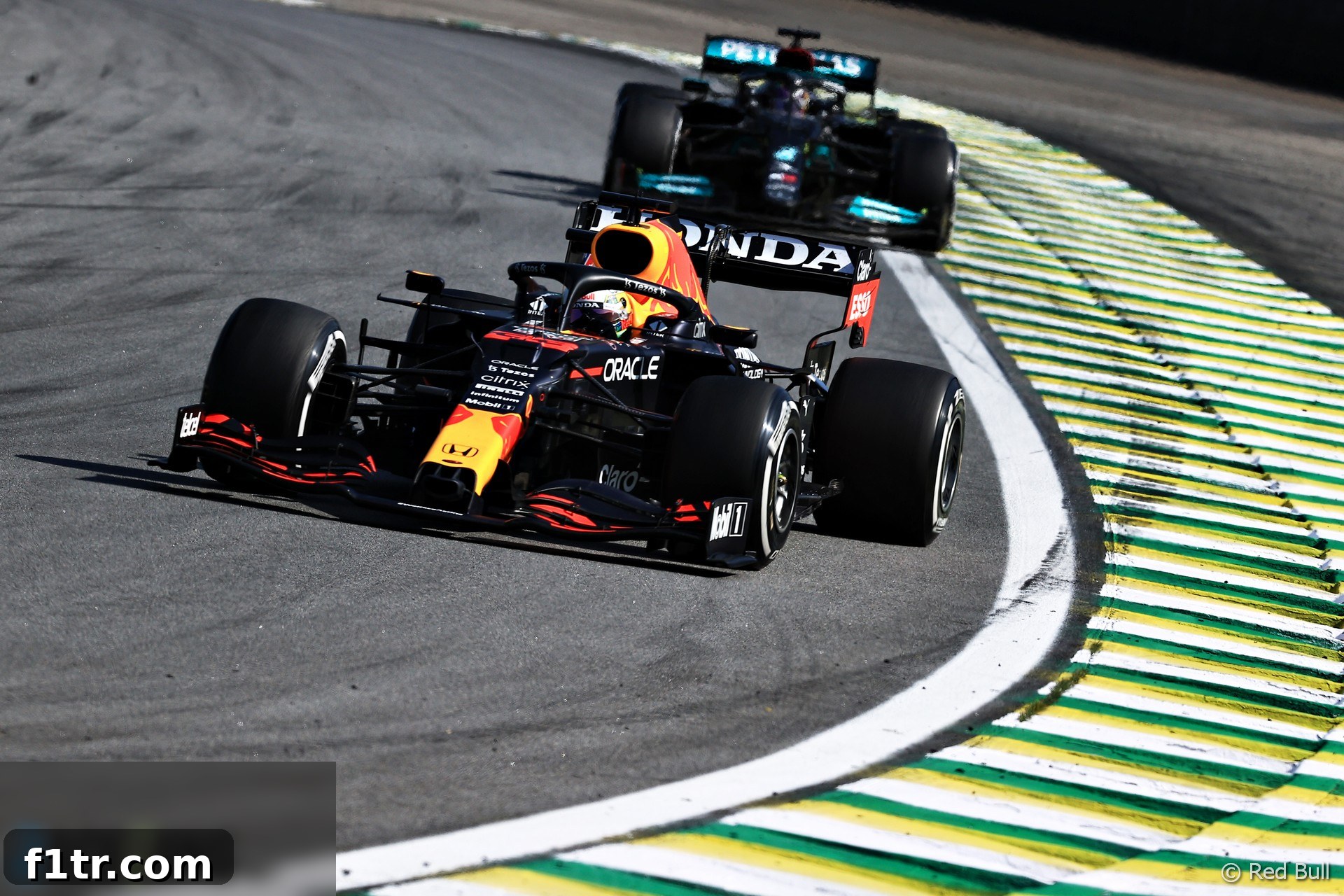
The incident unfolded during a critical phase of the Sao Paulo Grand Prix, as Lewis Hamilton, demonstrating incredible pace, launched an aggressive attack on Max Verstappen for the lead. Hamilton had managed to position his Mercedes W12 alongside Verstappen’s Red Bull RB16B as they approached the sweeping left-hander of Descida do Lago. With Hamilton on the outside, gaining a slight advantage into the corner, Verstappen, holding the inside line, defended robustly.
As the two titans of Formula 1 entered the corner side-by-side, Verstappen maintained his inside position, but his car visibly ran wide. This forced both drivers beyond the conventional racing line and, crucially, well outside the defined track limit boundaries at the exit of the corner. The maneuver saw Hamilton forced to take evasive action, his car pushed wide onto the run-off area alongside Verstappen’s. Despite both cars exceeding the white lines, Verstappen managed to retain his lead, leaving Hamilton to regroup and plan another assault.
The visual drama of the moment was undeniable. Two championship contenders, pushing the absolute limits of their machinery and the regulations, locked in a fierce battle. For many spectators and commentators, the outcome seemed clear: Verstappen had, intentionally or not, forced Hamilton off the track to defend his position. However, the subsequent lack of a penalty for the Red Bull driver would only amplify the controversy and fuel the already intense rivalry between the two teams.
Max Verstappen’s Defense: Explaining the Wide Line
In the immediate aftermath of the race, Max Verstappen was quick to offer his reasoning for the controversial driving, attributing his wide line to a combination of aggressive braking and diminishing tire grip. “We both of course, tried to be ahead into the corner,” Verstappen explained, outlining the natural competitive instinct that governed the exchange. “And so I braked a bit later to try and keep the position and the tyres were already a bit worn.”
Verstappen elaborated on the challenge he faced, emphasizing the delicate balance between braking performance and available grip. “So I was really on the edge of grip,” he continued, painting a picture of a driver pushing his car to its absolute limits. This critical lack of optimal grip meant that holding a precise, tight line through the apex was becoming increasingly difficult. “That’s why I think I was already not fully on the apex. And it’s a safer way, of just running a bit wide there.”
His explanation suggested that the expansive line was not a deliberate attempt to illegally force Hamilton off the circuit, but rather a natural consequence of attempting to defend his position under extreme racing conditions with compromised tire performance. From his perspective, running slightly wide was a necessity, a “safer way” to navigate the corner when grip was at a premium, rather than risking a loss of control or a collision by attempting to hold an impossibly tight line. This defense highlighted the nuanced decisions drivers must make in the heat of battle, often in fractions of a second, with championship aspirations hanging in the balance.
The Stewards’ Contentious Decision and Mercedes’ Fury
Perhaps even more surprising than the incident itself was the decision rendered by the FIA race stewards. Following a brief review, the stewards determined that no investigation was necessary, concluding that it was simply a racing incident. This ruling sent shockwaves through the paddock and ignited fierce criticism, most notably from the Mercedes-AMG Petronas F1 Team.
Mercedes Team Principal Toto Wolff was visibly infuriated by the stewards’ call, branding it “laughable” and expressing profound disbelief that such a maneuver could go unpunished. Wolff and Mercedes argued that Verstappen had clearly forced Hamilton off the track, an infringement typically met with a penalty. They pointed to what they perceived as an inconsistency in stewarding decisions throughout the season, raising concerns about the integrity of the racing rules and their application in the championship fight. The lack of a formal investigation, let alone a penalty, only intensified Mercedes’ frustration, adding another layer of animosity to an already heated rivalry. The incident quickly became a flashpoint, highlighting the differing interpretations of racing conduct and track limits between the competing teams and the governing body.
Verstappen’s Reaction and the Copse Comparison
Unsurprisingly, Max Verstappen welcomed the stewards’ decision, expressing satisfaction that the incident was deemed a part of normal racing. “I was, of course, happy that the stewards decided that we could just keep on racing,” he stated, reflecting a driver’s desire for less intervention in close-quarters battles. He further added, “because I think the racing in general was really good today,” implying that such incidents, when left unpenalized, contribute to the excitement and purity of Formula 1 racing.
The incident inevitably drew comparisons to a prior, equally controversial clash earlier in the season: the British Grand Prix at Silverstone, where Verstappen and Hamilton made contact at Copse corner, resulting in a heavy crash for Verstappen. When asked directly about the similarity, Verstappen was resolute in his denial. “I don’t think it’s the same,” he asserted, quickly dismissing any parallels. He emphasized the fundamental differences between the two scenarios: “It’s a completely different corner as well, so there’s not much more to comment. It’s not the same.”
Verstappen’s distinction between the two events underscored the complexities of judging racing incidents. While both involved contact or near-contact between the title rivals, the specific characteristics of Descida do Lago versus Copse, the entry speeds, the angles, and the immediate consequences were indeed distinct. At Copse, high-speed contact led to a crash, whereas in Sao Paulo, both drivers were able to continue, albeit with one forced off track. This nuanced perspective highlighted the subjective nature of racing judgments and the perpetual debate surrounding fairness and consistency in Formula 1.
The Race’s Dramatic Climax and Championship Impact
Despite successfully defending his position in the initial skirmish at Descida do Lago, Max Verstappen was ultimately unable to hold off Lewis Hamilton’s relentless charge. In a dramatic display of skill and determination, Hamilton launched a subsequent attack on lap 59, making a decisive pass approaching the very same corner. This time, Hamilton’s move was executed flawlessly, giving Verstappen no room to defend and allowing the Mercedes driver to seize the lead.
Hamilton then powered away to clinch a sensational victory, a triumph that was celebrated as one of his greatest career performances, particularly given his starting position. The implications for the championship were significant: Hamilton’s win drastically reduced Verstappen’s lead from 21 points to a mere 14 points, injecting even more intensity into the final races of the season. The Sao Paulo Grand Prix, with its blend of strategic brilliance, raw pace, and controversial on-track battles, proved to be a pivotal moment in the 2021 title fight, setting the stage for an electrifying conclusion.
The reduced points gap meant that every remaining race, starting with the upcoming Qatar Grand Prix, would be absolutely critical for both drivers and their respective teams. The Descida do Lago incident, while not penalised, served as a stark reminder of the high stakes and the fierce, unyielding nature of the championship rivalry between Verstappen and Hamilton – a rivalry that would undoubtedly continue to deliver captivating drama until the very final lap of the season.
Advert | Become a RaceFans supporter andgo ad-free
2021 Sao Paulo Grand Prix: Related Coverage
- Red Bull and Mercedes summoned to FIA hearing on review of Sao Paulo incident
- McLaren must “get back to scoring the results that are on the table” – Seidl
- Hamilton makes his second-biggest climb to victory from 10th on the grid
- F1 releases missing video footage from Verstappen’s car of Hamilton incident
- How Alonso and Ocon “pushed team tactics to the ultimate limit” to delay Gasly
Browse all 2021 Sao Paulo Grand Prix articles