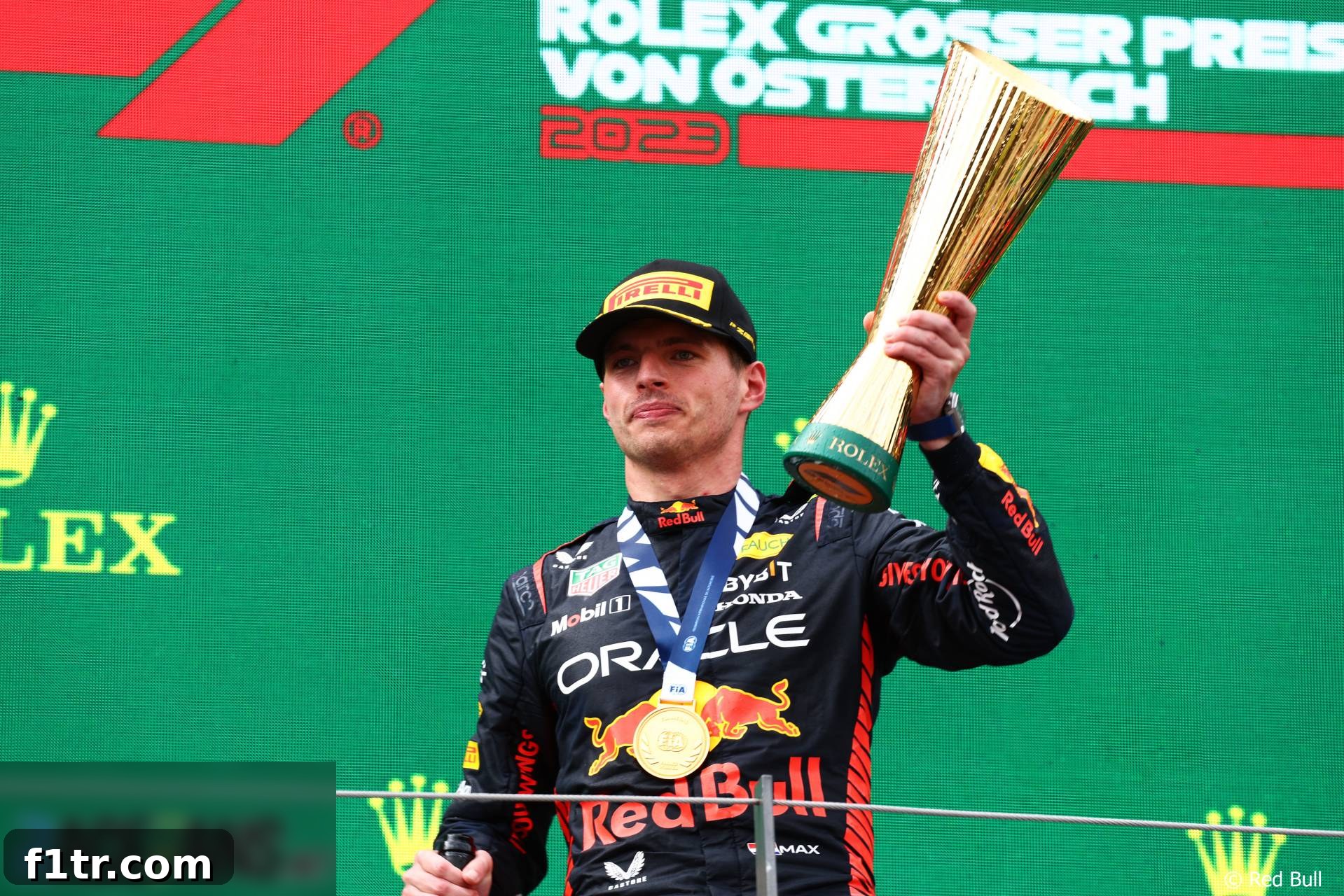
Max Verstappen Dominates Austrian Grand Prix Amidst Track Limits Drama
The 2023 Formula 1 season continued its relentless pace at the picturesque Red Bull Ring in Spielberg, Austria, where Max Verstappen once again showcased his unparalleled dominance. In a race marked by strategic plays, intense midfield battles, and a contentious track limits penalty saga, Verstappen delivered a masterclass, securing a comfortable victory ahead of Charles Leclerc. Rounding out the podium was Sergio Perez, who mounted an impressive recovery drive from a challenging starting position.
Verstappen’s triumph in Austria marked his seventh win of the 2023 campaign, further solidifying his commanding lead in the Drivers’ Championship. His performance was so assured that he held enough of an advantage in the closing stages to pit for fresh soft tyres, securing the bonus point for the fastest lap on his final tour, a testament to Red Bull’s overwhelming pace and his own unwavering confidence. While Leclerc secured a solid second place for Ferrari, Perez’s charge through the field, culminating in a decisive overtake on Carlos Sainz Jnr in the closing laps, added significant drama to the race’s final result.
Race Start: Early Drama and Safety Car Intervention
As the five red lights extinguished, signalling the start of the Austrian Grand Prix, Max Verstappen launched flawlessly from pole position, holding the lead into Turn 1. Behind him, Charles Leclerc, starting alongside the Dutchman on the front row, tried valiantly to challenge through the tight Turn 3 and Turn 4 complex, but Verstappen expertly rebuffed his attempts, maintaining his advantage.
The race’s opening lap, however, was not without incident. Although a major multi-car collision was averted, contact between Yuki Tsunoda of AlphaTauri and Esteban Ocon of Alpine resulted in significant debris being scattered across the circuit on the exit of Turn 1. Concerns for driver safety and the integrity of the cars following over the debris quickly prompted race control to deploy the Safety Car. The field was neutralised for two crucial laps, allowing marshals to clear the track and setting the stage for a condensed restart.
Strategic Chessboard: VSC and Early Pit Stops
The Safety Car period concluded at the start of Lap 4, with Verstappen leading the pack across the start-finish line, followed closely by Leclerc, Carlos Sainz Jnr, Lewis Hamilton, and Lando Norris, who had made a strong start to claim fifth. Immediately, Verstappen demonstrated his superior pace, quickly establishing a gap to the chasing Ferraris. Sainz, meanwhile, used the DRS advantage to keep close tabs on his teammate, signalling Ferrari’s intent to apply pressure.
A significant strategic turning point arrived on Lap 13 when Nico Hulkenberg’s Haas suffered a power unit failure, forcing him to pull off the circuit at Turn 3 with smoke billowing from the rear of his car. The Virtual Safety Car (VSC) was deployed, a moment of fortune for some and misfortune for others. Crucially, the VSC activated just as the two Ferraris were navigating the penultimate corner. This timing proved advantageous for several drivers behind them, including Hamilton, Norris, and numerous others in the midfield, who were able to pit under the reduced speed conditions, losing less time than a conventional pit stop.
The Ferraris, having missed the ideal window, were forced to pit on the very next lap, still under VSC conditions. While Leclerc managed to retain his second position, albeit having lost some of his buffer to Verstappen, Sainz dropped behind both Hamilton and Norris due to the staggered pit stop timings and the disadvantage of not pitting immediately. Conversely, Sergio Perez, who had started down the grid due to a poor qualifying, gained significantly by staying out and was promoted to third place, showcasing the unpredictable nature of early-race VSC periods.
The Track Limits Conundrum: Penalties Galore
The Red Bull Ring, with its fast, flowing corners and expansive run-off areas, has long been a challenging venue for policing track limits. The 2023 Austrian Grand Prix, however, escalated this issue to an unprecedented level. Stewards meticulously monitored every lap, issuing five-second time penalties for drivers exceeding track limits four separate times. This rule had a profound impact on the race order.
Carlos Sainz quickly recovered from his VSC pit stop disadvantage, swiftly passing Lando Norris for fifth and then executing a decisive overtake on Lewis Hamilton into Turn 4 to reclaim fourth, behind Perez. However, Hamilton’s resurgence was cut short as he was among the first prominent drivers to incur a five-second time penalty for his track limits infringements, receiving the sanction in fewer than 15 laps. Yuki Tsunoda, already having faced an early incident, also earned the same penalty, highlighting the strict enforcement of the rules.
The track limits saga continued to unfold, directly affecting the podium battle. Sainz, undeterred by the penalties elsewhere, eventually managed to overtake Sergio Perez, reclaiming third position and temporarily restoring Ferrari to a strong second and third place. But the penalties were not exclusive to one team. On Lap 25, Ferrari briefly claimed the lead when Verstappen pitted for hard tyres. The championship leader rejoined in third, behind both Ferraris. However, Verstappen quickly surged past Sainz to move back into second, leaving Sainz vulnerable. Soon after, Sainz himself became the next driver to receive a five-second time penalty for four track limits strikes, underscoring the relentless scrutiny.
Verstappen Reasserts Dominance and Midfield Flux
While the penalties shuffled the midfield, Max Verstappen was busy extending his lead. Norris, meanwhile, capitalised on Hamilton’s penalty-induced loss of pace to overtake the Mercedes driver, moving his McLaren up to fourth. Up front, Verstappen, having dispatched Sainz, set his sights on re-taking the lead from Charles Leclerc. The Red Bull’s superior straight-line speed and consistent cornering grip proved too much for the Ferrari. On Lap 35, Verstappen caught Leclerc and executed a clinical pass into Turn 3, sweeping past to retake the lead of the race, a position he would not relinquish.
Once back in the lead, Verstappen rapidly pulled out a substantial advantage over the Ferraris. The race then settled into a rhythm, with teams focusing on their second round of pit stops. Sainz made his second stop at the end of Lap 45, opting for hard tyres. He served his five-second penalty during this stop, rejoining the track behind Norris. Undeterred, he quickly found his way past the McLaren exiting Turn 4 to regain fourth place. His teammate, Leclerc, made his second stop shortly after, rejoining behind both Red Bulls in third position.
Verstappen’s second pit stop came at the end of Lap 49. By this point, his lead was so commanding that he was able to rejoin comfortably in the lead, approximately five seconds ahead of his teammate, Perez. Perez himself came into the pits on the very next lap, rejoining in fifth behind Norris, leaving Verstappen with a significant 13-second lead over Leclerc, a gap that would continue to grow inexorably in the remaining laps.
The Battle for the Podium: Perez vs. Sainz
With Verstappen marching towards an unchallenged victory, the most captivating action unfolded behind him in the fight for the final podium spot. Sergio Perez, having steadily climbed the order, caught and passed Lando Norris’s McLaren into Turn 4, setting his sights firmly on Carlos Sainz, who occupied third place.
What ensued was a thrilling, multi-lap battle between the Red Bull and the Ferrari. Perez, with fresher tyres and the powerful Red Bull beneath him, pressed Sainz relentlessly. For three consecutive laps, Sainz demonstrated exceptional defensive driving, using all his skill to repel Perez’s advances, meticulously placing his car to deny any clear overtaking opportunity. The crowd was on its feet as the two battled wheel-to-wheel through several corners. Eventually, Perez’s persistence paid off. On the run to Turn 4, he found a decisive move, finally getting ahead of the Ferrari to complete his remarkable charge to the podium, securing a well-deserved third place after a spirited recovery from his qualifying woes.
Fastest Lap Pursuit and Final Classification
With the podium places seemingly decided, Max Verstappen continued to stretch his lead over Charles Leclerc, building a gap of over 24 seconds. Such was his dominance that, with just two laps remaining, he elected to make an audacious third pit stop. His objective: to fit a fresh set of soft tyres and attempt to secure the fastest lap bonus point on the final lap. He rejoined the track a comfortable handful of seconds ahead of Leclerc and proceeded to blitz the 71st and final lap, crossing the chequered flag not only as the race winner but also with the additional point for the fastest lap, a defiant exclamation mark on an utterly dominant performance.
Charles Leclerc finished a strong five seconds behind Verstappen in second, delivering a crucial podium for Ferrari after a challenging period. Sergio Perez completed the podium, a further 12 seconds adrift, marking a successful recovery drive that salvaged valuable points for Red Bull’s Constructors’ Championship campaign. Carlos Sainz, despite his track limits penalty, secured fourth place, ahead of Lando Norris, who drove an impressive race to finish fifth for McLaren. Fernando Alonso took sixth for Aston Martin, while the two Mercedes cars of Lewis Hamilton and George Russell finished seventh and eighth, respectively, both drivers having struggled with the Red Bull Ring’s demands and the track limits rulings. Pierre Gasly claimed ninth for Alpine, and Lance Stroll rounded out the points scorers in tenth for Aston Martin.
The 2023 Austrian Grand Prix will be remembered not just for Verstappen’s commanding victory, but also for the extensive debate surrounding track limits. In total, a staggering seven drivers received penalties for at least four track limits violations throughout the race, with Yuki Tsunoda notably earning a second, more severe 10-second penalty for a total of seven infringements, highlighting the pervasive nature of the issue at this particular circuit. The controversy underscored the fine line drivers walk and the strict interpretations applied by race control, adding an unexpected layer of complexity to an otherwise straightforward victory for the championship leader.
Post-Race Analysis and Championship Implications
Max Verstappen’s victory in Austria further cemented his status as the undisputed leader of the 2023 season. His ability to control the race from start to finish, even allowing for an extra pit stop to secure the fastest lap, showcased the formidable combination of driver skill and Red Bull’s RB19 package. The championship gap to his closest rivals widened considerably, painting a clear picture of Red Bull’s current dominance.
For Ferrari, Charles Leclerc’s second place was a welcome boost, demonstrating potential pace and a step forward in managing race strategy, even if it wasn’t enough to challenge Verstappen directly. Carlos Sainz’s fourth place, despite the penalties, also indicated an improvement in performance, but the track limits penalties proved costly for their overall points haul. McLaren and Aston Martin continued their strong seasons, with Norris and Alonso consistently featuring in the points, while Mercedes faced a more challenging weekend, grappling with both car performance and the stringent track limits.
The pervasive track limits issue undoubtedly influenced the outcome for many drivers and sparked widespread discussion within the F1 community. While the rules are clear, their consistent application and the sheer number of penalties raised questions about potential solutions for future events at circuits like the Red Bull Ring. As the F1 circus moves on, the Austrian Grand Prix will be a key talking point, not just for Verstappen’s clinical performance, but for the complex strategic and regulatory challenges that unfolded throughout the 71 laps.