The Hungaroring, a circuit etched into the annals of Formula 1 history for nearly four decades, consistently serves as a dramatic stage for unprecedented moments. Nestled in the dry, dusty landscape outside Budapest, this iconic venue has witnessed countless historic firsts, pushing the boundaries of what’s possible in the world championship.
Advert | Become a Supporter & go ad-free
The Hungaroring: A Legacy of Milestones
From hosting the first European Grand Prix beyond the once-impenetrable ‘Iron Curtain’ to becoming the hallowed ground for numerous drivers’ maiden victories and even a handful of F1 debuts, the Hungaroring frequently breaks new ground, distinguishing itself amongst other events on the demanding Formula 1 calendar. Its unique, twisty layout, often compared to a street circuit without the walls, presents a formidable challenge for drivers and engineers alike, emphasizing precision and strategic prowess over raw straight-line speed.
The 2023 Hungarian Grand Prix continued this tradition, delivering an outcome never before witnessed in over 70 years of Formula 1. On this scorching summer day, one of the sport’s most enduring and cherished all-time records was not merely broken, but shattered with emphatic dominance, rewriting history in real-time.
The 2023 Hungarian Grand Prix: A Record-Breaking Spectacle Unfolds
With air temperatures soaring towards 30 degrees Celsius and the track surface exceeding 50 degrees, the eleventh round of the championship was destined to be a sweltering endurance test. The intense heat, combined with the anticipation of a front row featuring the sport’s two most successful drivers – Max Verstappen and Lewis Hamilton – separated by the closest qualifying margin in 14 years, elevated the Hungarian Grand Prix’s hype to a fever pitch, rivaling the cultural phenomena of ‘Barbie’ and ‘Oppenheimer’. Fans globally were glued to their screens, expecting a titanic struggle on a circuit notorious for its unforgiving nature.
Qualifying Drama and Pre-Race Tension
In a surprising turn of events, Max Verstappen, the reigning champion and dominant force, was denied pole position by none other than his fiercest adversary, Lewis Hamilton. This rare achievement sent ripples of excitement through the paddock, reigniting memories of their contentious title battle just two years prior. All eyes were firmly fixed on this electrifying duo, their rivalry adding an extra layer of intrigue to an already compelling narrative. Directly behind them, two hungry McLaren drivers, Lando Norris and Oscar Piastri, sat poised, eager to seize their moment in the spotlight and challenge the champions into the notoriously tricky Turn 1.
Lights Out: Verstappen’s Masterclass and McLaren’s Surge
The ‘dirty side’ of the grid has long been a significant factor at the Hungaroring, with many expecting Hamilton, starting from the cleaner left-hand side, to hold the advantage. However, as the lights extinguished, Verstappen defied all predictions. The Red Bull launched with precision, matching the Mercedes in the initial phase before pulling alongside in the second. By the time Hamilton attempted to defend his position, the crucial inside line into Turn 1 was already decisively claimed by Verstappen. This audacious move set the tone for the entire race.
Verstappen effectively secured the race lead before even touching the brakes for Turn 1. Despite Hamilton’s valiant efforts to maintain his position around the outside, the Red Bull completed the overtake by the apex, establishing an early lead. Behind the lead battle, Piastri executed a far tighter line than his McLaren teammate, brilliantly cutting inside both Norris and Hamilton on the exit to snatch an impressive second place as he powered out of Turn 1. Hamilton, caught off guard, then surrendered third place to Norris at Turn 3, leaving the two McLarens directly behind the imperious race leader, Verstappen.
Advert | Become a RaceFans supporter andgo ad-free
First Lap Chaos: Alpine’s Misfortune
“Car behind: Piastri,” Verstappen’s race engineer, Gianpiero Lambiase, relayed with a discernible hint of triumph. The sentiment was starkly different for Hamilton, who immediately apologized to his engineer, Peter Bonington: “Sorry about that, guys.” As the field completed the opening lap, Verstappen’s lead over McLaren’s rookie was a modest seven-tenths of a second. However, as the cars approached Turn 1 for the second time, the track was ominously littered with carbon fiber debris, a clear sign of early race drama.
Zhou Guanyu suffered a calamitous start from a career-best fifth place, quickly getting swallowed by the pack. His poorly timed braking then initiated a chain reaction, seeing him make contact with the returning Daniel Ricciardo, who in turn was sent into Esteban Ocon, which subsequently launched Ocon into his Alpine teammate Pierre Gasly. Despite being innocent victims in the melee, the Alpines bore the brunt of the incident, with Ocon’s car sent bouncing violently over his teammate. The impact was so severe that his race seat cracked upon landing back on the track, rendering both Alpines effectively out of the race on the spot. Ricciardo and Zhou, however, continued, with the Alfa Romeo driver receiving a five-second penalty for instigating the costly carnage.
Strategic Moves and Mid-Race Dynamics
Remarkably, despite the debris field, the race remained green. Most of the top 10 starters, with the exception of Sergio Perez, opted for the medium compound tyres. Carlos Sainz Jnr, however, made exceptional use of his soft tyres, catapulting five places from eleventh to sixth, positioning himself directly behind his Ferrari teammate, Charles Leclerc. As DRS was activated at the end of the second lap, Sainz was the only driver within the top six positions close enough (within one second) to utilize the overtaking aid, though he chose to hold station behind Leclerc for the time being.
In the early laps, Piastri managed to keep Verstappen’s lead within a three-second margin, with Norris trailing his teammate by a further two seconds. With softer tyre compounds and significantly warmer temperatures at the Hungaroring compared to the 2022 event, uncertainty loomed over how each of the three compounds would perform and degrade over a full race stint. It was perhaps a slight surprise when some drivers further down the order began to pit as early as the end of the ninth lap. While Verstappen’s pace remained metronomic, steadily increasing as his stint progressed, Piastri’s began to show subtle signs of fading. This combination allowed Verstappen’s lead to double within just six laps, ballooning to over seven seconds.
Advert | Become a RaceFans supporter andgo ad-free
The Pit Stop Dance: McLaren’s Internal Battle
It came as little shock when Sainz, on his soft tyres, became the first of the leading drivers to pit on lap 15. Lewis Hamilton was called in on the subsequent lap to switch his medium tyres for hards. “Can I not go long?” he questioned, but Mercedes expressed concerns about the potential threat posed by the Ferraris. Ahead, Norris confidently conveyed to his team that his pace was stronger than it appeared, but the dirty air from Piastri’s MCL60 ahead was impeding his progress and limiting his true speed.
McLaren brought Norris in for his first pit stop on lap 17, and he immediately pushed his fresh hard tyres, setting the fastest middle and final sectors of the race. This explosive burst of pace allowed him to swiftly erase the two-second deficit he had to his teammate. Piastri pitted on the very next lap, and as he rejoined the track, he could only watch as his teammate effortlessly drove past him, claiming second place through a well-executed undercut strategy. Hamilton’s more measured approach to his out-laps cost him dearly, leaving him a significant 10 seconds adrift of the charging McLarens. “We’ve probably taken it too easy on these opening laps,” his race engineer Peter Bonnington admitted, acknowledging the missed opportunity.
Perez’s Charge and Hamilton’s Chase
Verstappen continued his relentless pace, consistently lapping within the low 1’24s before eventually pitting for hard tyres at the end of lap 23. He rejoined the race with a comfortable five-second advantage over Norris, further solidifying his lead. While one Red Bull was cruising at the front, the other, driven by Sergio Perez, was making remarkable progress through the field, running a different compound strategy to his rivals. He expertly dispatched Sainz for sixth place into Turn 1, then gained another position by executing a decisive dive past George Russell’s Mercedes, which had started from a lowly 18th on the grid. Russell’s own charge through the field was impressive, but Perez’s pace on the mediums was undeniable.
On the hard tyres, Norris found himself unable to match Verstappen’s consistently rapid 1’23s lap times, and slowly but surely, the gap to the leader began to grow. Meanwhile, Piastri, struggling more on his tyres, was demonstrably slower than the other drivers in the top seven positions, and the persistent pressure from Hamilton behind him began to mount. Hamilton’s immediate challenge, however, was not only closing on Piastri but also managing the sight of Perez steadily looming larger in his mirrors, gaining ground quicker than Hamilton himself was catching the McLaren. By lap 39, the Red Bull was firmly within DRS range of Hamilton, but despite the DRS advantage and his softer tyres, Hamilton appeared to have Perez covered, even fending off a half-hearted attempt from Perez around the outside of Turn 2 on lap 42.
Advert | Become a RaceFans supporter andgo ad-free
Intense Battles and Final Pit Stops
Rather than allow Perez to spend valuable time locked in a prolonged battle with Hamilton, Red Bull strategically called him into the pits at the end of the lap. The well-drilled Red Bull pit crew executed a flawless stop, bolting on a fresh set of medium tyres in what proved to be the single quickest pit stop of the season so far. This lightning-fast service allowed Perez to rejoin the race in clear sight of Piastri’s McLaren, which had pitted on the very same lap. Norris soon followed suit, having built up more than enough time over his teammate to comfortably resume his second-place position.
While Verstappen and Hamilton continued to circulate on their aging hard tyres, Perez had fourth-placed Piastri squarely in his sights. Utilizing DRS, the Red Bull slipstreamed the McLaren down the pit straight at the start of lap 47. The rookie, anticipating the move, decisively went defensive, forcing Perez to commit to the outside line into Turn 1. Perez gladly accepted the challenge, expertly driving around the McLaren to snatch the position. However, Piastri was not finished, immediately mounting a counter-attack around the outside of Turn 2, only to see his prospects and available space vanish on the exit, kicking up dust as his outside wheels briefly ran off the road.
“Oscar, did Perez push you off at Turn 2?” Piastri’s engineer, Tom Stallard, queried, clearly eager to build a case for the stewards. “Did he leave you enough room?” The rookie’s reply, “He didn’t leave me much space,” demonstrated his burgeoning but still developing skill in articulating incidents to race control. The incident was noted by the stewards but, correctly, no further action was deemed necessary. With one McLaren dispatched, Perez now had his sights set on Norris, who was eight seconds further up the road. The move on Piastri had effectively secured Perez a provisional podium position, which was solidified when Hamilton eventually pitted at the end of lap 49 for a final set of medium tyres, slotting into the gap between Piastri and the Ferrari duo. The only driver yet to make a second stop was the dominant leader, Verstappen, but Red Bull rectified this two laps later when he finally pitted for a set of mediums to carry him through the remaining 20 laps.
Advert | Become a RaceFans supporter andgo ad-free
Closing Laps: Pressure and Penalties
As Verstappen once again set about further inflating his already commanding lead over Norris, who exclaimed how he “can’t keep up with the car ahead,” Perez was relentlessly chipping away at the gap to the second-placed driver. However, Norris’s teammate Piastri found himself under far more immediate pressure from Hamilton, who was now right behind the McLaren in fourth. With the benefit of DRS, Hamilton found Piastri to be significantly more accommodating than he had been for Perez just laps earlier. He completed an easy overtake into Turn 1, finally recapturing one of the places he had lost to the two McLarens on the opening lap.
Perez continued to erode Norris’s advantage in second as the laps rapidly ticked by, with the McLaren driver palpably feeling the pressure with every update he received about the closing gap between them. Lapped traffic also did him no favors, with Yuki Tsunoda proving particularly sluggish in letting him by, despite being shown blue flags for an entire lap. But just when the margin appeared destined to fall under three seconds, Perez lost critical time navigating a group of slower cars off the racing line. In doing so, he picked up numerous discarded ‘marbles’ of rubber, causing his pace to plummet by more than a second a lap. As the final handful of laps approached, Perez’s advance on Norris appeared to have stalled. Instead, he was now the one anxiously checking his mirrors as Hamilton was far closer to him than he was to the McLaren. However, Hamilton’s ultimate enemy was the dwindling number of laps available, a consequence of not pushing harder on his tyres earlier in the race, which prevented him from making up the remaining deficit to the Red Bull.
A fierce battle for sixth also unfolded, though not directly on the track. Leclerc held the position but had been handed a five-second time penalty for exceeding the pit lane speed limit by a mere 0.7 kph, making him vulnerable to Russell behind. The second Mercedes driver had staged an impressive climb from his ninth-row start to seventh, easily overtaking Sainz, and was now comfortably within five seconds of Leclerc. All he needed to do was maintain his position to secure the effective sixth place. Leclerc, conversely, had to ensure he ran fast enough in the closing stages to avoid losing yet another position to his teammate, Sainz.
Advert | Become a RaceFans supporter andgo ad-free
Out front, Verstappen had no such concerns. As his driver continued to effortlessly tick off the laps, Lambiase found himself with little to worry about. “Everything okay?” he asked. “Just checking in.” “Yep, all good,” came the quick and confident reply from Verstappen, a testament to his absolute control.
A Historic Victory and a Shattered Record
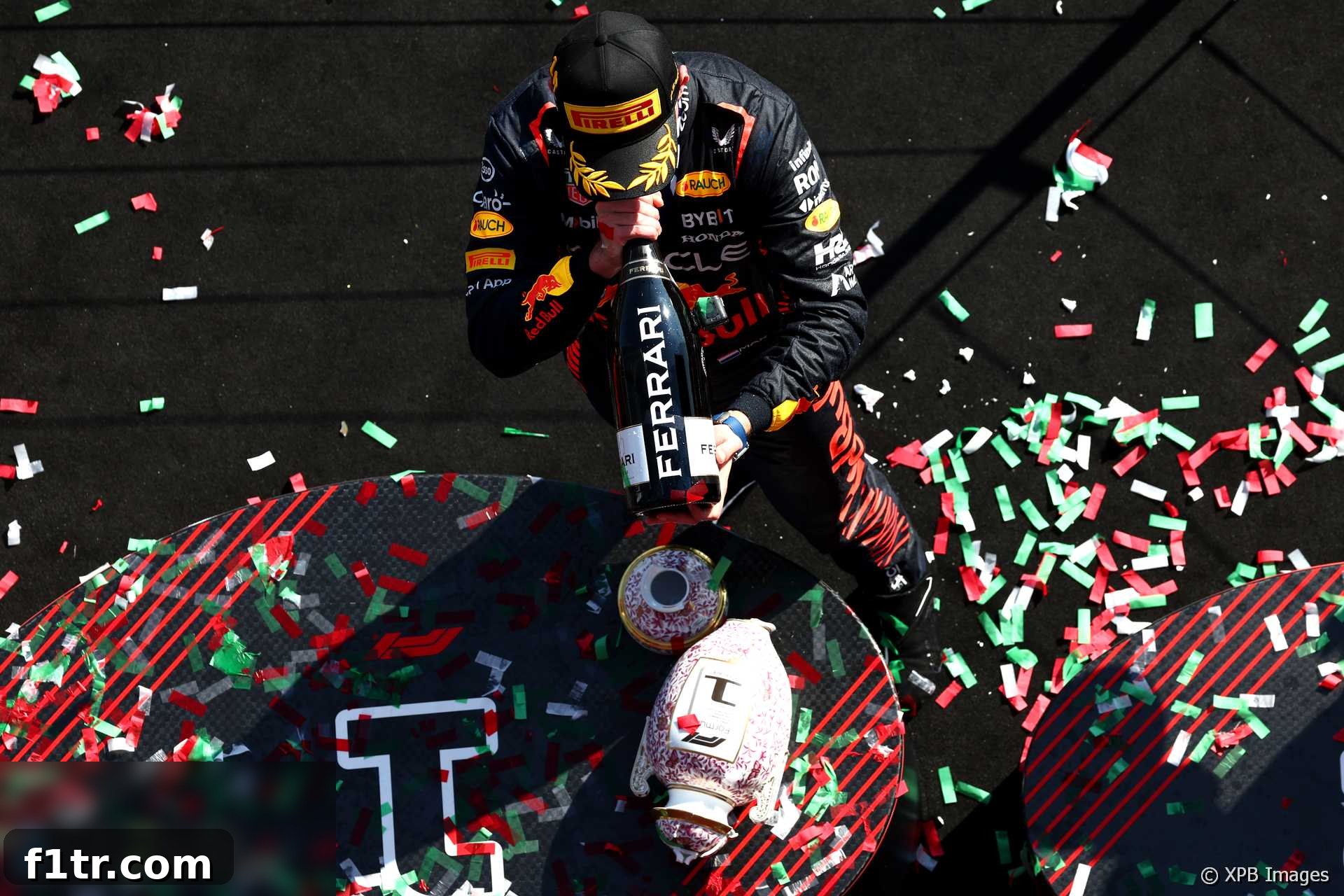
At the conclusion of what had initially promised to be an especially competitive and unpredictable weekend, Verstappen’s monumental half-minute lead by the checkered flag made any pre-race suggestions that he could have faced a genuine threat for the win seem utterly laughable in hindsight. After starting second, Verstappen had led every corner of every single lap of the race, delivering a flawless performance. At the end of the 70th and final lap, he took the checkered flag for the seventh consecutive race victory, his ninth win of the season. In doing so, he propelled Red Bull to unprecedented heights, eclipsing McLaren’s long-standing 35-year-old record of winning 11 consecutive Formula 1 races, setting a new benchmark of 12 straight victories.
“It’s one of those days where everything goes perfect and you’re just enjoying every lap, smiling in the car because it’s that perfect,” the elated winner declared after the race. “Everything just went well. I could take the lead into Turn 1 and basically from there I could just do my own race and look after the tyres.” So immense was Verstappen’s margin of victory that he could theoretically have pitted on the penultimate lap, stopped for ten seconds in his pit box, and still rejoined the track in the lead. Despite being nowhere near as close to the dominant Red Bull as he had been at Silverstone, Norris was nonetheless more than content with his well-earned second place, having successfully out-raced Perez in the closing stages.
Advert | Become a Supporter & go ad-free
“We’re very happy, because it’s my first time I’ve had consecutive podiums,” Norris beamed. “To be P2, I guess is a fantastic result in a car that probably shouldn’t be P2.” For Perez, a hard-fought third place meant he had achieved his objective of securing a podium finish despite starting from ninth on the grid. “I was looking forward to getting onto the podium,” he admitted. “I knew that I had to do some overtaking there. It was not easy to overtake out there today. It’s a track that is very difficult to overtake at, but I think we managed to execute a good strategy.”
Post-Race Revelations and Lingering Questions
From pole position, Hamilton’s fading hopes of ending his longest win drought had evaporated on the run to the first corner, while Piastri, after his initial heroics, faded through the race to finish in fifth, meaning his elusive first podium finish continued to evade him. Leclerc crossed the finish line in sixth, but his position was soon handed to George Russell due to the five-second penalty. Russell, after starting 18th, finished the race having gained more places than Verstappen did the previous year when he won from tenth, highlighting an exceptional recovery drive.
Leclerc did not have to suffer the immediate frustration of falling behind his teammate Sainz in the official race results after his post-race penalty was applied. However, this offered little comfort after a weekend where Ferrari’s performance in Hungary had ultimately failed to live up to their optimistic pre-weekend expectations. With Aston Martin’s Fernando Alonso and Lance Stroll completing the top ten, it meant that the points scorers consisted of just five teams, indicating a growing performance gap in the midfield.
On the podium, an exuberantly enthusiastic Norris created a viral moment by inadvertently knocking Verstappen’s winner’s trophy off the top step while spiking his champagne bottle, dramatically smashing the base of the exquisite vase ornament from the rest of it. While an unfortunate mishap that Verstappen good-naturedly laughed off, it served as an almost poetically fitting act of symbolic revenge for McLaren – smashing the trophy representing Red Bull’s victory on a day when the champions had, themselves, irrevocably smashed McLaren’s own long-standing win streak record. Team principal Christian Horner has certainly not lacked for reasons to feel immense pride in his team in recent seasons, but even he recognized the singular significance of this achievement. “It’s an amazing achievement for the whole team,” he stated emphatically.
“Twelve races in a row is insane – particularly against the level of competition that we have. So it’s something that the whole team, from every department, has played a key role in. I’m incredibly proud of everything that we’ve achieved.” And so, the Hungaroring had once again been the stage for another historic Formula 1 first. As the summer break beckoned for the weary teams, Red Bull’s first defeat of the 2023 season still felt like a distant, almost unimaginable prospect, cementing their place as one of the most dominant forces in the sport’s rich history.
Related Articles: 2023 Hungarian Grand Prix
- Was F1’s Alternative Tyre Allocation test successful? Drivers and teams have their say
- How far can McLaren climb with car rivals now say is the second-fastest in F1?
- Why Ricciardo says McLaren’s car “speaks Lando’s language” – but Norris disagrees
- Mercedes reveal cooling error behind loss of pace in Hungarian GP
- Perez answered critics in Hungary but needs to qualify better – Horner
Browse all 2023 Hungarian Grand Prix articles
More 2023 F1 Race Reviews
Browse all 2023 F1 race reviews