In the high-stakes world of Formula 1, where every race tells a story of triumph and despair, Max Verstappen has carved out a legacy marked by an astonishing ability to conquer varied circumstances. Over the past decade, his grand prix victories have become legendary, serving as perfect illustrations for almost every motorsport cliché imaginable. From defying expectations with strategic brilliance to demonstrating raw speed and unwavering resolve, Verstappen’s career has been a masterclass in adapting to any challenge.
Consider the timeless adage, “to finish first, first you must finish.” This fundamental truth found its ultimate expression in Verstappen’s historic maiden win at Barcelona in 2016, a victory that showcased his burgeoning talent and composure beyond his years. Then there’s the aggressive spirit encapsulated by “rubbing is racing,” perfectly embodied by his audacious triumph at Austria in 2019, where bold wheel-to-wheel action defined the final outcome. And for those who believe “it ain’t over ’til it’s over,” the dramatic climax of Abu Dhabi 2021 remains an indelible memory, a race won in the very last moments.
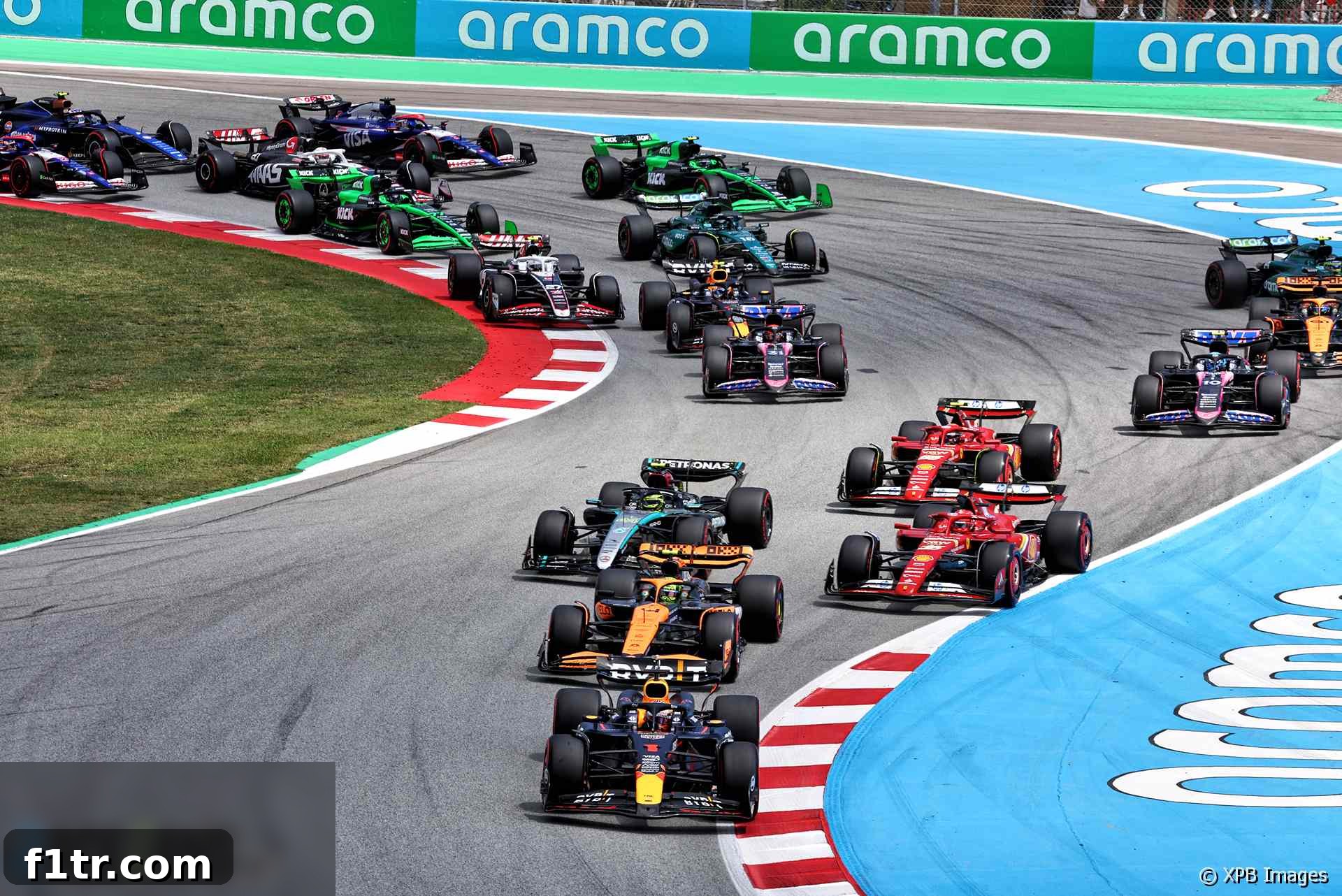
Now, the 2024 Spanish Grand Prix adds another chapter to this illustrious book, providing irrefutable evidence of a crucial racing maxim: you can never win a grand prix in the first corner – you can only lose it. This race vividly demonstrated how initial positioning, while vital, can quickly unravel into a complex strategic battle, ultimately favoring the driver who minimizes early risks while maximizing later opportunities.
Lando Norris arrived in Spain brimming with confidence, having secured his second career grand prix pole position after an enthralling qualifying session. It had been nearly three years since his last pole, a testament to the relentless pursuit of perfection from both Norris and the McLaren team. He had pushed his MCL38 to its absolute limit around the Circuit de Catalunya, admitting he’d thrown caution to the wind to best Verstappen by a hair’s breadth. However, Norris was acutely aware that pole position at this particular circuit came with a significant vulnerability: the long, almost 600-meter dash to the daunting first corner.
“It’s a long run down to Turn 1,” Norris explained, acknowledging the inherent challenge. “It’s probably one of the places you don’t want to start on pole.” This sentiment underscored the precarious position he found himself in, despite his qualifying heroics. McLaren, recognizing this threat, spared no expense in equipping Norris with the optimal defense strategy. They opted for his last remaining fresh set of soft tires, a crucial asset intended to provide maximum grip and acceleration off the line. This choice aimed to fend off the charging pack, including Verstappen, Lewis Hamilton, George Russell, and the Ferrari duo of Charles Leclerc and Carlos Sainz Jnr. While the Ferraris also started on fresh softs, Verstappen and the Mercedes drivers strategically chose used soft compounds, with only Verstappen having an unused set available for later in the race – a detail that would prove significant.
As the five red lights extinguished, signaling the start of the Spanish Grand Prix, both front-row contenders, Norris and Verstappen, launched off the line almost in perfect sync. Despite starting from the “dirty side” of the grid, known for offering less traction, Verstappen exhibited a phenomenal launch, quickly pulling level with the McLaren’s rear axle even before reaching the circuit’s iconic timing tower. In a defensive maneuver, Norris offered minimal space on the inside, forcing Verstappen’s right-hand wheels onto the treacherous grass verge. This early aggression set the tone for the intense battle that was about to unfold.
Verstappen, ever the competitor, was quick to radio his team about the close call. However, reflecting on the incident later, he conceded, “I think the first launch was quite okay, and then I got a little bit alongside. I had to go a little bit on the grass.” He then, with characteristic honesty, admitted, “If you turn it around, would I have done the same? I probably would have…” This raw acknowledgment highlighted the fine line between aggressive racing and fair play, a balance every top driver navigates.
Yet, while Verstappen and Norris were locked in their intense duel, their preoccupation with each other inadvertently created a critical opportunity. A gaping hole emerged on the outside line, a vacuum that George Russell, having made an absolutely stellar getaway from behind, exploited with clinical precision. Benefitting from a double dose of slipstream, Russell surged towards Turn 1 at a blistering pace, up to 20kph faster than his rivals. He masterfully swept around the outside of the first corner, snatching the lead in a move that stunned both the competitors and the spectators. Verstappen, holding the inside, managed to demote Norris to third, while a recovering Hamilton, overcoming a sluggish start, denied Leclerc fourth position, ensuring Mercedes secured a strong early presence at the front.
Verstappen had successfully dispatched Norris, but Russell’s unexpected appearance at the front was certainly not part of Red Bull’s meticulously crafted race plan. Russell now represented an unforeseen variable, a factor that needed to be neutralized swiftly. Once DRS (Drag Reduction System) was activated, the subtle encouragement came through Verstappen’s radio, urging him to seize the moment and reclaim the lead.
“Might be our best opportunity now, Max,” his race engineer Gianpiero Lambiase advised, adding, “Think wisely.” Despite the DRS zone along the main straight being 100 meters shorter than the previous year, it still provided Verstappen with a substantial 30kph speed advantage. He unleashed this power at the start of the third lap, executing a breathtaking maneuver around the outside of the first corner to reclaim the lead. It was a swift repayment to the Mercedes driver for his earlier heroics, and now Verstappen had the precious clear air, essential for tire management and setting his own pace, while Norris found himself trapped behind Russell’s Mercedes, battling dirty air.
With 66 grueling laps ahead, tire conservation was paramount. Ferrari had meticulously planned to treat their fresh soft tires gently in the initial stages, hoping to reap the benefits later in the stint. However, Carlos Sainz Jnr, exiting the final corner at the end of lap three with significantly more speed than his teammate Charles Leclerc, decided he would not be held up. He boldly attempted the now-fashionable move around the outside of Turn 1, a high-risk maneuver. The two SF-24s made contact, resulting in minor damage to Leclerc’s front wing. Sainz was forced to use the escape road but remarkably maintained his position. The stewards, observing the incident, waved on, signaling that it was a racing incident, allowing the action to continue without intervention.
After the initial flurry of excitement subsided, drivers settled into a rhythm, donning their “sensible caps” to meticulously manage their tires through Catalunya’s numerous long, demanding turns. Verstappen, while leading, didn’t immediately pull away with his usual dominant pace. A slight snap of oversteer through Turn 7, a tricky right-hander, offered Russell a brief glimmer of hope, allowing him to stay within a handful of seconds of the leader, maintaining pressure.
Meanwhile, Norris’s tires were in excellent condition, but he was struggling with the detrimental effects of dirty air, unable to fully unleash the McLaren’s potential while stuck behind Russell. McLaren, ever astute with strategy, attempted a clever psychological ploy. On lap 14, they radioed Norris with a thinly veiled message: “Box to overtake.” This was a deliberate attempt to bait Mercedes into pitting Russell early, opening up clear track for Norris. However, Mercedes proved too experienced to fall for the trap. Nevertheless, Russell did pit at the end of the very next lap, opting for medium tires, with Sainz following him in. This finally freed Norris, allowing him to pick up his pursuit of Verstappen with renewed vigor.
As Norris suddenly shaved a second off his lap time, dropping from 1’21s to a blistering 1’20s, the message went out to Verstappen: “Reduce all levels of management, Max.” McLaren contemplated pitting Norris to overcut Russell, but Norris, sensing an opportunity, had only eyes on the Red Bull ahead. The reigning world champion eventually pitted for mediums at the end of lap 17, handing the lead to Norris. McLaren, recognizing the strength of Norris’s tires and the clear track ahead, extended his stint until lap 23. This strategic delay allowed Norris to gain valuable time, and when he finally came in for mediums, he emerged back on track just behind Sainz. With his tires several laps younger and fresher than those in front of him, Norris was quickly on the attack, making swift work of the Ferrari with a rare and decisive pass to the inside of Turn 1, gaining fourth position behind the two Mercedes drivers.
Six minutes later, Norris showcased his superior pace, effortlessly driving around Hamilton along the main straight to claim third place. However, when he reached Russell shortly after, the second Mercedes driver proved to be a much tougher nut to crack. What ensued over the next several corners was arguably the best wheel-to-wheel battle of the entire race, a testament to both drivers’ skill and determination. Norris, relentless in his pursuit, ultimately forced his way past, but not without a fierce fight.
Norris later recounted the thrilling sequence: “He defended into Turn 1, then I could kind of get the cut back. I had him on the outside of 3. I was quite surprised in Turn 4… he could carry a lot more speed, get back to the outside, but then I could cut back on Turn 5 on the exit and get him into Turn 7. So it was a good fight.” This detailed recollection perfectly illustrated the intricate dance of overtaking at the Circuit de Catalunya, highlighting the micro-decisions and precision required to gain an advantage.
Having been overtaken by the charging McLaren, Russell was the first of the frontrunners to come in for his second pit stop, mirroring his timing in the first stint, with Sainz once again following him into the pits. With just under 30 laps remaining, hard tires were the only viable option for these drivers to reach the checkered flag without needing a third stop. However, Verstappen, Norris, Hamilton, and Leclerc, whose medium tires still showed good life, could afford to extend their stints further, positioning themselves to fit a faster compound for their final push to the finish.
Hamilton initiated this final round of stops among that leading group, pitting on lap 43. He was fitted with a fresh set of soft tires, a decision influenced by Russell’s earlier feedback that the hard tires were proving ineffective. Verstappen was next in, pitting on lap 44. By this point, Norris had managed to whittle down the Dutchman’s lead to just under five seconds, a remarkable effort. Verstappen emerged from his stop with clear track ahead and a fresh set of softs, ready to unleash the full potential of his Red Bull. Under McLaren’s urgent encouragement, Norris now faced the daunting task of extracting every conceivable millisecond from his 21-lap-old medium tires, desperately trying to limit the gains Verstappen would inevitably make on his fresh rubber. While he managed to pick up his pace by an impressive seven-tenths of a second on the first lap out of the pits, his subsequent lap dropped back to a 1’19.4, clearly suggesting that his well-worn tires had little more to offer.
With that stark reality, McLaren made the call to bring Norris in at the end of the next lap. However, due to his strategic decision to use his new set of softs at the start in a failed bid to hold the lead, he only had a three-lap-old, used set of softs at his disposal for the crucial final stint of the race. By the time he rejoined the track just ahead of Russell, Norris found himself a significant eight seconds adrift of Verstappen with 19 laps remaining. The disheartening truth was that he was now running on tires identical in compound and age to the leader’s, effectively negating any strategic advantage.
Despite Norris’s valiant efforts to chip away at Verstappen’s lead as the laps dwindled, Red Bull provided their driver with constant updates and encouragement to push. Norris found diminishing returns from his own charge, with the gap simply not falling fast enough for him to realistically catch the Red Bull before the end of the race. His frustration was palpable over the radio: “Yeah, I just don’t have the pace,” he conceded.
Verstappen, on the other hand, received a steady stream of updates from his pit wall: where Norris was pushing hardest, where on the track he was losing out to the McLaren, and the precise distance separating them. This was not a routine victory where Verstappen could simply cruise to the checkered flag. Instead, he was forced to actively work for his win, managing the gap and responding to Norris’s pace, much like he had been compelled to do at Imola earlier in the season. “It just seemed like he could push a bit more in some corners,” Verstappen observed after the race, reflecting on the intense pressure. “I think we are struggling a little bit for that outright pace, it felt like.”
Ultimately, whether Norris had the quicker car or not, he simply did not have enough laps remaining. Although he managed to close the gap to within three seconds of Verstappen by the finish, it was too little, too late for him to mount a serious challenge for the win. Max Verstappen crossed the finish line to claim his seventh victory of the 2024 season, his fourth win at the Circuit de Catalunya in ten years, and his third consecutive triumph at the Spanish Grand Prix. This added another 25 points to his already healthy championship tally. As at Imola, Verstappen’s jubilation upon crossing the line was noticeably more fervent than after his more routine, dominant victories, a clear indication of the effort and challenge this particular race had presented.
“Yes!” he roared over the team radio, the raw emotion evident in his voice. “We were definitely not the quickest out there today, but we did every well – strategy as well. Yes!” His words acknowledged the strategic mastery and collective effort required to secure a victory against a formidable opponent.
Norris crossed the line just over two seconds behind Verstappen, and immediately accepted responsibility for the outcome. “I should have won,” he sighed, a mixture of disappointment and self-reproach in his voice. “I fucked up the start. The car was amazing, well done – it deserved more.” His candid admission highlighted his belief in McLaren’s performance and his own frustration at a missed opportunity.
After the race, Norris echoed Verstappen’s view, confidently stating his belief that McLaren possessed the fastest package of the weekend. “I think we were quite easily the best car out there today,” he asserted. “I just didn’t do a good enough job off the line. And that one thing cost me everything.” He elaborated on his performance, emphasizing, “From Turn 2 onwards: 10 out of 10 – I don’t think I could have done much more. I think as a team, we did the perfect strategy and I was very happy with what we did. But the one part at the start, the 1%, wasn’t good enough.” This poignant reflection underscored the razor-thin margins that define success and failure in Formula 1.
Behind the intense battle for the lead, Lewis Hamilton delivered a commendable performance, leading the Mercedes pair to their second consecutive third and fourth place finish. This time, however, it was Hamilton who would stand on the podium, collecting the silverware – his first podium appearance of the season. “It’s been a minute since I’ve been up here,” Hamilton remarked after the race, a hint of satisfaction in his voice. “We’re slowly getting closer. Obviously, the last couple of races we’ve also been relatively competitive. So I think we have closed the gap a little bit but we still have a good couple of tenths to try and find.” His comments reflected Mercedes’ quiet but determined progress.
The Ferraris finished precisely where they started, in fifth and sixth positions. While Charles Leclerc and Carlos Sainz Jnr gained no ground compared to Saturday’s qualifying, their early race contact seemed to have strained their rapport, with not-so-subtle barbs traded between them in post-race interviews. Oscar Piastri, Norris’s teammate, delivered a solid performance, gaining two places to finish seventh, albeit half a minute behind his McLaren stablemate. Sergio Perez, in the second Red Bull, finished a distant eighth, nearly a full minute behind Verstappen, highlighting the performance disparity within the team. For the second consecutive Sunday, the final two points-scoring positions were claimed by Pierre Gasly and Esteban Ocon, ensuring a double points finish for the Alpine team.
Before the season commenced, few would have been surprised to learn that Max Verstappen would approach the halfway stage of the championship with more victories than the rest of the field combined. Yet, for perhaps the third time in 2024, the reigning world champion had not been the outright favorite over the entire weekend. Despite this, he consistently found a way to win, showcasing his unparalleled ability to extract maximum performance and exploit strategic opportunities. For Lando Norris, who had lost the lead and likely the win in the initial 600 meters of the race, there was only lament for letting his formidable rival off the hook once more.
“If I just made some better decision in Canada and if I had a better start today, we could have won two races,” Norris mused, the weight of missed opportunities heavy on his mind. “And I know there always has been a lot of ‘shoulda, woulda, couldas,’ but we have what it takes. It’s just about putting it all together.” His words spoke volumes about the growing confidence within McLaren and his own belief in their championship potential, despite the setbacks.
Heading into one of his favorite events just one week after this latest missed opportunity, Lando Norris will undoubtedly be more determined than ever. The sting of Barcelona will fuel his resolve not to let another chance at victory slip away from him once more, as the championship battle intensifies with each passing race.
Become a RaceFans Supporter
RaceFans is run thanks in part to the generous support of its readers. By contributing £1 per month or £12 per year (or the same in whichever currency you use) you can help cover the costs of creating, hosting and developing RaceFans today and in the future.
Become a RaceFans Supporter today and browse the site ad-free. Sign up or find out more via the links below:
- Become a RaceFans Supporter
- RaceFans Supporter FAQ
2024 Spanish Grand Prix
- Russell ensures Norris has still never kept his lead from pole position
- Williams repeatedly switch floors in search for Sargeant’s missing downforce
- “Why’s he not defending?”: How Russell sank to fourth after stunning start
- What radio calls reveal about Verstappen’s controlled pace and Perez’s struggles
- 2024 Spanish Grand Prix weekend F1 driver ratings
Browse all 2024 Spanish Grand Prix articles
F1 race reviews
- Antonelli lucks in for second win and becomes youngest F1 championship leader
- Emotional Antonelli grabs first Formula 1 victory in Chinese Grand Prix
- Russell sees off Ferrari threat to lead Mercedes one-two in Melbourne
- Norris clinches F1 title by two points as Verstappen wins finale at Yas Marina
- McLaren strategy blunder in Losail hands Verstappen crucial win and shot at title
Read all F1 race reviews