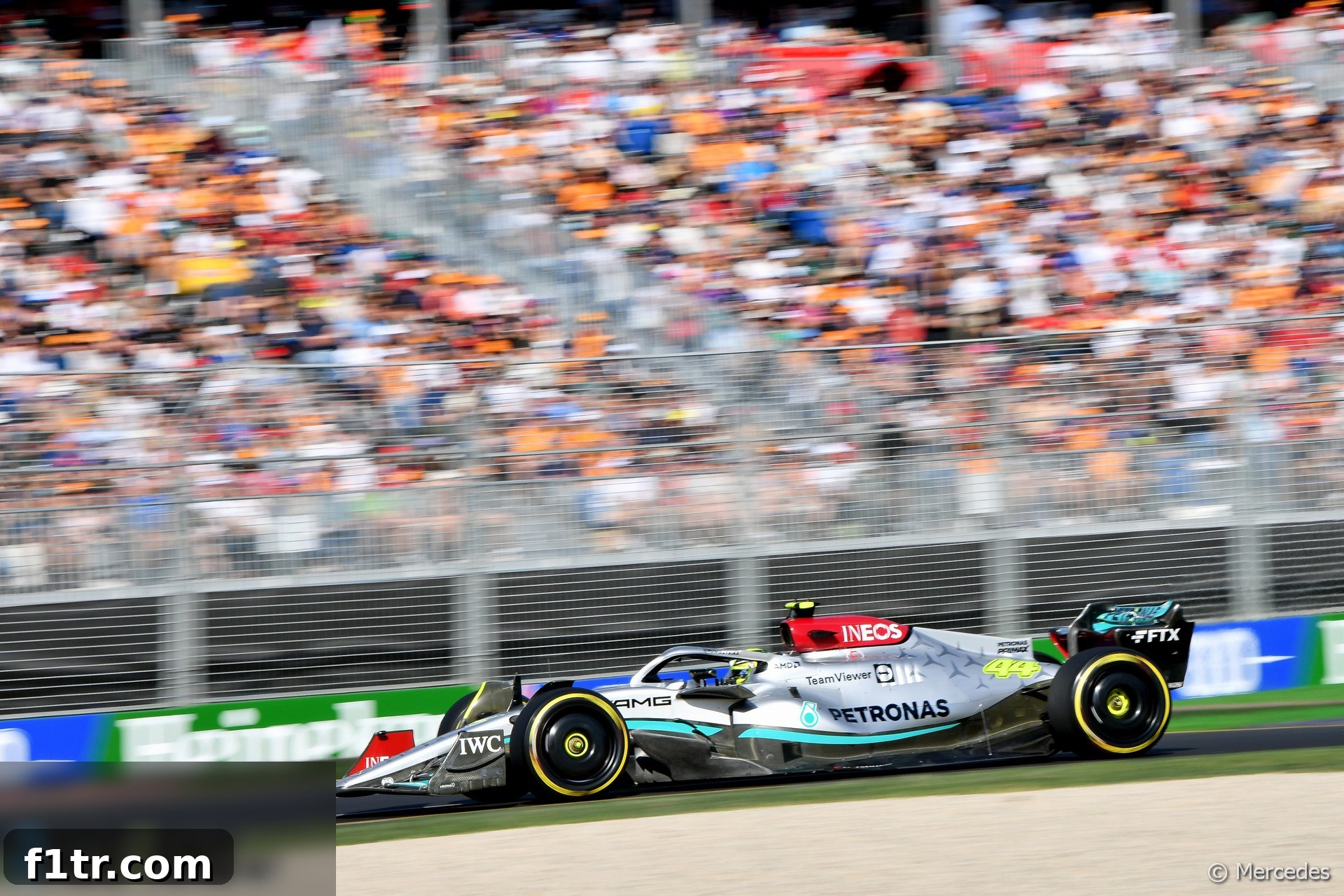
The Australian Grand Prix, a highly anticipated event on the Formula 1 calendar, often presents unique challenges to teams and drivers alike. During one such race, Mercedes-AMG Petronas driver Lewis Hamilton encountered a critical engine cooling problem that significantly impacted his performance and strategic options. This issue, which Hamilton himself described as putting him in a “difficult position” during the broadcast, was traced back to a seemingly minor, yet ultimately crucial, rise in ambient temperatures on race day.
The incident garnered considerable attention when Hamilton’s frustrated radio message was aired, leading to widespread speculation about the exact nature of his predicament. It later became clear that his concern stemmed from escalating temperatures within his car’s power unit, prompting his team to instruct him to adjust his driving style to enhance cooling – specifically, to “lift and coast.”
Mercedes’ chief strategist, James Vowles, provided an in-depth explanation of the situation in a video released by the team, shedding light on the intricate balance of performance and reliability in Formula 1. Vowles clarified that the directives given to Hamilton were entirely focused on managing the temperature of the internal combustion engine (ICE) and the overall power unit (PU) throughout the demanding race distance. “That was all about engine cooling and keeping the power unit cool during the course of the race,” Vowles articulated, emphasizing the razor-thin margins within which F1 teams operate.
In the high-stakes world of Formula 1, every component is engineered to its absolute performance limit, and the cooling system is no exception. Teams meticulously design their cars to optimize aerodynamics while simultaneously ensuring adequate cooling for the engine, gearbox, and other vital components. This delicate balance involves strategic choices regarding bodywork design, including the size and configuration of cooling louvres and air intakes. These decisions are typically finalized well in advance of a Grand Prix, often as early as the Saturday qualifying session, based on the most accurate weather forecasts available at the time.
However, as Vowles highlighted, forecasting in Formula 1 is not an exact science, and conditions can change rapidly. “That decision is made on Saturday but obviously we are racing on Sunday, 24 hours later,” he explained, underscoring the inherent challenge. In this particular instance at the Australian Grand Prix, the ambient temperature on race day was unexpectedly one, possibly two, degrees Celsius warmer than anticipated. While such a slight variation might seem insignificant to an outsider, for an F1 car operating at the very edge of its thermal envelope, it pushed the cooling requirements beyond the initial design parameters. Mercedes, alongside other teams on the grid, found themselves right on the “limit of what the engine and the power unit can take in terms of cooling requirements.”
The unexpected temperature increase had immediate and significant repercussions for Hamilton’s race craft. As Vowles elaborated, when a car is following another closely, it operates in what is known as “dirty air” – turbulent air disrupted by the car ahead. This turbulent air is less efficient at cooling the radiators, which are crucial for dissipating heat from the engine. Consequently, Lewis Hamilton was forced to alter his racing line, moving out of the slipstream of the car in front to seek “cool, clean air through the radiators” to bring down his power unit temperatures. While this was essential for engine reliability, it severely compromised his ability to aggressively race and challenge the car ahead, making overtakes or defensive maneuvers “incredibly difficult.” This direct conflict between managing engine temperatures and maximizing race performance was the core reason behind Hamilton’s frustrated radio message, articulating the difficult strategic quandary he faced.
Advert | Become a RaceFans supporter andgo ad-free
Managing the Heat: The “Lift and Coast” Imperative
The primary instruction given to Hamilton to mitigate the rising temperatures was to “lift and coast.” This technique involves the driver lifting their foot off the accelerator pedal earlier than usual before a corner and allowing the car to coast for a longer period before applying the brakes. This reduces the engine’s workload, allowing it to momentarily cool down as less fuel is being combusted. While effective for temperature management, “lift and coast” inevitably sacrifices crucial lap time, putting a driver at a distinct disadvantage against competitors who are able to push flat-out. Mercedes race engineer Pete Bonnington communicated these instructions to Hamilton with approximately 10 laps remaining in the race, signaling the critical nature of the issue.
The challenge of managing engine temperatures is a perpetual tightrope walk for Formula 1 teams. Engineers must design cooling packages that are robust enough to handle varying conditions while being compact and aerodynamically efficient. Oversizing the cooling system would incur significant aerodynamic drag, slowing the car down, while undersizing it risks catastrophic engine failure. The ideal scenario is to have a cooling setup that is precisely matched to the expected conditions, operating at the peak of efficiency. However, as the Australian Grand Prix demonstrated, unforeseen variables like a slight ambient temperature rise can quickly disrupt this delicate equilibrium, forcing immediate strategic adjustments from the cockpit.
This incident also underscores the sophisticated interplay between weather forecasting, aerodynamic design, and race strategy in modern Formula 1. Teams invest heavily in meteorological data and predictive models, but the dynamic nature of weather, especially in localized microclimates around a circuit, means that perfect prediction is often elusive. The commitment to a specific cooling configuration, based on Saturday’s forecast, becomes a calculated risk that can either pay dividends or lead to significant compromises on Sunday. Mercedes, known for their meticulous engineering and strategic prowess, faced a universal challenge that day, affecting multiple teams up and down the grid, as many operate with similarly aggressive cooling setups to maximize performance.
The communication between driver and pit wall becomes paramount in such high-pressure situations. The “lift and coast” directives, combined with regular updates on rival lap times, demonstrate the continuous stream of information and instruction necessary to navigate a race under sub-optimal conditions. Hamilton’s frustration, while understandable from a competitive standpoint, highlights the mental and physical toll these compromises take on a driver who is programmed to extract every ounce of performance from their machinery. Being told to ease off when fighting for position adds another layer of complexity to an already intense environment.
Hamilton’s radio messages from the end of the Australian Grand Prix
| Lap | Speaker | Comment |
|---|---|---|
| 46 | Hamilton | I’ve got a left-front blister. |
| 46 | Bonnington | Yeah, copy, we’ve seen it, don’t think it’s a problem. |
| 47 | Bonnington | George a 22.5. |
| 48 | Bonnington | So Lewis we need to introduce a small amount of lift-and-coast for PU temps. Tyres are good to the end. |
| 48 | Hamilton | [unclear] |
| 49 | Bonnington | Lewis, if you’re talking about fastest lap, we don’t think we’ll be able to achieve it. |
| 49 | Bonnington | George is 21.9 last lap, 21.9. |
| 50 | Bonnington | George 22.2. |
| 51 | Bonnington | Perez had a lock up into turn 13 and he’s now doing 22.4. |
| 52 | Bonnington | George a 22.0. |
| 52 | Bonnington | A little more for PU temps. lift-and-coast |
| 53 | Hamilton | You guys put me in a really difficult position. |
| 55 | Bonnington | And we have Alonso ahead of George who is traffic. |
| 57 | Bonnington | So one more lap. |
| 58 | Bonnington | So go strat mode one. |
| 58 | Bonnington | Well done today mate it’s P4. You just lucked out on the Safety Car. |
The radio transcript provides a chronological account of the unfolding situation, from initial tire concerns to the critical engine temperature warnings. Bonnington’s repeated instructions for “lift-and-coast” underscore the persistence of the cooling problem and the team’s need to continuously manage it. Hamilton’s frustrated outburst on Lap 53, “You guys put me in a really difficult position,” perfectly encapsulates the dilemma of a racing driver who wants to push but is held back by technical limitations. The pit wall’s role then shifts from optimizing performance to ensuring the car finishes the race reliably, even if it means sacrificing pace.
Advert | Become a RaceFans supporter andgo ad-free
Beyond the Race: The Ever-Evolving Challenge of F1 Design
The Australian Grand Prix cooling issue serves as a powerful reminder of the extreme engineering and dynamic challenges inherent in Formula 1. It illustrates that even with the most advanced technology and meticulous planning, external environmental factors can dictate race strategy and outcome. The relentless pursuit of performance means teams will always push the boundaries of design, balancing the necessity for powerful engines with the imperative for robust cooling systems that can adapt to the unpredictable nature of global racing conditions.
Every season, F1 regulations evolve, often impacting power unit design and aerodynamic freedom, which in turn influences cooling solutions. Engineers continuously seek innovative ways to improve heat rejection without compromising downforce or increasing drag. This includes optimizing radiator placement, designing more efficient heat exchangers, and exploring advanced materials for better thermal management. The incident at the Australian Grand Prix not only affected Lewis Hamilton’s race but also provided valuable data and lessons for Mercedes and other teams, feeding into their ongoing development cycles to build more resilient and adaptable racing machines for future competitions.
Ultimately, in a sport where milliseconds separate victory from defeat, the ability to manage every variable, no matter how small, becomes the true hallmark of championship contenders. The subtle rise in ambient temperature, leading to Hamilton’s cooling woes, perfectly encapsulates the razor-thin margins and the perpetual battle against the elements that define the pinnacle of motorsport.
2022 F1 season
- Mercedes told me “you’re wrong” about 2022 car’s problems – Hamilton
- FIA confirms all 10 F1 teams complied with 2022 cost cap
- Steiner “not ashamed” of panning “slow” Schumacher in Drive to Survive
- Albon believes year out of F1 improved him as a driver
- Hamilton sees diversity gains in F1 years on from his ‘traumatising’ experience of racism
Browse all 2022 F1 season articles