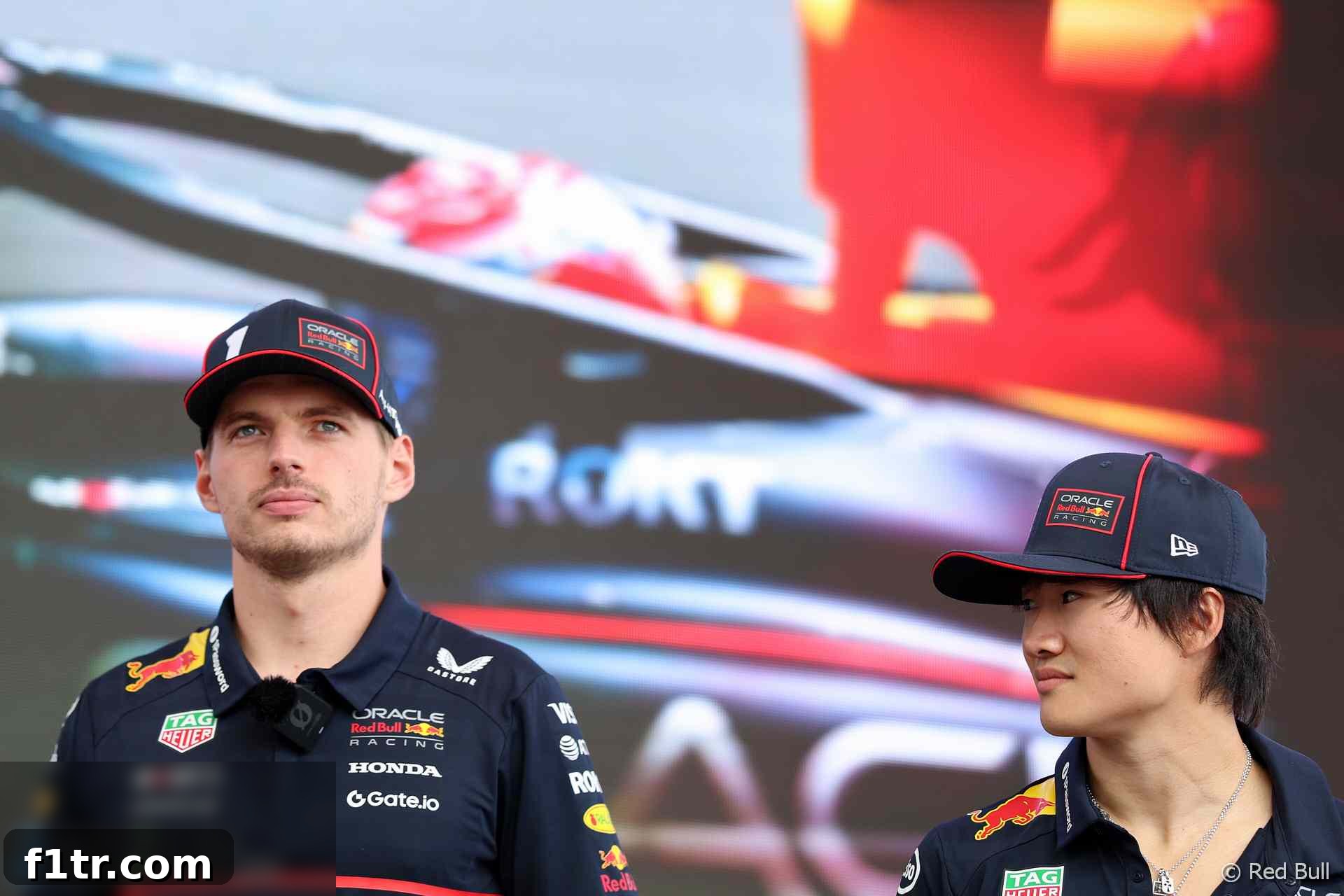
In the high-stakes world of Formula 1, where every point and every strategic advantage can dictate the outcome of a championship, the role of a secondary driver often extends far beyond merely securing points. For Yuki Tsunoda, currently a vital part of the Red Bull Racing lineup, this reality has become a central focus. Tsunoda has openly acknowledged the imperative to significantly elevate his performance to effectively support his illustrious teammate, Max Verstappen, particularly as Verstappen intensifies his bid for another drivers’ championship title.
Yuki Tsunoda’s Pivotal Role in Red Bull’s Championship Quest
While Max Verstappen has consistently delivered stellar performances, relentlessly closing the gap on the championship-leading McLaren drivers over the recent four rounds, Tsunoda’s position in the standings paints a different picture, placing him 16th overall. However, a recent double points finish at the demanding Circuit of the Americas showcased glimpses of his potential, underscoring his capability to contribute when it matters most. This performance serves as a crucial reminder of the impact a second driver can have, even if not directly contending for the title.
Tsunoda’s candid assessment highlights a clear understanding of his responsibilities within the team’s hierarchy. He recognizes that his primary goal, beyond his individual performance, is to be a strategic asset for Red Bull Racing. This support role is multifaceted, encompassing on-track maneuvers that can influence race dynamics, as well as off-track contributions to vehicle development. For a team like Red Bull, locked in an intense battle at the pinnacle of motorsport, the collective effort of both drivers is paramount.
Strategic Contributions: The Art of Team Play
The concept of a “supporting role” in Formula 1 is deeply rooted in strategic racing. It’s not simply about yielding position, but about creating tactical opportunities that bolster the lead driver’s chances. Tsunoda articulated this understanding, emphasizing the importance of running as close to the front as possible to unlock strategic flexibility for the team. “I think position-wise, especially being as high as possible, will create more opportunities to play around with the strategy in favor of the team,” Tsunoda explained. This involves a range of possibilities, from extending tire stints to influencing pit stop windows for rivals.
A secondary driver positioned strategically can be instrumental in dictating the pace of the race for competitors. For instance, by holding a strong track position, Tsunoda could effectively “delay” rival cars, forcing them to use up their tires prematurely, or compromising their ability to make optimal pit stops. Such actions can significantly enhance Verstappen’s prospects, providing him with a clearer track or more favorable tire degradation compared to his closest competitors. This kind of team play is a sophisticated dance of speed, tire management, and tactical awareness, where every decision can have championship implications.
Furthermore, a supportive driver can execute specific team strategies, such as acting as a defensive barrier against rivals threatening Verstappen’s position, or even providing a slipstream during crucial qualifying or race laps. “Strategy that, if I can help Max to have a higher chance to be P1 or make our competitors’ lives more difficult. So, that’s kind of the role I understand,” Tsunoda affirmed. His clear recognition of this hierarchy – “I’m not fighting for the championship, my team mate is” – underscores his dedication to the team’s overarching objective. To fulfill this demanding role effectively, consistent high-level performance is non-negotiable, a fact Tsunoda readily acknowledges, citing his strong Austin sprint race performance as an example of what he needs to deliver more frequently.
Bridging the Performance Gap: Tsunoda’s Growth Trajectory
Tsunoda’s journey to becoming a consistent front-runner capable of influencing a championship battle has been one of continuous learning and adaptation. His early career at Red Bull’s junior squad, Racing Bulls, honed his raw speed, but the demands of the main Red Bull Racing team require an even greater depth of understanding and execution. Tsunoda joined the senior team at the third round of the current year, bringing with him four seasons of valuable experience from the feeder team. This transition has naturally presented new challenges and opportunities for growth.
A key area of focus for Tsunoda has been his long-run performance, a critical aspect of race pace and tire management over a full Grand Prix distance. He candidly admitted to struggling with this earlier in the season. “I was struggling quite a lot in the long run, I would say, in the beginning of the season, and now I’ve improved that. I’ve made quite a big step,” he revealed. This self-awareness and dedication to improvement are vital for any driver aspiring to compete at the sharp end of the grid. The ability to maintain competitive lap times throughout a race, while preserving the tires, is a hallmark of elite F1 drivers, and Tsunoda’s progress in this area is a promising sign for his future and his capacity to support Verstappen.
While significant strides have been made, Tsunoda acknowledges that the challenge now lies in consistently executing these improvements throughout an entire race weekend. “Now, [I’m] struggling a little bit to put it all together the whole weekend in terms of performance in the long run, so that’s what I’m focusing on,” he explained. This focus on consistency – from practice sessions through qualifying and both sprint and main races – is the final frontier for many aspiring F1 talents. His progress, however, is not a solitary effort. Tsunoda credited the unwavering support from the Red Bull team, specifically mentioning Team Principal Laurent Mekies and the engineering staff. “Without that, I wouldn’t be here and able to improve. The tools are there, and that’s why I started to go in the right direction, I guess,” he added, highlighting the collaborative environment crucial for driver development in Formula 1.
Beyond the Track: Driver Feedback and Car Development
The role of an F1 driver extends far beyond merely turning the wheel on race day. Drivers are integral to the ongoing development of the car, providing crucial feedback that guides engineers in their relentless pursuit of performance improvements. Yuki Tsunoda fully embraces this aspect of his role, understanding that his contributions to car setup and resource utilization directly benefit the entire team, including Max Verstappen’s championship campaign.
“I think I can help in a lot of areas,” Tsunoda stated, “Set-up, different resources. We’re still trying to discover a lot of new set-ups that suit or maximize the current package and that’s what we are doing very well this year so far.” This involves extensive work in simulators, detailed debriefs after every session, and a keen analytical eye on how changes to the car’s balance, aerodynamics, or suspension affect its behavior on track. A second driver, especially one who is actively improving and providing clear, consistent feedback, can accelerate the development cycle, helping the team unlock the full potential of their machinery. This collective effort ensures that Red Bull remains at the forefront of technical innovation, a critical factor in maintaining a competitive edge against formidable rivals like McLaren and Ferrari.
The Pressure Cooker: Securing a Future with Red Bull
The Formula 1 driver market is a relentless and unforgiving environment, and the stakes for Yuki Tsunoda are particularly high. Red Bull is yet to announce who will partner Max Verstappen for the 2025 season, making Tsunoda’s current performances and contributions critically important for his future. His trajectory from the junior Racing Bulls team, where he spent four seasons, to the senior Red Bull squad highlights the organization’s faith in his talent. However, to solidify his place, he must demonstrate consistent growth and a clear ability to fulfill the strategic team role required of him.
The decision on Verstappen’s teammate is not merely about individual speed but also about team cohesion, development input, and the capacity to execute complex race strategies. Tsunoda’s recent improvements, particularly in his long-run pace and his growing understanding of his supporting role, are precisely the attributes Red Bull’s management will be scrutinizing. His ability to deliver those crucial points at COTA, coupled with his self-confessed commitment to further improvement, positions him as a strong contender for the coveted seat. The coming races will undoubtedly be a crucial proving ground for Tsunoda, as he seeks to demonstrate his indispensable value to Red Bull Racing’s championship aspirations and secure his place on the grid for years to come.
RaceFans Daily Updates: Don’t Miss a Moment
Stay connected with the latest news, analysis, and insights from the world of Formula 1. Get a daily email with all our latest stories – absolutely no marketing or ads. Sign up here to ensure you don’t miss any critical updates, race reports, or driver interviews:
Recent Formula 1 Insights
Explore more in-depth articles and stay informed about the latest happenings in Formula 1:
- F1 fans shocked as ferry company screens “adult film” by mistake
- Russell: Lack of penalties over corner-cutting was ‘especially unfair for Lewis’
- Williams aim to give Albon more “consistent” car after consecutive Q1 exits
- Lawson “not at fault” for marshal incident says FIA following criticism from Mexico’s OMDAI
- Stats: Norris takes F1’s biggest win for two years as Ferrari go win-less for 12 months
Browse all 2025 Mexican Grand Prix articles