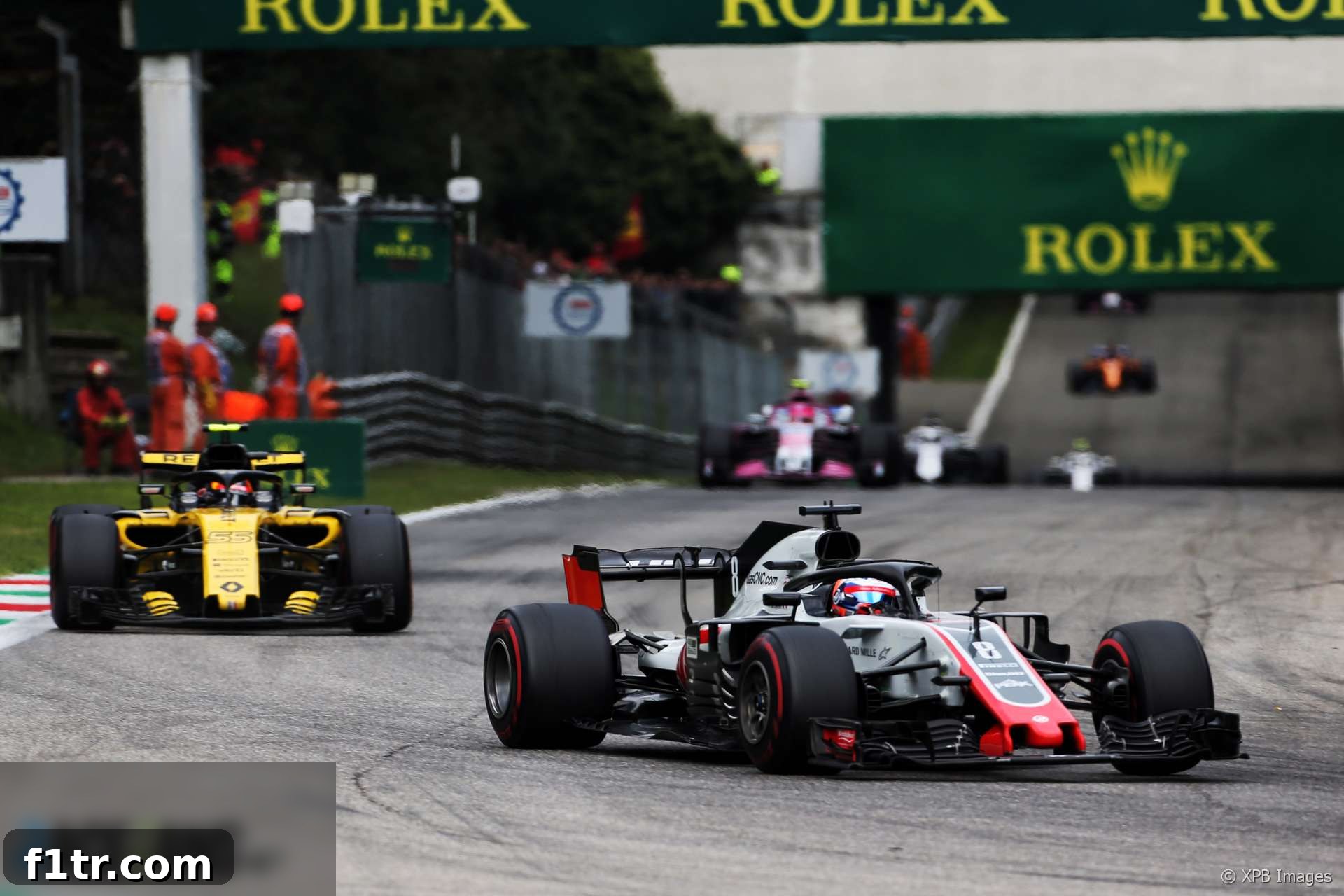
In a dramatic twist following the exhilaration of the Italian Grand Prix, Formula 1 witnessed a significant post-race development that reshaped the standings and underscored the unwavering strictness of its technical regulations. Romain Grosjean, who had skillfully piloted his Haas VF-18 to a commendable sixth-place finish at Monza, was stripped of his hard-earned points after a protest lodged by the Renault F1 team was meticulously reviewed and subsequently upheld by the race stewards. This decision, an unwelcome blow for the Haas team and their French driver, sent ripples through the paddock, impacting not only championship standings but also celebrating a poignant career milestone for another driver.
The controversy ignited almost immediately after the chequered flag fell at the legendary Italian circuit. While Grosjean celebrated what appeared to be a strong points haul, a vital contribution to Haas’s championship aspirations, Renault wasted no time in formally protesting the legality of his car. Their contention centered on a specific element of the Haas VF-18’s floor, an area of intricate aerodynamic design where even the slightest deviation from the stipulated rules can yield a performance advantage. This protest triggered an extensive investigation by the FIA stewards, a process designed to ensure fair competition and uphold the integrity of the sport’s technical framework.
Unpacking the Technical Infraction: The Car’s Floor
The crux of Renault’s protest lay in Article 5.1.4 of the FIA Formula 1 Technical Regulations. This particular rule dictates that the front reference plane of a car’s floor must have a radius of 50mm to each front corner. This seemingly minor detail is, in fact, a crucial parameter in managing airflow beneath the car, significantly influencing aerodynamic performance. Any alteration, however small, from this precise measurement can impact downforce generation, allowing a car to potentially carry more speed through corners or achieve greater stability, thereby conferring an unfair advantage over competitors whose designs meticulously adhere to the prescribed dimensions.
For weeks leading up to the Italian Grand Prix, the F1 paddock had been buzzing with discussions surrounding this specific regulation. Following requests for clarification from several teams, the FIA had issued a technical directive in July, explicitly detailing the interpretation of Article 5.1.4 and providing teams with a clear deadline: they were expected to bring their cars into compliance by the Italian Grand Prix. This directive aimed to eliminate any ambiguity surrounding the design of the front floor and ensure that all cars met the exact specifications, fostering an equitable playing field.
The Stewards’ Investigation and Haas’s Defense
Upon receiving Renault’s protest, which notably included compelling photographic evidence suggesting Haas’s non-compliance, the stewards initiated their thorough investigation. Their role is akin to a judicial panel in motorsport, tasked with impartially reviewing evidence, hearing arguments from all parties involved, and making a judgment based strictly on the technical regulations. In this instance, the photographic evidence proved pivotal, clearly illustrating the discrepancy between Haas’s car floor and the stipulated 50mm radius requirement.
Haas, in their defense, acknowledged that their car was not fully compliant with the updated technical directive at Monza. However, they presented an argument centered around communication and practicality. They informed the stewards of an email thread where they claimed to have notified the FIA’s technical director that they would introduce a new, compliant floor update by the subsequent Singapore Grand Prix. Their reasoning for this delay was primarily attributed to the constraints of the mandatory summer shutdown, a period when factory operations are largely halted, making immediate design and manufacturing changes exceptionally challenging. Haas contended that because they had not received a direct, explicit response prohibiting their proposed timeline for compliance, they had operated under the “understanding… that their solution and timing were accepted.”
The Ruling: Strict Interpretation of Regulations Prevails
Despite Haas’s detailed explanation and their perceived implicit agreement, the stewards ultimately sided with a strict interpretation of the regulations. Their ruling firmly stated that “it was therefore the obligation of the competitor to be in compliance, which they did not do.” The stewards emphasized that while communication with the technical director is vital for clarification and guidance, it does not absolve a team of its ultimate responsibility to ensure its car fully complies with all applicable technical regulations at all times during competition. The absence of a direct rebuttal from the FIA regarding a proposed compliance timeline could not be construed as an official waiver or acceptance of non-compliance for a race where the directive was explicitly in effect.
Consequently, the stewards formally confirmed Grosjean’s Haas had been excluded from the final classification of the Italian Grand Prix. This decision underscored the FIA’s commitment to rigorous rule enforcement, leaving no room for interpretations that might compromise the technical integrity of the sport. It sent a clear message across the paddock: in Formula 1, adherence to the letter of the law is paramount, and any perceived grey areas will almost always be resolved in favor of strict compliance.
Repercussions on the Drivers’ and Constructors’ Championships
The ramifications of this decision were immediate and far-reaching, dramatically altering the points allocation for the Italian Grand Prix and influencing the broader championship narrative.
Impact on Drivers:
- Romain Grosjean: For Grosjean, the exclusion was a bitter pill to swallow. Having driven a strong race to secure P6, losing those valuable eight points was a significant setback for his personal championship tally and a blow to his morale, especially after a season that had seen its share of ups and downs. It denied him a crucial contribution to Haas’s efforts.
- Sergey Sirotkin: On the flip side, the decision brought unexpected joy for Williams’ Sergey Sirotkin. As all drivers behind Grosjean were promoted by one position, Sirotkin moved from P11 to P10, earning him his first-ever Formula 1 championship point. For the young Russian driver and the struggling Williams team, this solitary point was a momentous achievement, a rare moment of celebration in what had been a challenging and often frustrating 2018 season for the historic British outfit. It represented a testament to perseverance and the unexpected fortunes that can sometimes arise in motorsport.
Impact on Constructors’ Championship:
- Renault: The most immediate beneficiary of the exclusion was the protesting party itself, Renault. With Grosjean’s points nullified, Renault cemented their fourth position in the constructors’ championship. Instead of being level on points with Haas, the decision ensured Renault maintained a crucial eight-point lead over their American rivals. This advantage was significant in the tight midfield battle, directly impacting prize money distribution and team prestige at the season’s end.
- Haas F1 Team: For Haas, the exclusion was a devastating blow. The loss of eight points not only widened the gap to Renault but also complicated their pursuit of a coveted top-four finish in the constructors’ standings. This particular season was a high point for Haas, and every point was essential in their quest to establish themselves as a consistent force in the upper midfield. The incident served as a costly reminder of the extreme precision required in F1 technical compliance.
Broader Implications for Formula 1
Beyond the immediate points shifts, Grosjean’s exclusion at Monza carried broader implications for the sport. It served as a stark reinforcement of the FIA’s commitment to upholding the technical regulations without compromise. In a sport where teams constantly push the boundaries of design and engineering, such definitive rulings are vital to maintain a level playing field and ensure that success is achieved through legitimate innovation within the defined rulebook, rather than through technical non-compliance.
The incident also highlighted the critical importance of clear, unambiguous communication between teams and the FIA technical department. While teams seek to gain every possible advantage, the onus of compliance ultimately rests squarely on their shoulders. The episode became a case study in F1 legal circles, demonstrating that internal understandings or unconfirmed timelines cannot supersede explicit directives and regulatory obligations. It reaffirmed that the “letter of the law” often takes precedence over any perceived “spirit of the regulations” when it comes to technical adherence.
Conclusion: A Costly Lesson in Compliance
The exclusion of Romain Grosjean from the 2018 Italian Grand Prix marked a pivotal moment in that season. It was a testament to the relentless competition in Formula 1, where rivals scrutinize every detail, and the FIA rigorously enforces its rulebook. For Romain Grosjean and the Haas F1 Team, it was a harsh and costly lesson in the absolute necessity of technical compliance. For Renault, it was a strategic victory that paid dividends in the constructors’ championship. And for Sergey Sirotkin, it etched a memorable, albeit unexpected, moment into his Formula 1 career with the acquisition of his very first point. Ultimately, the Monza ruling served as a powerful reminder that in the high-stakes world of Formula 1, precision, diligence, and strict adherence to every single rule are not just advantageous, but absolutely mandatory.
2018 F1 Season: Further Reading
- F1 feared “death knell” for Drive to Survive after Ferrari and Mercedes snub
- McLaren staff told us we were “totally crazy” to take Honda engines in 2018 – Tost
- ‘It doesn’t matter if we start last’: How Red Bull’s junior team aided Honda’s leap forward
- Honda’s jet division helped F1 engineers solve power unit problem
- McLaren Racing losses rise after Honda split
Browse all 2018 F1 season articles