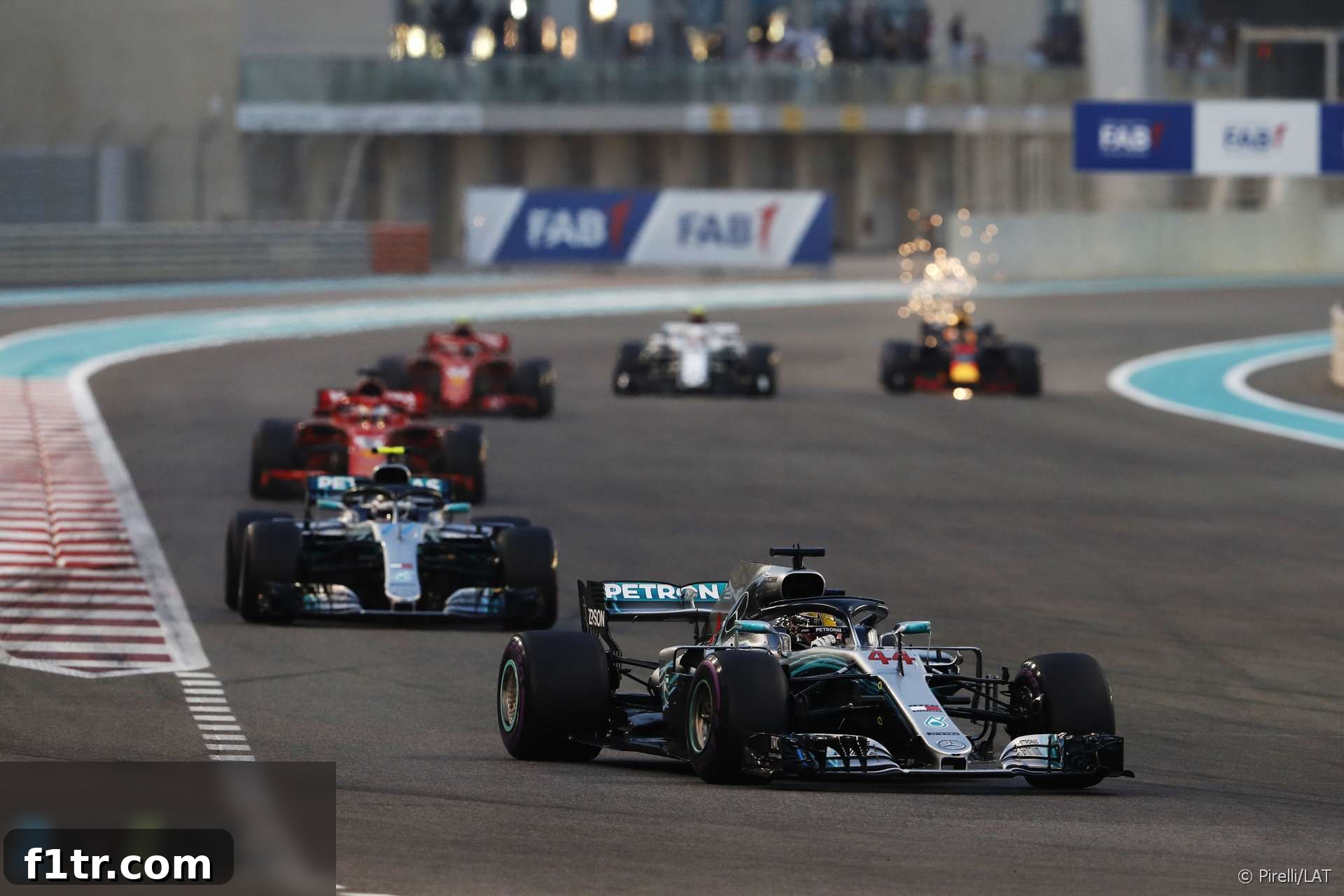
The 2018 Formula 1 season culminated in the vibrant desert setting of the Abu Dhabi Grand Prix, a race that, while not carrying the tension of a championship decider, still delivered its share of drama, strategic masterclasses, and poignant farewells. For some drivers, it was a chance to underscore their prowess and end the year on a high note, while for others, the struggles of a challenging season unfortunately continued. This comprehensive review delves into the performances of the standout stars and those who encountered significant hurdles at the Yas Marina Circuit, providing an in-depth analysis of the final race weekend.
2018 Abu Dhabi Grand Prix: Stars, Struggles, and Season Farewells
The Abu Dhabi Grand Prix served as the grand finale of the 2018 Formula 1 season, a stage where champions cemented their legacy and rising talents offered a glimpse into the future. From dominant drives to heartbreaking mechanical failures, the Yas Marina Circuit provided a fitting backdrop for the conclusion of another thrilling championship. This article meticulously reviews the key performances, strategic decisions, and pivotal moments that defined the race for its most prominent figures, both those who shone brightly and those who faced significant adversity.
Drivers Who Shone Brightly: The Star Performers
Despite the championship having been decided, a true competitor never eases off the throttle. In Abu Dhabi, several drivers seized the opportunity to demonstrate their skill, resilience, and strategic acumen, delivering performances that marked them out as the weekend’s stars.
Lewis Hamilton: A Champion’s Dominant Farewell
Having already secured his fifth World Championship title, Lewis Hamilton arrived in Abu Dhabi with the pressure off, yet his performance was anything but relaxed. He was in commanding form from the outset, signaling his intent to finish the season as he had dominated much of it. In Q2, Hamilton produced a truly stunning lap, a testament to his raw speed and ability to extract every ounce of performance from his Mercedes W09. Though his initial Q3 attempt might have been described as “messy” by his own high standards, it was still remarkably quick, outpacing most of the field.
His second and decisive Q3 lap was flawless, perfectly underlining his strong qualifying performance. He secured pole position with a tenth of a second advantage over his teammate Valtteri Bottas and a significant three-tenths lead over his closest championship rival, Sebastian Vettel. This pole set the stage for what was to become a characteristic Hamilton Sunday drive. At the start of the race, Hamilton executed a textbook getaway, maintaining his lead into Turn 1 and never looking back. During his initial short stint, he was never truly pressured by Bottas, establishing a comfortable margin.
A pivotal moment in his race strategy came with 48 laps remaining when the Virtual Safety Car (VSC) was deployed. Hamilton was the only front-runner to seize this opportunity, diving into the pits for a set of supersoft tyres. This aggressive move saw him emerge behind the two Red Bulls, Max Verstappen and Daniel Ricciardo. Displaying superb presence of mind and race craft, he wisely chose not to challenge Verstappen immediately upon exiting the pits, understanding the long game. Mercedes engineers were confident in his ability to make the supersofts last for the remainder of the race, a gamble that paid off handsomely. Hamilton managed his tyres impeccably, preserving enough life in them to match Vettel’s pace in the closing stages, even as the Ferrari driver attempted a late charge. His controlled performance from start to finish was a fitting end to a championship-winning season, reaffirming his status as a true legend of the sport.
Charles Leclerc: A Glimpse of Future Brilliance
Charles Leclerc, in his final race for Sauber before his highly anticipated move to Ferrari, continued to impress, showcasing the talent that had marked him as one of the grid’s most exciting young prospects. He comfortably outpaced his teammate Marcus Ericsson, advancing to Q3 and narrowly missing out on being “best of the rest” by a mere 0.045 seconds. His qualifying performance was a clear indicator of his raw pace and ability to extract maximum performance from his machinery, even in a midfield car.
The race start was equally spectacular. Leclerc capitalized on a slow-starting Max Verstappen and audaciousness dived down the inside of Romain Grosjean to emerge in an impressive sixth position after the first corner. His aggressive yet precise driving continued on the second straight, where he managed to overtake Daniel Ricciardo just before the Safety Car was deployed on Lap 1 for Nico Hulkenberg’s dramatic accident. This early surge demonstrated his exceptional race craft and ability to seize opportunities.
Following the restart, Leclerc applied relentless pressure on Kimi Räikkönen until the Finn’s engine failed on the main straight just seven laps into the race. This incident triggered another VSC period, prompting Sauber to make a strategic decision, mirroring Hamilton’s earlier pit stop by switching to supersoft tyres. This early pit stop, while potentially offering a long-term advantage, initially sacrificed Leclerc’s track position, dropping him down the order. The young Monegasque driver then faced the challenging task of fighting his way back through the field from fourth. Despite the setback and the difficulty of overtaking on the Yas Marina circuit, Leclerc methodically worked his way up to seventh position. Although he was unable to challenge Carlos Sainz Jr. for sixth, largely due to Sainz’s benefit of fresh tyres from a later stop, Leclerc’s recovery drive was a testament to his tenacity and skill, proving once again why Ferrari had chosen him for the following season.
Pierre Gasly: Valiant Efforts Amidst Adversity
Pierre Gasly’s final race for Toro Rosso before his promotion to Red Bull Racing was a mix of immense promise and cruel misfortune. His weekend began with a significant setback in Q1. He was six-tenths up on his personal best lap, looking set for a strong qualifying position, when his engine dramatically failed as he exited the final corner. This immediate mechanical issue eliminated him from qualifying, forcing him to start a disappointing 17th. Fortunately, he avoided any grid penalties for the engine change, which at least gave him a fighting chance from the back.
Despite the lowly starting position, Gasly demonstrated impressive race craft and resilience. He intelligently navigated the chaos ahead during the opening lap, which included the Safety Car deployment for Hulkenberg’s crash. He capitalized on the incidents and early retirements, climbing several positions to run 13th when the Safety Car was called. This early progress was crucial for his hopes of scoring points. Opting for a long first stint on supersoft tyres, Gasly managed his rubber effectively, preserving tyre life before finally pitting on Lap 29 for a set of ultrasofts.
After his pit stop, he re-joined the race in 16th place, facing another challenge to climb back into the points-paying positions. Displaying excellent pace and strategic overtaking, Gasly steadily made his way through the midfield, eventually breaking into the top ten. However, his valiant efforts were once again thwarted by a devastating mechanical failure. On Lap 46, his engine gave up, treating Max Verstappen behind him to a spectacular smoke screen as he was forced to retire. This second engine failure of the weekend, particularly after such a strong recovery drive, was a bitter pill to swallow for Gasly. The incident was compounded by a brief communication lapse, where Gasly stated he might have avoided the dramatic smoke if his team had warned him quicker on the radio. Despite the DNF, his performance showcased his fighting spirit and potential, even when luck was not on his side.
Drivers Who Faced Hurdles: The Strugglers
Formula 1 is a relentless sport, and even the most talented drivers can have weekends where everything seems to go wrong. In Abu Dhabi, a few prominent names found themselves grappling with challenges that significantly hampered their performances.
Kevin Magnussen: A Disappointing End to the Season
Kevin Magnussen’s performance in Abu Dhabi proved to be one of his most challenging weekends of the season, particularly when compared to his teammate Romain Grosjean. While Grosjean demonstrated that the Haas VF-18 had the pace to be at the sharp end of the midfield, Magnussen found himself over a second slower in qualifying. This significant deficit put him at an immediate disadvantage, highlighting a struggle to extract the car’s full potential.
Starting outside the top ten, Magnussen opted to take advantage of the free tyre choice regulations, beginning the race on supersoft tyres. He pursued an aggressive one-stop strategy, becoming the last driver to pit, staying out on his initial set of tyres until Lap 41. This long first stint was designed to gain track position and provide a tyre advantage at the end of the race. He then switched to fresh ultrasofts for the final 13 laps, hoping to make significant progress. He ultimately finished in 10th place, securing a solitary point, thanks in part to Pierre Gasly’s late retirement. However, this result somewhat flattered his overall speed and performance relative to Grosjean, whose own race was compromised by first-lap damage. Magnussen’s weekend underscored the fine margins in Formula 1 and how quickly a performance can seem lacklustre when a teammate excels.
Valtteri Bottas: A Season’s Frustration Culminates
For Valtteri Bottas, the Abu Dhabi Grand Prix was a microcosm of his challenging 2018 season: moments of potential followed by struggles that ultimately led to disappointment. In qualifying, he was just a tenth of a second shy of his teammate Lewis Hamilton, securing a front-row start. However, this small deficit proved significant as he was unable to challenge Hamilton off the line into Turn 1, immediately losing the opportunity to dictate the race from the front. For the remainder of his first stint, Bottas maintained his position, inheriting the lead for nine laps when Hamilton made his early VSC pit stop.
The second stint proved to be where Bottas’s race truly unraveled. He struggled significantly with tyre management, battling graining and degradation. This manifested in two costly lock-ups, which brought him under intense pressure from Sebastian Vettel and Max Verstappen. The mounting pressure eventually told, and Bottas conceded positions to both drivers. Once he had lost out to his rivals, Mercedes decided to make a second pit stop, as he wouldn’t lose any further track positions, effectively minimizing the damage. He finished a distant fifth, significantly adrift of the front-runners and the battle for the podium. This result was a disheartening end to a season that had started with such promise, particularly after his strong performances in the early races. Abu Dhabi painfully highlighted the contrast between his early season form and the difficulties he faced throughout the latter half of 2018, underscoring a year of missed opportunities and mounting frustration for the Finn.
The Rest of the Field: Mixed Fortunes and Memorable Moments
Beyond the primary stars and strugglers, the 2018 Abu Dhabi Grand Prix saw a wide array of performances and incidents that collectively painted the picture of the season’s final act, from team strategies to emotional goodbyes.
Ferrari and Red Bull: Chasing the Silver Arrows
Ferrari entered the weekend with hopes of challenging Mercedes, but for the majority of the Abu Dhabi Grand Prix weekend, they lagged behind the dominant Silver Arrows. In qualifying, Sebastian Vettel and Kimi Räikkönen locked out the second row, a decent result but still a step behind Hamilton’s pace. The race itself proved to be a mixed bag for the Scuderia. Kimi Räikkönen, in his final race for Ferrari, suffered an unfortunate electrical problem on Lap 7, forcing him into an early retirement. It was a premature and disappointing end to his second stint with the Italian team, denying fans a chance to see his final competitive laps in red.
Sebastian Vettel, despite his best efforts, was never truly able to challenge for the lead. However, he did manage to pressure Valtteri Bottas into a crucial mistake, allowing him to take second place, which salvaged a podium finish for Ferrari. Red Bull Racing, on the other hand, employed a split tyre strategy between their drivers. Max Verstappen suffered an anti-stall issue at the start, dropping him down to tenth position, forcing him into recovery mode from the outset. He had started on the softer hypersoft tyres, prompting an earlier pit stop. Daniel Ricciardo, in his last race for Red Bull, enjoyed the advantage in qualifying and during the first stint over Verstappen, putting in a solid performance.
Despite being ahead in the first stint, Ricciardo stopped sixteen laps later than Verstappen, a strategic decision that ultimately didn’t pay off as hoped. Even with significantly fresher tyres in the closing stages, Ricciardo was unable to get close enough to challenge Verstappen for position, highlighting the difficulties of overtaking and the impact of track position at Yas Marina. It was a somewhat bittersweet end for Ricciardo’s chapter with Red Bull, as he finished fourth, just off the podium.
Midfield Battles and Incidents: Haas, Renault, Toro Rosso, Force India
The midfield battle was as intense as ever, marked by both strategic brilliance and dramatic incidents. Romain Grosjean qualified well for Haas, demonstrating the car’s potential. However, his race took a tumultuous turn with a poor start, leading to contact with Nico Hulkenberg on the very first lap. This incident sent the Renault driver’s car rolling spectacularly into the wall and out of the race, triggering the Safety Car. Crucially, Grosjean was deemed blameless for the collision, a small consolation in an otherwise compromised race. The Haas driver later gambled on the Virtual Safety Car for a pit stop, a decision that unfortunately cost him track position and effectively ruined his race. Despite the setbacks, Grosjean managed to salvage points, finishing ninth.
Brendon Hartley, driving for Toro Rosso, found himself caught in the debris from the Hulkenberg/Grosjean crash, suffering a slow puncture that severely impacted his race. He was forced to complete the vast majority of the race on a single set of supersoft tyres, which meant he couldn’t push the car as hard as he would have liked, significantly hindering his pace and ability to fight for positions. Carlos Sainz Jr. delivered a commendable performance for Renault, finishing “best of the rest” in sixth place despite a less-than-ideal qualifying. His strategy of running a long first stint on supersofts paid dividends, allowing him to navigate through as little traffic as possible and optimize his tyre advantage later in the race. Sergio Perez, for Force India, mirrored Sainz’s success with smart strategy. Starting outside the top ten, he capitalized on his freedom to choose his starting tyre. He stopped on Lap 26, swapping ultrasofts for supersofts, and efficiently managed his race to finish a comfortable eighth, adding valuable points for his team.
Final F1 Farewells: Alonso, Ericsson, Ocon, Vandoorne, and Williams
The Abu Dhabi Grand Prix was also a race of poignant farewells for several drivers. Fernando Alonso competed in what was, at the time, his final Formula 1 Grand Prix. He rounded off his career by outqualifying his McLaren teammate Stoffel Vandoorne for the 21st time that season, a testament to his enduring speed and talent. Alonso finished just outside the points in 11th, ending an illustrious chapter in the sport. Marcus Ericsson and Esteban Ocon both endured frustrating mechanical failures in their last races for Sauber and Force India, respectively. It was an unfortunate way for both drivers to conclude their stints with their teams, especially as they looked towards uncertain futures in F1.
Stoffel Vandoorne also concluded his Formula 1 career with McLaren, finishing behind his more experienced teammate, a reflection of a challenging two seasons. Meanwhile, Williams continued their struggles as the slowest car in the field for much of 2018. However, even with their lack of pace, both Lance Stroll and Sergey Sirotkin showed resilience, engaging in some battles with midfield teams at various points in the race, particularly by running long first stints. Their efforts, though not yielding points, highlighted their determination in a difficult season for the storied British team.
Your Voice Matters: Driver of the Weekend Poll
Now that you’ve read our comprehensive analysis of the 2018 Abu Dhabi Grand Prix, we want to hear from you. Who do you think truly excelled amidst the high-speed drama and strategic complexities of the season finale? Cast your vote for the driver who impressed you most and discover if other Formula 1 fans share your perspective.
- Vote for your 2018 Abu Dhabi Grand Prix Driver of the Weekend
Explore More from the 2018 Abu Dhabi Grand Prix
Delve deeper into the events and storylines from the final race of the 2018 Formula 1 season with our curated collection of related articles.
- 1,000 wins: A world championship milestone
- 2018 Abu Dhabi Grand Prix Star Performers
- Top ten pictures from the 2018 Abu Dhabi Grand Prix
- Untouchable Hamilton ends season with 11th victory
- Vote for your 2018 Abu Dhabi Grand Prix Driver of the Weekend
Browse all 2018 Abu Dhabi Grand Prix articles