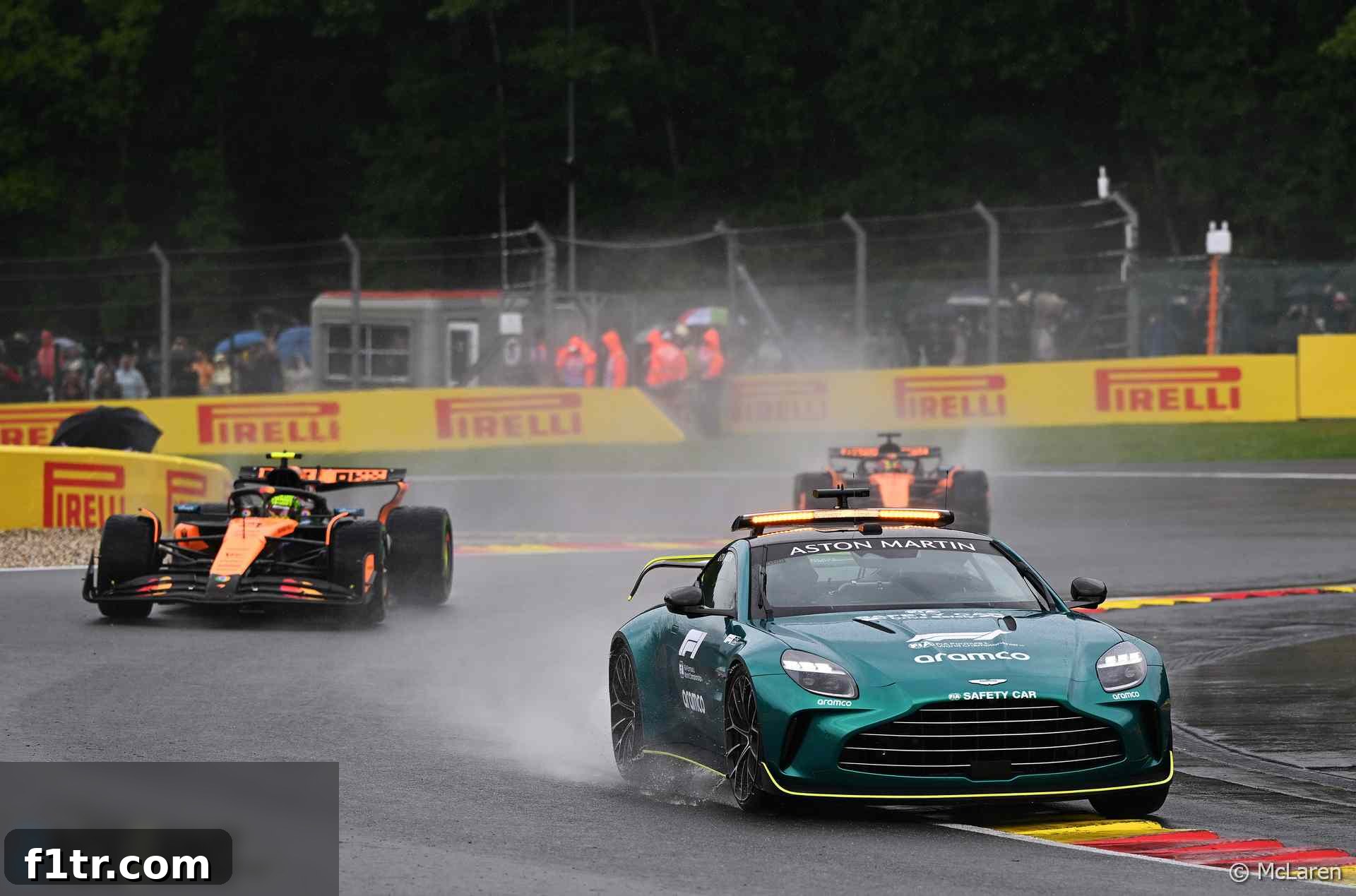
The Belgian Grand Prix at the iconic Spa-Francorchamps circuit experienced a dramatic and unexpected start, as heavy rain forced the race to be red-flagged during the formation lap. Conditions were deemed too treacherous for racing, leading to an immediate suspension of proceedings and a significant delay, highlighting the ever-present challenges and dangers of wet weather racing in Formula 1.
Torrential rain began to fall just minutes before the scheduled start of the Grand Prix, transforming the already challenging Spa circuit into a waterlogged hazard. As the drivers embarked on the formation lap behind the Safety Car, the severity of the downpour quickly became apparent. Visibility plummeted, and standing water accumulated rapidly on the track surface. Within moments of the Safety Car leading the field out, Race Control announced the suspension of the starting procedure and waved the red flag, bringing all cars back into the pit lane.
An FIA spokesperson later clarified that the decision to red-flag the race was primarily driven by the unanimous feedback from the majority of drivers, who reported critically poor visibility during their brief tour of the circuit. This collective concern underscored the extreme danger posed by the conditions, where the ability to see beyond the car immediately ahead was virtually non-existent, making high-speed competition untenable.
Drivers Grapple with Near-Zero Visibility at Spa
The radio communications from the drivers painted a vivid picture of the treacherous scene. Pole-sitter Lando Norris, positioned at the very front behind the Safety Car, immediately voiced his concerns. “I can’t see a lot behind the Safety Car, so I can’t imagine what it’s like for everyone else,” he told his McLaren team. When asked if the main issue was aquaplaning or visibility, Norris unequivocally stated: “Visibility. The standing water is not too bad.” His comments underscored that while the grip might have been acceptable in some areas, the sheer lack of visual reference was the overriding problem.
Norris’s teammate, Oscar Piastri, echoed these sentiments from just behind him. “It’s still very difficult to see,” Piastri communicated to his race engineer Tom Stallard. “I can’t see anything so I don’t know how anyone else can.” The sentiment was shared widely across the paddock. Alpine’s Esteban Ocon concisely summarized the situation for his team: “I can’t see anything.” These statements highlighted a universal concern amongst the drivers, recognizing that even a single lap at reduced speed behind the Safety Car was enough to demonstrate the impossibility of a safe race start.
Further back in the field, Carlos Sainz Jnr, who was set to start the race from the pits and caught the queue of cars during the formation lap, also confirmed the grim reality. “Probably a bit too much rain now, still,” he noted, indicating that the conditions were far from suitable for a race commencement. The combined reports from various positions on the grid left little doubt about the correctness of the FIA’s decision.
Divergent Views: Caution vs. Opportunity
Despite the overwhelming consensus on poor visibility, a few drivers expressed alternative perspectives. Alexander Albon, starting fifth on the grid, suggested that staying out might have been a better approach. “I think we should just drive around a bit,” he told his team after being informed that the start had been suspended, implying that a few more laps behind the Safety Car could have improved track conditions or driver acclimatization.
Reigning world champion Max Verstappen, running immediately behind Albon, also voiced his frustration with the decision to abandon the initial start attempt. He critically labeled it “Too cautious.” Verstappen’s comments reflected a driver’s instinct to race and perhaps a belief that the conditions, while challenging, might not have warranted an immediate red flag, or that more time could have been given for the rain to subside or the track to clear. However, the FIA’s protocol places ultimate emphasis on safety, especially when numerous drivers report zero visibility, preventing them from reacting to potential hazards or other cars.
FIA’s Unwavering Commitment to Driver Safety
The FIA’s decision to red-flag the Belgian Grand Prix underscores its paramount commitment to driver safety. While fans and teams are always eager for racing action, the governing body is entrusted with ensuring that competitors operate in conditions that meet fundamental safety thresholds. At a high-speed circuit like Spa-Francorchamps, particularly through iconic sections such as Eau Rouge and the Kemmel Straight, the consequences of a loss of control due to minimal visibility can be catastrophic.
The decision was not taken lightly but was a direct response to the critical feedback received from multiple drivers across the grid. When pilots cannot see beyond a few car lengths, the risk of multi-car pile-ups escalates exponentially, turning what should be a thrilling sporting event into a potentially life-threatening scenario. This proactive measure by Race Control ensured that no unnecessary risks were taken, prioritizing the well-being of all participants over the immediate desire to start the race.
Following the red flag, the FIA announced a revised start time of 4:20 PM local time, 80 minutes after the race’s original scheduled commencement. This delay provided the necessary buffer for race officials to monitor weather patterns, assess track conditions, and allow for a potential improvement in the rain before attempting a restart.
Spa-Francorchamps: A Unique Challenge in the Rain
The Spa-Francorchamps circuit is legendary for its challenging layout, dramatic elevation changes, and often unpredictable weather. Nestled within the Ardennes forest, the track frequently experiences localized rain, where one part of the circuit can be drenched while another remains dry. This microclimate adds an extra layer of complexity to wet-weather racing. Iconic sections like Eau Rouge/Radillon, Pouhon, and Blanchimont, which are incredibly fast in the dry, become significantly more treacherous when wet, demanding absolute precision and offering little margin for error. The dense spray generated by F1 cars in heavy rain, particularly on the long Kemmel Straight, further exacerbates the visibility issues, creating a near white-out effect for trailing cars.
The unique topography of Spa, with its sweeping corners and high-speed sections, means that standing water can accumulate rapidly in certain areas, increasing the risk of aquaplaning. Coupled with the powerful aerodynamic downforce of modern F1 cars creating immense spray, the conditions can quickly become untenable. The drivers’ collective feedback during the formation lap, specifically highlighting visibility over aquaplaning, underscores the inherent danger when the very act of seeing the track, braking points, and competitor cars becomes impossible.
A Broader Perspective on Wet-Weather Racing in F1
The events at the Belgian Grand Prix reignited discussions within the F1 community about the delicate balance between spectacle and safety in extreme wet conditions. While fans often relish the drama of wet races, the threshold for safe competition is finite. Modern Formula 1 cars, while incredibly advanced, still generate enormous amounts of spray, which has been a persistent issue in heavy rain. The evolution of tire technology and safety standards has undoubtedly made the sport safer, but certain natural elements, like a deluge at Spa, can still push conditions beyond acceptable limits.
The FIA’s decision, though frustrating for some, was a stark reminder that driver well-being remains the ultimate priority. The unanimous concerns expressed by drivers across the grid served as critical input, reinforcing the notion that in situations of extreme low visibility, the most responsible action is to halt proceedings until conditions improve. This incident will undoubtedly contribute to ongoing debates and potential future innovations aimed at making wet-weather racing safer without sacrificing the competitive spirit of Formula 1.
Drivers’ comments on the conditions on their radios
| Position | Driver | Comments on conditions during formation lap |
|---|---|---|
| 1 | Lando Norris | I can’t see a lot behind the Safety Car, so I can’t imagine what it’s like for everyone else. |
| 2 | Oscar Piastri | It’s still very difficult to see. I can’t see anything so I don’t know how anyone else can. |
| 3 | Charles Leclerc | This is a mess. Track is in really bad shape. |
| 4 | Max Verstappen | Quite bad spray from turn one to turn five. After being told the start had been suspended. Ah that’s a bit silly. If you jut run a few laps, Jesus. They’re way too cautious and now the rain is coming, the heavy rain. |
| 5 | Alexander Albon | After being told the start had been suspended I think we should just drive around a bit |
| 6 | George Russell | I don’t see Albon. I don’t see him. Visibility very bad. Zero visibility down the straight. |
| 7 | Yuki Tsunoda | Can’t see anything. Aquaplaning. |
| 8 | Isack Hadjar | I feel like the track is not too wet, it’s actually in good condition. But on the back straight I can’t see much from two seconds already. |
| 9 | Liam Lawson | Oh my god, mate, literally can’t see anything. |
| 10 | Gabriel Bortoleto | I cannot see anything ahead of me. So much spray. |
| 11 | Esteban Ocon | I can’t see anything. |
| 12 | Oliver Bearman | Visibility is quite poor right now. |
| 13 | Pierre Gasly | I can’t see. On Kemmel straight I can’t see a thing. |
| 14 | Nico Hulkenberg | None |
| 15 | Franco Colapinto | I can’t see anything. |
| 16 | Lance Stroll | This is like totally blind. |
| 17 | Carlos Sainz Jnr | Probably a bit too much rain now, still. |
| 18 | Lewis Hamilton | None |
| 19 | Andrea Kimi Antonelli | Yeah visibility is really bad. |
| 20 | Fernando Alonso | None |
Miss nothing from RaceFans
Get a daily email with all our latest stories – and nothing else. No marketing, no ads. Sign up here:
2025 Belgian Grand Prix
- Hadjar’s Silverstone crash shows FIA was right to be cautious with Spa rain, say drivers
- “Stay out”: Antonelli told Mercedes track was ready for slicks on same lap as Hamilton
- Antonelli ‘paying the price for wrong steps’ made by Mercedes – Allison
- Verstappen is in his longest run of races without a podium finish for six years
- “I’m down to try”: How Hamilton changed his mind about crucial Spa pit stop
Browse all 2025 Belgian Grand Prix articles