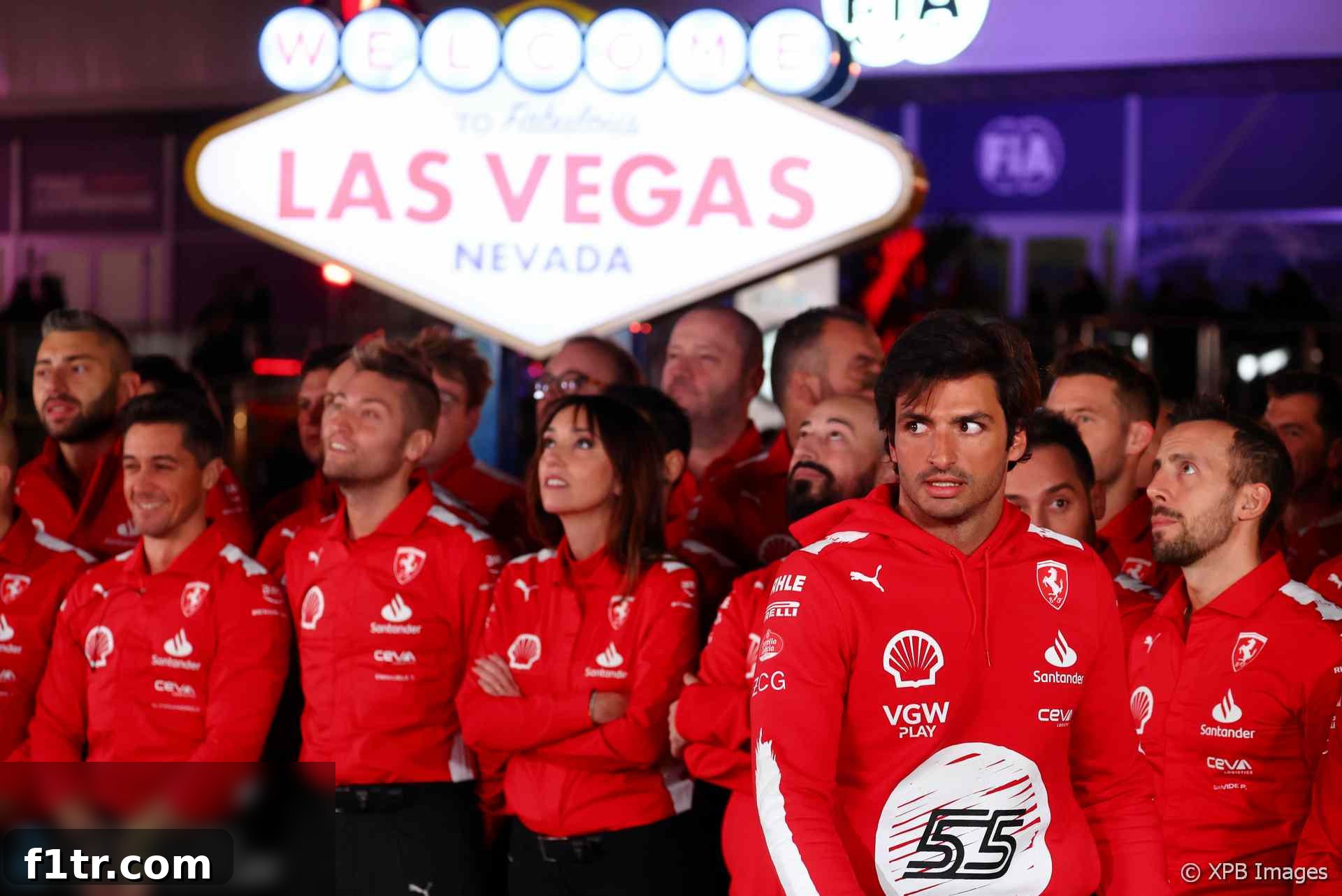
Carlos Sainz Jnr believes the second edition of Formula 1’s Las Vegas Grand Prix marked a significant improvement, attributing its success to a more understated approach from the series. The Ferrari driver noted that the event, held last weekend, represented a clear “step forwards compared to last year,” suggesting that F1 learned valuable lessons from its inaugural outing.
Advert | Become a Supporter & go ad-free
Formula 1’s Evolved Approach to the Las Vegas Spectacle
Formula One Management (FOM) took an unprecedented step in promoting the Las Vegas Grand Prix, directly investing in the event by purchasing land to construct the pit and paddock facilities. This proactive involvement marked a departure from traditional F1 race promotion models, underscoring the strategic importance of the Las Vegas event to the sport’s expansion, particularly within the lucrative North American market.
However, the highly anticipated inaugural race last year faced criticism for what many perceived as an over-the-top promotional effort. There were concerns about the intense demands placed upon drivers and teams, who were expected to participate extensively in pre-race spectacles and promotional activities, often overshadowing the core racing product itself. This focus on “Vegas style” entertainment, rather than pure motorsport, was a point of contention among some fans and participants.
Sainz articulated this sentiment, explaining that F1’s approach in its second year felt more balanced and authentic. “I feel like last year F1, if anything, was trying a bit too hard to put on too much of a show,” he commented. “It got a bit too much away from Formula 1 and too much into the Vegas style. I feel like this year we’ve just been more normal doing our own thing and it’s been a success. It just shows the Formula 1 product works and you don’t need to try too hard.” His observation highlights a crucial insight: the inherent thrill and competitive drama of Formula 1 are powerful enough to captivate audiences without excessive external embellishment.
Navigating the Unyielding Schedule: Timing and Logistics Challenges
Despite the overall positive reception of the event’s second iteration, one element continues to draw significant criticism: the unusually late race schedule. The Las Vegas Grand Prix once again started at 10 pm local time, a timing decision designed to maximize viewership across various global time zones and capture the iconic illuminated cityscape at night. While visually spectacular, this late start presents substantial challenges for everyone working within the paddock.
Sainz was vocal about the need for adjustment, stating, “I’d bring the race a couple hours earlier if I could. I think it would help everyone in the paddock, everyone that does the job in this sport, I think, would put everyone in a healthier, better mood through the weekend.” The late hours disrupt natural sleep cycles, impacting the physical and mental well-being of drivers, engineers, mechanics, and support staff who operate under already demanding conditions throughout the F1 season. A healthier work environment, as Sainz suggests, could significantly enhance performance and morale.
Compounding the challenge, the Las Vegas Grand Prix was strategically placed back-to-back with the Qatar Grand Prix on the F1 calendar. This scheduling choice meant that teams and drivers had to endure an arduous 11-hour time zone change within a matter of days. The immediate transition from the Middle East to the American West Coast is logistically complex and physically draining, forcing individuals to rapidly adjust their body clocks, often leading to severe jet lag and fatigue. This grueling travel itinerary adds immense pressure to an already intensive sport.
“So a couple of hours earlier race timings and not a back-to-back with Qatar, that’s what I would ask everyone as the next step,” Sainz concluded, offering concrete suggestions for improvement. Beyond these two critical adjustments, he expressed satisfaction with the circuit itself, praising its characteristics. “For the rest, it’s a great circuit to put on a good race, great for overtaking, a challenging track. I wouldn’t change anything, just those two details and I think everything will be better.” His remarks underscore the potential of the Las Vegas Street Circuit as a racing venue, provided the logistical and human-factor elements are better managed.
Advert | Become a RaceFans supporter andgo ad-free
Diverse Driver Perspectives: Acknowledging Success Amidst Strain
Sainz’s sentiments regarding the demanding schedule were echoed by other prominent drivers. Race winner George Russell of Mercedes acknowledged the significant impact on personnel, agreeing that the race timing is “not great timing at all for the people who are here in the moment.” Russell, however, offered a broader perspective, balancing the operational difficulties for the relatively small number of F1 personnel against the vast global audience. “But we’re 20 drivers, let’s say 4,000 people who do all the F1 races collectively, and there’s tens of millions of people who watch at home.” This highlights the commercial imperative behind scheduling decisions, which often prioritize fan engagement and broadcast windows over the comfort of those on the ground.
Russell further emphasized the particular strain of the back-to-back schedule. “I’d probably say having it back-to-back with Qatar is the biggest challenge. If we have a week off afterwards, I’d say that’s probably the only thing realistically that would help.” His suggestion for a buffer week post-Vegas reflects a pragmatic approach to mitigating the effects of intense travel and time zone shifts, offering teams and individuals much-needed recovery time before the next event.
Lewis Hamilton, a seven-time world champion and Russell’s teammate at Mercedes, also concurred on the taxing nature of the schedule, describing it as “massively challenging for everyone.” Despite these operational hurdles, Hamilton was effusive in his praise for the event itself, celebrating its on-track action and overall atmosphere. “The actual race is absolutely fantastic. It’s such a great event. They’ve really, really done a mega job this year so I can’t wait to come back.” Hamilton’s enthusiastic endorsement underscores the spectacle and entertainment value that the Las Vegas Grand Prix has managed to deliver, despite its logistical complexities. It illustrates the delicate balance F1 must strike between creating an incredible show and ensuring the well-being of its participants.
The collective feedback from these top drivers paints a nuanced picture of the Las Vegas Grand Prix. While acknowledging the inherent success and excitement generated by the event, there’s a clear call for refining the operational aspects, particularly the race timing and calendar placement. The consensus suggests that with minor but significant adjustments, the Las Vegas Grand Prix could truly solidify its place as a premier event on the Formula 1 calendar, one that delivers both exceptional racing and a sustainable environment for its dedicated personnel.
Advert | Become a RaceFans supporter andgo ad-free
Miss nothing from RaceFans
Get a daily email with all our latest stories – and nothing else. No marketing, no ads. Sign up here:
2024 Las Vegas Grand Prix
- “Disappointing” Las Vegas GP performance prompts ticketing changes for 2025 race
- Vowles clarifies Colapinto’s claim he was concussed in Las Vegas crash
- Norris lost title because McLaren weren’t competitive enough early on – Stella
- Ferrari are now in their longest-ever championship drought
- F1 “was trying too hard” in first year at Las Vegas – Sainz
Browse all 2024 Las Vegas Grand Prix articles