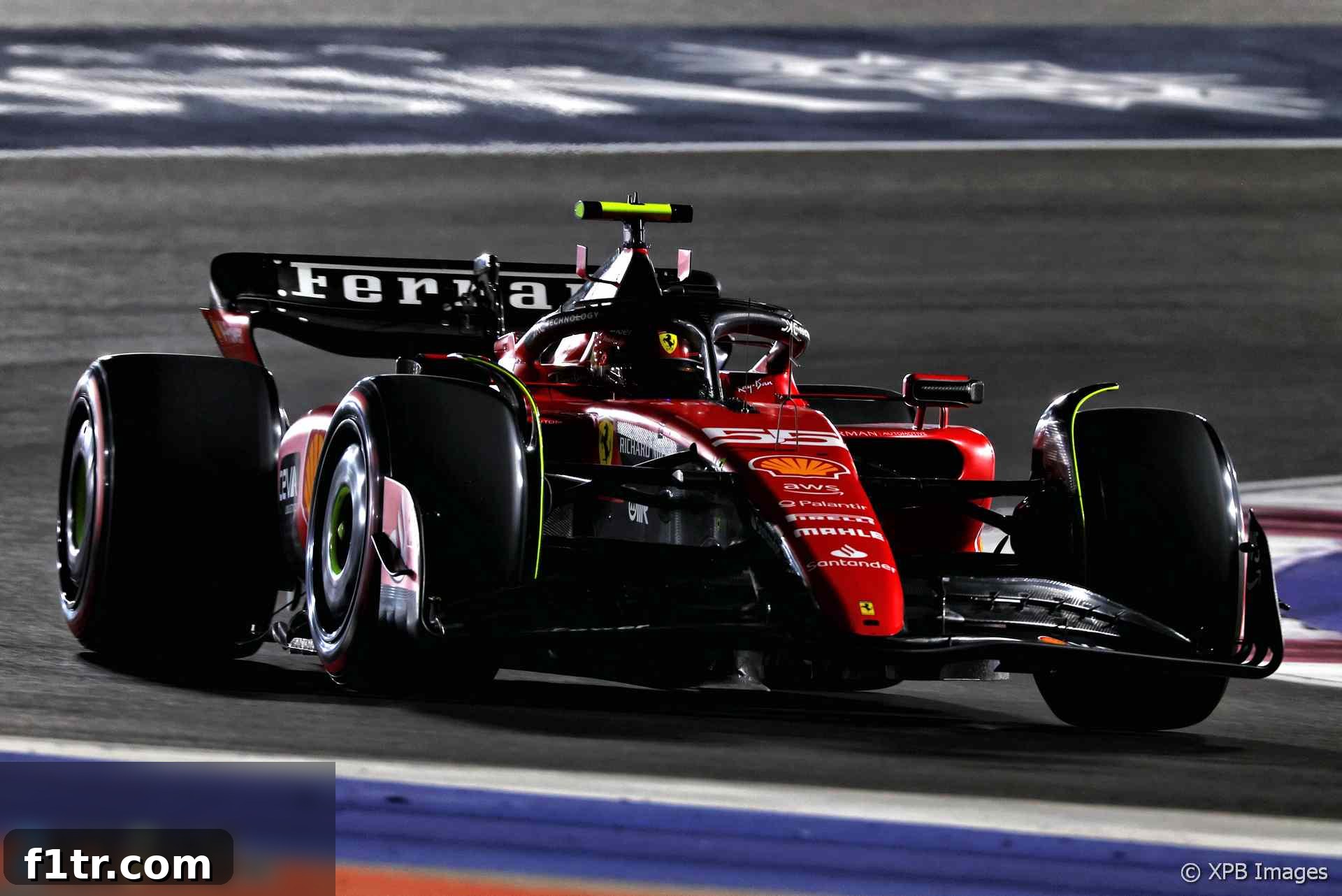
The intense scrutiny of driver conduct during Formula 1 qualifying sessions once again took center stage at the Qatar Grand Prix, as Carlos Sainz Jnr found himself facing the race stewards. The Ferrari driver received a formal warning, the mildest sanction possible, following an incident during Q2 that saw him accused of driving in an “erratic” manner while attempting to manage traffic and prevent a rival from overtaking. This ruling underscored the delicate balance drivers must strike between adhering to regulations and maximizing their performance in the crucial qualifying stages.
Meanwhile, in a separate but equally significant investigation, four other prominent drivers, including seven-time world champion Lewis Hamilton, avoided grid penalties. They were investigated for driving too slowly between the Safety Car lines, a common point of contention in modern F1 qualifying. After a thorough review, the quartet, which also included Oscar Piastri and AlphaTauri team mates Yuki Tsunoda and Liam Lawson, were ultimately cleared, highlighting the complex circumstances drivers face when preparing for flying laps on a congested circuit.
Advert | Become a Supporter & go ad-free
Carlos Sainz Jnr’s Warning: Navigating the Fine Line
The incident involving Carlos Sainz and reigning world champion Max Verstappen unfolded during the frenetic Q2 session. Sainz had just completed a flying lap, while Verstappen was emerging from the pit lane, beginning his out-lap. As is often the case in qualifying, drivers meticulously manage their positioning and speed to create sufficient gaps for subsequent flying laps, all while adhering to the maximum lap time delta between designated Safety Car lines. This particular rule aims to prevent drivers from driving excessively slowly and impeding others, a crucial safety measure in high-speed environments.
Sainz’s explanation to the stewards centered on this very regulation. He stated that he deliberately attempted to prevent Verstappen from overtaking him because he needed to maintain a specific pace to stay below the maximum lap time between the Safety Car lines. This internal delta time is a critical factor for teams and drivers, ensuring they don’t fall foul of rules designed to keep traffic flowing reasonably. However, the stewards, after reviewing comprehensive video evidence, telemetry data, and hearing from both drivers, concluded that Sainz’s efforts to keep the Red Bull behind were excessive and “unnecessary.”
Their official statement clarified the nuance: “During the hearing the driver of car 55 [Sainz] stated that he could not afford being passed by another car as he had to stay below the maximum lap time between SC lines two and one. Whilst this was accepted by the stewards as well as by the driver of car one [Verstappen], the measures taken by car 55 were deemed to be unnecessary given the fact that the incident happened in qualifying and cars are not supposed to directly race each other while preparing for flying laps.” The emphasis on qualifying etiquette – where direct racing is generally avoided on out-laps – played a key role in their decision. The stewards ultimately determined that a formal warning was the appropriate sanction, considering all the circumstances. A warning is the mildest form of penalty in Formula 1 and does not accumulate towards potential grid penalties or super licence points, unlike reprimands. This ensures Sainz’s qualifying result remained unaffected, though the incident serves as a clear reminder of the stringent expectations placed upon drivers regarding their on-track conduct.
Advert | Become a RaceFans supporter andgo ad-free
Slow Driving Investigations: A Matter of Intent and Impeding
The second major incident cluster involved four drivers – Lewis Hamilton, Oscar Piastri, Yuki Tsunoda, and Liam Lawson – all summoned for allegedly exceeding the maximum time between the two Safety Car lines. This rule is particularly challenging for drivers in qualifying, as they often need to slow down significantly to create a large enough gap to the car ahead before starting their own flying laps. The stewards investigated a total of six incidents, with both Hamilton and Tsunoda each exceeding the time limit twice.
The complexity of these investigations often lies in distinguishing between deliberately impeding other drivers by driving too slowly, and strategically slowing down to manage traffic without causing obstruction. The stewards noted that while five of the six incidents could be clearly assessed from video evidence, one involving Lewis Hamilton required a more detailed explanation, leading to him being the only one of the four drivers specifically summoned to clarify his actions. This highlights the importance of driver testimony in nuanced situations where video alone might not provide the full picture of intent and awareness.
In all six cases, the stewards’ verdict was consistent and favorable to the drivers. They ruled that “the drivers took appropriate actions to not impede other drivers, and in all cases they slowed down significantly to allow other drivers to pass while giving those drivers a clear track.” This crucial finding indicated that while the drivers were indeed slow, their actions were primarily aimed at creating space and not at hindering their competitors. Consequently, the stewards concluded that these drivers did not drive “unnecessarily slowly,” and their reasons for exceeding the maximum delta time were justifiable given their appropriate actions on track. No further action was taken against any of the four drivers, allowing them to retain their qualifying positions.
A Continuous Monitoring: The Balance of Rules and Reality
Despite clearing the drivers in the slow driving investigations, the stewards issued a significant reminder, acknowledging the ongoing challenges associated with managing track traffic in qualifying. They observed that in most of the incidents, the behavior of other cars – specifically drivers trying to create gaps at the end of their laps – directly influenced those trying to maintain their delta time. This creates a ripple effect where one driver’s attempt to gain clear air can force another to slow down more than intended, pushing them over the maximum delta time.
The stewards’ concluding statement on this matter served as a caution: “The drivers are reminded once again that no car may be driven unnecessarily slowly and the Stewards will continue to monitor the issue closely.” This underscores the dynamic nature of Formula 1 regulations and their interpretation. While drivers were exonerated in this instance due to their demonstrable efforts to avoid impeding, the message is clear: the onus remains on them to navigate these complex scenarios responsibly. The sport’s governing body is keen to maintain high safety standards and ensure fair play, particularly in the high-stakes environment of qualifying, where every millisecond and every track position counts. These incidents from the Qatar Grand Prix qualifying serve as valuable case studies for future rulings, continuously shaping the evolution of F1’s sporting regulations and driver conduct guidelines.
Advert | Become a RaceFans supporter andgo ad-free
2023 Qatar Grand Prix Related Articles
- Albon fears Qatar GP conditions risked creating dangerous “wet bulb effect”
- Alonso: New-spec fireproofs and pre-race anthem timing made Qatar heat worse
- Magnussen admits he took “too long to learn” Losail circuit
- Analysis: Sargeant’s Qatar radio reveals his painful struggle to end point-less run
- Alfa Romeo ‘finally understand their upgrade’ Bottas believes as team target Williams
Browse all 2023 Qatar Grand Prix articles