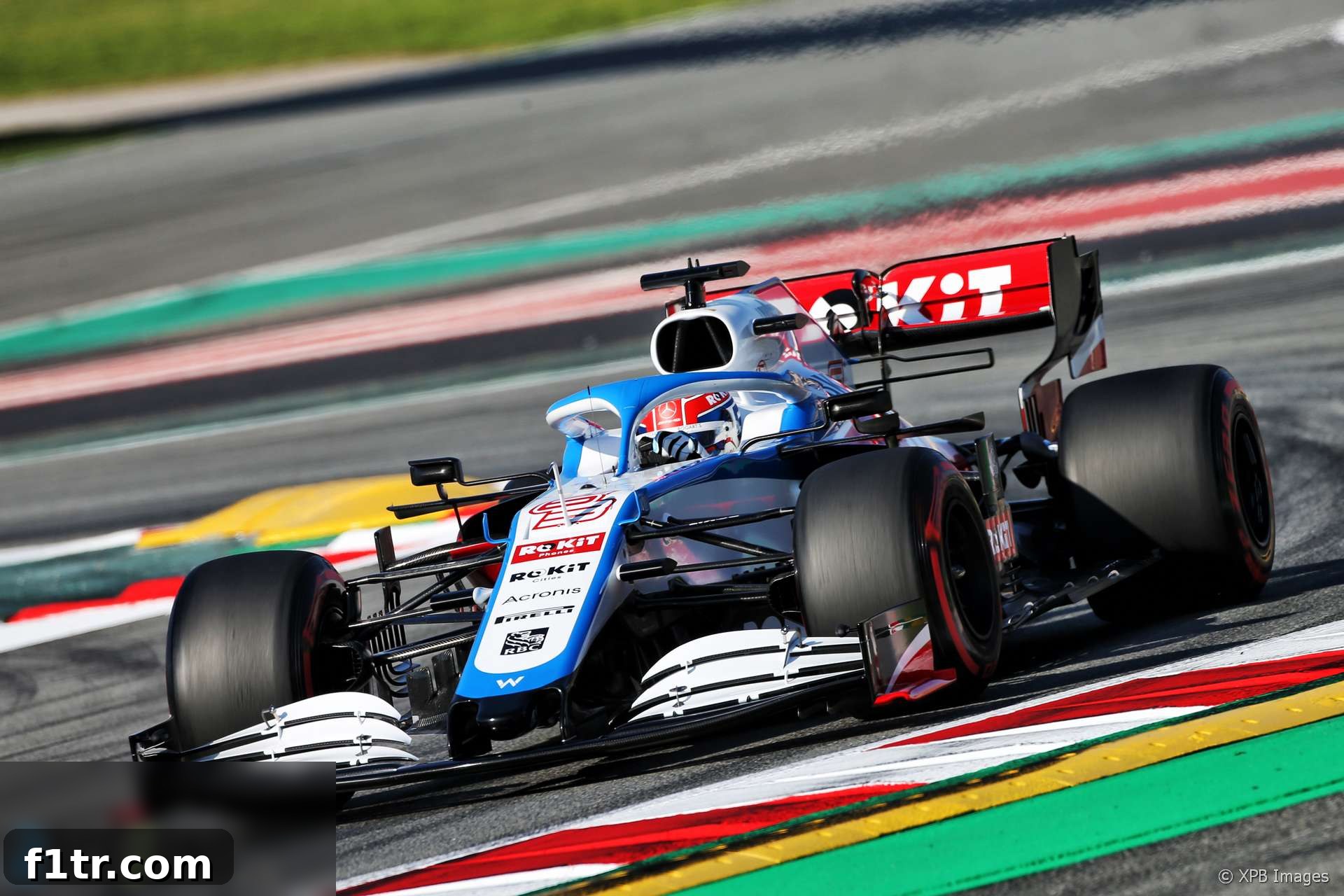
George Russell, the promising British talent, has shared his initial thoughts on Williams’ new challenger, the FW43, after its first official outing in pre-season testing. The young driver expressed significant optimism, noting a substantial improvement in the car’s driveability compared to its predecessor. This positive feedback from Russell, delivered during an FIA press conference alongside F1 stalwarts Kimi Raikkonen, Lando Norris, and Alexander Albon, offers a glimmer of hope for the Grove-based outfit after a challenging period in Formula 1.
Russell’s comments underscore a crucial psychological and engineering milestone for Williams. “Definitely the general handling of the car is much better,” Russell stated emphatically. This isn’t merely a minor tweak; it represents a fundamental shift in the car’s behavior. He elaborated on the immediate feeling of confidence, a stark contrast to the initial laps in the FW42 last year. “From lap one today I had confidence to push the car to the limit, whereas last year it wasn’t a nice feeling in the early laps. It was quite scary to drive, actually, last year, in the opening laps and trying to build that confidence. So already that’s better.” This instant connection with the car is invaluable for a driver, allowing them to extract performance sooner and provide more accurate feedback to engineers.
The Crucial Balance: Driveability vs. Outright Speed
While the improved handling and driver confidence are undoubtedly positive signs, Russell, ever the pragmatist, was quick to emphasize that a “nice car” doesn’t automatically equate to a “fast car.” In the high-stakes world of Formula 1, ultimate lap time is the only metric that truly counts. “Not always a nice car to drive is a fast car,” he wisely pointed out. “It’s a lap time-based sport. It doesn’t matter how you get around the lap as long it’s fast, that’s all that counts. So it’s been improved in that area. Now we just need to see if we’ve managed to smash enough downforce onto the car to compete with the guys around me.”
This statement highlights the perennial challenge in F1 car design: balancing stability and predictability with raw performance. A car that is easy to drive allows a driver to push harder, but if it lacks fundamental aerodynamic grip, especially downforce, it will never truly be competitive. Williams, having consistently struggled at the back of the grid, knows this all too well. The focus now shifts from simply making the car manageable to extracting the maximum aerodynamic performance needed to challenge their midfield rivals. The quest for more downforce is a never-ending battle in Formula 1, and Russell’s insight confirms that this remains a key area for the FW43’s development.
The FW43’s superiority over its predecessor is not merely an assumption but a verifiable fact, particularly when considering the catastrophic start to Williams’ 2019 season. Russell candidly admitted, “The car is definitely faster than it was this time last year, because this time last year the car was still in bits.” This stark reminder of the FW42’s late arrival – a significant setback that saw the car miss the initial days of testing – underscores the gravity of Williams’ previous predicament. The fact that the FW43 was not only present but performing competently from day one of testing is a monumental step forward, signifying a more organized and efficient off-season for the team.
A Psychological Triumph: First Out of the Pits
Beyond the technical advancements, the psychological boost for the Williams team cannot be overstated. Russell, a poignant symbol of the team’s resilience, was the very first driver to leave the pits at the start of testing. This seemingly minor detail carried immense weight for the entire organization. “We had an intense morning planned to get everything [done],” he explained. “And it was important to get out from the beginning.”
The significance of this early departure, especially in the wake of previous struggles, resonated deeply. “Also off the back of last year, I guess it was psychologically important for all of us and for everybody who’s worked day and night back at the factory to see their car go out first,” Russell reflected. The memory of the FW42’s protracted build and late debut still lingers, highlighting the tremendous pressure and demanding hours endured by the 700-plus dedicated individuals at the Grove factory. “From the struggles of last year it was incredibly tough time for the 700-odd people back at Grove last year when they’re working absolutely flat out to try and make things ready and work in double time. So now it’s sort of a relief for all and now we can just get cracking on our test programme.” This moment of relief and collective pride is a powerful motivator, signaling a fresh start and renewed sense of purpose for one of Formula 1’s most historic teams.
The improved build quality of the FW43 is another testament to Williams’ concerted efforts to rectify past issues. The FW42, which barely made it to the third day of testing in 2019, was widely criticized for its rushed construction and inherent flaws. Russell confirmed that the new car represents a significant leap forward in this regard. “The build quality of the car is so much better standard than last year,” he asserted. “Things fit properly, the car looks better from a design perspective. So I think overall it’s been a very positive morning.” This attention to detail in manufacturing not only improves reliability but also streamlines the assembly process, allowing engineers and mechanics to focus on performance optimization rather than resolving basic fitment issues.
Pre-Season Testing: The Foundation for Success
Pre-season testing is a critical period for all Formula 1 teams, but for a team like Williams, aiming to climb out of the Constructors’ Championship cellar, its importance is amplified. It’s not just about setting quick lap times; it’s about systematically evaluating every aspect of the new car. Teams utilize these precious days to validate aerodynamic models, test new components, understand tire degradation, optimize car setups for different tracks, and most importantly, ensure bulletproof reliability. Russell’s extensive 73 laps in the morning session represent valuable data acquisition, feeding crucial information back to the engineers at the factory.
The comprehensive test program that Williams has planned for the FW43 over the two weeks of testing will be vital. It allows the team to correlate real-world performance with simulations, identify any unforeseen issues, and fine-tune the car’s balance before the first race of the season. For Russell, this means putting the car through its paces in various conditions, simulating race stints, qualifying runs, and testing different fuel loads and tire compounds. The confidence he already feels in the car will enable him to push harder and provide more nuanced feedback, accelerating the team’s understanding of the FW43’s full potential.
Looking Ahead: The Road to Melbourne and Beyond
Despite the encouraging initial feedback and the tangible improvements, George Russell maintains a grounded perspective on the road ahead. He understands that while the car’s timely completion and superior build quality are significant victories, they are merely prerequisites for competitive performance. “But nevertheless, like I said before, come the end of the week and going into Melbourne it doesn’t matter if the car’s here on time or in one piece, it all depends on my lap times and we just need to focus on our program and just get the most out of these two weeks.”
This pragmatic outlook is essential for a team aiming for recovery. The focus must remain squarely on performance data, lap times, and extracting every last tenth of a second from the FW43. The two weeks of testing provide an invaluable opportunity for Williams to hone their package, and Russell, alongside his new teammate Nicholas Latifi, will be instrumental in this process. Latifi, who took over driving duties from Russell in the afternoon session, will also contribute to the vital data gathering, offering a different perspective and helping to accelerate the team’s learning curve.
The journey for Williams will undoubtedly be challenging, but the early signs from Barcelona testing offer a renewed sense of purpose and cautious optimism. The FW43, with its improved handling, enhanced build quality, and the team’s revitalized morale, represents a significant step forward. While the ultimate measure of success will be determined by lap times and championship points, George Russell’s initial assessment suggests that Williams has, at the very least, laid a much stronger foundation upon which to build their future.