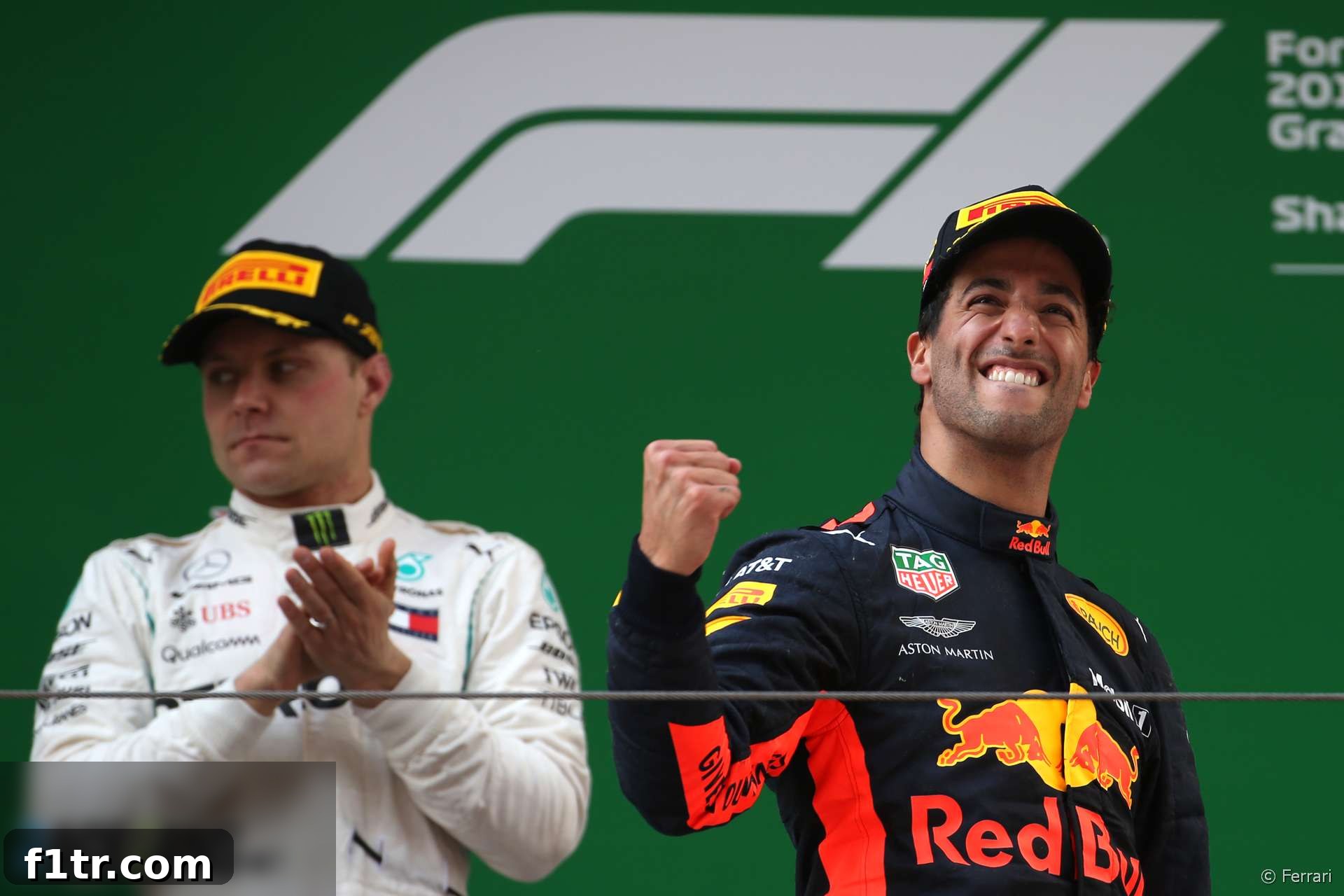
In a thrilling spectacle that defied early predictions, Daniel Ricciardo clinched a remarkable victory at the Shanghai International Circuit, navigating a Chinese Grand Prix described as a “race of two halves.” This pivotal win came at the expense of the driver many speculate he might replace at Mercedes in the upcoming season, marking a significant moment in the unfolding 2018 Formula 1 championship.
The initial phase of the race mirrored the established pattern of the 2018 season: the leading cars swiftly pulled away, meticulously managing their gaps and engaging in a tense strategic standoff. This involved a delicate game of “tire chicken,” where teams pushed their stints to the absolute limit, waiting for the opportune moment to pit and gain the crucial advantage of fresh rubber. This tactical chess match characterized the calculated, high-stakes nature of modern Formula 1.
However, the latter half of the Grand Prix dramatically shifted gears, transforming into a chaotic and electrifying chase reminiscent of an IndyCar event. A Safety Car deployment, prompted by unforeseen debris on the track, completely upended the carefully orchestrated strategies of the front-runners, setting the stage for an unforgettable sprint to the checkered flag.
Bottas’s Early Brilliance and Ferrari’s Pit Lane Misfortune
The first segment of the race was masterfully executed by Mercedes and Valtteri Bottas. Flying somewhat under Ferrari’s radar, Bottas executed a stunning maneuver to seize the lead from Sebastian Vettel. While swift pit stop execution played a role, it was Bottas’s exceptional sector times that truly set him apart and made the crucial difference.
Bottas’s early success was also aided by his astute positioning at the start, managing to split the two Ferraris. Here, Vettel inadvertently contributed to his own temporary setback. His teammate, Kimi Raikkonen, had a marginally better launch from the grid than the pole-sitter Vettel. In an attempt to discourage Raikkonen from capitalizing on this advantage, Vettel edged right, inadvertently creating a clear path for Bottas on the outside. This small defensive move had significant repercussions for the race’s early dynamics.
Ferrari’s strategy subsequently drew scrutiny, particularly their decision to keep Raikkonen out on track for an extended period. This allowed the faster, fresh-tired Bottas and Vettel to close in on him. If the intention behind this extended stint was for Raikkonen to act as a defensive barrier against Bottas to aid Vettel, the execution was flawed. Raikkonen afforded Bottas ample space on the outside of Turn One, allowing the Mercedes driver to complete a clean and decisive overtake. This moment starkly contrasted with the ruthless defending demonstrated later in the race by Fernando Alonso against Vettel at precisely the same point on the track, highlighting the varying approaches to racecraft.
Bottas’s lead was not only secured with superb driving but also sustained through Ferrari’s strategic machinations. With minimal disparities in tire life between him and Vettel, all indicators strongly pointed towards a potential victory for the Mercedes driver. His performance was meticulously crafted and seemingly unassailable. Tragically for Bottas, his meticulously executed afternoon was destined to be overshadowed, through no fault of his own, by the driver widely tipped to inherit his seat in the 2019 season.
Red Bull’s Audacious Strategy and the Safety Car Catalyst
Just as Ferrari had benefited from a fortuitous Virtual Safety Car in Australia, triggered by one of their engine customers, it was Red Bull’s turn to capitalize on a stroke of luck in China. This came courtesy of their junior team, Toro Rosso, leading some playfully to suggest Mercedes might need a word with their own engine customers, Force India or Williams, about timing future incidents.
The contact between the two Toro Rosso drivers, Pierre Gasly and Brendon Hartley, which necessitated the Safety Car period, was undeniably unintentional. Gasly, instead of being waved past Hartley, tragically drove into his teammate, causing debris that brought out the safety car. “I think on TV it looks really bad for myself,” Gasly candidly admitted later, highlighting the mortification of the incident.
The risks involved in the pit lane, in pursuit of ever-faster tire changes, had been a significant topic of discussion prior to this race, particularly in the wake of Ferrari mechanic Francesco Cigliani’s injury during the Bahrain Grand Prix. McLaren had further intensified this debate by committing an ‘unsafe release’ violation during practice just days before.
However, during the Chinese Grand Prix, Red Bull delivered a masterclass in efficient pit lane operations. They successfully double-stacked both their drivers on the same lap, twice, within mere seconds of each other. The second instance proved absolutely crucial, positioning them perfectly to exploit the sudden appearance of the Safety Car. This decisive action exemplified Red Bull’s strategic prowess and rapid decision-making under pressure.
Bottas and Vettel had already bypassed the pit lane entry by the time the Safety Car was deployed, a fact that understandably irked Vettel greatly. Max Verstappen, running in third, was instructed to pit as he accelerated out of Turn 14, just making it into the pit lane. Lewis Hamilton, following closely, made the surprising decision to remain on track. Christian Horner, Red Bull’s team principal, later expressed his surprise: “I was surprised they didn’t pit Hamilton. I don’t know whether they told him to do the opposite to Max or not to maybe get the track position. But I was surprised he didn’t follow.”
Mercedes, for their part, maintained that their calculations indicated their cars on older tires would still be too quick for Red Bull’s cars on fresh rubber to successfully overtake. Given the significant performance advantage Bottas had already demonstrated with new tires to seize the lead earlier, this conclusion appeared counter-intuitive. Vettel, expressing his frustration, stated he would have certainly pitted had the opportunity arisen.
This situation perfectly encapsulates the classic dilemma teams face during Safety Car periods when they are confident of reaching the race’s end but are anticipating marginal tire performance. A similar scenario unfolded in the IndyCar race at Phoenix just a week prior. In that instance, race leader Josef Newgarden opted for new tires and successfully overtook those who remained out on older compounds, though he only regained his lead with a handful of laps remaining. It’s a calculation fraught with uncertainty, lacking a definitively correct answer, with a substantial portion of the outcome resting on the individual skill of the driver executing the overtakes. Fortunately for Red Bull, they possessed such a driver in Daniel Ricciardo, though as the race resumed, he was still trailing behind his teammate, Max Verstappen.
Ricciardo’s Dazzling Drive Denies Bottas a Deserved Victory
Red Bull’s strategic brilliance following the Safety Car period should have, by all rights, culminated in a dominant one-two finish, with Max Verstappen leading the charge. However, Verstappen squandered his golden opportunity by attempting an overly ambitious overtake on Lewis Hamilton around the outside of Turn Seven, a move that proved costly.
Ricciardo, who was closely shadowing the pair, observed the unfolding drama with a keen eye. “I could see it coming a few corners before,” he recounted later, noting Verstappen’s proximity to Hamilton exiting Turn Three. “I saw he was trying on the outside of [Turn] seven and I could see them both drift wide and I could see that one car was probably not going to make it.”
Hamilton and Verstappen had previously clashed in Bahrain, and their rivalry continued to simmer. This time, the speeds were considerably higher, and Hamilton held the crucial inside line. He barely needed to deviate from his racing line to make life exceedingly difficult for Verstappen. Carrying too much speed into the corner, the Red Bull driver ran out of track, forcing him wide and losing valuable positions.
“When Max went off track I wasn’t sure if he was going to slide back across, hold the line, so that was quite tricky initially,” Ricciardo explained. “But then I could see he was coming on with quite a bit of speed so then it was quite easy in my mind to cut across the inside to let him go.” This calculated decision allowed Ricciardo to bypass his teammate’s error and maintain his momentum.
With fresh tires and a clear track ahead, Ricciardo then embarked on a breathtaking charge, systematically dismantling Mercedes’s calculations about tire performance. He expertly passed both Hamilton and Bottas, along with Vettel in between them, in a series of audacious and perfectly executed overtakes. Just days before the race, Ricciardo had openly criticized Bottas’s perceived hesitation to challenge Vettel for the win in Bahrain, stating he “wouldn’t be content” to merely sit behind, especially “if it was for a win.” He delivered on his promise, bravely diving for the inside line at Turn Seven and holding his ground even as Bottas subtly attempted to squeeze him. This demonstrated not only his exceptional car control but also his unyielding desire to win, cementing his reputation as one of F1’s most exciting and opportunistic drivers.
Mercedes’s Winless Streak and the Intensifying Championship Battle
Max Verstappen’s day went from bad to worse after his earlier mishap, culminating in a blunder when he collided with Sebastian Vettel, earning himself a penalty. The contact caused significant damage to the Ferrari, forcing Vettel to limp home in eighth position. This incident had profound implications for the championship standings, significantly tightening the title race: the top five drivers were now separated by less than a single race victory, from championship leader Vettel down to the triumphant Ricciardo.
Daniel Ricciardo, meanwhile, basked in the glory of an astonishing reversal of fortunes. Just 24 hours prior, a power unit problem during qualifying had almost prevented him from even starting the race from a competitive position. “We really thought we were going to start the race at the back,” he confessed, highlighting the dramatic turnaround.
Reflecting on the unpredictable nature of Formula 1, Ricciardo shared his candid emotions: “This sport’s crazy. A week ago I was with my head down after two laps on Sunday. Frustrated at the sport, frustrated at all the variables that are involved in the sport. Sometimes I question why I chose this sport because there’s so many other things out of your control and it does get you down a lot. But then when you have a day like this it’s worth fifty of those bad ones.” His words perfectly captured the emotional rollercoaster inherent in top-tier motorsport.
While Mercedes had enjoyed an unparalleled run of dominance in the preceding four seasons, three races into the 2018 campaign, they were yet to secure a victory. This represented an unprecedented development in the V6 hybrid turbo era, sending a clear signal that the season ahead would be fiercely competitive and unpredictable.
In each of the three races so far, Mercedes acknowledged they possessed the raw potential to win. A critical miscalculation hampered their efforts in Australia. In Bahrain, Lewis Hamilton’s gearbox change penalty compromised their race strategy. And in China, an unfortunately timed Safety Car period proved to be their undoing, denying Valtteri Bottas a well-deserved win.
However, beyond these individual race incidents, it became increasingly apparent that Mercedes was grappling with deeper challenges. Their struggles with the 2018-specification Pirelli tires, coupled with Ferrari’s undeniable step forward in power unit performance, indicated a team under pressure like never before in the current era of Formula 1. The Chinese Grand Prix served as a powerful reminder that the battle for the championship was wide open, promising a captivating season for fans worldwide.
2018 Chinese Grand Prix Coverage
- Top ten pictures from the 2018 Chinese Grand Prix
- Ricciardo denies Bottas a badly-needed win
- 2018 Chinese Grand Prix Star Performers
- Hamilton breaks Raikkonen’s record for consecutive points finishes
- Paddock Diary: Chinese Grand Prix day four
Browse all 2018 Chinese Grand Prix articles
F1 Race Reviews & Analysis
- Antonelli lucks in for second win and becomes youngest F1 championship leader
- Emotional Antonelli grabs first Formula 1 victory in Chinese Grand Prix
- Russell sees off Ferrari threat to lead Mercedes one-two in Melbourne
- Norris clinches F1 title by two points as Verstappen wins finale at Yas Marina
- McLaren strategy blunder in Losail hands Verstappen crucial win and shot at title
Read all F1 race reviews