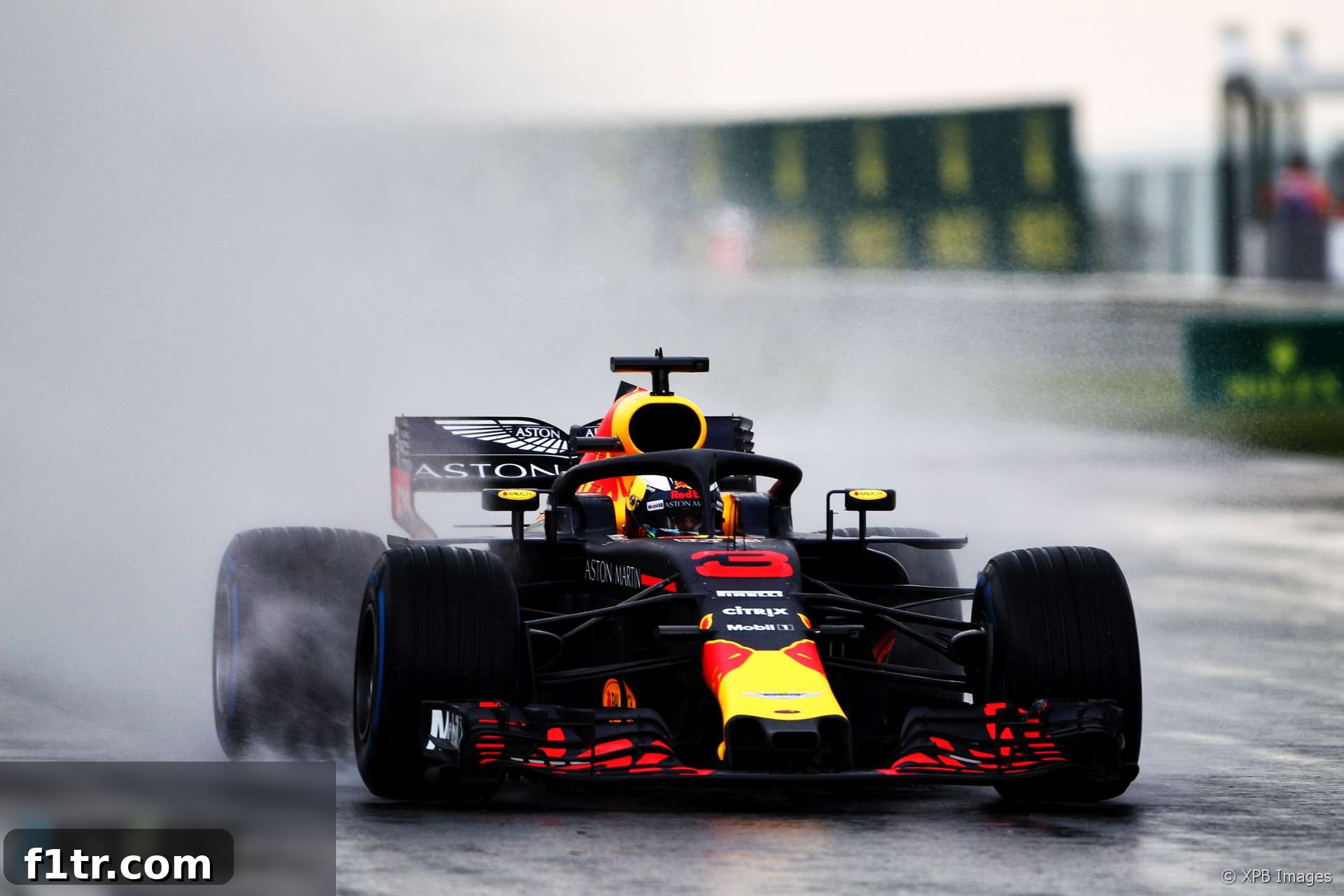
The usually formidable Formula 1 team, Red Bull Racing, found themselves in an uncharacteristic predicament during a rain-soaked qualifying session at the tight and twisty Hungaroring circuit. Both star drivers, Max Verstappen and Daniel Ricciardo, expressed profound surprise and disappointment with the lacklustre performance of their challenger, the RB14, under conditions where they typically thrive. This unexpected struggle left the team and their fans bewildered, as the squad anticipated a strong showing in the adverse weather, only to conclude the crucial Saturday session with results far below their championship aspirations.
Red Bull’s Unexpected Struggle in Wet Hungarian Qualifying
Heading into the qualifying session for the Formula 1 Hungarian Grand Prix, the paddock consensus, and indeed Red Bull’s internal expectations, pointed towards a strong performance from the Milton Keynes outfit. Red Bull cars have historically demonstrated superior chassis dynamics, often excelling on tracks with numerous slow-to-medium speed corners, a characteristic synonymous with the Hungaroring. Furthermore, their prowess in wet conditions is well-documented; the agile RB14, with its high-downforce setup, was widely expected to come alive when rain began to lash down on the circuit. However, Saturday’s qualifying unfolded into a surprising narrative of struggle rather than triumph. Despite the track conditions theoretically playing to their strengths, Max Verstappen could only manage a distant seventh place on the grid, while his teammate Daniel Ricciardo faced an even more disheartening outcome, being eliminated in Q2 and starting from an uncharacteristic twelfth position. This stark contrast between expectation and reality immediately raised questions about the team’s understanding of their car’s behaviour in the tricky, rain-affected environment.
Max Verstappen’s Battle with Grip: “Like Driving on Eggs”
For Max Verstappen, a driver renowned for his exceptional car control and ability to exploit challenging conditions, the qualifying session was an exercise in frustration. Speaking to the media post-session, a visibly perplexed Verstappen admitted he was at a loss to explain the profound performance deficit. He recounted being an astonishing 2.3 seconds slower than Lewis Hamilton’s pole position time, a margin that felt insurmountable given the typical competitive gaps in Formula 1. Verstappen’s primary complaint centered around a severe lack of grip, a fundamental requirement for speed in wet racing. He elaborated, stating, “The car was just not having a lot of grip. Especially on the [full wet] tyres we were really struggling. But even on the intermediates it was not fantastic. I don’t know why otherwise we would have changed it.” This pointed directly to a fundamental issue with how the car was interacting with the wet asphalt, irrespective of the specific rain tyre compound.
Understanding the Grip Deficit
Verstappen’s vivid description of the RB14’s handling painted a stark picture of a car operating far outside its optimal window. He described the car as “just sliding around, no grip, locking” at corner entry, continuing with “mid-corner: no grip, no traction” as he attempted to navigate the turns. The Dutchman’s memorable analogy, “Like driving on eggs,” perfectly encapsulated the precarious and unpredictable nature of the car’s behaviour. This indicated a fundamental instability across all phases of cornering, from initial turn-in to apex and subsequent acceleration. In Formula 1, generating tyre temperature and maintaining it is crucial for grip, especially in the wet. The inability to get the full wet tyres, designed for heavy rain, or even the intermediate tyres, designed for damp conditions, into their working window would lead to such a dramatic loss of performance. The Red Bull chassis, usually celebrated for its mechanical grip, seemed unable to unlock the potential of the Pirelli tyres on this particular day, raising serious questions for the engineering team.
Daniel Ricciardo’s Unfortunate Q2 Exit and Team Disappointment
Daniel Ricciardo’s qualifying session was marred by both external circumstances and the same fundamental performance issues plaguing his teammate. The Australian driver found himself eliminated in Q2, a rare occurrence for the popular driver and a testament to the difficult conditions. His fastest lap attempt, which could have seen him progress into Q3, was cruelly interrupted by yellow flags deployed after Lance Stroll spun off track. “Having to abort a lap due to yellow flags caused by Lance Stroll” in such rapidly evolving wet conditions is a huge blow, as track conditions can improve or worsen within seconds, making every clear lap crucial. This incident undoubtedly played a role in his eventual P12 starting position, but Ricciardo was quick to acknowledge that even without the yellow flag, the inherent pace simply wasn’t there. He confessed, echoing Verstappen’s sentiments, “It just felt like we didn’t have as much grip. Why, we’re not sure. Normally the car is really strong in the wet.” This reiterated the puzzling nature of their struggles, as the RB14 usually shines in these conditions.
Team Expectations Versus Reality
The collective disappointment within the Red Bull garage was palpable. Ricciardo’s comments highlighted the stark contrast between the team’s pre-session confidence and the harsh reality of the results. “Obviously me going in Q2 was a big disappointment,” he stated, adding a layer of introspection, “I don’t know if that was a bigger disappointment or Max [being] seventh in Q3 in the wet.” This sentiment underscored the deep-seated belief that Red Bull had a genuine chance at securing a front-row start, or even pole position, once the rain began to fall. The team had strategically approached the weekend with an eye on the potential for wet weather, hoping to leverage their car’s intrinsic advantages. “I’m sure everyone was thinking ‘one car’s out, maybe one car can get pole’. It seemed like we kind of wanted the wet but it didn’t happen,” Ricciardo revealed, capturing the collective aspirations that were shattered on a gloomy Saturday afternoon. This dramatic underperformance forced the engineering team to embark on an immediate and intense analysis to understand the root cause of their unexpected lack of pace.
Analyzing the Unforeseen Performance Deficit
The reasons behind Red Bull’s unusual struggles in the wet at the Hungaroring are undoubtedly complex, but both drivers’ comments point predominantly towards a critical tyre issue. In Formula 1, tyre temperature management is paramount, even more so in wet conditions where cold tyres offer minimal grip. It’s plausible that the specific conditions at the Hungaroring – perhaps a particular track surface temperature or rainfall intensity – prevented the Red Bull cars from generating and maintaining optimal operating temperatures in their Pirelli wet or intermediate tyres. This could manifest as the sensation of “driving on eggs” described by Verstappen, where the tyres are simply not biting into the tarmac. Alternatively, a suboptimal car setup, possibly biased towards anticipated dry conditions or misjudging the balance needed for the wet, could have exacerbated the problem. Even the most aerodynamically efficient car will struggle if its tyres aren’t functioning correctly, turning its advanced downforce into a liability rather than an advantage. For a team that prides itself on its strategic acumen and technical precision, this qualifying session served as a humbling reminder of the unpredictable variables that can influence Formula 1 performance, especially in changing weather.
Looking Ahead: The Road to Recovery for Red Bull
The disappointing qualifying results set up a challenging Sunday for Red Bull Racing at the Hungarian Grand Prix. Starting from seventh and twelfth positions on a track notorious for its difficulty in overtaking means both Max Verstappen and Daniel Ricciardo will need to employ aggressive strategies and execute flawless races to salvage valuable championship points. The immediate priority for the team will be a thorough debrief and technical analysis to precisely identify why their car underperformed so dramatically in the wet. Understanding whether it was a fundamental car characteristic, a specific setup choice, or a tyre interaction issue will be critical not only for the race but also for future wet weather scenarios throughout the season. Despite the setback, Red Bull has often demonstrated a remarkable ability to rebound. Their strategic prowess and the sheer talent of their drivers mean that while pole position might have been out of reach, a spirited charge through the field remains a distinct possibility, turning a surprising Saturday into an opportunity for a memorable Sunday recovery.
2018 F1 season
- F1 feared “death knell” for Drive to Survive after Ferrari and Mercedes snub
- McLaren staff told us we were “totally crazy” to take Honda engines in 2018 – Tost
- ‘It doesn’t matter if we start last’: How Red Bull’s junior team aided Honda’s leap forward
- Honda’s jet division helped F1 engineers solve power unit problem
- McLaren Racing losses rise after Honda split
Browse all 2018 F1 season articles