In the evolving landscape of Formula 1, the sprint race format has continually sought to balance thrilling Saturday action with maintaining the suspense for Sunday’s main event. Initially, a valid criticism of the still-young sprint race format was its tendency to inadvertently diminish the mystery and intrigue surrounding the Grand Prix. When Saturday’s 100km sprint dictated the grid for Sunday, it often felt like the first segment of a longer, two-part race. This structure gave teams, drivers, and fans a premature understanding of race pace, tyre degradation, and potential strategies, revealing who had the upper hand and who struggled under race conditions. Consequently, much of the strategic guesswork and anticipation for Sunday was unwrapped a day too early, arguably taking some shine off the Grand Prix itself.
However, the 2023 season introduced a significant revision to the sprint format, a change that has largely addressed this particular concern. Under the new regulations, the sprint race now operates as a standalone event, complete with its own dedicated qualifying session, entirely separate from the Grand Prix grid. This crucial adjustment means that the outcomes of Saturday’s sprint have no bearing on the starting order for Sunday’s main race. This separation has revitalized the Grand Prix weekend, ensuring that Friday’s qualifying remains paramount for the primary event, while Saturday offers a distinct, high-octane spectacle. With the sprint’s results no longer spilling over into Sunday, fewer concrete conclusions can be drawn about the Grand Prix strategy from Saturday’s action. This effect is further amplified when unpredictable weather conditions, such as the rain experienced at the Red Bull Ring, throw an additional layer of complexity into the mix, making Saturday’s insights even less predictive for a potentially dry Sunday.
One resounding conclusion, which frankly required no sprint race to establish, is the formidable dominance of Max Verstappen and Red Bull Racing. Their synergy continues to be a virtually insurmountable force in Formula 1. Verstappen’s performance in the sprint race was a stark reminder of this supremacy. After briefly ceding the lead to his teammate Sergio Perez on the opening lap, Verstappen swiftly reasserted his authority, not only over Perez but over the entire field. His ability to build a significant lead with apparent ease showcased the raw pace and exceptional car control that have become his hallmarks. This unwavering performance serves as a clear indicator of the challenge facing any competitor hoping to dethrone him in the Grand Prix.
Even as Sergio Perez eventually navigated past Nico Hulkenberg to secure second place in the sprint, Verstappen’s lead continued its relentless expansion, growing by another staggering 12 seconds over the latter half of the race. By the time the chequered flag waved, a substantial 21-second chasm separated the two Red Bull drivers, underscoring Verstappen’s unchallenged pace. While Perez’s initial challenge faded quickly in the sprint, his prospects for Sunday’s Grand Prix are significantly more complicated. Starting from 15th on the grid due to track limits infringements during Friday’s qualifying, he is highly unlikely to pose a direct threat to Verstappen at the front. This dramatically shifts the strategic landscape for Red Bull, as their focus will now be on Verstappen’s primary challengers: the two Ferraris lining up immediately behind him on the grid, mirroring the intense battle seen at this very circuit last season.
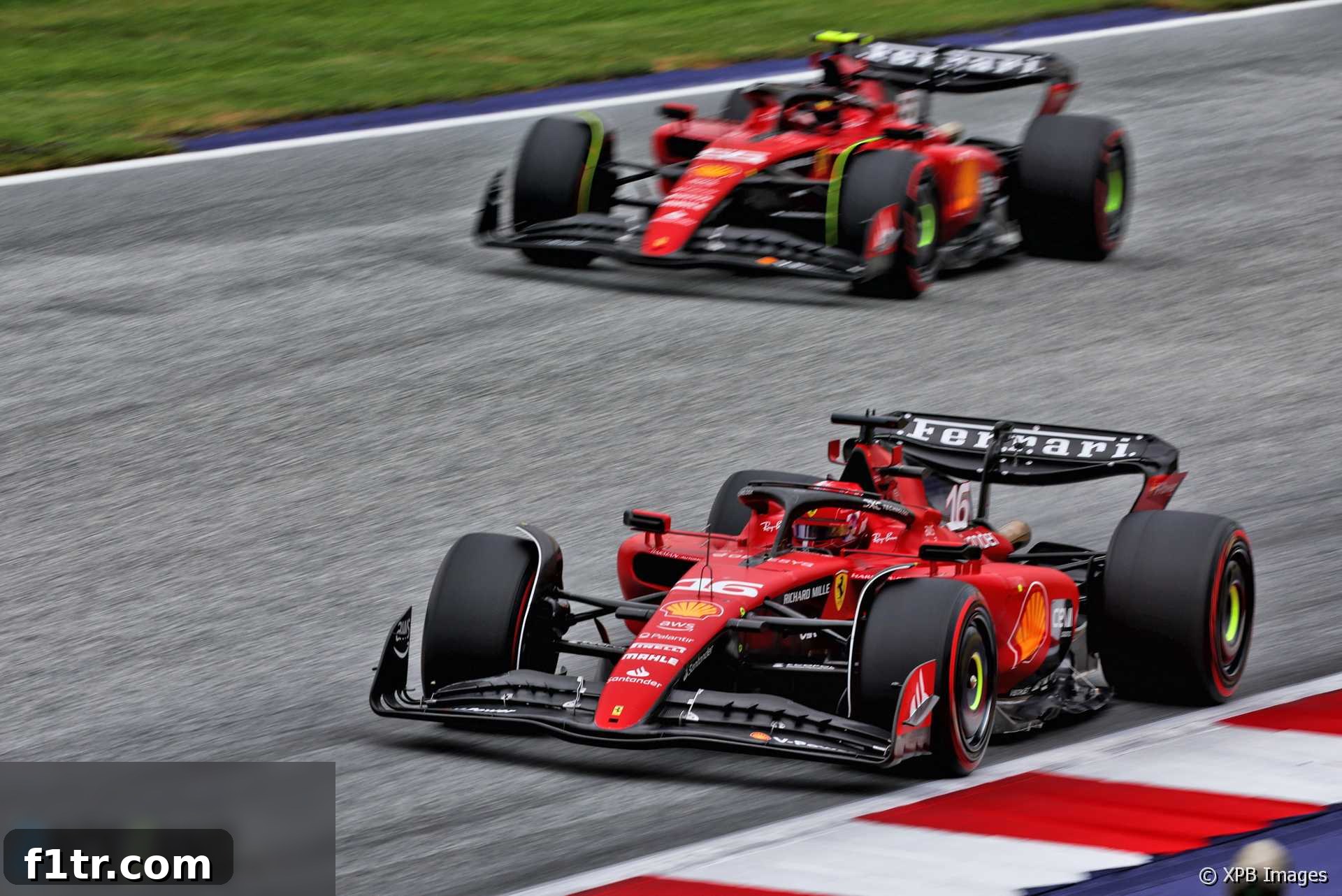
Ferrari arrives at the Red Bull Ring with a fierce determination to demonstrate the tangible progress made with their recent car upgrades. This weekend presents a perfect, high-stakes opportunity to validate those advancements by directly confronting Max Verstappen and Red Bull on their home turf. The Scuderia’s engineers and strategists have been working tirelessly to fine-tune the SF-23, and the Austrian Grand Prix, a circuit where they have historically performed well, offers an ideal stage for a resurgent performance. The memories of last year’s race, where Charles Leclerc mounted a brilliant challenge, will undoubtedly fuel their ambition. This showdown is not just about points; it’s about making a statement, proving that Ferrari can once again compete at the pinnacle of Formula 1.
Advert | Become a RaceFans supporter andgo ad-free
Last year, Max Verstappen emerged victorious in the sprint race, but the Grand Prix was an entirely different narrative. Charles Leclerc delivered a masterful drive, overtaking Verstappen not once, not twice, but three times to claim what remains Ferrari’s most recent victory to date. Those cherished memories and a renewed sense of confidence, following a frustrating start to the 2023 season, buoy the spirits within the Ferrari camp. However, Leclerc himself harbors a degree of pragmatism. Despite his undeniable talent and the team’s efforts, he does not anticipate replicating the ease with which he was able to challenge and pass Verstappen last year. The Red Bull RB19 is a far more refined and dominant machine than its predecessor, making any direct confrontation a much tougher proposition.
“I would be very surprised if we are doing the same race as last year,” Leclerc candidly admitted. “I hope so, and will do absolutely everything for this, but I will be very surprised if we’ve got as good of a pace as last year.” Leclerc’s cautious optimism reflects the reality of Red Bull’s current performance advantage. Nevertheless, he will not be the only Ferrari driver aiming to challenge Verstappen. Despite being narrowly outqualified by Leclerc for second on the grid on Friday, Carlos Sainz demonstrated superior form and comfort during sprint day, signaling a significant upturn in his confidence. Sainz has openly stated his renewed belief in the car’s potential, asserting that he’s heading into the Grand Prix with more confidence than at any other point this season.
“I’ve been very comfortable, especially today,” Sainz remarked, highlighting his ease with the SF-23. “Since the first lap of quali – which was actually my only lap of SQ1 – I looked very quick. I’m very at ease with the car and kept the feeling through in the wet. Hopefully tomorrow in the dry, I confirm the step and we can be strong in the whole race.” Sainz’s comfort and pace, even in variable conditions, could be a critical factor for Ferrari, offering a dual-pronged attack on Verstappen from the opening lap. Having both Ferraris starting directly behind the dominant Red Bull driver puts immense pressure on Verstappen and his strategists, creating a dynamic start to the race.
When it comes to tyre strategy, a pivotal element at the Red Bull Ring, the three softest compounds from Pirelli’s range – the C3 (hard), C4 (medium), and C5 (soft) – are available to the drivers. The high track temperatures recorded on Friday, hovering around 50 degrees Celsius, had a noticeable impact on tyre degradation, prompting Mercedes driver George Russell to describe the wear as “pretty bad.” This significant degradation strongly suggests that any heroic one-stop strategy, featuring a marathon first or second stint – akin to the audacious move Alexander Albon and Williams executed in Montreal – is highly improbable. Pirelli’s chief F1 engineer, Simone Berra, echoed this sentiment, solidifying the expectation for a multi-stop race.
Advert | Become a RaceFans supporter andgo ad-free
“From what we’ve seen, the degradation was quite high,” Berra confirmed on Friday, after a dry practice session and Grand Prix qualifying. “But in free practice, you have a green track.” He further elaborated on the influencing factors: “We had high track temperatures – we don’t know if on Sunday we will have similar temperatures, probably slightly lower. But from the numbers that we have, it’s probably a two-stop race. On paper it should be quicker, as it was last season.” This expert analysis provides teams with a clear direction, moving them away from overly aggressive one-stop plans and towards more conventional two-stop approaches, emphasizing tyre management throughout the Grand Prix.
The 2022 Austrian Grand Prix offers valuable historical context for tyre strategy. Last year, the vast majority of competitors opted to start the race on the medium C4 tyres. Their first pit stops, on average, occurred around laps 17 or 18, where drivers typically switched to the hard C3 compound. Most then chose a second set of hard tyres to carry them through to the chequered flag. However, the race also featured an unforeseen twist: a late Virtual Safety Car, triggered by Sainz’s Ferrari spontaneously combusting, prompted both Charles Leclerc and Max Verstappen to make opportunistic third stops for fresh rubber. Intriguingly, across the entire field, not a single driver completed even a single lap on the soft C5 tyres during the Grand Prix, a testament to the high degradation characteristics of the Red Bull Ring under race conditions. This data from the previous year will undoubtedly heavily influence strategic planning for the upcoming race.
After enduring sprint race qualifying and the sprint race itself in challenging, damp conditions, where the track remained persistently wet or drying throughout both sessions, drivers could certainly be forgiven for fervently hoping for a completely dry 71-lap Grand Prix on Sunday. While a completely dry race cannot be absolutely guaranteed, current forecasts indicate a reassuringly low risk of rain, less than 20%, during the two-hour window when the race is scheduled to take place. This weather outlook is particularly favorable for Ferrari, and especially for Charles Leclerc.
Leclerc, in particular, will be eager for the rain to remain absent. He openly admitted to struggling to find a comfortable operating window with his intermediate tyres during the sprint race on a drying track. He candidly expressed his concerns about facing similar “half-dry, half-wet” conditions on Sunday, highlighting a specific vulnerability for Ferrari in those tricky transitional phases.
“If it does rain – again in those half-dry, half-wet conditions – yes,” Leclerc stated, acknowledging his apprehension. “If it’s full-dry or full-wet, no, because I know that in those conditions we are strong and I feel good. But it’s more in these in-between conditions that we are struggling.” This insight from Leclerc underlines the critical importance of a stable weather forecast for Ferrari’s performance. With a predominantly dry race looking increasingly probable, Ferrari finds itself with arguably its best opportunity of the season thus far to mount a serious challenge against Max Verstappen and the dominant Red Bull team. The stage is set for a thrilling strategic battle, with Ferrari needing to capitalize on every advantage to push for victory.
Advert | Become a RaceFans supporter andgo ad-free
While outright victory is always the ultimate goal for any team, Carlos Sainz realistically acknowledges the immense scale of the challenge that lies ahead for both himself and his teammate, Charles Leclerc. The Red Bull Ring, traditionally a hunting ground for Red Bull, coupled with Max Verstappen’s current form, makes any aspiration for a win an uphill battle. “Never say never, but you know how tricky it will be,” Sainz commented, injecting a dose of realism into the team’s ambitions. However, he quickly followed up with a note of strategic optimism: “We are in a good position though with two cars right behind him and ready to attack.” This confident assessment from Sainz highlights Ferrari’s intention to leverage their advantageous grid positions to apply maximum pressure on Verstappen from the very start, potentially forcing Red Bull into defensive strategies and opening up opportunities for a thrilling, unpredictable Grand Prix. The prospect of a two-pronged Ferrari attack against the solitary Red Bull at the front sets the stage for a captivating Sunday race.
Qualifying Times in Full: Austrian Grand Prix 2023
Here are the complete qualifying results from Friday’s session, which set the grid for the Grand Prix. These times highlight the blistering pace of the front-runners and the competitive nature of the midfield battle, offering a crucial overview of each driver’s performance over the three qualifying segments.
| Position | Number | Driver | Team | Q1 time | Q2 time (vs Q1) | Q3 time (vs Q2) |
|---|---|---|---|---|---|---|
| 1 | 1 | Max Verstappen | Red Bull-Honda RBPT | 1’05.116 | 1’04.951 (-0.165s) | 1’04.391 (-0.560s) |
| 2 | 16 | Charles Leclerc | Ferrari | 1’05.577 | 1’05.087 (-0.490s) | 1’04.439 (-0.648s) |
| 3 | 55 | Carlos Sainz Jnr | Ferrari | 1’05.339 | 1’04.975 (-0.364s) | 1’04.581 (-0.394s) |
| 4 | 4 | Lando Norris | McLaren-Mercedes | 1’05.617 | 1’05.038 (-0.579s) | 1’04.658 (-0.380s) |
| 5 | 44 | Lewis Hamilton | Mercedes | 1’05.673 | 1’05.188 (-0.485s) | 1’04.819 (-0.369s) |
| 6 | 18 | Lance Stroll | Aston Martin-Mercedes | 1’05.710 | 1’05.121 (-0.589s) | 1’04.893 (-0.228s) |
| 7 | 14 | Fernando Alonso | Aston Martin-Mercedes | 1’05.655 | 1’05.181 (-0.474s) | 1’04.911 (-0.270s) |
| 8 | 27 | Nico Hulkenberg | Haas-Ferrari | 1’05.740 | 1’05.362 (-0.378s) | 1’05.090 (-0.272s) |
| 9 | 10 | Pierre Gasly | Alpine-Renault | 1’05.515 | 1’05.308 (-0.207s) | 1’05.170 (-0.138s) |
| 10 | 23 | Alexander Albon | Williams-Mercedes | 1’05.673 | 1’05.387 (-0.286s) | 1’05.823 (+0.436s) |
| 11 | 63 | George Russell | Mercedes | 1’05.686 | 1’05.428 (-0.258s) | Missed by 0.041s |
| 12 | 31 | Esteban Ocon | Alpine-Renault | 1’05.729 | 1’05.453 (-0.276s) | Missed by 0.066s |
| 13 | 81 | Oscar Piastri | McLaren-Mercedes | 1’05.683 | 1’05.605 (-0.078s) | Missed by 0.218s |
| 14 | 77 | Valtteri Bottas | Alfa Romeo-Ferrari | 1’05.763 | 1’05.680 (-0.083s) | Missed by 0.293s |
| 15 | 11 | Sergio Perez | Red Bull-Honda RBPT | 1’05.177 | 2’06.688 (+61.511s) | Missed by 61.301s |
| 16 | 22 | Yuki Tsunoda | AlphaTauri-Honda RBPT | 1’05.784 | Missed by 0.021s | |
| 17 | 24 | Zhou Guanyu | Alfa Romeo-Ferrari | 1’05.818 | Missed by 0.055s | |
| 18 | 2 | Logan Sargeant | Williams-Mercedes | 1’05.948 | Missed by 0.185s | |
| 19 | 20 | Kevin Magnussen | Haas-Ferrari | 1’05.971 | Missed by 0.208s | |
| 20 | 21 | Nyck de Vries | AlphaTauri-Honda RBPT | 1’05.974 | Missed by 0.211s |
Sector Times: A Detailed Look at Driver Performance
Delving deeper into Friday’s qualifying, the sector times offer a micro-analysis of where drivers gained or lost crucial tenths across the Red Bull Ring’s three distinct sections. This breakdown reveals individual strengths and car characteristics, providing insights beyond the overall lap time.
| Position | Number | Driver | Sector one | Sector two | Sector three | Ultimate lap | Deficit to ultimate lap |
|---|---|---|---|---|---|---|---|
| 1 | 1 | Max Verstappen | 16.3 (1) | 28.732 (2) | 19.359 (1) | 1’04.391 | – |
| 2 | 16 | Charles Leclerc | 16.336 (4) | 28.686 (1) | 19.417 (2) | 1’04.439 | – |
| 3 | 55 | Carlos Sainz Jnr | 16.304 (2) | 28.785 (3) | 19.479 (3) | 1’04.568 | 0.013 |
| 4 | 4 | Lando Norris | 16.358 (6) | 28.808 (4) | 19.492 (4) | 1’04.658 | – |
| 5 | 44 | Lewis Hamilton | 16.312 (3) | 28.975 (9) | 19.532 (5) | 1’04.819 | – |
| 6 | 11 | Sergio Perez | 16.438 (11) | 28.839 (5) | 19.559 (8) | 1’04.836 | 0.341 |
| 7 | 14 | Fernando Alonso | 16.399 (10) | 28.919 (6) | 19.542 (7) | 1’04.860 | 0.051 |
| 8 | 18 | Lance Stroll | 16.388 (7) | 28.969 (8) | 19.536 (6) | 1’04.893 | – |
| 9 | 10 | Pierre Gasly | 16.398 (9) | 29.028 (10) | 19.595 (10) | 1’05.021 | 0.149 |
| 10 | 27 | Nico Hulkenberg | 16.392 (8) | 28.94 (7) | 19.758 (15) | 1’05.090 | – |
| 11 | 31 | Esteban Ocon | 16.475 (13) | 29.124 (13) | 19.593 (9) | 1’05.192 | 0.261 |
| 12 | 81 | Oscar Piastri | 16.519 (16) | 29.081 (11) | 19.613 (11) | 1’05.213 | 0.392 |
| 13 | 23 | Alexander Albon | 16.346 (5) | 29.225 (15) | 19.683 (12) | 1’05.254 | 0.133 |
| 14 | 63 | George Russell | 16.515 (14) | 29.097 (12) | 19.704 (13) | 1’05.316 | 0.112 |
| 15 | 77 | Valtteri Bottas | 16.518 (15) | 29.179 (14) | 19.736 (14) | 1’05.433 | 0.247 |
| 16 | 20 | Kevin Magnussen | 16.553 (18) | 29.227 (16) | 19.841 (16) | 1’05.621 | 0.350 |
| 17 | 24 | Zhou Guanyu | 16.537 (17) | 29.239 (17) | 19.892 (19) | 1’05.668 | 0.150 |
| 18 | 22 | Yuki Tsunoda | 16.6 (19) | 29.329 (19) | 19.852 (18) | 1’05.781 | 0.003 |
| 19 | 21 | Nyck de Vries | 16.719 (20) | 29.322 (18) | 19.844 (17) | 1’05.885 | 0.089 |
| 20 | 2 | Logan Sargeant | 16.463 (12) | 29.383 (20) | 20.102 (20) | 1’05.948 | – |
Speed Trap Data: Unpacking Top Speeds at the Red Bull Ring
The speed trap figures from qualifying provide fascinating insights into each car’s straight-line efficiency and engine power. While not the sole determinant of lap time, top speed is crucial for overtaking and defending, especially on a circuit like the Red Bull Ring with its long straights and multiple DRS zones.
| Position | Number | Driver | Car | Engine | Model | Max kph (mph) |
|---|---|---|---|---|---|---|
| 1 | 23 | Alexander Albon | Williams | Mercedes | FW45 | 322.0 (200.1) |
| 2 | 1 | Max Verstappen | Red Bull | Honda RBPT | RB19 | 320.7 (199.3) |
| 3 | 55 | Carlos Sainz Jnr | Ferrari | Ferrari | SF-23 | 320.7 (199.3) |
| 4 | 2 | Logan Sargeant | Williams | Mercedes | FW45 | 319.9 (198.8) |
| 5 | 11 | Sergio Perez | Red Bull | Honda RBPT | RB19 | 319.5 (198.5) |
| 6 | 16 | Charles Leclerc | Ferrari | Ferrari | SF-23 | 318.6 (198.0) |
| 7 | 27 | Nico Hulkenberg | Haas | Ferrari | VF-23 | 318.2 (197.7) |
| 8 | 24 | Zhou Guanyu | Alfa Romeo | Ferrari | C43 | 317.3 (197.2) |
| 9 | 77 | Valtteri Bottas | Alfa Romeo | Ferrari | C43 | 317.2 (197.1) |
| 10 | 20 | Kevin Magnussen | Haas | Ferrari | VF-23 | 316.9 (196.9) |
| 11 | 44 | Lewis Hamilton | Mercedes | Mercedes | W14 | 316.7 (196.8) |
| 12 | 63 | George Russell | Mercedes | Mercedes | W14 | 316.6 (196.7) |
| 13 | 10 | Pierre Gasly | Alpine | Renault | A523 | 316.4 (196.6) |
| 14 | 4 | Lando Norris | McLaren | Mercedes | MCL60 | 316.3 (196.5) |
| 15 | 18 | Lance Stroll | Aston Martin | Mercedes | AMR23 | 316.1 (196.4) |
| 16 | 31 | Esteban Ocon | Alpine | Renault | A523 | 315.5 (196.0) |
| 17 | 81 | Oscar Piastri | McLaren | Mercedes | MCL60 | 314.9 (195.7) |
| 18 | 22 | Yuki Tsunoda | AlphaTauri | Honda RBPT | AT04 | 314.8 (195.6) |
| 19 | 14 | Fernando Alonso | Aston Martin | Mercedes | AMR23 | 314.6 (195.5) |
| 20 | 21 | Nyck de Vries | AlphaTauri | Honda RBPT | AT04 | 313.3 (194.7) |
Advert | Become a RaceFans supporter andgo ad-free
Over to You: Your Austrian Grand Prix Predictions
As the anticipation builds for the main event, the crucial questions remain: Is there any realistic and sustained threat to another dominant victory for Max Verstappen at the Red Bull Ring? Or have Ferrari finally managed to get on top of their notorious tyre degradation woes, positioning themselves for a genuine challenge? Share your expert views, insights, and predictions for the 2023 Austrian Grand Prix in the comments section below!
Related Articles: 2023 Austrian Grand Prix Insights
- Mercedes left scratching heads by lack of performance at Austrian GP
- Verstappen’s determination to grab every point makes him a record-breaker
- Austrian GP track limits farce was avoidable like ‘IndyGate’ and Spa 2021 – Brown
- Alpine now “definitely beatable” for McLaren after upgrade – Brown
- Paddock Diary: 2023 Austrian Grand Prix
Browse all 2023 Austrian Grand Prix articles