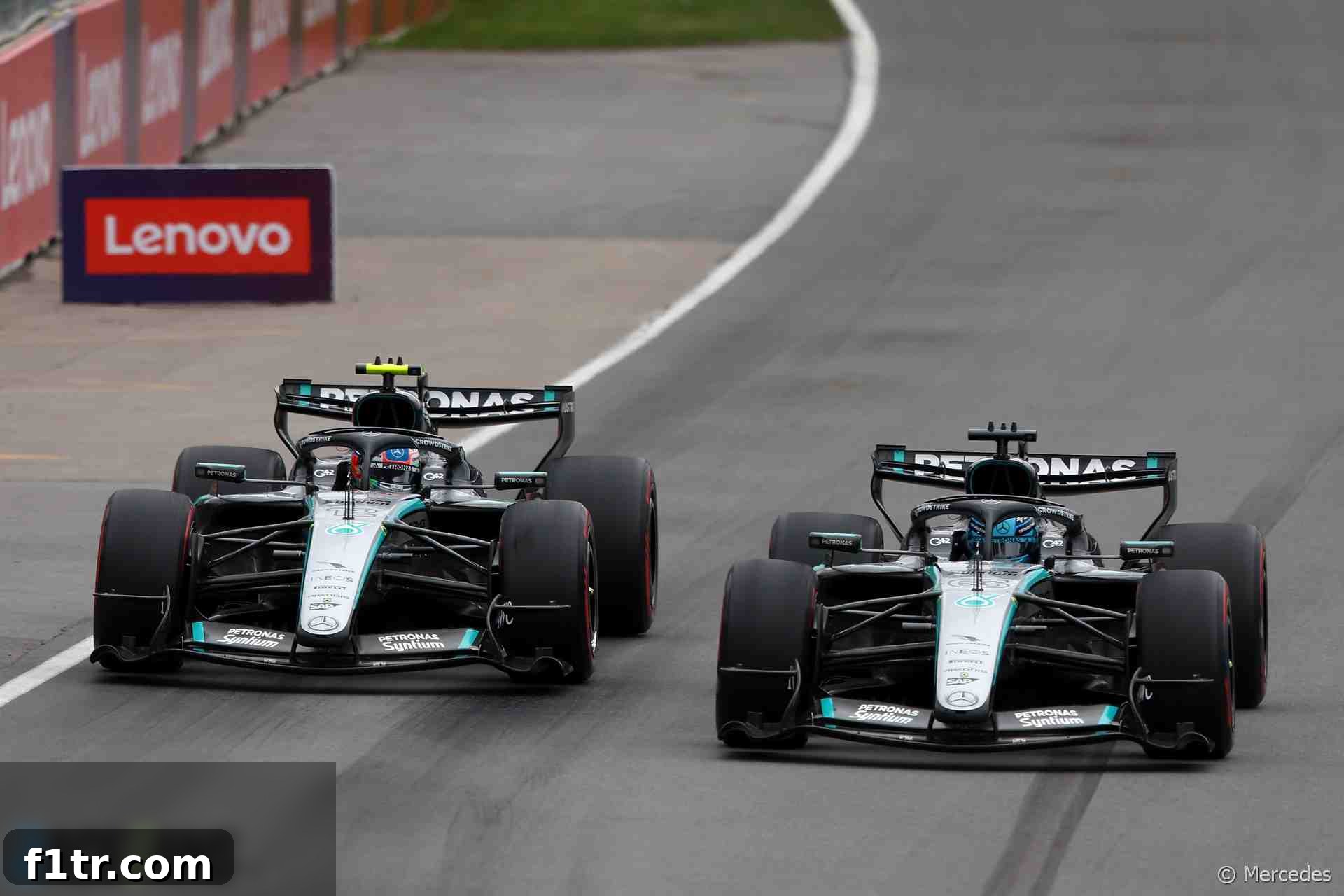
Formula 1’s new Overtake Mode played a clear role in the battles for position at the Canadian Grand Prix, according to Mercedes’ head of trackside operations Andrew Shovlin.
Advert | Become a Supporter & go ad-free
The importance of this mode, introduced this year to replace the Drag Reduction System, has been difficult to isolate from other changes to the 2026 cars. Altered energy deployment strategies across teams and the smaller, lighter 2026 car designs also influence overtaking. Nevertheless, Overtake Mode — like DRS before it — works on proximity: a driver within one second of the car ahead can harvest additional energy and deploy extra power.
Shovlin says that effect was obvious in Montreal, where cars that were passed tended to stay close to the car that had just overtaken them.
“The regulations make it quite hard to break away because the car behind can harvest a bit more energy,” Shovlin explained in a video published by Mercedes. “Also in Montreal, because it was really cold and there’s low speed corners, the cars actually followed [each other] really well. So you could sit within less than a second, sometimes even half a second from the, from the car in front.
“The two cars get a little bit locked together in a battle. The energy does help the one behind keep up. It’s just quite hard for [the leader] to break away.”
This locking effect was visible when the Mercedes drivers swapped the lead in the opening laps, until George Russell retired. Russell’s teammate Andrea Kimi Antonelli said during the race he needed Overtake Mode to make passes and even used Lando Norris’s lapped McLaren to gain the boost when he got ahead.
Advert | Become a RaceFans supporter andgo ad-free
The influence of Overtake Mode was also apparent at the end of the race when Lewis Hamilton closed on Max Verstappen. Although Hamilton managed to pass Verstappen, he was unable to pull clear beyond the one-second window that would prevent Verstappen from harvesting extra energy himself.
Shovlin notes that while Overtake Mode does not dramatically improve outright lap time, it gives a driver who has been overtaken a useful tool to fight back.
“It’s not particularly powerful in terms of lap time. You’re only getting a tenth, tenth and a half [of a second].
“But what it does allow a driver to do because they can harvest more is deploy more. There’s also an effect where the car with the Overtake Mode can ultimately go faster because they get into a region of the map where it starts to tail off the power at a certain speed and the car behind has a higher threshold. So they ultimately have a higher top speed.
“In Montreal, it’s very much about making one big move with a lot of energy down one of the long straights. And that was allowing them to get through.”
Advert | Become a RaceFans supporter andgo ad-free
2026 Canadian Grand Prix
- Overtake Mode helped ‘lock cars together’ in battle at Canadian GP
- Stats: Antonelli has larger points lead than any driver had last year, and more
- Power deficit is keeping Ferrari out of the fight with Mercedes – Hamilton
- ‘Actually an opportunity’: How McLaren answered drivers’ calls to ditch tyre gamble
- “He needs to back up”: How Mercedes managed Russell and Antonelli’s Canadian GP fight
Browse all 2026 Canadian Grand Prix articles