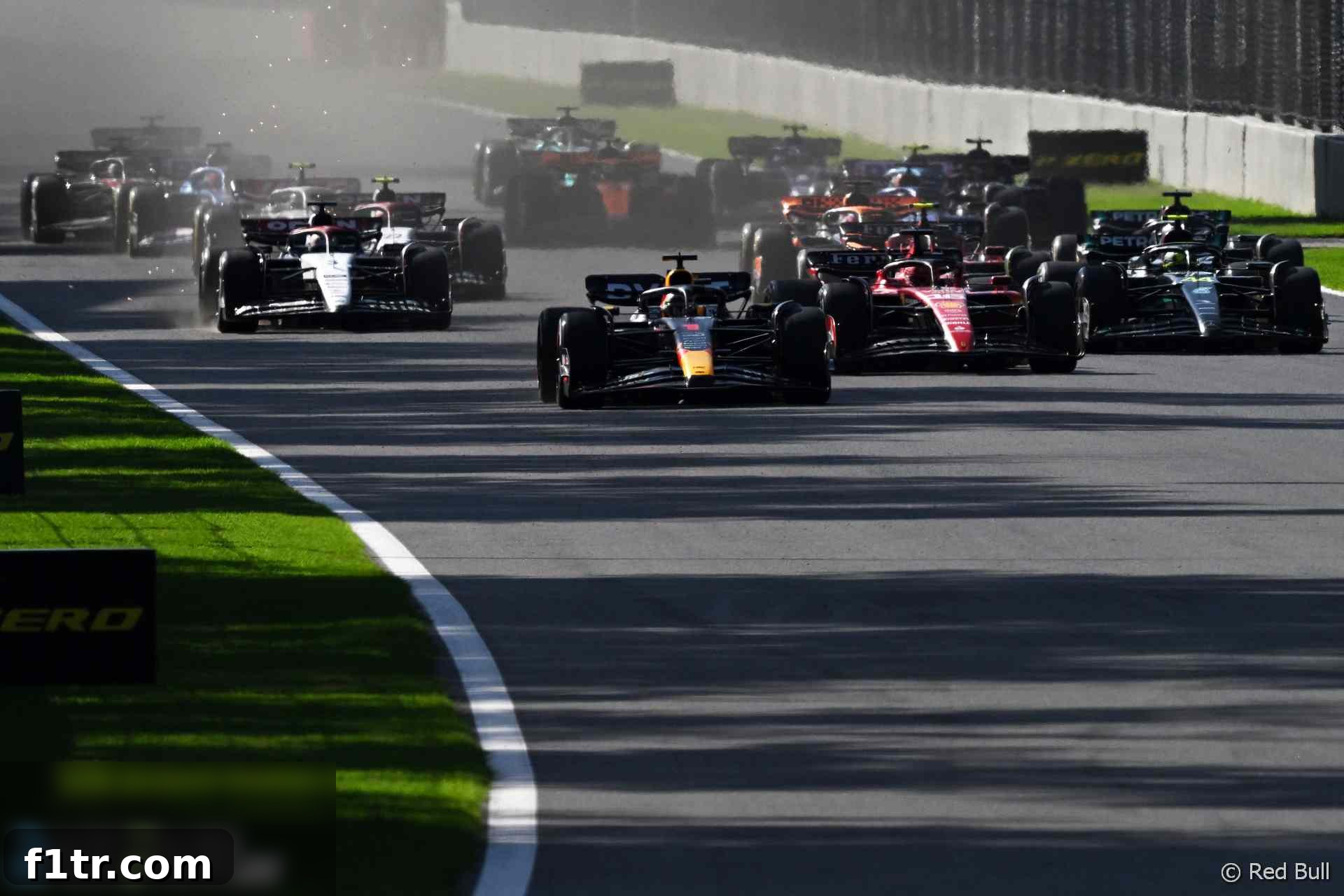
In a thrilling display of skill and unwavering resolve at the recent Autódromo Hermanos Rodríguez, Lando Norris orchestrated a truly remarkable recovery drive in the Mexican Grand Prix. His impressive ascent from a challenging 17th position on the grid to a superb fifth-place finish was a testament to his exceptional talent, yet it was not without its moments of significant peril and candid critique. Following the race, the McLaren driver openly expressed his concerns regarding what he perceived as a notable lack of awareness among some of his rivals during a particularly chaotic restart phase, revealing how he was compelled to take crucial evasive action to avert a potentially devastating multi-car incident.
The incident Norris highlighted occurred amidst the high-speed dash towards the notoriously challenging Turn 1, immediately following a safety car period. In the high-stakes environment of Formula 1, restarts are inherently fraught with tension as drivers aggressively vie for track position. According to Norris, several competitors displayed a concerning disregard for the proximity of other cars, leading to a dangerous convergence that threatened to engulf multiple vehicles. “I probably had to avoid a very big crash,” Norris recounted, detailing the split-second decisions required to navigate the perilous situation. He elaborated, “Just people coming across, not probably realising that people can be three-abreast in such a critical moment.” This insight underscores the unique challenges of close-quarters racing, where an understanding of spatial dynamics and the potential for multiple cars side-by-side is paramount.
Formula 1 restarts are a crucible of pressure, demanding a flawless blend of aggressive driving, strategic foresight, and mutual respect among competitors. Norris’s observations shed light on the inherent dangers when these qualities are not consistently demonstrated by all drivers on the grid. He vividly described a harrowing experience on the track, stating, “I avoided two extremely big crashes which would have been very nasty.” Such comments underscore the infinitesimal margins within which F1 drivers operate, where a minor miscalculation can lead to catastrophic consequences, especially when cars are travelling at speeds well over 300 km/h and jostling for every inch of tarmac. His direct plea for “a bit more self awareness of some drivers would be great” served as a clear call for increased caution and consideration from his peers, emphasizing the collective responsibility each driver holds for ensuring safety within the high-octane spectacle of Grand Prix racing.
Despite the frightening nature of the near-collisions, Norris was quick to clarify that these close calls were not the primary reason for his initial loss of position during the restart phase, where he momentarily dropped back by four places. “It’s not why I lost out,” he asserted, attributing his initial setback predominantly to a less-than-ideal getaway from his starting box. However, he then added a crucial nuance: “I lost out because of a bad start, but I lost out even more because of these things,” directly referencing the aggressive and, in his view, ill-judged manoeuvres of other drivers that compounded his initial struggles. This distinction is vital, as it separates a personal performance issue—the quality of his initial start—from an external factor, the conduct of his rivals, which exacerbated his challenging position on track.
Once he had successfully navigated the tumultuous opening laps and found clear air, Lando Norris was truly unleashed, and the formidable potential of his McLaren MCL60 was vividly showcased. His subsequent recovery drive was nothing short of spectacular, captivating audiences and serving as a powerful demonstration of his exceptional talent and determination. Embarking on his quest from an unenviable 17th position on the grid, the young Briton systematically and methodically carved his way through the field, executing a masterful blend of aggressive yet precise overtaking manoeuvres and intelligent race craft. By the time the chequered flag waved, he had propelled himself to an astounding fifth place, a monumental achievement that not only underscored his individual brilliance but also highlighted the significant performance advancements made by the McLaren team throughout the challenging season.
Reflecting on his remarkable performance, Norris expressed immense satisfaction with the capabilities and outright speed of his car. “The pace was amazing,” he enthused, beaming with pride. Yet, even with such formidable raw speed, the race at the Autódromo Hermanos Rodríguez presented its own unique set of intricate challenges. From the very first lap, Norris found himself engaged in a delicate balancing act, meticulously managing crucial engine parameters. “Already from lap one, there was a lot of management involved and already when I came over the line the first time, I got told to cool the engine,” he disclosed. This revealed that while the McLaren MCL60 possessed incredible outright speed, it might not have been perfectly optimized for the high-altitude, thin-air conditions and ambient heat prevalent in Mexico City, demanding constant thermal management from the driver to prevent overheating and maintain performance. Consequently, there were moments during the Grand Prix when Norris admitted he “couldn’t maybe push as much as I wanted to at times.”
Despite these thermal limitations, when the opportunities arose to push the car to its absolute limits, particularly during a significant portion of his second stint, the McLaren driver capitalized decisively and ruthlessly. “But in the times I could, which is a lot of the second stint, the pace was excellent,” he affirmed with confidence. The statistical data from the race painted a clear and compelling picture of McLaren’s competitive resurgence, with Norris demonstrating a superior pace to “almost everyone bar Hamilton and Max [Verstappen].” This elevated his car firmly into the upper echelon of contenders, a truly remarkable achievement considering the team’s struggles and development trajectory earlier in the season. His ability to transform a challenging qualifying result into a hard-fought top-five finish was not merely a personal triumph but also served as “very encouraging for us” as a team, signaling their strong and sustained upward trajectory in the constructors’ championship. For Norris himself, given the initial hurdles and subsequent challenges, it was “as perfect a day as I could probably ask for,” encapsulating the immense satisfaction derived from maximizing the outcome.
Adding another intriguing layer to Norris’s stellar performance was McLaren’s audacious and unorthodox strategic gamble at the very start of the race. Uniquely among the entire 20-car grid, Norris was the sole driver to opt for the soft compound tyres to commence his Grand Prix campaign. This decision, while carrying inherent risks due to the potentially higher degradation rate of the softer rubber, was ultimately vindicated by its tangible benefits on track. Norris unequivocally confirmed its value, stating it was “absolutely” a worthwhile move, meticulously designed to provide him with an immediate and crucial grip advantage off the starting line and through the notoriously chaotic initial phases of the race.
The strategic rationale behind selecting soft tyres for the opening stint is typically rooted in gaining superior grip and acceleration during the initial laps, offering the potential to quickly gain positions or defend robustly against faster competitors. While Turn 1 at the Mexican Grand Prix is infamously challenging and highly unpredictable – a corner where “it’s always tough in turn one, it can go your way, it can not go your way” – the aggressive soft tyre choice evidently played a pivotal role in mitigating some of the initial disadvantages of starting deep in the midfield. Despite the inherent risks of accelerated wear and potential early pit stops, the team’s tactical calculations proved astute, enabling Norris to maintain a highly competitive position early on before eventually transitioning to a more durable compound later in the race, seamlessly executing their planned strategy.
Norris was also effusive in his praise for his team’s strategic acumen and adaptability throughout the dynamic event. “I think we played everything smart, I think we played it well,” he observed, acknowledging the sophisticated decision-making emanating from the McLaren pit wall, which expertly responded to the fluctuating conditions of the race. While external factors such as the deployment of the Safety Car and Virtual Safety Car periods were “not perfectly timed for us,” potentially disrupting their optimal strategy or costing them valuable track position, the team’s overall execution ensured they remained firmly in contention and capitalized on every available opportunity. “But, otherwise I think everything pretty much went our way and we maximised today,” Norris concluded, underscoring the collective effort to extract every possible performance gain and championship point from a weekend that had initially presented significant qualifying hurdles.
Lando Norris’s exceptional drive in the Mexican Grand Prix served as a compelling microcosm of McLaren’s remarkable resurgence in Formula 1: a potent fusion of raw, blistering speed, astute strategic foresight, and the unparalleled talent of their lead driver. His extraordinary ability to navigate chaos, skillfully manage a demanding racing machine under pressure, and execute a near-flawless recovery speaks volumes about his profound growth as a Formula 1 driver and the indomitable competitive spirit that permeates the Woking-based squad. The performance not only secured invaluable championship points but also delivered a resounding message to their rivals about McLaren’s consistent upward trajectory and increasing threat within the constructors’ championship battle.
2023 Mexican Grand Prix
- ‘I’m so s*** in qualifying’: Norris berates himself despite pole-winning lap
- Ferrari reaping the benefits of having F1’s most closely-matched team mates
- Norris had “no chance” to beat Verstappen in Mexico even without Q1 exit
- Transcript: How Ricciardo’s race went awry soon after he was told to “bring it home”
- Mercedes see “very encouraging signs” from Austin floor update
Browse all 2023 Mexican Grand Prix articles