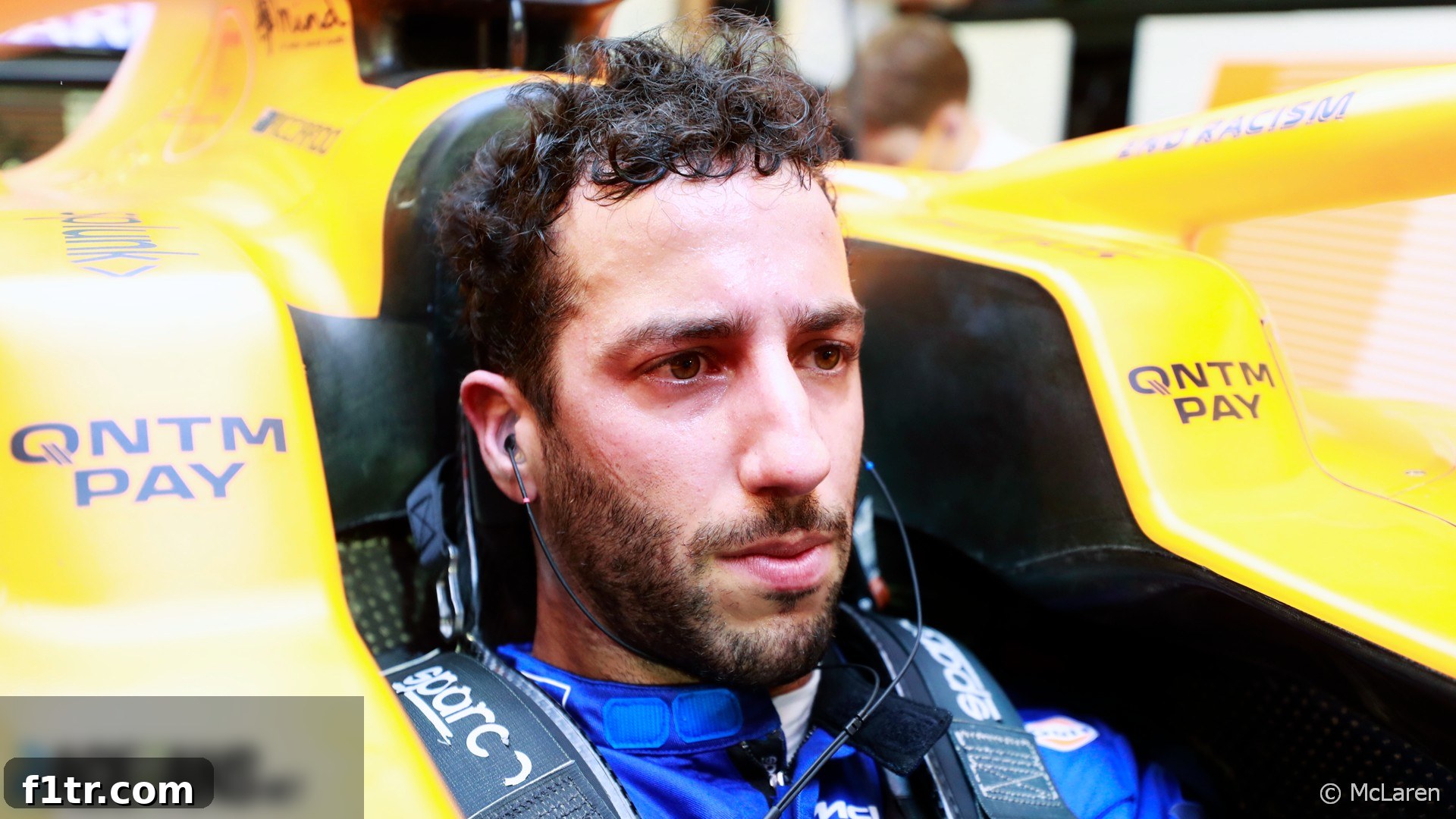
Daniel Ricciardo on McLaren Adaptation at Imola: Learning to Trust the Car and Unlock Potential
Following his second competitive outing with McLaren at the Emilia-Romagna Grand Prix in Imola, Daniel Ricciardo offered a candid assessment of his performance. Despite securing a respectable sixth-place finish, the Australian driver openly admitted he “wasn’t fast” and highlighted the ongoing process of building trust and familiarity with his new machinery. The race underscored a stark contrast between Ricciardo’s struggle for pace and his less experienced teammate Lando Norris’s impressive drive to a podium finish, putting the spotlight on the challenge of integrating into a new Formula 1 team.
The Imola Race: A Tale of Two McLarens
The Imola weekend proved to be a challenging yet insightful experience for Daniel Ricciardo. While he managed to out-qualify Lando Norris, the race itself painted a different picture. Norris, in his third season with McLaren, demonstrated superior pace and control, ultimately securing his second career podium with a brilliant third place. This performance not only showcased Norris’s burgeoning talent but also the inherent potential of the McLaren MCL35M, a potential Ricciardo is still striving to fully exploit.
Ricciardo’s honest self-assessment following the race revealed his determination. “Sixth, the result looks alright on paper, but I wasn’t fast,” he conceded. “A bit like most of the weekend, but obviously Lando got a podium and had stronger pace for at least the majority of the race.” This direct comparison to his teammate provided Ricciardo with both a benchmark and a clear indicator of the work ahead. He acknowledged the positives for the team, seeing Norris’s result as proof of the car’s capabilities, while simultaneously focusing on his personal journey to improve.
This period of adaptation is common for drivers switching teams, especially given the nuanced differences in car philosophies and driving requirements across different constructors. For Ricciardo, whose career has seen him master various machines from Red Bull to Renault, the McLaren presents a unique set of characteristics that demand a recalibration of his driving instincts.
Unlocking McLaren’s Potential: Trust and Technique
A recurring theme in Ricciardo’s reflections was the critical element of “trust in the car.” This isn’t merely about confidence; it’s about a deep, intuitive understanding of how the car will react at its absolute limit, particularly through high-speed corners. Having spent years developing a specific driving style honed by the characteristics of his previous cars, primarily those from Red Bull and Renault, Ricciardo is now confronting the need to adjust his muscle memory and technique to suit the McLaren’s unique traits.
“I think that even if personally I’m not getting everything out of it yet, the thing that gives me confidence is obviously looking at the potential of the car. It’s there and it’s pretty good,” Ricciardo explained, emphasizing the inherent capability of the MCL35M. He elaborated on the specific challenge: “It can do more than I think it can as far as just carrying more speed through the corners and the car is going to stick. So there’s a little bit of trust in the car.”
This “trust” involves pushing beyond perceived limits, understanding that the car possesses greater grip and stability than his current instincts might suggest. It requires a mental reset, shedding ingrained habits that might have been optimal for a different car but are suboptimal for the McLaren. “But I don’t think it’s like, just turn in and close your eyes and it’s going to stick. A lot of it is technique as well,” he clarified. “And this, I try not to say it as excuses from the past, but there is probably just still some old habits that I need to flush out a little bit and things that maybe don’t work as well for this car.”
The process of “flushing out old habits” is a complex one for an elite athlete. Formula 1 drivers operate at such a high level where milliseconds count, and every input — from steering angle to throttle application and brake pressure — is executed with incredible precision, often subconsciously. Over years, these actions become second nature, ingrained responses to specific car behaviors. Adapting this deeply embedded driving style to a new car, with different weight distribution, aerodynamic balance, and suspension characteristics, takes time, repetition, and a willingness to unlearn and relearn.
The Tyre Management Conundrum
Tyre management emerged as another crucial factor distinguishing the performance of the two McLaren drivers at Imola. Both Ricciardo and Norris adopted similar strategies, starting on intermediate tyres before switching to soft compounds. However, their ability to extract performance and preserve the tyres over the race distance varied significantly.
“He was definitely quicker in the race,” Ricciardo acknowledged regarding Norris’s pace. He reflected on his own struggles: “I think the initial part was actually okay. I got up to fifth and I was doing alright with the intermediates. But then I started to lose the front right and my pace dropped off quite a lot.” The declining performance on intermediates eventually led to the team asking Ricciardo to let Norris pass, a request he promptly complied with. “That second phase of the intermediates, I wasn’t fast,” he reiterated.
The challenges with tyre performance didn’t end there. Like Sebastian Vettel, Ricciardo opted for soft tyres during the final restart, a decision he later regretted. The expectation of a standing start, which typically allows for quicker tyre warm-up and immediate grip, informed this choice. However, when the race resumed with a rolling start, the soft tyres struggled to come up to optimal temperature quickly enough, leaving Ricciardo at a disadvantage.
“For the restart I thought there would be a standing start. So we put the soft on but then I saw rolling start and thought ‘ah’,” he recounted. “I tried to look after the tyre but the others just kept pulling away so I started to push on it and then I was really, really struggling.” This incident highlights the razor-thin margins in Formula 1 and how strategic decisions, even based on reasonable assumptions, can dramatically impact race performance.
Learning from Lando: A Productive Mindset
Despite the challenges, Daniel Ricciardo’s mindset remains resolutely positive and forward-looking. His comments consistently reflected a constructive approach, focusing on improvement rather than dwelling on setbacks. Observing Lando Norris’s strong performance, rather than causing frustration, serves as a powerful motivator and a tangible demonstration of the McLaren’s true potential.
“I’m definitely in a productive mindset and not in a defeatist mindset. I certainly see the positives and for the team as well,” Ricciardo affirmed. The fact that McLaren secured a podium so early in the season, in only the second race, is a testament to the team’s progress and the competitiveness of the MCL35M. This team success provides a solid foundation upon which Ricciardo can build his individual performance.
His willingness to “forget a little bit of pride and actually have a look at what I can improve” speaks volumes about his character and experience. Acknowledging that he needs to learn from his teammate and adapt his approach is a sign of a mature and highly motivated driver. It underscores the collaborative spirit within McLaren, where driver feedback and data analysis are crucial for continuous development.
Looking Ahead: Patience and Persistence
As the Formula 1 season progresses, Daniel Ricciardo is committed to a process of gradual improvement. He understands that adapting to a new car, especially one with a distinct personality like the McLaren, takes time. His current focus is on incrementally enhancing his understanding of the car’s limits, refining his technique, and optimizing his tyre management skills.
“It’s encouraging to be up in the mix,” he noted, highlighting McLaren’s position as a strong contender in a highly competitive field. “I think the sport in general is all pretty tight, and so I’m okay with that. I’m certainly happy with the progress we made today, and there’s still more to come. So I’ll be patient yet persistent.”
This balance of patience and persistence will be key. While Ricciardo is eager to unlock his full speed, he recognizes that rushing the process could lead to errors. Instead, a methodical approach, supported by rigorous data analysis and close collaboration with his engineers, will be instrumental in bridging the performance gap to Norris and maximizing his own potential within the team.
Conclusion: A Promising Start for Ricciardo and McLaren
Daniel Ricciardo’s journey with McLaren is in its nascent stages, and the Imola weekend offered a valuable snapshot of the challenges and opportunities ahead. While his personal performance was not at his usual benchmark, his candid self-assessment and productive mindset are indicative of a driver fully committed to the task. The fact that McLaren is already fighting for podiums and demonstrating strong pace provides a fantastic platform. As Ricciardo continues to build trust in the car, adapt his technique, and integrate fully into the team’s operational rhythm, there is every reason to believe that his trademark speed and racecraft will shine through, making McLaren a formidable force in the 2021 Formula 1 season.
2021 F1 season
- Masi ‘basically gifted the championship’ to Verstappen says 2021 FIA steward Sullivan
- Las Vegas race backers looking to extend F1 deal beyond 2025
- Why Mercedes put ‘a reminder of joy and pain’ on display in their factory lobby
- Verdict on error in GT race suggests Mercedes would have lost 2021 Abu Dhabi GP appeal
- Title ‘stolen’ from Mercedes made us ‘underdogs people cheer for’ – Wolff
Browse all 2021 F1 season articles