F1 US Grand Prix: Mercedes, Alpine, and Alfa Romeo Introduce Final Major Upgrades
The highly anticipated United States Grand Prix at the Circuit of the Americas (COTA) marks a pivotal moment in the 2022 Formula 1 season, not just for championship battles but also for engineering development. As teams head into the final races, three prominent contenders – Mercedes, Alpine, and Alfa Romeo – have chosen this iconic Texas venue to roll out their last significant upgrade packages of the year. This strategic timing underscores the critical importance of COTA’s demanding layout and the fierce competition still raging across the grid, from the fight for constructor supremacy to crucial mid-field standings.
Mercedes, the outgoing constructors’ champions, arrive in Austin with a cloud of uncertainty hanging over their season. Striving to avoid their first win-less season since 2011, the Brackley-based team has invested heavily in a comprehensive suite of aerodynamic refinements for their challenging W13 challenger. These changes, targeting the front, rear, and crucially, the underfloor sections of the car, aim to unlock elusive performance and demonstrate the team’s relentless pursuit of perfection, even amidst a difficult campaign. Meanwhile, Alpine and Alfa Romeo, both embroiled in tight championship contests, have focused their efforts on critical floor modifications, hoping to gain a decisive edge over their rivals.
Mercedes’ Urgent Pursuit of Victory: A Final Stand for the W13
For Mercedes-AMG Petronas F1 Team, the 2022 season has been an arduous journey, characterized by the ‘porpoising’ phenomenon and a car that proved notoriously difficult to set up. Despite significant progress throughout the year, a victory has remained tantalizingly out of reach. The United States Grand Prix presents one of their final opportunities to rectify this statistic and prevent an unprecedented win-less campaign in the hybrid era. Their latest upgrades are a testament to their unwavering commitment, targeting the complex aerodynamic interactions that define the current generation of F1 cars.
The W13’s performance has often been dictated by its ride characteristics, making the notoriously bumpy Circuit of the Americas a particular challenge. However, the team hopes their final aerodynamic package will mitigate some of these issues while substantially boosting overall downforce, a crucial element for navigating COTA’s high-speed corners and technical sections. These enhancements are not merely minor tweaks but fundamental revisions aimed at optimizing airflow from front to rear, maximizing the car’s ground effect potential, and ultimately, improving stability and grip.
W13’s Final Evolution: A Deep Dive into Mercedes’ Upgrades
Mercedes’ upgrade package for COTA is extensive, covering key areas of the car’s aerodynamics. Each component has been meticulously designed to work in synergy, enhancing the car’s overall efficiency and stability.
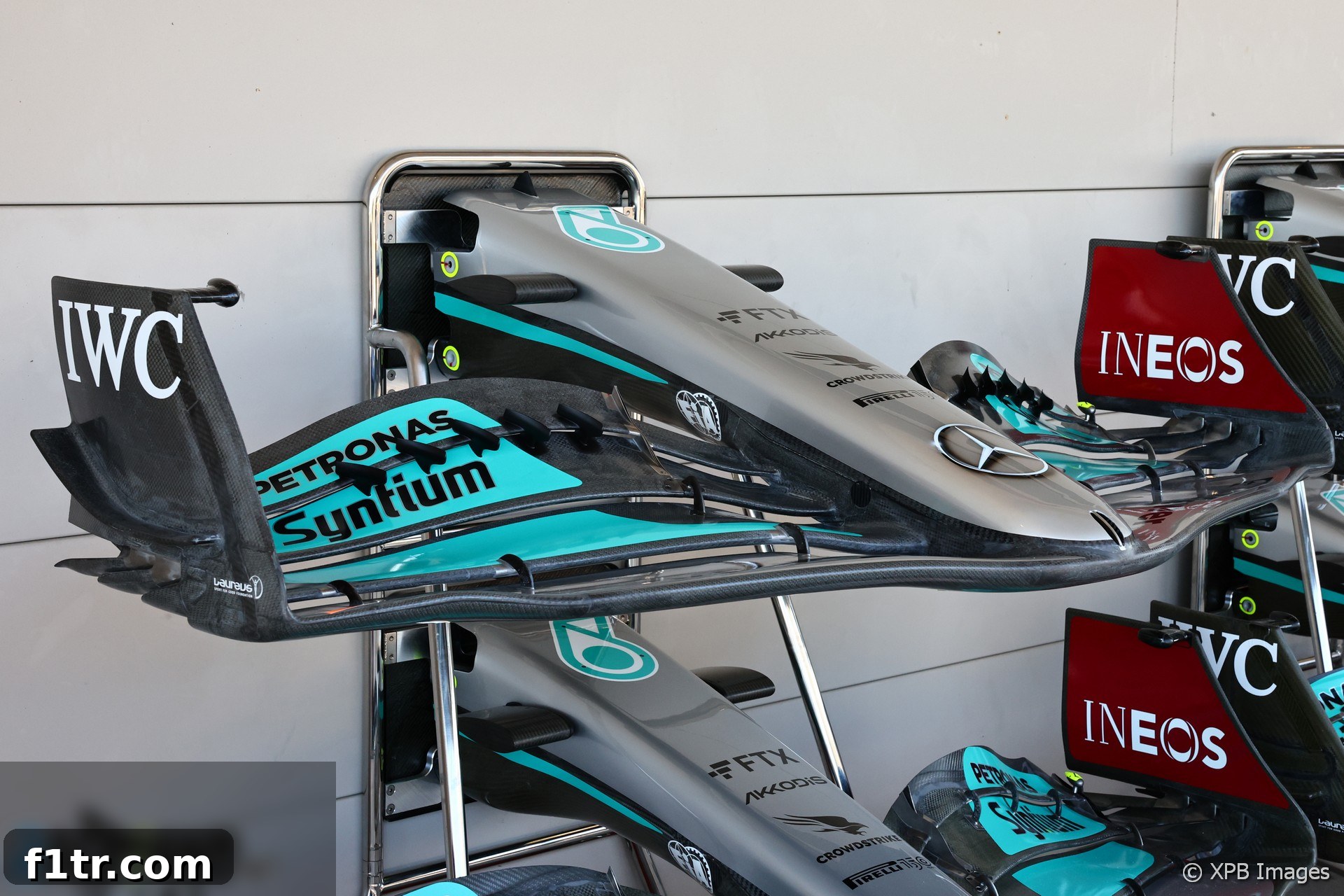
Front Wing Enhancements
Reason for change: Performance – flow conditioning
Difference: “Reduced camber front wing tip and additional slot gap separators added.”
Description: The front wing is the first element to interact with the oncoming airflow, dictating how the air is managed across the entire car. By reducing the camber on the front wing tip, Mercedes aims to lessen the local load at this critical point. This modification is designed to improve the onset flow to the front brake drum deflector, which plays a vital role in managing the turbulent air generated by the spinning front tires, commonly known as ‘tyre squirt.’ Better management of tyre squirt is paramount for directing cleaner, more energized airflow to the rest of the car, particularly towards the crucial underfloor and rear diffuser. Furthermore, the addition of slot gap separators enhances the rigidity of the final two front wing elements. This increased stiffness ensures that the wing maintains its intended aerodynamic profile more effectively, especially under high-speed loads, leading to more consistent and predictable front-end performance and improving the driver’s confidence when turning into corners.
Optimized Floor Fences
Reason for change: Performance – flow conditioning
Difference: “Small change to floor fence camber.”
Description: The floor fences are vertical elements positioned along the edge of the underfloor, crucial for sealing the turbulent air from escaping beneath the car and disrupting the ground effect. A subtle alteration to the camber of these floor fences is intended to refine the airflow quality traveling towards the rear of the car. This seemingly minor adjustment has a profound impact: by improving the flow structure, it directly contributes to an increase in diffuser load. The diffuser, located at the rear of the floor, is responsible for expanding the air volume and creating a low-pressure area, thereby generating significant downforce. Crucially, this upgrade aims to achieve this increased rear downforce without compromising the existing load at the front of the floor, ensuring a balanced aerodynamic platform that enhances overall stability and grip through high-speed corners and under heavy braking.
Refined Floor Edge Wing
Reason for change: Performance – local load
Difference: “Floor edge wing with increased forward chord.”
Description: The floor edge wing, a complex aerodynamic device running along the car’s side, plays a significant role in managing the airflow along the critical outer perimeter of the floor. By increasing the forward chord of this element, Mercedes engineers seek to amplify the local aerodynamic load generated by this specific part. This enhancement is designed to boost the total downforce produced by the floor without negatively impacting the efficiency of the main diffuser. Effectively, it helps to better seal the underfloor from external turbulence, allowing the car to operate more consistently and generate higher levels of grip, particularly in fast sweeping corners, which are abundant at COTA. This holistic approach ensures that downforce gains are achieved efficiently across the entire underfloor area.
Rear Wing Endplate Redesign
Reason for change: Performance – local load
Difference: “Reprofiled rear wing endplate.”
Description: The rear wing endplates are critical for optimizing the efficiency of the main rear wing elements. Their primary function is to contain the high-pressure air on the upper surface of the wing and the low-pressure air beneath it, preventing pressure equalization at the tips which would otherwise lead to drag-inducing vortices. By reprofiling the endplate, Mercedes has improved its alignment with the onset airflow across all on-track conditions. This optimization minimizes turbulent disturbances and maximizes the effective span of the rear wing, resulting in more upper rear wing load. A higher upper rear wing load translates directly into increased downforce at the rear of the car, providing greater stability, improved traction out of slow corners, and enhanced confidence for the drivers under high-speed demands and during braking zones. This upgrade complements the front and floor changes, working to balance the W13’s overall aerodynamic package.
Alpine’s Strategic Battle for Fourth Place
While Mercedes battles for their first win, Alpine is engaged in a tight and financially significant struggle for fourth place in the Constructors’ Championship against McLaren. The difference between fourth and fifth can amount to millions in prize money and crucial bragging rights. For the French outfit, every point counts, and their targeted upgrade package reflects this high-stakes scenario. Their development for COTA focuses on a single, yet impactful, area: the floor edge.
A Final Push: Alpine’s Floor Edge Upgrade
Reason for change: Performance – flow conditioning
Difference: “Compared to the previous version of the floor, an additional winglet has been added underneath the floor edge.”
Description: In modern Formula 1, the floor and its intricate details are paramount to generating ground effect downforce. Alpine’s engineers have introduced an additional winglet positioned underneath the floor edge. This clever addition is designed to meticulously control and improve the airflow reaching two critical areas: the tyre flank and the diffuser area. By optimizing the air’s path around the spinning tires, the winglet helps to mitigate the disruptive turbulent wake created by the wheels, ensuring cleaner air reaches the rear of the car. Simultaneously, it enhances the efficiency of the diffuser by providing it with more structured and energized airflow, leading to an increase in local downforce. This improvement in airflow conditioning and local load translates to better overall grip, particularly through cornering, and potentially a more efficient diffuser, reducing drag while maintaining or increasing downforce. Alpine has confirmed this update represents their final revision to the floor for the season, indicating a high degree of confidence in its potential impact on their battle for fourth place.
Alfa Romeo’s Bid for Stability and Points
Alfa Romeo began the 2022 season strongly but has experienced a significant downturn in performance in recent rounds. Having scored just a single point from the last nine races, the team finds itself under increasing pressure from rivals like Aston Martin, who have steadily chipped away at their championship lead. To halt this slide and regain their competitive edge, Alfa Romeo has also brought a crucial floor upgrade to Austin, aimed at bolstering the car’s stability and downforce.
Reconfiguring for Performance: Alfa Romeo’s Floor Body Update
Reason for change: Performance – local load
Difference: “Reconfigured the geometry of the forward part of the floor and modified the side curtains.”
Description: Alfa Romeo’s engineers have undertaken a significant overhaul of the floor’s central body and its side curtains. The forward section of the floor has been reprofiled, meaning its shape and contours have been adjusted to optimize how air flows underneath the car from its initial entry point. Concurrently, the side curtains – which are vertical elements designed to seal the floor and control airflow along its edges – have been modified. These comprehensive changes are engineered to produce substantial additional downforce across the entire underfloor area. More downforce translates directly into greater grip and higher cornering speeds. Furthermore, the updated floor aims to significantly improve the car’s stability, providing drivers with more confidence, especially during high-speed directional changes and heavy braking. This upgrade is a vital part of Alfa Romeo’s late-season push to stabilize their performance, secure more points, and defend their position in the Constructors’ Championship.
The Circuit of the Americas: A Unique Challenge for New Aerodynamics
The selection of the Circuit of the Americas for these crucial upgrades is no coincidence. COTA is renowned for its diverse and demanding layout, making it an excellent proving ground for new aerodynamic components. The track features a mix of high-speed sweeps reminiscent of Silverstone’s Maggots and Becketts, technical slow-speed sections, significant elevation changes, and notorious bumps. The ability to generate consistent downforce across varying speeds and through undulating terrain is paramount for success here.
Mercedes’ pursuit of higher downforce and improved ride quality is directly targeted at COTA’s inherent challenges. The front wing and floor modifications are designed to manage airflow efficiently through the long, fast esses of sector one, while the rear wing enhancements are critical for stability under braking into corners like Turn 11 and Turn 12, and traction out of slow corners. For Alpine and Alfa Romeo, their floor upgrades will be tested rigorously in these same demanding conditions, with every tenth of a second in enhanced grip and stability potentially making the difference in their championship fights.
The Broader Impact of F1 Aerodynamic Development
These upgrade packages for the United States Grand Prix highlight the relentless pace of development in Formula 1. Even as the season draws to a close, teams continue to push the boundaries of car performance, driven by the intense competition and the detailed understanding of aerodynamic principles. Under the current cost cap regulations, every upgrade must be meticulously planned and executed, making these final packages a strategic investment for immediate results and valuable data for future car development.
The insights gained from real-world testing at tracks like COTA are invaluable. They inform not only the remainder of the current season but also lay the groundwork for the next year’s challengers. The ongoing evolution of F1 car design, particularly in the complex realm of ground effect aerodynamics, means that even a small change can have a ripple effect throughout the entire car’s performance envelope. The race engineers and designers will be closely scrutinizing data from Friday practice sessions to assess the real-world impact of these significant upgrades.
As the teams prepare for battle in Austin, the stage is set for an exhilarating weekend. The performance of these newly introduced aerodynamic packages could very well decide the fate of Mercedes’ winless streak, bolster Alpine’s bid for fourth, or reignite Alfa Romeo’s points-scoring potential. The United States Grand Prix is more than just a race; it’s a showcase of cutting-edge engineering and strategic decision-making, promising high-octane action and potentially surprising results.