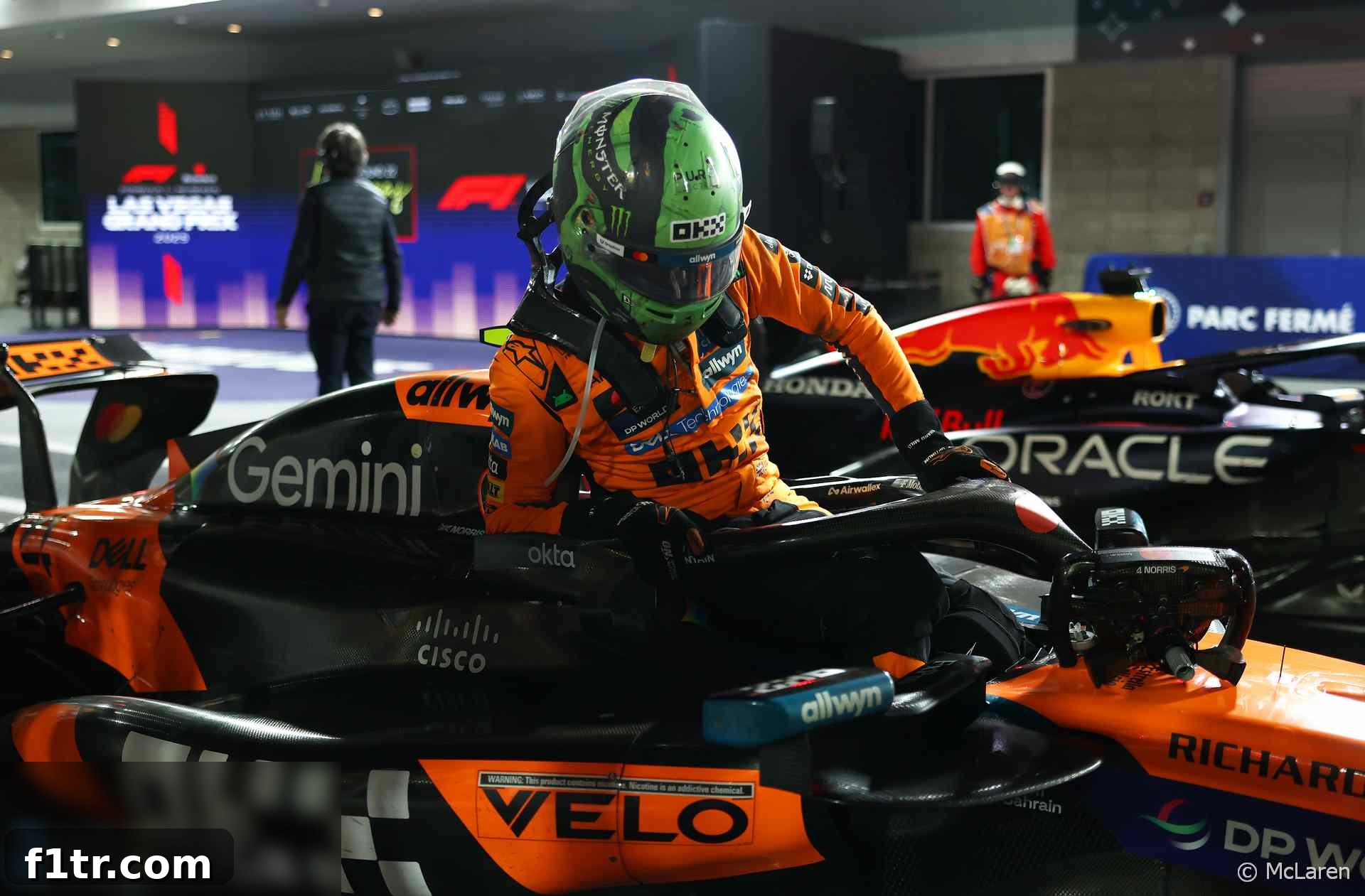
The high-stakes world of Formula 1 rarely sees a team of McLaren’s stature face a double disqualification, especially at a pivotal moment in the season. With nearly 1,000 Grands Prix under their belt – their 992nd event having just concluded – the recent Las Vegas Grand Prix marked an unprecedented event in their illustrious history: both cars, those of Lando Norris and Oscar Piastri, were disqualified. This extraordinary turn of events comes at a critical juncture, with the drivers’ and constructors’ championships finely balanced, amplifying the impact of losing crucial points and casting a shadow over what had been a promising weekend.
The post-race disqualification of Norris and Piastri stemmed from excessive plank assembly wear on their MCL39s. This technical infringement wasn’t just the first time McLaren left an event without a single point this year; it abruptly halted an impressive points-scoring streak that had become a testament to the team’s remarkable resurgence. The incident underscores the unforgiving nature of Formula 1 regulations, where even minor technical deviations can lead to severe penalties, regardless of on-track performance or driver skill. Such strict adherence to the rulebook is fundamental to maintaining fairness and competitive integrity in the sport.
The plank, a mandatory component of a Formula 1 car’s underbody, plays a crucial role in regulating a car’s ride height and preventing it from running excessively low to the ground. Introduced in the mid-1990s following a series of accidents and concerns about uncontrolled ground effect aerodynamics, its primary function is to limit the aerodynamic advantages gained when a car runs very close to the track surface. The plank has a specified minimum thickness of 10mm, with only a small allowance for wear – typically 1mm over the course of a race weekend. Any wear exceeding this permitted tolerance suggests that the car has been operating below the mandated minimum ground clearance for a significant period, potentially gaining an unfair aerodynamic advantage through increased downforce. In McLaren’s case, the excessive wear on both Norris’s and Piastri’s cars points to a significant technical oversight or miscalculation, likely related to suspension settings, car setup, or the inherent characteristics of the bumpy Las Vegas street circuit. This technical breach, despite not affecting the drivers’ on-track performance directly in terms of driving ability, is a strict violation of the sport’s regulations designed to maintain a level playing field and ensure both performance parity and driver safety.
The origins of McLaren’s recent success and their ascent back to the sharp end of the grid can be traced back to the 2023 Austrian Grand Prix. That event saw the introduction of a comprehensive and significantly updated car package, which dramatically transformed their MCL39 into a legitimate front-running contender capable of challenging for podiums and even victories. From that pivotal moment, McLaren embarked on a remarkable 59-race points-scoring run, a consistent display of performance, strategic acumen, and mechanical reliability that firmly re-established them among the sport’s elite. This sustained period of competitiveness not only brought the team valuable championship points but also rekindled the hopes of their fervent fanbase. This impressive streak, however, found its unexpected and unfortunate end on the glitzy yet challenging streets of Las Vegas, marking a somber conclusion to a period of consistent achievement.
Prior to the Las Vegas incident, McLaren was on course to achieve the longest such points-scoring run in their storied history, a testament to their improved engineering and operational excellence. The 59-round achievement, though significant and a clear marker of their current competitiveness, fell just short of their all-time record: a monumental 64-round streak. That previous record-setting period began at the 2010 Bahrain Grand Prix – the very race where Formula 1’s current top-10 scoring system was first implemented, fundamentally changing how points were awarded – and extended all the way to the Monaco Grand Prix three years later in 2013. That remarkable run was ultimately broken at the subsequent Canadian Grand Prix, where their drivers at the time, Jenson Button and Sergio Perez, finished 11th and 12th respectively, just outside the coveted points-paying positions. The intense competition of the current era, coupled with increasingly complex technical regulations, highlights the extraordinary difficulty of maintaining such consistent performance, making McLaren’s recent run all the more impressive, despite its premature conclusion in Las Vegas.
While the names of Button and Perez are associated with the end of a previous streak, neither of them ever faced disqualification while competing for McLaren. Indeed, the team’s last disqualification for *any* reason, regardless of the cause, dated back to 2009 with Lewis Hamilton, who was penalized for misleading stewards. However, a technical infringement leading to disqualification in a Grand Prix was an even rarer occurrence for McLaren, having not happened for a quarter of a century before the events of Las Vegas. This extended period highlights the team’s historical adherence to technical regulations and their meticulous engineering standards, making the recent incident a particularly poignant and surprising moment in their rich racing narrative, reminding everyone that in F1, no detail is too small to escape scrutiny.
| Year | Race | Driver | Notes |
|---|---|---|---|
| 1976 | British Grand Prix | James Hunt | Disqualified for illegally taking part in a race restart after his car was initially deemed irreparable following an accident. This controversial decision had significant implications for the world championship battle that year. |
| 1982 | Belgian Grand Prix | Niki Lauda | Disqualified after his McLaren MP4/1 was found to be underweight during post-race scrutineering, a harsh reminder of the tight technical margins in Formula 1’s golden age. |
| 1983 | German Grand Prix | Niki Lauda | Disqualified for reversing in the pit lane during the race, a clear breach of safety regulations that prohibits such maneuvers on pit lane. |
| 1985 | San Marino Grand Prix | Alain Prost | Found to be underweight after winning the race, resulting in a disqualification and the loss of a crucial victory. This incident underscored the constant technical scrutiny faced by top teams and their cars. |
| 1989 | Japanese Grand Prix | Ayrton Senna | Disqualified for rejoining the track in an illegal manner after his infamous collision with teammate Alain Prost at the chicane on lap 47. This decision had profound implications for the world championship outcome. |
| 1997 | Belgian Grand Prix | Mika Hakkinen | Disqualified due to a fuel sample mismatch, failing to comply with technical regulations regarding fuel composition. This strict rule ensures that all teams use compliant fuel. |
| 2000 | Brazilian Grand Prix | David Coulthard | Disqualified after his front wing was found to be too low during post-race inspection, an aerodynamic infringement that could provide an illegal performance advantage. |
| 2005 | Canadian Grand Prix | Juan Pablo Montoya | Disqualified for leaving the pits under a red light, a critical safety violation during a Safety Car period that puts other competitors and marshals at risk. |
| 2009 | Australian Grand Prix | Lewis Hamilton | Disqualified for misleading the stewards regarding an incident where Jarno Trulli overtook him under Safety Car conditions. This was a non-technical, sporting infringement relating to conduct. |
| 2025 | Las Vegas Grand Prix | Lando Norris | Disqualified due to excessive plank assembly wear, indicating his MCL39 ran below the mandated minimum thickness, thereby gaining an illegal aerodynamic edge. |
| 2025 | Las Vegas Grand Prix | Oscar Piastri | Also disqualified due to excessive plank assembly wear, mirroring his teammate’s infringement and highlighting a potential systemic setup issue for McLaren at this specific event. |
Beyond the disappointment of the disqualifications, Lando Norris achieved a significant personal milestone during the Las Vegas weekend, securing his 16th career pole position. This impressive feat now places him level with Formula 1 legends such as Felipe Massa and Stirling Moss in the all-time pole positions list, highlighting his growing stature in the sport. More remarkably, it was his third consecutive pole position, marking his first such hat-trick in Formula 1. This exceptional run of qualifying brilliance showcases Norris’s growing maturity, formidable raw pace, and consistent ability to extract maximum performance from the MCL39 on a single lap. His talent, coupled with McLaren’s improved machinery, has made him a formidable force on Saturdays, demonstrating that even amidst controversy, individual excellence can shine through.
Norris’s achievement of three consecutive poles is a rare accomplishment in modern Formula 1, underscoring the intense competition at the front of the grid. No driver had managed such a hat-trick since Max Verstappen’s extraordinary and dominant run of eight consecutive pole positions, which spanned from the final race of the 2023 season into the current one, a period of unparalleled qualifying supremacy. Before Verstappen’s remarkable streak, the last driver to achieve a hat-trick of poles was Charles Leclerc, who managed an impressive four consecutive pole positions early in the 2022 season for Ferrari. This statistic further emphasizes the exceptional nature of Norris’s qualifying form and his ability to consistently challenge the very best in the sport, solidifying his reputation as one of F1’s top qualifiers, even if the team’s weekend ultimately ended in controversy.
Meanwhile, the Las Vegas Grand Prix also saw Max Verstappen continue his dominant march through the 2025 season. He secured his sixth Grand Prix victory of the year and his second consecutive win at the unique Las Vegas street circuit, further extending his impressive record. Verstappen’s mastery of race management, combined with his Red Bull car’s unparalleled performance, saw him further extend his lead in the championship standings. He has now led a staggering 391 laps this season, demonstrating his incredible control and consistent pace at the front of the field. For context, this puts him 20 laps ahead of Lando Norris, despite Norris’s strong qualifying performances, and just 11 laps shy of Oscar Piastri’s season total, illustrating the significant amount of time Verstappen consistently spends in the lead compared to his nearest rivals, cementing his status as the driver to beat.
The Las Vegas race also contributed to a growing trend this season, being the sixth time this year there were no lead changes after the first lap of the race. This particular statistic indicates a certain predictability in the race dynamics once the initial chaos of the start subsides and the cars settle into their rhythm. This figure is one more than last season and matches the count from the 2023 season, suggesting that factors such as track design, minimal car performance gaps once DRS is enabled, or conservative strategic approaches might be contributing to fewer overtakes for the lead once the race settles, potentially raising questions about the excitement level of certain Grand Prix.
The ramifications of McLaren’s double disqualification extended far beyond their own garage, leading to a significant redistribution of points across the Constructors’ Championship, reshaping the battles for crucial positions. Mercedes emerged as one of the primary beneficiaries, getting both their drivers onto the podium for the second time this year, a strong showing for the Silver Arrows. Andrea Kimi Antonelli delivered a particularly impressive performance, making a remarkable charge from a 17th-place grid start to secure a provisional third-place finish, showcasing his talent and potential. This reshuffle allowed Mercedes to tighten their grip on second place in the Constructors’ Championship, now holding a comfortable 40-point advantage over Red Bull, significantly bolstering their position as the season draws to a close and intensifying the fight for championship runner-up honors. The incident has thus injected fresh drama into the battle for championship positions, highlighting how quickly fortunes can change in the volatile world of Formula 1.
Haas also saw a welcome uplift in their championship standing due to the post-race adjustments following McLaren’s penalty. Oliver Bearman and Esteban Ocon, who originally finished just outside the points in 11th and 12th respectively, were promoted into the final two points-scoring positions in the top 10. These crucial three points allowed Haas to leapfrog Aston Martin in the championship standings, marking a significant boost for the American team and demonstrating the immense value of every single point, especially for midfield competitors. For smaller teams, such unexpected gains can have a profound impact on their budget, development plans, and overall morale for the upcoming seasons, making the Las Vegas disqualifications a bittersweet but ultimately beneficial moment for some competitors while being devastating for others.
Lewis Hamilton, too, experienced a mixed bag of fortunes following the race. While he originally finished 10th, the disqualifications ahead of him meant he gained two additional points, moving him up the order and providing a small boost to his individual tally. However, the weekend also delivered a rare and notable blow to the seven-time world champion: he qualified last ‘on pace’ for the first time in his illustrious career, a truly uncharacteristic performance for the Briton. Although he ultimately started 19th on the grid due to Yuki Tsunoda starting from the pit lane, the raw qualifying performance was a stark reminder of the underlying challenges he and Mercedes have faced at times this season in extracting consistent single-lap pace. This unusual qualifying result stands out in a career defined by consistent excellence, adding another layer to the narrative of an unpredictable and tightly contested 2025 Formula 1 season.
The 2025 Las Vegas Grand Prix will undoubtedly be remembered for its dramatic conclusion and the significant implications of McLaren’s double disqualification. It serves as a stark reminder of the technical precision, regulatory adherence, and operational excellence demanded at the pinnacle of motorsport. The fluctuating fortunes experienced by various teams and drivers post-race underscore the razor-thin margins and intense scrutiny that define Formula 1. As the championship battles intensify and the season progresses, every point becomes more valuable, and the events of Las Vegas have certainly added an unexpected and unforgettable twist to the unfolding narrative.
Over to you
Have you spotted any other interesting stats and facts from the Las Vegas Grand Prix? Share them in the comments section below, and join the discussion about this memorable and controversial race weekend.
2025 Las Vegas Grand Prix Related Content
- Losing win through strategy error “hurts more” than Las Vegas disqualification – Piastri
- FIA feels McLaren’s Las Vegas GP disqualification is “draconian”, claims Brown
- Why did McLaren’s messages to Norris and Piastri not mention plank problems?
- McLaren explain Las Vegas disqualifications – including their “counterproductive” reaction
- McLaren’s first double disqualification ended their second-longest points streak
Browse all 2025 Las Vegas Grand Prix articles