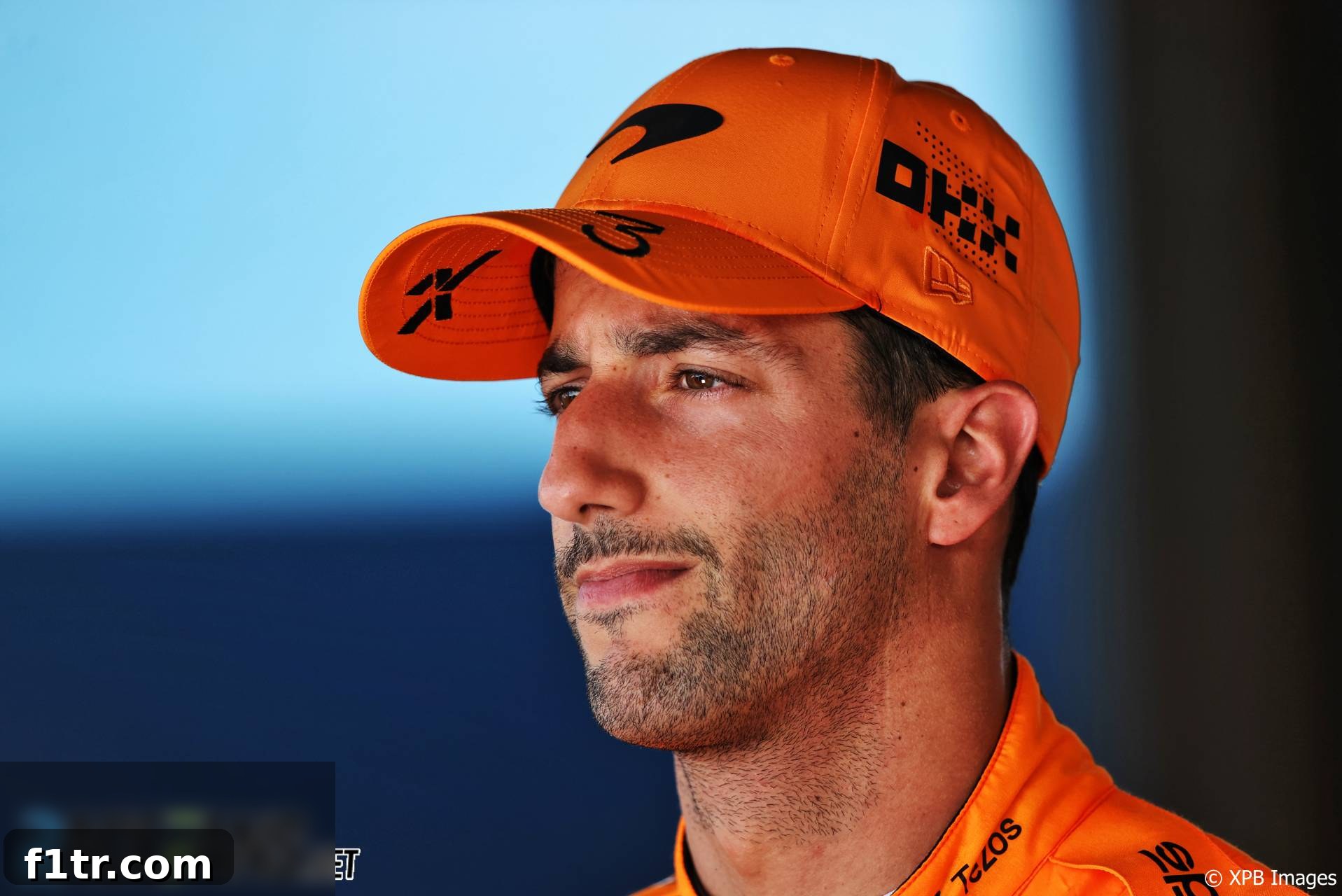
Daniel Ricciardo at McLaren: A High-Stakes Dilemma and the Future of a F1 Career
When McLaren proudly announced in 2020 that Daniel Ricciardo would be joining their Formula 1 squad for the 2021 season, filling the void left by Carlos Sainz Jnr, it resonated across the paddock as an almost perfect alignment. The Woking-based team was poised to gain an established Grand Prix winner, a driver with nine-and-a-half seasons of top-tier experience, who had impressively steered Renault to multiple podium finishes during the 2020 campaign. Partnering him with the highly promising talent of Lando Norris, McLaren CEO Zak Brown and team principal Andreas Seidl had every reason to feel optimistic about the team’s trajectory and competitive future.
However, the reality that unfolded in the subsequent seasons starkly contrasted with those initial high expectations. Whatever McLaren, Ricciardo, or their legions of fans envisioned, it was certainly not the consistent pattern of underwhelming results and a significant performance gap that emerged. Across 35 races together, the difference in total points scored between Norris and Ricciardo swelled to a staggering 102, a clear indicator of the struggles faced by the seasoned Australian driver. As Formula 1 observed its traditional summer break, a flurry of rumors and credible reports began to circulate, strongly suggesting that McLaren was actively seeking a way to terminate their contractual commitment with Ricciardo for the 2023 season. This complex situation was further entangled with the highly publicised dispute involving rising star Oscar Piastri and the Alpine F1 team, painting a tumultuous picture for the driver market.
This raises a critical question that has divided opinions among fans and pundits alike: Would McLaren be justified in dropping Daniel Ricciardo, undoubtedly one of the most successful drivers of his generation, merely halfway through their agreed three-season deal? The answer is far from straightforward, requiring a deep dive into performance metrics, team dynamics, contractual obligations, and the unpredictable nature of top-tier motorsport.
The Case for a Change: Why McLaren Might Need to Act
A Disappointing Tenure Unfolds
In the fiercely competitive landscape of 21st-century Formula 1, it is genuinely challenging to recall a driver signing that has proven as underwhelming as Daniel Ricciardo’s arrival at McLaren. This sentiment is amplified when one considers the impressive accolades and race-winning prowess Ricciardo displayed during his prior stints at Toro Rosso, Red Bull Racing, and Renault. Rather than embodying the role of an experienced, leading figure within the team’s driver lineup, Ricciardo has, with disarming regularity, appeared to be the junior driver when benchmarked against Lando Norris, a talent who is quite literally two-thirds his age. Their time sharing the McLaren garage has seen Norris secure five impressive podium finishes, while Ricciardo has managed to claim only a single one, despite his extensive career experience.
The Elusive “Reset” of 2022
Ricciardo’s difficult and challenging first season with McLaren in 2021 was often excused, and perhaps rightly so, due to the inherent difficulties in adapting to a new car, particularly one that was largely an evolution of its 2020 predecessor. Indeed, many other drivers who switched teams that season also grappled with similar struggles relative to their new teammates. However, the 2022 season, with its radical overhaul of technical regulations and entirely new car designs, was widely heralded as a crucial “reset” for Ricciardo, offering him a pristine opportunity to start afresh and demonstrate his true potential. Yet, the stark reality is that his performance deficit to Norris has, if anything, grown even larger than it was previously.
McLaren finds itself locked in an intense and critical battle with Alpine for the coveted fourth position in the Constructors’ Championship, a position that carries significant financial and reputational rewards. In this high-stakes contest, the team simply cannot afford to be reliant solely on Lando Norris to spearhead their challenge. Alpine’s Fernando Alonso and Esteban Ocon have consistently delivered regular points finishes for their team, highlighting the necessity for both McLaren drivers to perform at a high level. That Ricciardo’s struggles have not only persisted but seemingly deepened in 2022 is the most profoundly worrying sign for McLaren’s management. With no discernible or compelling explanation for why he appears unable to extract his peak performance from the car, there is little to suggest that anything will magically transform or improve during a hypothetical third season. Making the difficult but decisive call to part ways now and pursue an alternative direction for the upcoming season, while undoubtedly tough, could ultimately prove to be the most prudent long-term strategic decision for the team’s ambitious goals.
Glimpses of the Old Ricciardo
While Daniel Ricciardo’s performances with McLaren thus far have undeniably been underwhelming relative to his proven calibre, it does not automatically follow that prematurely giving up on him would represent the optimal solution to his enduring struggles. On several notable occasions throughout this season, he has unequivocally demonstrated his capacity to run competitively with Lando Norris in races, and at specific points, has even showcased superior pace, only for strategic team orders or race circumstances to come into play. His commendable drives at his home Grand Prix in Australia and during the challenging Azerbaijan Grand Prix serve as compelling evidence that he is clearly capable of matching, if not exceeding, Norris’s on-track performance when he manages to get on top of the car’s complex characteristics and finds his rhythm.
The Risks of the Unknown
Furthermore, while the concept of replacing Ricciardo with one of the many alternative driving talents currently associated with McLaren might seem overtly appealing on paper, it simultaneously carries its own significant set of inherent risks. Offering a coveted Formula 1 seat to any of the IndyCar drivers who have tested with the team or signed development contracts would constitute a bold and potentially perilous gamble. History is replete with examples where such cross-series transitions have often failed to yield the desired results, underscoring the unique demands and driving styles required in Formula 1. Similarly, Oscar Piastri, despite his glittering and highly successful junior career, remains a rookie. His transition to the pinnacle of motorsport would inevitably come with a degree of unknowns and a steep learning curve, potentially creating a new set of challenges for the team.
Finding the “Magic Solution”
Finally, there is the undeniable and demonstrably powerful factor that Daniel Ricciardo has clearly not lost his innate race-winning abilities. After securing an impressive seven career victories with Red Bull Racing during his five highly successful seasons with the team, Ricciardo’s pedigree as a proven Grand Prix winner was firmly established. The single, solitary instance where he came tantalizingly close to sniffing victory during his tenure in papaya – back at Monza in 2021 – saw Ricciardo deliver McLaren’s first win in almost a decade, triumphing over his teammate Lando Norris in the process. This victory served as a potent reminder of his exceptional talent and capability when everything aligns.
It might indeed be a formidable challenge to identify precisely what changes could be implemented to help bring Ricciardo back to his absolute best once more. However, if that elusive “magic solution” can somehow be unearthed by McLaren’s engineers and strategists, the team could very well unlock the truly world-class driver they had initially hoped to acquire when they first penned his contract. By prematurely giving up on him now, McLaren would irrevocably forfeit any remaining chance of ever achieving that potentially transformative breakthrough and reaping the rewards of his undeniable talent.
The Author’s Perspective: A Justified Decision?
In countless professional sports environments, there are abundant examples of teams succumbing to the powerful influence of the so-called “sunk-cost fallacy.” This cognitive bias dictates the misguided notion that it is preferable to rigidly adhere to a past decision, rather than altering course, purely because of the substantial level of investment – be it financial, emotional, or time-related – that has already been poured into it. By actively contemplating the replacement of Daniel Ricciardo, McLaren’s leadership is demonstrating a clear and commendable strategic intent to consciously avoid making such a potentially costly mistake themselves.
If McLaren were to indeed proceed with this challenging decision, they would be entirely justified in doing so. Ricciardo’s illustrious achievements throughout his career so far have undeniably proven his stature as a formidable and consistently high-performing driver. Rather than merely securing facile victories in a superior, dominant car, almost all of his Grand Prix triumphs have been the result of hard-fought, gritty battles in machinery that was not inherently the class of the field. Such feats are simply not accomplished by a driver who is fundamentally lacking elite-level talents or the requisite mental fortitude to compete at the very pinnacle of Formula 1.
However, the uncomfortable truth remains that Ricciardo’s performances since joining McLaren have, by and large, regrettably failed to live up to any reasonable or objective expectations that his team, or indeed anyone within the informed Formula 1 paddock, could realistically have harboured for him. His challenging first season could, perhaps, be generously excused given the unique circumstances and the steep learning curve associated with adapting to a new car and environment. But the incontrovertible fact that his woes have not only persisted but have demonstrably continued into his second season – and that the performance chasm to his teammate Lando Norris in the standings has only grown wider – signifies a critical juncture. This persistent underperformance means that McLaren is entirely within its legitimate rights to not only question their ongoing commitment to him for a third contractual season but to actively and proactively explore alternative directions for their driver lineup.
These two undeniably difficult years do not necessarily equate to Ricciardo being “washed” or somehow having irrevocably lost his signature edge or potent efficacy as a racing driver. It would, in fact, not be entirely shocking to witness him relocate to a different team and swiftly begin to demonstrate his exceptional skills and competitive fire once again. Nevertheless, for McLaren specifically, it is a straightforward and pragmatic matter of return on investment. The team has dedicated immense effort, significant time, and substantial financial resources to integrate and unlock the “great Daniel Ricciardo” they had observed performing at an elite level for many years prior. Despite these considerable investments, he has simply failed to consistently provide them with a worthwhile and competitive return on the track. This pragmatic reality, coupled with their championship aspirations, forms the bedrock of McLaren’s difficult, yet arguably necessary, considerations for the future.
Debates and polls
- What must Formula 1 fix with its new rules – and what should it leave unchanged?
- ADUO: Do F1 teams who fall behind deserve to get help to catch up?
- F1 is considering doubling its sprint races. Do you want more or fewer?
- Will this be a fight or a rout? 20 questions for the 2026 Formula 1 season
- Which Formula 1 team has the best-looking car – and the worst – for the 2026 season?
Browse all debates and polls