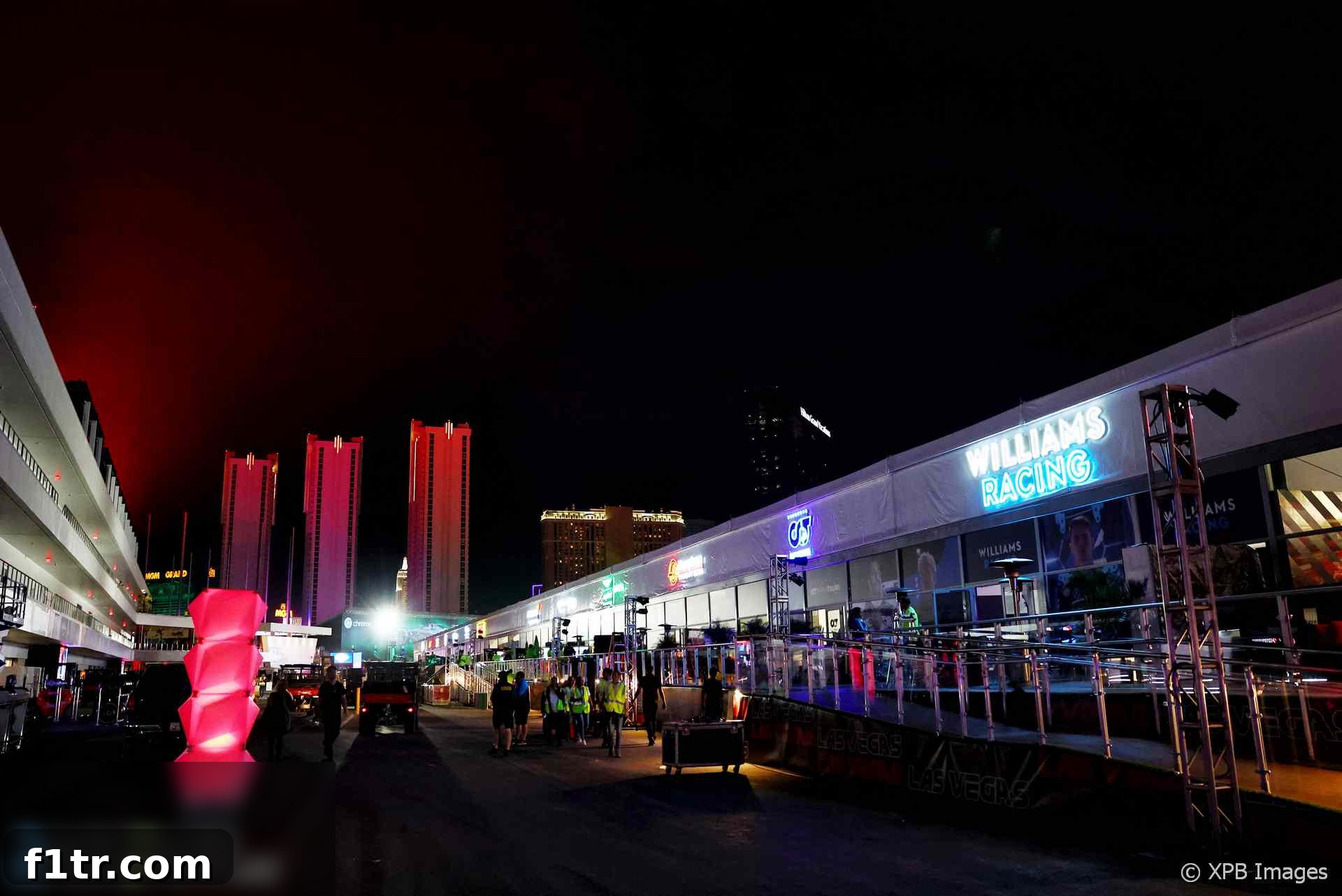
The Las Vegas Grand Prix: A Deep Dive into F1’s Return to Sin City
The highly anticipated Las Vegas Grand Prix marks a thrilling new chapter on the Formula 1 calendar, but it’s not the first time the pinnacle of motorsport has graced the iconic city. While this iteration, with its spectacular street circuit cutting through the heart of the Strip, is a groundbreaking event, it represents the third occasion Las Vegas has welcomed the world championship. This rich history, spanning decades and different eras of Formula 1, underscores the sport’s complex relationship with the United States and its enduring pursuit of a prominent presence in the lucrative American market.
The Desert’s First Dance: The Caesars Palace Era (1981-1982)
Formula 1 first ventured into Las Vegas in 1981 and 1982, not on the sprawling Strip we know today, but within the confines of a makeshift circuit laid out in the car park of the Caesars Palace hotel. These were unique, albeit somewhat controversial, events in Formula 1 history. The 1981 Caesars Palace Grand Prix saw Australian legend Alan Jones take victory for Williams, clinching a memorable win. The following year, Michele Alboreto secured his first Formula 1 victory for Tyrrell at the same venue.
Despite the spectacle of holding a Grand Prix in Las Vegas, the circuit itself faced criticism. Designed as a tight, counter-clockwise layout with minimal overtaking opportunities and set against the rather unglamorous backdrop of a car park, it lacked the iconic status and challenge of traditional F1 tracks. The oppressive desert heat also proved a significant physical challenge for drivers. Crucially, the absence of racing down the city’s famous Strip – a feature that defines the modern Las Vegas Grand Prix – meant these early races struggled to truly capture the imagination and identity of their host city. As a result, after just two seasons, the Caesars Palace Grand Prix fell off the F1 calendar. Interestingly, the circuit found a new life, being adopted by the CART series for its 1983 and 1984 seasons, showcasing the adaptability of American motorsport.
America’s Enduring Love-Hate Relationship with F1: Street Circuits of the 80s
The experience of the Caesars Palace Grand Prix mirrored a broader trend for Formula 1 in the United States during the 1980s. The sport experimented with a variety of street circuits, often encountering mixed success and logistical challenges. Two other notable American venues hosted F1 races in the same period as Las Vegas’s initial foray: Long Beach and Detroit.
The Long Beach Grand Prix, situated on the picturesque streets of California, enjoyed a more successful run, hosting Formula 1 from 1976 to 1983. It became a beloved fixture, renowned for its challenging layout and vibrant atmosphere. After F1’s departure, Long Beach seamlessly transitioned to become a cornerstone of the IndyCar calendar, a position it has held ever since, cementing its status as one of America’s premier motorsport events.
Detroit also hosted Formula 1, albeit with a shorter and more tumultuous tenure, from 1982 to 1988. The downtown street circuit, known for its tight corners and bumpy surface, presented a stern test for drivers and machinery. Following F1’s exit, CART took over the Detroit track from 1989 to 1991. The event later relocated to Belle Isle, a scenic island park. Remarkably, in a nod to its heritage, the Detroit Grand Prix returned to its downtown roots this year, utilizing sections of the very roads that formed F1’s original challenging track, bringing motorsport full circle in the Motor City.
The United States: A Land of Many Circuits and Multiple Races
The 2023 Las Vegas Grand Prix holds particular significance as it represents the 12th different circuit in the USA to host a Formula 1 Grand Prix in the sport’s 74-year history. This impressive number highlights the vast and diverse landscape of American motorsport, from purpose-built road courses to iconic street circuits. Only 13 countries globally have hosted Formula 1 at more than one track, with traditional powerhouses like France leading with seven different circuits, followed by Spain with six. Britain, Italy, and Portugal have each utilized four distinct venues for races, underscoring their deep roots in Grand Prix racing.
Perhaps even more strikingly, the USA is among a select group of nine nations to have held more than one round of the world championship in a single season. This multi-race format in the US dates back to 1959 and 1960, and then again consistently from 1976 to 1981, followed by 1983, 1984, and most recently, last year. The 2023 season is a prime example of F1’s renewed focus on America, featuring races in Miami, at the renowned Circuit of the Americas in Austin, and now in Las Vegas. This makes the Las Vegas event F1’s third visit to the United States within a single year – a testament to the sport’s aggressive expansion strategy in the region.
The last time F1 staged three races in the same country within one season was in 1982, with events in Long Beach, Detroit, and the original Las Vegas. The only other season to feature such an unprecedented triple header in a single nation was the pandemic-disrupted 2020 campaign. During that extraordinary year, Formula 1 had to hastily arrange three visits to Italy – to the legendary Monza, the challenging Imola, and the picturesque Mugello – to compensate for rounds canceled elsewhere due to global travel restrictions. This contextualizes the significance of the 2023 US triple-header, demonstrating F1’s commitment to the American market.
While the USA boasts an impressive tally of 13 years with multiple F1 races, matching Germany’s record, it is Italy that stands alone with an astonishing 30 seasons featuring multiple rounds. This statistic underscores Italy’s historical importance to Formula 1, home to iconic teams and passionate fans, and a consistent presence on the calendar since the sport’s inception.
A Milestone Event: The 1,100th Grand Prix
The Las Vegas Grand Prix is poised to be a landmark occasion for Formula 1, marking the 1,100th round of the world championship. While this number is a significant milestone, it’s important to acknowledge the historical nuances of F1’s early calendars. The figure isn’t strictly representative of 1,100 Formula 1-specific races, as 15 of these early events, primarily in 1952 and 1953, were run for Formula 2 cars. Furthermore, the iconic Indianapolis 500, a staple of American motorsport, was included on the first F1 calendars for 11 editions, despite being run with IndyCars. These historical inclusions allowed the fledgling world championship to bolster its event count and global reach in its formative years.
This 1,100th round also marks the 76th Grand Prix to be held in the United States, further cementing its place in F1 history. Only a handful of countries have hosted more races: Italy leads with 105, followed by Germany with 79, and Britain closely behind with 78. These nations represent the traditional heartlands of Formula 1, consistently hosting races and contributing significantly to the sport’s legacy. The USA’s growing number of events signals a potential shift in F1’s global footprint.
A Weekend of Firsts: The Saturday Race Phenomenon
One of the most distinctive features of the Las Vegas Grand Prix is its highly unusual timetable. For the first time since the 1985 South African Grand Prix, a Formula 1 weekend will conclude with the main race on a Saturday evening. This unique scheduling sees practice sessions taking place on Thursday and Friday, followed by qualifying as the clock strikes midnight, effectively marking the very beginning of Saturday, with the Grand Prix itself commencing at 10 PM local time that evening. This departure from the traditional Sunday race schedule is a bold move, designed to maximize viewership and align with the vibrant nightlife culture of Las Vegas.
The last 680 Grands Prix have all been held on a Sunday, making this Saturday race a rare occurrence indeed. The Las Vegas Grand Prix will be the 70th race in the world championship to be held on a Saturday, and the 86th overall not to take place on a Sunday. Throughout its history, Formula 1 has, remarkably, raced at least once on every day of the week. The United States holds the unique distinction of having hosted the only F1 races to be held on a Tuesday, Wednesday, and Thursday. These were all editions of the Indianapolis 500 during its brief inclusion on the F1 calendar in the 1950s, highlighting the historical anomalies and unique scheduling traditions of American motorsport.
This trend of Saturday races is not just a one-off for Las Vegas. Remarkably, three of the next four Grands Prix on the F1 calendar are scheduled to be held on Saturdays. While normal service is expected to resume at the subsequent Abu Dhabi Grand Prix, the first two races on the 2024 F1 calendar are also scheduled for Saturdays. Given that these early 2024 races are held much further east, they will appear live on Saturday for a significantly larger global audience, including millions of fans in Europe, unlike the late-night Las Vegas event. This strategic scheduling demonstrates a growing flexibility within F1 to cater to different markets and broadcasting windows.
Alonso’s Longevity and Historical Connections
Two-time world champion Fernando Alonso will embark on his 17th US F1 race this weekend, a testament to his incredible longevity in the sport. Not only is Alonso, now in his early forties, old enough to faintly remember the last time the paddock packed up on a Saturday (though admittedly he was only four years old during the 1985 South African Grand Prix), but he is also the only active Formula 1 driver who was alive when the series last raced in Las Vegas in 1982. This unique historical connection adds another layer of intrigue to his participation, linking the modern era with F1’s past in Sin City.
While many of today’s F1 teams are relatively young or have undergone significant transformations, three iconic names that graced the grid at the original Las Vegas races in the early 1980s are still present today: Williams, Ferrari, and McLaren. Among them, only one active team can already claim to have tasted victory in Las Vegas: Williams, who powered Alan Jones to his triumphant win in the 1981 edition of the event. The 1982 race saw Michele Alboreto secure victory for Tyrrell, a team whose entry was later acquired by BAR, which eventually evolved into the dominant Mercedes-AMG Petronas F1 Team of today. Other teams present at that last Vegas race included Toleman, which, after several ownership changes over the years, ultimately became the Alpine team we know today, and Alfa Romeo, which, in its current form, operates as a completely separate entity run from Switzerland but utilizes the illustrious Italian marque’s name to brand its cars.
Championship Drama in the Desert
The original two races in Las Vegas hold a special place in Formula 1 lore for another significant reason: they both served as championship-deciding season finales. The unforgiving desert circuit became the backdrop for intense title battles. In 1981, Nelson Piquet famously clinched his first world championship by finishing fifth in the Caesars Palace Grand Prix, a result just enough to secure the coveted crown. His successor, Keke Rosberg, mirrored this achievement in 1982, also securing his maiden world championship with a fifth-place finish in the season-ending Las Vegas race. These dramatic conclusions cemented Las Vegas’s brief but impactful role in Formula 1 history as a place where champions were crowned.
However, despite its championship significance, the original Las Vegas track only enjoyed a short two-year stint on the Formula 1 calendar. This fleeting presence highlights the transient nature of many circuits in F1’s history. Looking back at the 1982 calendar, only five of the circuits that hosted races that year remain on the schedule to this day. Four of these enduring venues are in Europe, representing the traditional heartlands of F1, while the fifth is the beloved Circuit Gilles Villeneuve in Canada, a testament to its enduring appeal and challenge.
2023 Las Vegas Grand Prix: Related Content
- Tost blames track inspection oversight for Sainz’s damage in Las Vegas
- Hard to repeat “rare” combination of factors behind Vegas shunt – Norris
- Las Vegas Grand Prix “got a lot more hate than it deserved” – Sargeant
- Williams’ “incredible” Vegas qualifying made us “poor” in race – Vowles
- Piastri is first rookie to take two fastest laps in a season since Hamilton
Browse all 2023 Las Vegas Grand Prix articles
The Las Vegas Grand Prix may be the first race with that title to appear on the Formula 1 calendar, but it is the third time the city has hosted the world championship.
Advert | Become a Supporter & go ad-free
The car park of the Caesars Palace hotel was used for races in 1981 and ‘82, but with no chance of getting to race down the city’s iconic Strip – as F1 will be doing this weekend – the Caesars Palace Grand Prix dropped off the calendar and was picked up by CART for its 1983 and ‘84 seasons.
It was a similar story for other street circuits in the USA in the eighties, including the two other venues in the country F1 visited in the same year as its last race in Las Vegas. Long Beach hosted F1 from 1976 to 1983 and has been on the IndyCar calendar ever since.
F1 raced in Detroit from 1982 to 1988, before CART took over the track from 1989 to 1991. That race was subsequently relocated to Belle Isle, but returned to downtown Detroit this year and used some of the roads which formed F1’s original track.
The new Las Vegas track will be F1’s 12th circuit in the USA in its 74-year history. Only 13 countries in total have hosted F1 at more than one track, with France having seven different circuits and Spain having six while Britain, Italy and Portugal have each used four different venues for races.
Perhaps unsurprisingly, the USA is among the nine nations to have held more than one round of the world championship in a season, having held two races in 1959 and 1960, then again from 1976 to 1981, 1983, 1984 and most recently last year. In 2023 there have already been races in Miami and at the Circuit of the Americas, meaning Las Vegas will be F1’s third trip to the USA within a year.
It last did that in 1982, with races in Long Beach, Detroit and Las Vegas. The only other season to feature three races in the same country was the pandemic-disrupted 2020 campaign where F1 had to hastily arrange three visits in Italy – to Monza, Imola and Mugello – to make up for cancelled rounds elsewhere.
Advert | Become a RaceFans supporter andgo ad-free
Although the USA has had an impressive tally of 13 years with multiple F1 races, which matches Germany, there have been 30 seasons featuring multiple Italian rounds.
The Las Vegas Grand Prix will be the 1,100th round of the world championship. Of course this isn’t strictly the 1,100th F1 race, as 15 of those events were run for Formula 2 cars in 1952 and 1953 while IndyCars were used for the 11 editions of the Indianapolis 500 that were on the first F1 calendars, and the 76th to be held in the USA. Only Italy (105), Germany (79) and Britain (78) have hosted more.
Advert | Become a RaceFans supporter andgo ad-free
For the first time since the 1985 South African Grand Prix an F1 weekend will finish on a Saturday (if everything goes to plan) courtesy of the Las Vegas Grand Prix’s unusual timetable. Practice sessions take place on Thursday and Friday, followed by qualifying as the clock strikes midnight to mark the start of Saturday and then the race at 10pm that evening.
The last 680 grands prix have been held on Sunday, and this weekend’s race will be the 70th in the world championship to be held on a Saturday and the 86th to not take place on a Sunday, with F1 having raced at least once on every day of the week. The USA is responsible for the only F1 races to be held on Tuesday, Wednesday and Thursdays, all being editions of the Indy 500 when it was on the calendar in the fifties.
Advert | Become a Supporter & go ad-free
Remarkably, three of the next four grands prix will be held on Saturdays. While normal service will resume at next week’s Abu Dhabi Grand Prix, the first two races on the 2024 F1 calendar are also scheduled for Saturdays. And as those races are held much further east, they will appear live on Saturday for many more fans, including those in Europe, unlike this weekend’s event.
Fernando Alonso will embark on his 17th US F1 race this weekend. Not only is he old enough to remember the last time the paddock got packed up on a Saturday (though admittedly he was four at the time), he is also the only active F1 driver who was alive when the series last raced in Las Vegas.
Williams, Ferrari and McLaren were on the grid at the time. Only one active team can already claim to have won in Las Vegas: Williams, who took Alan Jones to victory in the 1981 edition of the event. Michele Alboreto won the 1982 event for Tyrrell, whose entry was later bought by BAR, who ultimately became Mercedes.
Also present for that last race in Vegas were Toleman (which after several ownership changes over the years became the Alpine team of today) and Alfa Romeo (which in its current form is a completely separate entity run from Switzerland but using the Italian marque’s name to brand its cars).
The first two races in Las Vegas also had the distinction of being the championship-deciding season finales. Both 1981 champion Nelson Piquet and his successor Keke Rosberg clinched their crowns with fifth place finishes in those races.
The original Las Vegas track only lasted two years with F1, and only five of the circuits that F1 raced on in 1982 remain on the calendar to this day. Four are in Europe, and the other is Canada’s Circuit Gilles Villeneuve.
Advert | Become a RaceFans supporter andgo ad-free
2023 Las Vegas Grand Prix
- Tost blames track inspection oversight for Sainz’s damage in Las Vegas
- Hard to repeat “rare” combination of factors behind Vegas shunt – Norris
- Las Vegas Grand Prix “got a lot more hate than it deserved” – Sargeant
- Williams’ “incredible” Vegas qualifying made us “poor” in race – Vowles
- Piastri is first rookie to take two fastest laps in a season since Hamilton
Browse all 2023 Las Vegas Grand Prix articles