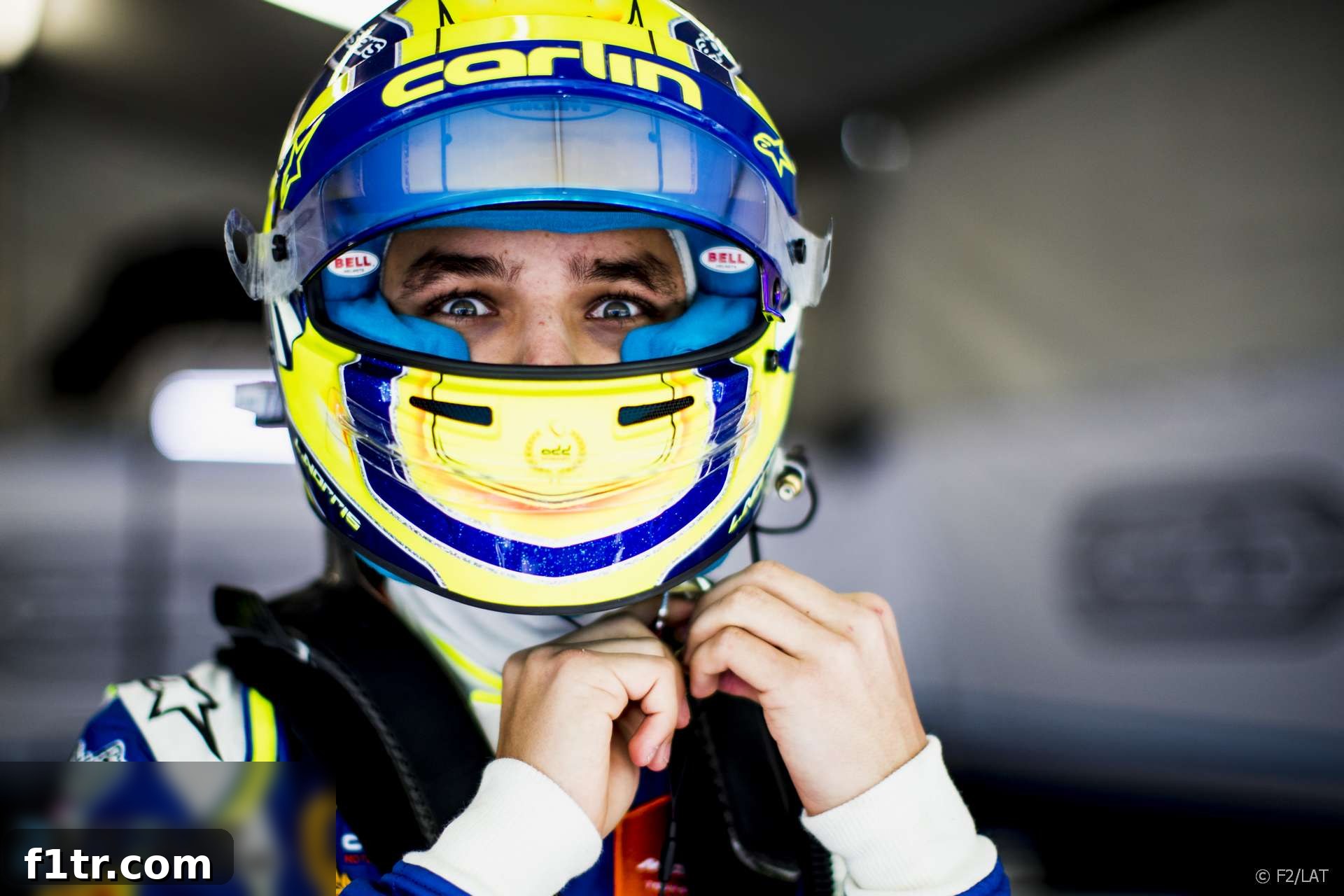
Lando Norris’s arrival at McLaren marks a significant moment, drawing inevitable parallels to Lewis Hamilton’s sensational debut 12 years prior. Both are prodigious British talents, stepping into the hallowed halls of Britain’s most iconic Formula 1 team as rookies. This surface-level similarity, however, only scratches the surface of what promises to be an intriguing career. While the comparisons are compelling, a closer examination reveals distinct journeys, each shaping a unique trajectory in the fiercely competitive world of elite motorsport.
Norris is widely regarded as the most promising British talent to emerge since Hamilton, standing out even amidst a particularly strong generation of young drivers from the UK. His remarkable one-lap speed, an exquisite touch in challenging wet conditions, and a natural flair for audacious overtaking maneuvers have frequently led observers to label him a fitting successor to Hamilton, especially within the context of McLaren. Yet, beyond the shared nationality and the rookie status at Woking, their stories diverge dramatically.
Hamilton’s debut in 2007 saw him instantly challenging for race wins and the world championship, an unprecedented feat for a rookie. Norris, with commendable prudence, has tempered expectations for his maiden season. The 2019 F1 season is unlikely to witness a resurgent McLaren capable of replicating their 2007 championship-contending form, meaning Norris’s immediate path will be markedly different from the stratospheric rise of his compatriot. This fundamental difference in team performance context sets a unique stage for Norris’s entry into the pinnacle of motorsport.
From Rags to Racing: Hamilton’s Path vs. Norris’s Advantage
The life stories of Lando Norris and Lewis Hamilton are cut from vastly different cloths, exemplifying contrasting pathways to Formula 1 stardom. Hamilton’s well-documented rags-to-riches narrative, from his humble beginnings in Stevenage to his eventual residence in Monaco, is a testament to extraordinary dedication and sacrifice. His father, Anthony Hamilton, famously worked three jobs to fund his son’s karting ambitions, meticulously maintaining a rudimentary “four-poster bed” of a go-kart. This unwavering commitment, coupled with a serendipitous introduction to McLaren’s then-chief Ron Dennis, paved the way for Hamilton’s meteoric ascent through the single-seater ranks. His journey became an inspiring tale of talent, grit, and perseverance against economic odds.
Lando Norris, in stark contrast, hails from a significantly more privileged background, a fact he candidly admits he is largely unaware of due to his singular focus on racing. “I’m really bad at the history of Formula 1,” Norris confessed. “It’s easy for somebody from the outside to say what I’ve done different compared to him because I don’t know.” This genuine lack of awareness highlights a key divergence: while Hamilton’s family desperately needed a benefactor like McLaren to sustain his racing career, financial constraints have never been a concern for Norris. His father’s substantial wealth, estimated to be well over £200 million, has provided an unparalleled advantage.
This considerable financial backing allowed Norris and his management team, ADD (who joined him during his cadet karting days), to meticulously chart his racing progression. They could strategically select the most advantageous championships, often competing in more than one series per season, thereby maximizing track time, experience, and exposure as he climbed the motorsport ladder towards Formula 1. This level of curated development is a luxury few drivers can afford, presenting a stark contrast to Hamilton’s more arduous path, which often involved sacrificing opportunities due to lack of funds.
Norris vs. Stroll: Addressing the “Pay Driver” Label
To draw a more contemporary parallel, if Hamilton’s early circumstances bore a resemblance to those of Esteban Ocon – whose parents famously sold their house to fund his karting dreams – then Norris’s comparable reference point on the current F1 grid would undoubtedly be Lance Stroll. Stroll, the son of billionaire fashion magnate Lawrence Stroll, has consistently faced accusations that his career trajectory is primarily a result of his father’s financial might, rather than solely his inherent talent. The ongoing discussions surrounding Stroll being fitted for Ocon’s seat at Force India serve as a poignant reminder of this persistent narrative. This raises a critical question for Norris: Is his success, including his European F3 championship, merely a product of his father’s backing? Or does he, perhaps, receive an easier ride from the anglophone F1 media due to his nationality, much like some argue about Stroll?
The announcement of Lando Norris’s promotion to McLaren last week was met with a spectrum of reactions, with some detractors dismissing him as pure “hype and no substance.” This perception, seemingly prevalent among those whose exposure to Norris’s racing has been limited to his Formula 2 performances, is a profound misjudgment of his true capabilities. For anyone who has followed his career more closely, it becomes abundantly clear that Norris possesses an exceptional and undeniable talent that extends far beyond mere financial backing.
A Stellar Junior Career: Unpacking Norris’s Talent
My first encounter with Norris’s undeniable skill came two years prior, during my commentary duties for the Formula Renault Eurocup. Even then, whispers from those who had witnessed his karting prowess suggested that both financial resources and raw talent were in abundant supply. The latter point was immediately and emphatically underscored. In a championship typically dominated by second-year drivers vying for overall honors, the then-diminutive 15-year-old rookie stood head and shoulders above his more experienced rivals. He left the opening triple-header at Motorland Aragon with an astonishing two wins, a second-place finish, and a commanding lead in the championship – a lead he would never relinquish throughout the season.
This triumph was but one of three titles Norris spectacularly secured that year, demonstrating a level of versatility and dominance rarely seen in junior motorsport. He had already clinched the Toyota Racing New Zealand Series title, showcasing his adaptability across different racing environments and continents. He then achieved a remarkable double victory in Formula Renault, winning both the Eurocup and the NEC series. Such a haul of championships in a single season is a rare feat, signaling a driver of extraordinary potential and adaptability who could master diverse car characteristics and competitive landscapes.
Furthermore, during the same period, Norris contested 11 out of 23 races in the then-MSA Formula Four (now British F3) series, accumulating an impressive 247 points. This partial campaign was still good enough for an eighth-place finish in the overall championship standings. Remarkably, only one driver, the eventual champion Matheus Leist, managed to out-score Norris during his limited spell in the series, securing just ten more points (257). These achievements paint a vivid picture: while Norris has undoubtedly benefited from tremendous opportunities, his consistent and overwhelming success across multiple, highly competitive junior categories unequivocally demonstrates that he has seized every single one of them with exceptional skill and determination. He wasn’t just there; he was winning, and winning convincingly.
The F3 Face-Off: Norris Outshines Stroll
The brief overlap in their Formula 3 careers provides an especially enlightening comparison between Norris and Stroll, further dismantling the “pay driver” label often unfairly applied to the former. In the FIA European F3 Championship, Lance Stroll had the benefit of a Prema team largely built around him and ambitions. Despite this formidable support and significant testing mileage, it took Stroll two full seasons to secure the title. His 2016 championship success, while legitimate, occurred against a backdrop of a significantly weakened and depleted field. Many rival teams, recognizing the overwhelming financial and organizational juggernaut that was the Stroll/Prema combination, chose not to commit the substantial resources required to mount a serious challenge, thereby diminishing the overall competitiveness of the grid.
Amidst this landscape, Carlin, a prominent F3 outfit, temporarily withdrew mid-season from the championship. However, they made a strategic return for the final round specifically to allow Lando Norris to gain crucial experience in the category. In a stunning display of raw talent, Norris, as a wildcard entrant in his very first F3 weekend, not only held his own but sensationally out-qualified the newly crowned champion, Lance Stroll, for the final race of the year. This single performance, unburdened by years of preparation or a team built around him, provided a compelling glimpse into Norris’s intrinsic speed and adaptability, unequivocally demonstrating his natural prowess.
Building on this early promise, Norris went on to add the European F3 championship to his rapidly growing roster of titles in 2017, achieving this feat in his maiden full season. This success, following immediately after Stroll’s two-year effort, served as a powerful testament to Norris’s exceptional skill, proving that his victories were earned through sheer ability rather than merely facilitated by financial leverage. His ability to adapt quickly and master a new category in his first full attempt solidified his reputation as a formidable talent.
Navigating the F2 Gauntlet: Challenges and Distractions
Despite his sterling junior record, Norris’s Formula 2 bid has not entirely met his own exceptionally high standards. While he secured a dominant victory in the opening round in Bahrain, he has surprisingly not repeated that feat in the subsequent five months of racing. This period of slightly subdued results has, ironically, coincided with an explosion of media attention, largely fueled by his presence on the Formula 1 support bill and his consistently convincing test performances for McLaren. As elements of the British media anxiously ponder the emergence of the next Lewis Hamilton, the “Norris hype machine” has inevitably gone into overdrive, even as his on-track results in F2 have experienced a slight dip, creating a paradoxical situation.
Several factors appear to contribute to this unexpected plateau. Early in the season, Norris, along with several other competitors, was hampered by a spate of technical problems with the new generation F2 cars. These mechanical issues, often unpredictable and frustrating, undoubtedly robbed him of valuable points and momentum, though it’s arguable that some of his championship rivals may have suffered to an even greater extent, showcasing the fragility of racing at this level.
However, the most significant element appears to be a perennial challenge for any driver transitioning into a FOM-sanctioned championship: the peculiar characteristics of Pirelli’s high-degradation tyres. These complex compounds demand careful nurturing within a precise operating window to deliver optimal performance, requiring a nuanced understanding that can only be developed through extensive experience. With the severely limited practice time available during each F2 race weekend, drivers who are already intimately familiar with the intricate demands of these specific tyres, such as reigning GP3 champion George Russell, naturally hold a considerable advantage. Norris, as a rookie in F2, has been on a steep learning curve, grappling with the subtleties of tire management while simultaneously adjusting to a new car and competitive environment.
A further complication for Norris in recent races has been the demanding task of dovetailing his F2 duties with practice outings for McLaren. Driving an F1 car first thing on a Friday morning before F2 practice has proved a significant distraction. This challenge is not unique to Norris; other highly promising talents have encountered similar issues. Charles Leclerc, for instance, faced this exact situation during his F2 campaign last year, and George Russell has even opted to postpone further practice outings for Force India for precisely the same reason. The mental shift, physical demands, and the sheer prestige of F1 involvement can undoubtedly impact focus and performance in the fiercely competitive F2 environment, making it a double-edged sword for young talents.
The Future is Orange: Norris and McLaren’s Hopes
Fortunately, this particular concern will no longer plague Norris as he prepares for his full-time F1 debut. While he will continue to make practice appearances for McLaren over the remaining races of the current season, he will strategically skip those that conflict with his F2 commitments. Moreover, McLaren has firmly ruled out the possibility of him making his Grand Prix debut before next year, allowing him to fully concentrate on his immediate F2 objectives and aim for a strong finish to his junior career.
The stage is now set for a thrilling showdown between Norris and championship leader George Russell, who currently holds a 22-point advantage with just four races remaining. Norris has made his intentions unequivocally clear, expressing a fierce desire to maintain his impeccable winning record in junior categories: “I don’t want it saying on my CV ‘win, win, win, win, win, loss, Formula 1…'” This competitive drive underscores his unwavering ambition and dedication to excellence, highlighting his determination to secure the F2 title.
Whether he ultimately clinches the F2 title or not, Lando Norris possesses a junior category CV that would be the envy of virtually any aspiring Formula 1 driver. The “hype” surrounding him is undeniably real, but it is deeply rooted in a tangible and exceptional talent. The most pressing question now shifts from Norris’s ability to McLaren’s capacity to provide him with a competitive machine. After years of underperformance, McLaren is banking on young talent to steer them back to glory, and Norris is a central figure in this revitalized vision.
The cautionary tale of Stoffel Vandoorne serves as a potent reminder of this challenge. Vandoorne was the most dominant GP2 (now F2) champion in history when he secured the title three years ago, showcasing a level of supremacy rarely seen. Yet, despite his extraordinary junior success, his Formula 1 career with McLaren failed to ignite, largely due to the team’s significant performance struggles. As Norris prepares to step into Vandoorne’s seat next year, the onus will be on McLaren to provide a package that truly allows this generational talent to flourish and demonstrate his full potential on the world stage, rather than being stifled by uncompetitive machinery. His journey promises to be one of the most compelling narratives in the upcoming F1 season, as fans eagerly watch whether his prodigious talent can be unleashed.
2018 F1 Season Articles
- F1 feared “death knell” for Drive to Survive after Ferrari and Mercedes snub
- McLaren staff told us we were “totally crazy” to take Honda engines in 2018 – Tost
- ‘It doesn’t matter if we start last’: How Red Bull’s junior team aided Honda’s leap forward
- Honda’s jet division helped F1 engineers solve power unit problem
- McLaren Racing losses rise after Honda split
Browse all 2018 F1 season articles