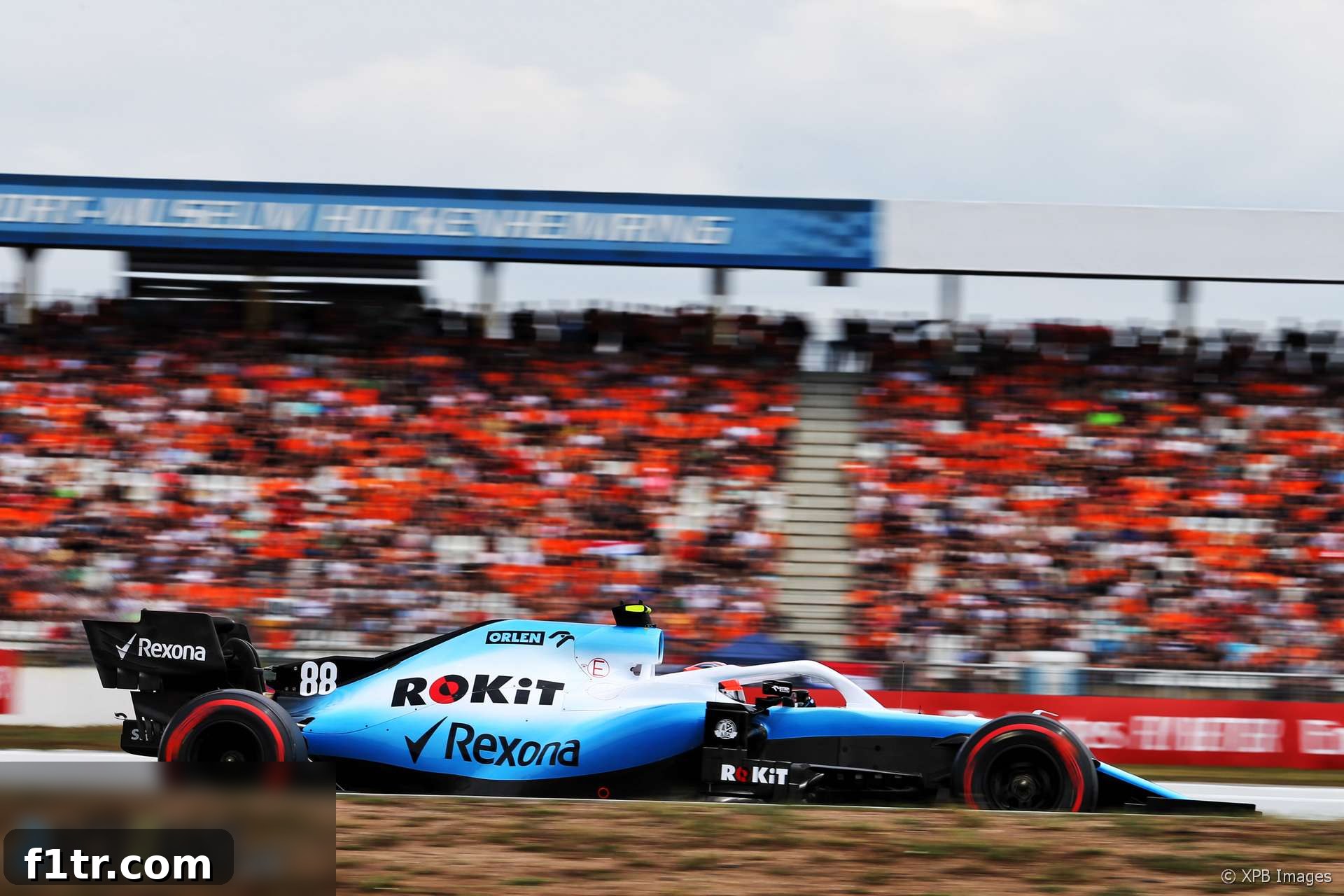
The much-anticipated upgrade package brought by Williams to the German Grand Prix was hoped to be a significant turning point, bringing the struggling team closer to the competitive mid-field. However, according to veteran driver Robert Kubica, these hopes were largely unfulfilled. Despite the team’s diligent efforts, the FW42s remained considerably off the pace, highlighting the persistent challenges faced by the historic British outfit in the demanding world of Formula 1.
Advertisement | Become a RaceFans supporter and go ad-free
This space for an advertisement.
The Hockenheimring Challenge: Hopes for a Breakthrough
The Hockenheimring, a circuit known for its mix of high-speed straights and technical stadium section, presents a unique challenge for car setup and aerodynamic efficiency. For a team like Williams, every marginal gain from an upgrade package is crucial, as it could potentially unlock performance that allows them to compete more effectively. The pressure on the team to show progress was immense, with both drivers, Robert Kubica and his teammate George Russell, eager to assess the impact of the new components and to demonstrate forward momentum for the team.
Qualifying Struggles and Unavoidable Compromises
During the pivotal qualifying session, both Kubica and his talented teammate George Russell had the new upgrade package fitted to their FW42 cars. Yet, the outcome was familiar and disheartening. The Williams machines once again occupied the back row of the grid, clocking lap times more than 1.2 seconds adrift of their closest competitors. Kubica candidly admitted that part of this significant deficit stemmed from unavoidable compromises made to the car’s setup. These adjustments were necessitated by issues that arose during Friday’s running, where some of the newly introduced parts sustained damage.
“We did have to compromise a bit the set-up for the issues we are having,” Kubica explained, shedding light on the difficulties faced by the engineering team. “I went into qualifying with probably not the balance I wanted, but that decision was made to try to protect the parts we are suffering with damage.” This paints a picture of a team battling not just for raw pace, but also for reliability and component integrity, a further testament to the uphill struggle they faced. The sensitive nature of newly introduced aerodynamic elements means that even minor damage can have a cascading effect on the car’s overall performance, forcing teams into suboptimal configurations.
Reflecting on his individual performance, Kubica noted, “The laps were quite OK, although I lost due to the traffic a bit in the second run and due to understeer in the last few corners. I was very much on the edge, and I lost there quite a lot of lap time, around two-tenths.” These small margins, while frustrating for a driver, underscore the razor-thin differences in performance at the pinnacle of motorsport and how easily precious tenths can be forfeited. In Formula 1, where the difference between midfield and the back can be measured in fractions of a second, such losses are magnified significantly.
Overnight Chassis Change and Undiminished Hopes
Adding to the weekend’s complexities, Williams had to make a significant decision overnight, opting to change Robert Kubica’s chassis following the problems he encountered on Friday. Such a move is not undertaken lightly and requires immense effort from the crew, often signaling underlying issues with a car’s fundamental integrity or persistent setup difficulties. Despite the Herculean efforts from the team mechanics and engineers working tirelessly through the night, the ultimate outcome on the stopwatch remained largely unchanged, highlighting the deep-seated challenges.
“All the team here on track did a good job,” Kubica acknowledged, praising the tireless work of his crew under immense pressure. “But still, I would say the outcome is what it is. It’s a bit, I would say, not unexpected, but probably there were higher hopes of getting the car closer to the rest of the grid.” This sentiment perfectly encapsulates the blend of realism and yearning for progress that defines Williams’ current predicament. The team had dared to hope for a breakthrough with their latest package, only to be met once again with the harsh, uncompromising realities of Formula 1 where every rival is also pushing the boundaries of performance.
The Relentless Race of Formula 1 Development
A fundamental challenge for Williams, as Kubica further elaborated, is their current inability to fully extract the maximum potential from their development items. “Maybe it does not deliver the gain as some people hoped,” he mused, indicating that even when new parts bring theoretical performance benefits, integrating them effectively and unlocking their full capabilities on track is another hurdle entirely. This process requires extensive testing, precise data analysis, sophisticated simulation tools, and a deep understanding of car dynamics – resources and expertise that front-running teams often have in abundance, allowing them to optimize new components far more rapidly.
Furthermore, Kubica astutely highlighted a crucial aspect of Formula 1 development often overlooked by casual observers: the constant and rapid evolution of the entire grid. “Another factor is that we keep forgetting we are racing against the others and the others are improving,” he emphasized. “If you make a step forward but the others are making another step forward, even two steps forward, it looks like we haven’t made it, but the reality is that everybody moved forward. Formula 1 has been always like this.” This “moving target” scenario means that merely making progress internally is insufficient; a team must progress *faster* and *more significantly* than its rivals to genuinely close the performance gap. The competitive landscape never stands still, demanding constant innovation and relentless effort just to maintain position, let alone advance.
The Mountain to Climb: Overcoming the Performance Deficit
To illustrate the sheer scale of the challenge facing Williams, Kubica used a compelling analogy: “The fact is if we want to see significant improvement, we need to move three steps forwards while the others are doing one.” This encapsulates the monumental task before the team. They are not merely striving to improve their own car in isolation; they are fighting against the collective innovative power of nine other well-funded and highly skilled Formula 1 teams, all of whom are also constantly pushing the boundaries of engineering and design. The inherent competitive nature of the sport means that stagnation, even relative to others, is akin to going backward, making every incremental gain incredibly hard-won.
“The one thing guaranteed in Formula 1 is that most of the teams are improving through the year, so you have to make sure you improve more than the others in order to close the gap,” Kubica concluded. This statement serves as a stark reminder of the relentless technological arms race that defines Formula 1. For Williams, who have consistently found themselves at the very back of the pack, this means every single upgrade, every strategic decision, and every ounce of effort from every team member must yield disproportionately greater gains compared to their rivals. It’s a battle not just against the clock, but against the relentless march of technological progress across the entire grid, demanding extraordinary dedication and a robust long-term development strategy.
Advertisement | Become a RaceFans supporter and go ad-free
This space for an advertisement.
2019 F1 season: Related Articles
- Crying in the Melbourne car park at 2019 grand prix was my career low – Ocon
- McLaren Racing reports reduced £71 million loss in 2019
- Kvyat: Hockenheim podium last year was “my biggest achievement” so far
- How the FIA’s new encrypted fuel flow meter targets Ferrari’s suspected ‘aliasing’ trick
- “He smashed my office door”: 23 must-see moments from ‘Drive to Survive’ season two
Browse all 2019 F1 season articles
Conclusion: The Long Road Ahead for Williams
The German Grand Prix weekend, despite the tireless work from the Williams team, starkly underscored the profound difficulties in escaping the clutches of the backmarker position in Formula 1. While the upgrade package represented a genuine effort to improve, its immediate impact was dulled by operational challenges, such as damaged components and compromised setups, as well as the relentless competitive advancements of other teams. For Robert Kubica and George Russell, the immediate future promises continued grit and determination as they navigate a challenging season, hoping that future developments will eventually provide the transformative leap needed to bring Williams back towards the heart of the competitive F1 field. The journey for Williams remains a testament to the sheer difficulty of climbing the pecking order in a sport where standing still means falling behind.