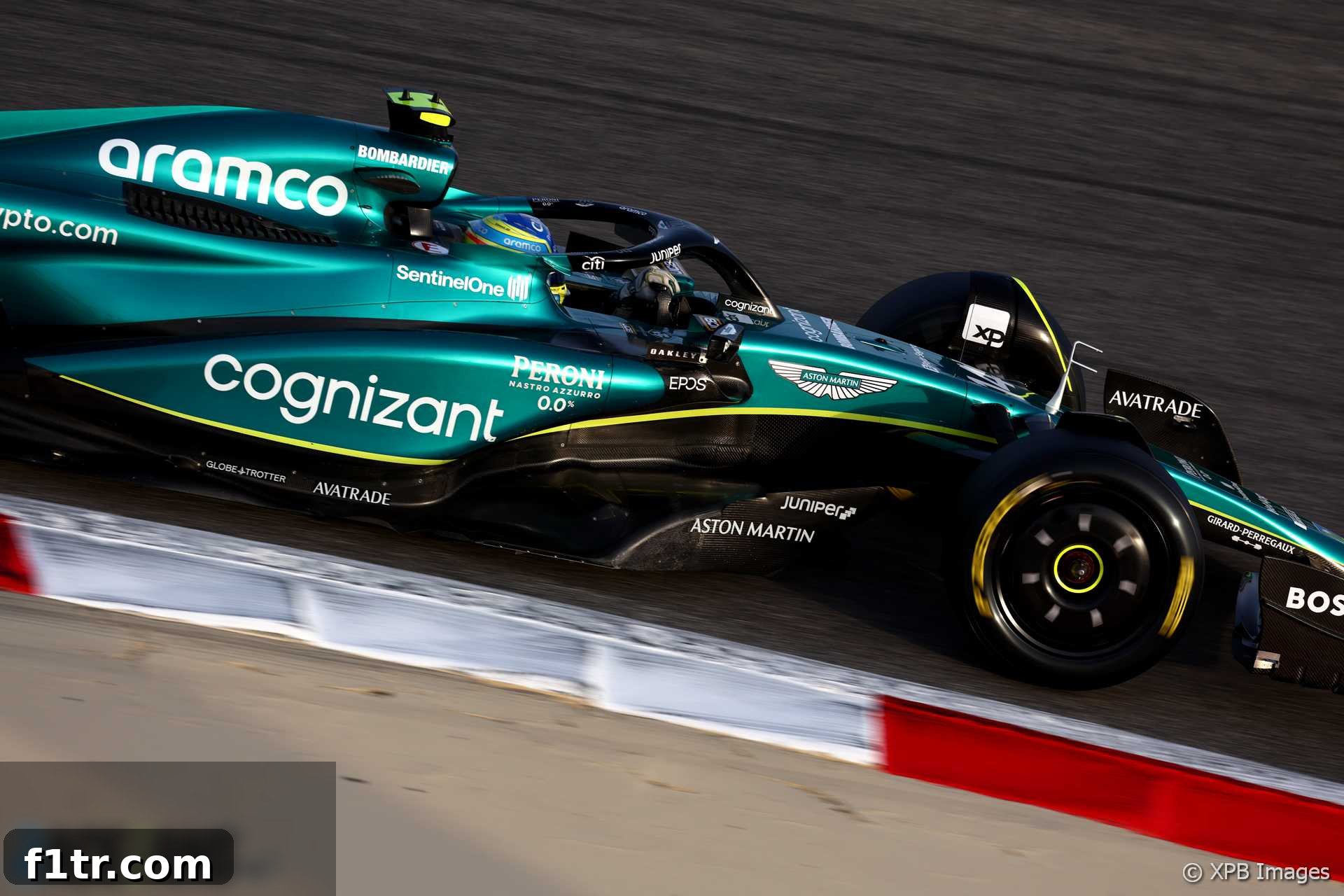
In the highly competitive world of Formula 1, pre-season testing serves as the crucial proving ground for new machinery, often hinting at the pecking order for the season ahead. This year, one team has unequivocally captured the attention and admiration of its rivals: Aston Martin. The Silverstone-based squad, which showed promising signs towards the close of the previous season, appears to have made significant strides over the winter break, leaving an indelible impression on even the most formidable competitors. Red Bull team principal Christian Horner, whose team has dominated recent F1 campaigns, has openly expressed his surprise and respect for Aston Martin’s performance, joining a growing chorus of rivals impressed by their new car, the AMR23.
Horner’s assessment carries considerable weight in the paddock. As the architect behind Red Bull’s multiple championship-winning efforts, his observations are rarely off the mark. Speaking to Sky, Horner remarked, “I think they’ve made a big step. It looks like their concept of car is moving forward and they look like they’re not too far away. Fernando in particular looks very competitive.” This glowing endorsement from a direct competitor underscores the magnitude of Aston Martin’s progress. For a team like Red Bull, accustomed to leading the pack, to acknowledge another team’s “big step” signifies a genuine threat, or at least a notable challenger, emerging from the midfield.
The AMR23: A Technical Triumph Under Scrutiny
The new Aston Martin challenger, the AMR23, has been the subject of much discussion due to its clear departure from its predecessor. While official details on specific technical changes remain under wraps, the visual cues and performance indicators suggest a bold design philosophy aimed at optimizing aerodynamic efficiency and downforce. Crucially, the car has demonstrated impressive reliability throughout testing. Aside from a brief stoppage early in the test session – a common occurrence as teams push boundaries and validate systems – the AMR23 has run consistently, accumulating valuable mileage. This reliability is as important as outright pace during testing, as it allows teams to gather critical data and validate design choices without undue interruption.
The speed shown by the AMR23 has been equally compelling. With reserve driver Felipe Drugovich behind the wheel, the car has managed to lap within half a second of Red Bull’s quickest time. This performance, achieved by a reserve driver rather than a seasoned race driver pushing to the absolute limit, speaks volumes about the inherent potential of the car. It suggests that the AMR23 possesses a strong baseline performance, indicating that the team’s new design concept is delivering tangible results on track. Such a narrow gap to the reigning champions’ car, even in testing conditions where fuel loads and engine modes are unknown, is a powerful indicator of Aston Martin’s competitive aspirations.
Competitor Insights: Weighing Aston Martin’s Potential
Beyond Christian Horner, other figures within the paddock have also voiced their impressions, offering a broader perspective on Aston Martin’s upward trajectory. These insights from across the grid paint a picture of a team that has truly turned heads and established itself as a potential dark horse for the 2023 season.
Kevin Magnussen on Aston Martin’s Consistent Pace
Kevin Magnussen, driver for the Haas F1 Team, which finished just one place behind Aston Martin in the constructors’ championship last year, highlighted the consistent strength demonstrated by the AMR23. “I think Aston Martin looks fast,” Magnussen commented. “They seem to constantly be doing good long runs, and when they try to put a lap time, they seem to do it as well. I think they look like they’ve done a big step.” Magnussen’s observation regarding both “good long runs” and successful “lap times” is particularly insightful. Long runs are indicative of race pace and tire management over a sustained period, while strong single-lap times demonstrate outright qualifying speed. Excelling in both areas suggests a well-rounded car capable of performing strongly on both Saturdays and Sundays, a trait coveted by all teams.
Esteban Ocon’s Cautious Optimism Amidst Testing Variables
Esteban Ocon, who drove for the team when it was known as Force India, offered a more cautious but equally positive perspective. Recognizing the inherent difficulties in accurately assessing performance during pre-season testing, Ocon nonetheless conceded his former team’s strong start to 2023. “It’s early days to really give a conclusion,” he stated. “Those cars it’s so easy to go from five seconds slower to a five second quicker in one go so it’s difficult to tell exactly the fuel loads. Obviously we can see the tyres but the energy management and what engine mode you run. So they look for sure competitive at the moment.” Ocon’s points about unknown fuel loads, engine modes, and energy management are crucial; teams often “sandbag” or run conservative setups during testing to hide their true potential. Yet, despite these variables, Ocon’s conclusion that Aston Martin “look for sure competitive” is a significant endorsement. It suggests that even accounting for potential obfuscation, their performance baseline is undeniably strong.
Otmar Szafnauer’s Broader View of the Midfield Challenge
Otmar Szafnauer, now reunited with Ocon at Alpine and a former team principal at Aston Martin, offered a broader perspective on the competitive landscape. While acknowledging Aston Martin’s strength, Szafnauer’s focus remained on the tight nature of the entire midfield. “I’m nervous about everybody in the midfield,” he said. “It’s not just Aston that we’ve got to beat.” He further elaborated on the impact of stable regulations: “With regulations that are stable, everyone gets closer together, and then it’s other things that matter. You’ve got to do a lot of things right to be top of that midfield. So it’s not just Aston, I’m worried about everybody.” Szafnauer’s comments highlight a critical aspect of modern Formula 1: with regulation stability, the performance gap between teams naturally shrinks, making every marginal gain, every operational detail, and every strategic decision more impactful. This context underscores that while Aston Martin may have made a leap, the midfield battle will remain intensely fierce, requiring consistent excellence to secure leading positions.
The Momentum from 2022 and Alonso’s Catalytic Impact
Aston Martin’s impressive showing in pre-season testing isn’t entirely out of the blue. The team enjoyed a remarkably strong end to the 2022 season, consistently challenging for points and demonstrating improved pace in the latter half of the year. Christian Horner’s belief that they’ve “carried that momentum into this year” is a testament to the continuous development work and strategic planning undertaken by the team. This strong foundation has been further bolstered by significant investment from owner Lawrence Stroll, including a state-of-the-art new factory and the recruitment of key personnel, all aimed at transforming Aston Martin into a championship-contending outfit.
Central to their 2023 aspirations is the arrival of two-time world champion Fernando Alonso. Known for his fierce determination, unparalleled race craft, and exceptional car development skills, Alonso’s presence is a game-changer. His ability to extract the maximum from any car, coupled with his vast experience across multiple teams and eras, provides Aston Martin with invaluable feedback and a powerful benchmark. Horner’s specific mention that “Fernando in particular looks very competitive” indicates that Alonso has quickly integrated into the team and is already showcasing his legendary pace and fighting spirit. The “Alonso effect” is not merely about his driving talent; it’s about his capacity to motivate an entire team, push technical boundaries, and relentlessly pursue every performance advantage. His partnership with Lance Stroll promises a potent driver lineup for the season ahead.
Ambition Meets Reality: The Road Ahead for Aston Martin
While pre-season testing provides an encouraging glimpse into Aston Martin’s potential, the true test awaits with the commencement of the 2023 F1 season. The team’s ambition is clear: to become a front-running force in Formula 1. The investment, the technical advancements, and the recruitment of a driver of Alonso’s caliber all point towards a serious commitment to this goal. However, Formula 1 is a brutal sport where sustained performance is paramount. Challenges will undoubtedly arise, from maintaining the development pace against larger, more established teams to managing the increased pressure that comes with elevated expectations.
The early races will be crucial for Aston Martin to validate their pre-season promise. Can they convert impressive testing times into strong qualifying and race results? Can they consistently challenge the top teams and consolidate their position at the sharp end of the midfield, or even break away from it? The excitement surrounding Aston Martin is palpable, offering a compelling narrative for the upcoming season. Their progress has not gone unnoticed, and the respect from rivals signals that the team has truly arrived as a force to be reckoned with. The journey has just begun, but the initial signs are overwhelmingly positive, setting the stage for what could be a memorable year for the green machines.
2023 F1 Season Related Articles
- FIA president cleared of alleged interference in two 2023 races
- First week viewing figures for new Drive to Survive season fall again
- Max who? Drive to Survive season six prefers its favourite faces
- RaceFans’ complete 2023 season review
- The F1 drivers who pulled off the 10 biggest charges through the field in 2023
Browse all 2023 F1 season articles