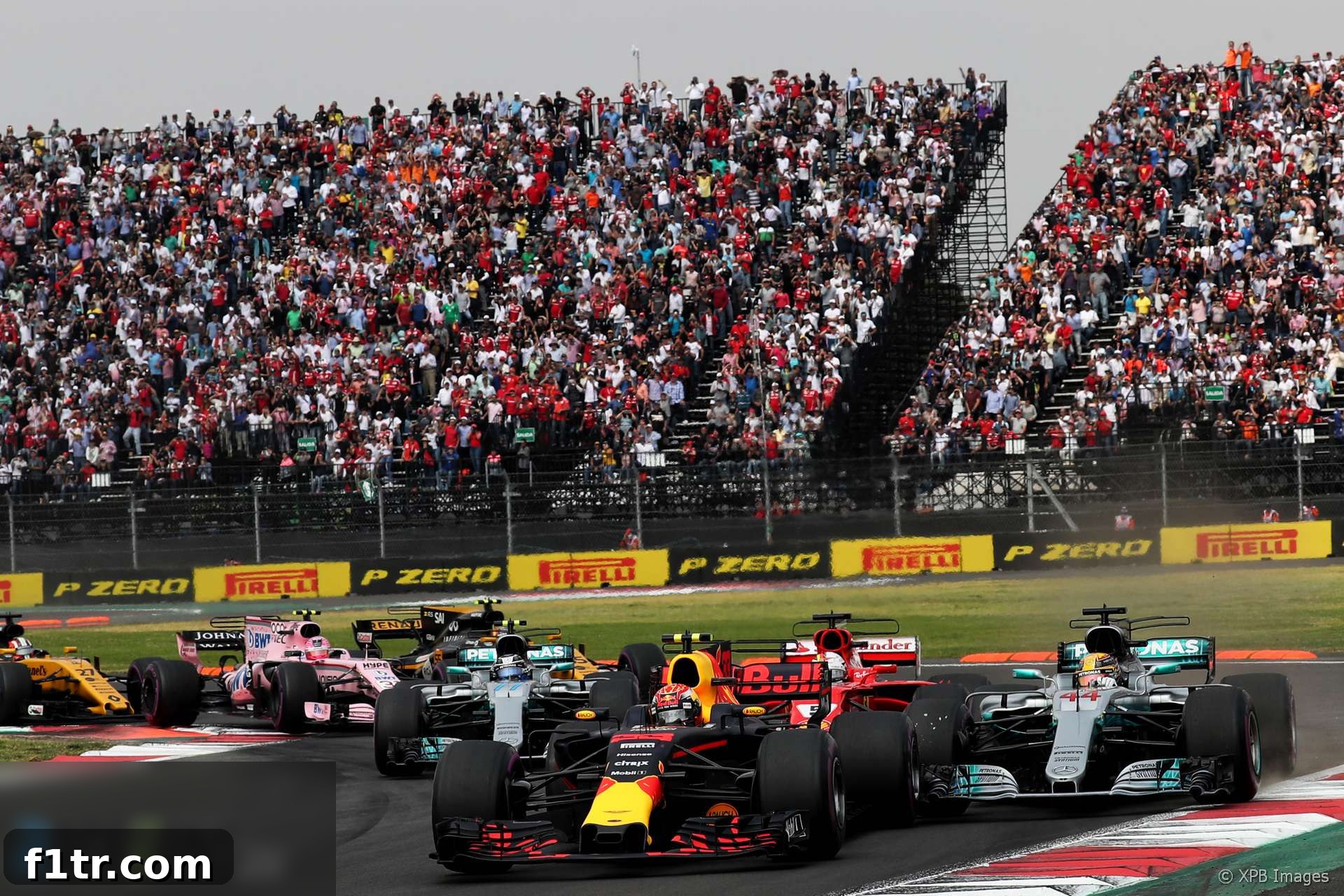
The stage is set for an electrifying Mexican Grand Prix, with the grid promising an unpredictable opening sequence that could define the race outcome. Mercedes team principal Toto Wolff has voiced significant concerns, expecting considerable drama as the cars hurtle down the long main straight towards Turn 1. With Red Bull drivers Daniel Ricciardo and Max Verstappen locking out the front row, and championship contenders Lewis Hamilton and Sebastian Vettel occupying the second row, the tension is palpable.
A Volatile Start: Red Bull, Mercedes, and Ferrari Battle for Position
Wolff’s apprehension stems from the unique blend of car performance and grid positioning. “The grid has the potential for carnage on the straight and through the first corners,” he stated. His analysis highlights a crucial disparity: the Red Bulls, despite their pole positions, possess the least straight-line speed among the top contenders. Directly behind them are Mercedes and Ferrari, whose cars exhibit a significant straight-line speed advantage, potentially up to 10 kph faster than their Red Bull rivals. This creates a volatile scenario for the run into the first corner.
“I try to visualise how that could look down the straight and through the first corner and I hope we just come out of it with two cars intact,” Wolff added, underscoring the high risk of collision. The Autódromo Hermanos Rodríguez circuit, known for its challenging high-altitude conditions, features an exceptionally long run to Turn 1, making the slipstream effect profoundly influential. Last year’s race offered a preview of this dynamic, with Max Verstappen aggressively weaving his way to the front while Lewis Hamilton and Sebastian Vettel infamously clashed.
Ferrari drivers believe their starting positions might, paradoxically, offer an advantage. By not qualifying in the top three, they are strategically placed to capitalize on the powerful tow from the cars ahead. “We have higher speed than the others on the straight so maybe it helps us,” admitted Vettel. His teammate, Kimi Raikkonen, who recorded the fastest straight-line speed during Saturday’s qualifying, echoed this sentiment. Starting sixth, Raikkonen is well-positioned within the ‘big six’ to benefit from a strong slipstream. “We need to make a good or decent start and the tow makes everything here on the straight,” Raikkonen explained. “We need to get in a good tow and then obviously try to stay out of any issues in the first corner. Usually it’s pretty hectic here.” The opening lap will undoubtedly be a spectacle, with strategic positioning and raw speed battling for supremacy.
The Critical Role of Tyre Strategy at High Altitude
Beyond the initial scramble, tyre management is expected to be the defining factor of the Mexican Grand Prix. The unique challenges of Mexico City’s high altitude – including thinner air, reduced downforce, and increased engine strain – place immense stress on the tyres, leading to accelerated degradation. All top six qualifiers managed to navigate Q2 using the more durable ultra-soft compound, securing a significant strategic advantage over the four cars immediately behind them on the grid.
This decision was crucial, especially given the dire predictions for the softer compounds. Wolff starkly described the hyper-softs, the softest compound available, as a tyre that would “melt in two-and-a-half laps” and be “not a tyre you can actually race on.” Mercedes’ ability to qualify on the ultra-softs was a substantial relief for Lewis Hamilton, who noted the team’s initial concerns. “We didn’t think [on Friday] with that performance that we would be able to qualify on an ultra. So that would have been a massive disadvantage for us if we had to start on the hyper for example,” Hamilton revealed. His improved confidence in the car’s feeling during qualifying validated their strategic choice, placing them in a much stronger position for the race.
Pirelli, the official tyre supplier, typically suggests a one-stop strategy for most races, but for Mexico, they believe a two-stop strategy might prove quicker. Their recommendation involves two stints on the super-soft compound. However, with careful tyre management, particularly if an early Safety Car period helps preserve the initial set, a one-stop strategy remains a viable, and potentially race-winning, option for drivers starting on the ultra-softs, aiming to stretch them to lap 15 or later. The intricate dance between tyre life, pit stop timing, and track position will be a captivating element of the race, demanding precision from both drivers and strategists.
The Looming Threat of Rain: Chaos on an “Ice Rink” Track
As if the high-stakes start and complex tyre dynamics weren’t enough, the forecast adds another layer of unpredictability: a risk of rain on Sunday. The Autódromo Hermanos Rodríguez is already known for its low-grip surface, a characteristic exacerbated by the thin air at altitude. Should rain arrive, it would transform the track into something akin to an “ice rink,” according to Nico Hulkenberg.
“If it rains tomorrow I think it would be chaos,” Hülkenberg predicted. “It would be pretty tricky to keep the car on the road. I think we’d see a lot of cars going off.” The already challenging conditions would be amplified, pushing driver skill to its absolute limits. Wet weather racing often levels the playing field, making car performance less dominant and driver talent more critical. The potential for multiple incidents, safety car deployments, and even red flags could completely rewrite the script for the Grand Prix, promising an even more “interesting and difficult” spectacle for both competitors and fans.
Quotes: Dieter Rencken
Qualifying Times in Full: A Snapshot of Pace and Potential
The qualifying session provided a clear indication of team performance and driver prowess heading into the Mexican Grand Prix. Red Bull’s commanding front-row lockout highlighted their inherent strength in the circuit’s twisty sections, while Mercedes and Ferrari demonstrated competitive pace, especially with their superior straight-line speed. The full qualifying results are detailed below, offering a closer look at the gaps and strategic choices made by each team.
| Driver | Car | Q1 | Q2 (vs Q1) | Q3 (vs Q2) | |
| 1 | Daniel Ricciardo | Red Bull | 1’15.866 | 1’15.845 (-0.021) | 1’14.759 (-1.086) |
| 2 | Max Verstappen | Red Bull | 1’15.756 | 1’15.640 (-0.116) | 1’14.785 (-0.855) |
| 3 | Lewis Hamilton | Mercedes | 1’15.673 | 1’15.644 (-0.029) | 1’14.894 (-0.750) |
| 4 | Sebastian Vettel | Ferrari | 1’16.089 | 1’15.715 (-0.374) | 1’14.970 (-0.745) |
| 5 | Valtteri Bottas | Mercedes | 1’15.580 | 1’15.923 (+0.343) | 1’15.160 (-0.763) |
| 6 | Kimi Raikkonen | Ferrari | 1’16.446 | 1’15.996 (-0.450) | 1’15.330 (-0.666) |
| 7 | Nico Hulkenberg | Renault | 1’16.498 | 1’16.126 (-0.372) | 1’15.827 (-0.299) |
| 8 | Carlos Sainz Jnr | Renault | 1’16.813 | 1’16.188 (-0.625) | 1’16.084 (-0.104) |
| 9 | Charles Leclerc | Sauber | 1’16.862 | 1’16.320 (-0.542) | 1’16.189 (-0.131) |
| 10 | Marcus Ericsson | Sauber | 1’16.701 | 1’16.633 (-0.068) | 1’16.513 (-0.120) |
| 11 | Esteban Ocon | Force India | 1’16.252 | 1’16.844 (+0.592) | |
| 12 | Fernando Alonso | McLaren | 1’16.857 | 1’16.871 (+0.014) | |
| 13 | Sergio Perez | Force India | 1’16.242 | 1’17.167 (+0.925) | |
| 14 | Brendon Hartley | Toro Rosso | 1’16.682 | 1’17.184 (+0.502) | |
| 15 | Pierre Gasly | Toro Rosso | 1’16.828 | ||
| 16 | Romain Grosjean | Haas | 1’16.911 | ||
| 17 | Stoffel Vandoorne | McLaren | 1’16.966 | ||
| 18 | Kevin Magnussen | Haas | 1’17.599 | ||
| 19 | Lance Stroll | Williams | 1’17.689 | ||
| 20 | Sergey Sirotkin | Williams | 1’17.886 |
Sector Times: Dissecting Performance
Analyzing sector times provides further insight into where each car gains or loses time around the circuit. Sebastian Vettel notably claimed the fastest Sector 1, indicative of Ferrari’s strong straight-line speed. Red Bull, while perhaps not the fastest on the straight, excels in the more technical middle sector, demonstrating their superior aerodynamic package. These nuances in performance will be critical during the race as drivers seek to exploit their car’s strengths.
| Driver | Sector 1 | Sector 2 | Sector 3 |
|---|---|---|---|
| Daniel Ricciardo | 27.131 (8) | 28.353 (1) | 19.275 (1) |
| Max Verstappen | 26.929 (4) | 28.539 (3) | 19.315 (2) |
| Lewis Hamilton | 26.867 (3) | 28.612 (4) | 19.341 (3) |
| Sebastian Vettel | 26.687 (1) | 28.756 (5) | 19.527 (5) |
| Valtteri Bottas | 26.995 (5) | 28.528 (2) | 19.520 (4) |
| Kimi Raikkonen | 26.793 (2) | 28.771 (6) | 19.692 (11) |
| Nico Hulkenberg | 27.233 (13) | 28.997 (7) | 19.536 (6) |
| Carlos Sainz Jnr | 27.287 (15) | 29.094 (8) | 19.647 (8) |
| Charles Leclerc | 27.008 (6) | 29.103 (9) | 19.830 (14) |
| Marcus Ericsson | 27.121 (7) | 29.434 (12) | 19.808 (13) |
| Esteban Ocon | 27.189 (10) | 29.392 (11) | 19.669 (9) |
| Fernando Alonso | 27.611 (20) | 29.274 (10) | 19.936 (15) |
| Sergio Perez | 27.141 (9) | 29.459 (13) | 19.642 (7) |
| Brendon Hartley | 27.420 (18) | 29.571 (15) | 19.688 (10) |
| Pierre Gasly | 27.383 (17) | 29.725 (17) | 19.720 (12) |
| Romain Grosjean | 27.225 (12) | 29.609 (16) | 20.073 (17) |
| Stoffel Vandoorne | 27.438 (19) | 29.528 (14) | 20.000 (16) |
| Kevin Magnussen | 27.212 (11) | 29.857 (18) | 20.286 (20) |
| Lance Stroll | 27.260 (14) | 30.082 (20) | 20.206 (18) |
| Sergey Sirotkin | 27.299 (16) | 30.061 (19) | 20.273 (19) |
Speed Trap: The Ultimate Straight-Line Test
The speed trap data clearly illustrates the horsepower battle on the long main straight. Ferrari-powered cars, including those of Haas and Sauber, consistently ranked highest, with Kimi Raikkonen leading the pack. This significant straight-line speed advantage for Ferrari and Mercedes over Red Bull’s TAG Heuer (Renault-rebadged) engines underscores the potential for overtakes and strategic maneuvers on the opening lap and throughout the race, especially with the benefit of a slipstream.
| Pos | Driver | Car | Engine | Speed (kph/mph) | Gap |
|---|---|---|---|---|---|
| 1 | Kimi Raikkonen | Ferrari | Ferrari | 356.4 (221.5) | |
| 2 | Marcus Ericsson | Sauber | Ferrari | 354.2 (220.1) | -2.2 |
| 3 | Sebastian Vettel | Ferrari | Ferrari | 354.2 (220.1) | -2.2 |
| 4 | Charles Leclerc | Sauber | Ferrari | 352.1 (218.8) | -4.3 |
| 5 | Esteban Ocon | Force India | Mercedes | 350.3 (217.7) | -6.1 |
| 6 | Lance Stroll | Williams | Mercedes | 350.0 (217.5) | -6.4 |
| 7 | Kevin Magnussen | Haas | Ferrari | 349.6 (217.2) | -6.8 |
| 8 | Sergio Perez | Force India | Mercedes | 349.4 (217.1) | -7.0 |
| 9 | Lewis Hamilton | Mercedes | Mercedes | 348.0 (216.2) | -8.4 |
| 10 | Romain Grosjean | Haas | Ferrari | 347.8 (216.1) | -8.6 |
| 11 | Sergey Sirotkin”>Sergey Sirotkin | Williams | Mercedes | 347.2 (215.7) | -9.2 |
| 12 | Valtteri Bottas | Mercedes | Mercedes | 347.2 (215.7) | -9.2 |
| 13 | Max Verstappen | Red Bull | TAG Heuer | 346.5 (215.3) | -9.9 |
| 14 | Brendon Hartley | Toro Rosso | Honda | 345.9 (214.9) | -10.5 |
| 15 | Pierre Gasly | Toro Rosso | Honda | 345.7 (214.8) | -10.7 |
| 16 | Nico Hulkenberg | Renault | Renault | 343.0 (213.1) | -13.4 |
| 17 | Daniel Ricciardo | Red Bull | TAG Heuer | 341.9 (212.4) | -14.5 |
| 18 | Carlos Sainz Jnr | Renault | Renault | 341.6 (212.3) | -14.8 |
| 19 | Fernando Alonso | McLaren | Renault | 339.3 (210.8) | -17.1 |
| 20 | Stoffel Vandoorne | McLaren | Renault | 335.7 (208.6) | -20.7 |
Your Take: Predictions for the Mexican Grand Prix
As all eyes turn to the Mexican Grand Prix, the critical questions remain: Can the Red Bull drivers maintain their front-row advantage through the chaotic sprint to Turn 1? Who will ultimately master the intricate tyre strategies and unpredictable weather to claim victory? Will the race deliver the ‘carnage’ Toto Wolff fears, or a masterclass in controlled aggression?
Share your predictions and insights on the Mexican Grand Prix in the comments below.
2018 Mexican Grand Prix Coverage
- “These tyres are a disgrace for F1”: Over 300 Mexican GP team radio messages
- Verstappen breaks record for most wins without a pole
- 2018 Mexican Grand Prix Star Performers
- Top ten pictures from the 2018 Mexican Grand Prix
- Verstappen’s win, Hamilton’s title in tyre-dominated Mexican GP
Browse all 2018 Mexican Grand Prix articles