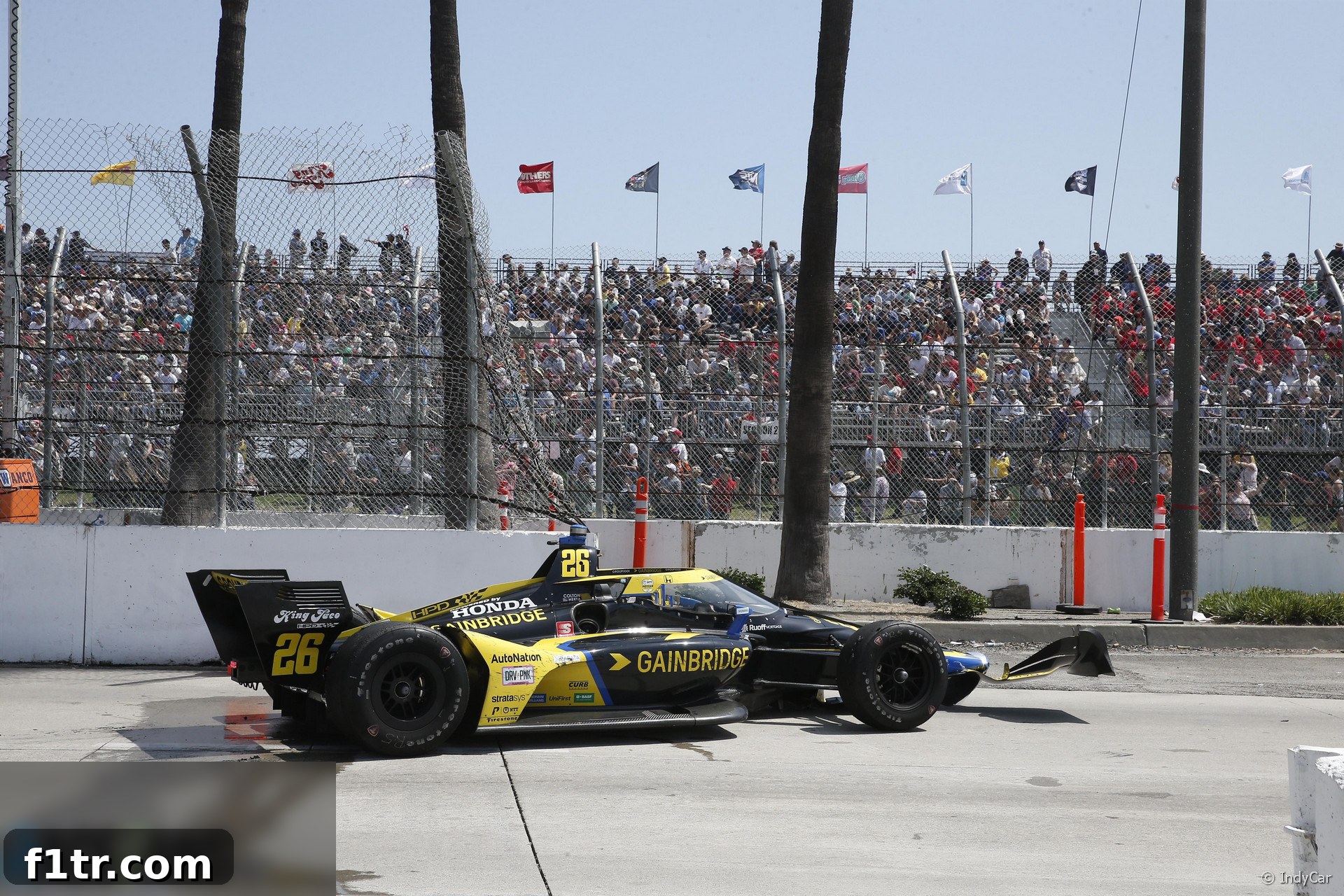
Colton Herta’s Long Beach Grand Prix Heartbreak: A Close Look at a Promising Season’s Setback
The iconic streets of Long Beach witnessed a dramatic turn of events last weekend as Colton Herta, a young driver touted for his exceptional talent, saw his bid for a second consecutive victory at the prestigious Grand Prix come to a crashing halt. What began as a dominant performance quickly devolved into a moment of palpable frustration, drawing immediate and unfortunate comparisons to a similar incident from last year’s Nashville race. Herta’s error, occurring while fiercely battling Álex Palou and eventual race winner Josef Newgarden, underscored the razor-thin margins and immense pressure inherent in IndyCar racing, leaving fans and pundits to ponder the implications for his championship aspirations in the competitive NTT IndyCar Series.
A Commanding Start to the Long Beach Challenge
The Acura Grand Prix of Long Beach is one of the most iconic and demanding races on the NTT IndyCar Series calendar. Its challenging street course, with unforgiving concrete walls, tight hairpins, and fast straights, requires absolute precision and unwavering focus from drivers. Colton Herta, intimately familiar with the circuit’s nuances, having conquered it the previous year, arrived with a clear intent to repeat his success. His exceptional pace was evident from the outset, as he shattered the track record during qualifying, securing a pole position that signaled his formidable intent and placed him firmly as the favorite for the race.
The race itself began exactly as Herta would have scripted it. From the moment the green flag waved, the Andretti Autosport driver demonstrated blistering speed and masterful control, confidently leading the opening 28 laps. His Honda-powered car looked perfectly balanced, and he appeared to be in a class of his own, extending a comfortable gap over the chasing pack. The strategy seemed straightforward: control the pace, manage tire degradation, and execute flawless pit stops to maintain his commanding lead. However, as is often the case in IndyCar, a single strategic decision or a momentary lapse can completely reshape the race narrative, especially when championship contenders are breathing down your neck.
The Pivotal Pit Stop and a Shift in Dynamics
Herta’s initial pit stop marked a significant turning point in the race. While a necessary part of any fuel and tire strategy, the timing and execution ultimately reshuffled the front-runners. Upon rejoining the track, Herta found himself in third position, trailing both the reigning IndyCar champion Álex Palou of Chip Ganassi Racing and the formidable Josef Newgarden of Team Penske, who had leveraged their pit windows more effectively. This strategic shuffle immediately intensified the competition at the front, transforming what had been a controlled lead into an exhilarating chase, forcing Herta to adapt rapidly to a new dynamic.
Suddenly, Herta was no longer dictating the pace but was instead in hunter mode, forced to push harder to reclaim his lost ground. The pressure mounted with every lap as he worked to close the gap on two of the series’ most experienced and successful drivers. He expressed his disappointment following the race, acknowledging the strength of his car and his initial performance. “We were definitely in that thing,” Herta stated, reflecting on his dominant early laps. “We were running good there in third, and keeping up with Alex and Josef so it’s unfortunate. I feel really bad.” This sentiment highlighted his belief that victory was well within reach, adding another layer of regret to the eventual outcome of his race.
The Moment of Error: A Costly Mistake in Pursuit
The turning point, a heart-stopping moment for Herta and his legions of fans, occurred on lap 56. Pushing relentlessly to close the gap on Palou and Newgarden, Herta misjudged his braking point into a crucial corner. The aggressive late braking, a tactic often employed to maximize speed and overtake rivals, resulted in a front wheel lock-up. In an instant, his car veered off track and into the unforgiving tire barriers. The impact, though not severe enough to cause serious injury to the young driver, spelled an immediate and disheartening end to his race. The sight of the distinctive Andretti Autosport car immobilized on the side of the track was a bitter pill to swallow, particularly given his strong form throughout the entire weekend and his dominant start.
Herta’s immediate reaction was one of raw self-criticism, devoid of excuses. Speaking to NBC shortly after the incident, he didn’t mince words, taking full responsibility for the error. “It’s just a stupid mistake,” he admitted candidly. “I just braked a little bit too late, got in there, locked the front front and that’s it.” This honest assessment, while commendable for its candor, underscored the profound disappointment of an opportunity squandered due to a self-inflicted error. Such mistakes are amplified in the ultra-competitive world of IndyCar, where every single point and every position can significantly impact championship hopes and define a driver’s season.
Echoes of Nashville: A Recurring Pattern?
What made Herta’s Long Beach incident particularly poignant was its striking resemblance to a race-ending crash at the Nashville street circuit just eight months prior. In that event, Herta had also showcased an undeniable dominance, leading 39 laps and appearing poised for victory. However, after the final round of pit stops, he found himself behind Marcus Ericsson. While intensely chasing his Ganassi rival with only six laps remaining, Herta again pushed beyond the limit, resulting in a crash that extinguished his winning aspirations. This recurring theme of aggressive errors while battling for the lead has begun to raise questions among analysts and fans about a potential pattern in Herta’s driving style under the most high-pressure scenarios.
Both incidents highlight a crucial aspect of high-level motorsport: the fine line between aggressive determination and over-driving. Herta’s raw speed, natural talent, and fearless approach are unquestionable, making him one of the most exciting prospects in open-wheel racing. However, these two high-profile errors suggest that learning to temper that aggression, particularly when battling wheel-to-wheel with seasoned championship contenders, will be key to unlocking his full potential and securing consistent championship bids. The emotional toll of such mistakes is often immense, and the ability to learn and adapt quickly from them is a hallmark of true champions who ultimately ascend to the pinnacle of their sport.
The Strategic Enigma and Team Performance
Beyond the final error, Herta also expressed some surprise regarding the pit stop sequence that saw him drop behind Newgarden and Palou. Newgarden’s efficient stop on lap 30 placed him ahead, while defending champion Palou expertly capitalized by pitting two laps earlier than Herta, gaining crucial track position over both of them. This nuanced strategic play highlights the intricate calculations and quick decisions that define IndyCar pit strategy. “I was surprised – I didn’t know how that happened, so we’ll have to look a little bit more into that,” Herta commented, indicating a need for his team to analyze the strategy closely to prevent future occurrences.
Despite this, he remained highly complimentary of his car’s performance throughout the weekend: “But the car was fantastic. My engineer Nathan [O’Rourke] gave me a great car. I just overdid it a bit today.” This balance of self-blame and strategic questioning provides valuable insight into the complex interplay of driver execution and team strategy in IndyCar racing, where fractions of a second and astute tactical calls can mean the difference between victory and defeat.
While Herta endured a challenging Sunday, his Andretti Autosport teammate Romain Grosjean delivered a stellar performance, navigating the treacherous Long Beach circuit with precision and skill to secure a commendable second-place finish. Grosjean’s podium was a significant moment for the team, marking their first top-three finish of the 2022 season. This impressive result underscored the team’s overall competitiveness and provided a much-needed silver lining for Andretti Autosport on an otherwise bittersweet race day, demonstrating the strength and depth within the team.
Championship Implications and Future Outlook
After three races into the 2022 NTT IndyCar Series season, Colton Herta’s Long Beach misfortune has positioned him 11th in the drivers’ standings. While the season is still young and many races remain, losing valuable points in races where he demonstrated winning potential can be detrimental in a championship battle known for its fierce competition, razor-thin margins, and intense driver rivalries. The ability to convert pole positions and dominant early drives into victories is paramount for any driver aspiring to the coveted series title.
The IndyCar calendar now moves to Barber Motorsports Park for the next round on May 1st. This undulating road course presents a different challenge, with its flowing corners and elevation changes. Herta will undoubtedly be looking to rebound strongly, aiming for a clean, consistent performance to reassert his championship credentials. The season is a marathon, not a sprint, and while the Long Beach crash was a setback, Herta’s undeniable talent, aggressive style, and competitive spirit suggest that he will remain a significant force to be reckoned with throughout the rest of the year. The lessons learned from these high-stakes errors will either define his season or, crucially, serve as invaluable stepping stones towards future glory in his promising career.
IndyCar Insights and Developments
The world of IndyCar racing continues to captivate fans with its exhilarating competition and evolving landscape. Recent news and developments underscore the series’ dynamic nature and its growing global appeal:
- IndyCar driver McLaughlin cleared of injury after crashing through barrier at Barber
- Schumacher says his IndyCar feels like ‘an F2 car, just with better tyres’
- IndyCar “way faster than Formula 1” in some corners, says Grosjean
- FIA to award more F1 superlicence points to IndyCar drivers from 2026
- Schumacher to race full-time in IndyCar with RLL in 2026
Browse all IndyCar articles