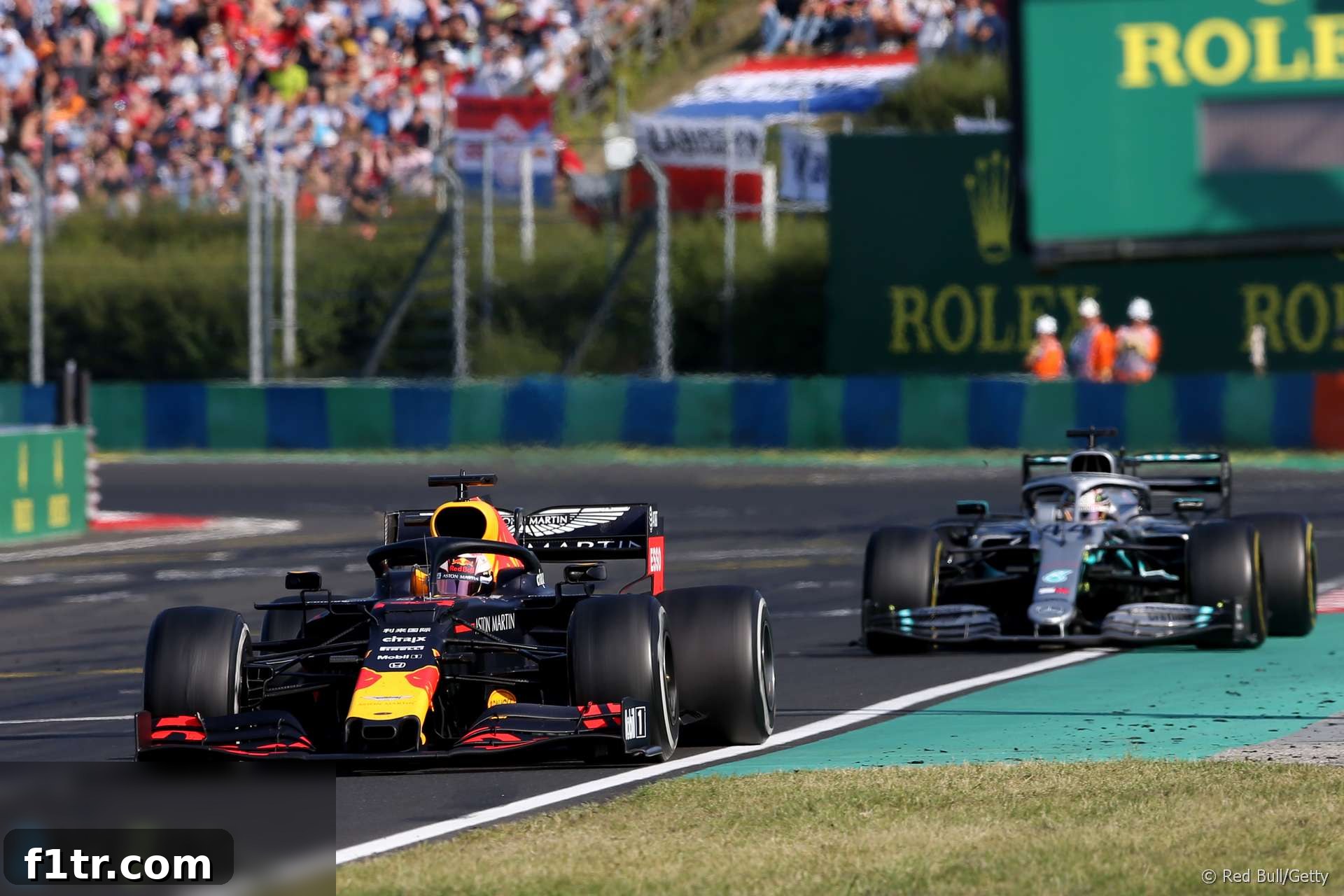
The build-up to the Hungarian Grand Prix was already simmering with tension, amplified by a pointed comment from Max Verstappen. The young Dutchman, known for his directness, suggested that five-time world champion Lewis Hamilton had “never really had big pressure from his team mates” throughout his illustrious career. This statement set the stage for a race that would test the mettle of both drivers, as the Hungaroring circuit typically offers a strategic challenge where strong performance under pressure is paramount.
Indeed, Verstappen’s pre-race assertion proved remarkably accurate for both competitors on Sunday. The Hungarian Grand Prix quickly distilled into a captivating two-horse race. Only one Red Bull and one Mercedes-AMG Petronas Formula 1 car remained in genuine contention for the ultimate prize at the notoriously tight Hungaroring. Even with the Ferrari duo finding themselves out of the immediate fight for the lead, the duel between Hamilton and Verstappen provided an absolutely scintillating spectacle, delivering one of the most memorable races of the 2019 Formula 1 season.
Bottas’s Costly Start
Valtteri Bottas arrived at the Hungaroring circuit facing immense pressure. Having squandered a prime opportunity to significantly cut into Lewis Hamilton’s championship lead just a week prior, he found himself a substantial 41 points adrift of his teammate. Whispers within the Mercedes paddock hinted that this Hungarian Grand Prix might be his final chance to firmly establish his worth to the team, securing his seat for the 2020 season against the rising challenge of Esteban Ocon.
Bottas started the weekend with a strong showing, qualifying second on the grid, just behind pole-sitter Max Verstappen and ahead of Hamilton. This was an excellent foundation, but his hard work quickly unraveled on the opening lap before the cars even reached turn four. As he attempted an ambitious maneuver around the outside of Verstappen at turn one, his front tyres locked up, resulting in a significant flat-spot. This compromise forced him wide at the exit of turn two, an error that would prove devastating.
In the chaos that ensued, Bottas consciously left Hamilton ample room – perhaps too much, as he later conceded – allowing his teammate to sweep past cleanly. But his troubles were far from over. Compromised and lacking momentum, Bottas then found himself in a skirmish with Charles Leclerc, who was making a move on his right. The two cars made contact, resulting in a damaged front wing for Bottas. Just five laps later, his car was in the pits for urgent repairs, effectively ending any realistic hopes of a significant points haul and further damaging his championship aspirations.
The early demise of Bottas, coupled with Pierre Gasly’s lacklustre qualifying performance – he was a notable eight-tenths of a second slower than Verstappen, placing him sixth – streamlined the battle at the very front. Gasly, on medium tyres, quickly fell behind three soft-tyred rivals at the start, signaling that he would not factor in the lead fight. His race trajectory appeared set for a day as demoralizing as Bottas’s. Meanwhile, Leclerc managed to hold off Sebastian Vettel at the start, but by lap 10, both Ferraris were already over 10 seconds behind race leader Verstappen. The stage was perfectly set for a captivating 70-lap strategic and on-track fight between the most successful active driver in Formula 1 and the rising star widely considered his most likely successor.
Verstappen’s Early Dominance Tested
By lap 17, the strategic picture at the front was beginning to clarify. It became evident that the leaders possessed enough pace to make their mandatory pit stops and rejoin the track ahead of the Ferrari drivers, provided their timing was impeccable. However, Verstappen and Hamilton were pulling away from the rest of the field at such an extraordinary rate that they were already encountering backmarkers. These slower cars now introduced an additional, unpredictable variable into the crucial timing of their pit stops.
Hamilton’s blistering pace made him an undeniable threat. He was consistently fast, almost but not quite within range of Verstappen’s Drag Reduction System (DRS). The initial lap on fresh tires following a pit stop offers a significant ‘undercut’ advantage, allowing a driver to gain time on a competitor who stays out longer. Recognizing this, Red Bull made the aggressive call to bring Verstappen in first.
This was a calculated risk. Verstappen emerged from the pits directly behind Antonio Giovinazzi’s Alfa Romeo. Fortunately for Red Bull, the Alfa Romeo driver swiftly moved aside, minimizing any potential time loss. Mercedes, meticulously monitoring Verstappen’s sector times, quickly realized that immediately pitting Hamilton would only guarantee he would fall behind the Red Bull again. Their best strategic option was to extend Hamilton’s stint on his current set of tyres, hoping to gain time.
Hamilton eventually pitted six laps after Verstappen, providing him with the benefit of slightly fresher tires for the crucial second stint. Despite a slower pit stop that cost him over a second, he quickly recovered that time and more. Upon rejoining the track, Hamilton unleashed a blistering series of hot laps, tearing two seconds per lap out of Verstappen’s lead. In response, the Red Bull pit wall urged Verstappen to turn up his power unit, allowing him to claw back nine-tenths of a second, showcasing the intensity of the battle.
As the lead pair meticulously navigated through lapped traffic, Verstappen’s compromised line through the final corner presented Hamilton with a golden opportunity to challenge the Red Bull driver’s famously uncompromising defensive driving. Verstappen expertly covered the inside line at turn one as they lapped Daniel Ricciardo. Hamilton, relentless in his pursuit, continued to press, forcing Verstappen to defend the inside line through the subsequent two corners. He even attempted a move at turn four, but the short, fast, and slightly blind curve at the Hungaroring makes it one of the most challenging places to execute an overtake. Hamilton ran wide onto the asphalt apron, and Verstappen successfully maintained his slender lead.
The sustained, high-intensity attack had taken a significant toll on Hamilton’s brakes. For several critical laps, he was forced to back off and allow them to cool down and recover. By lap 43, however, he was once again on the cusp of entering Verstappen’s DRS detection zone. But after failing to pass the Red Bull when his tires were at their absolute peak, his chances now appeared considerably slimmer, prompting Mercedes to re-evaluate their strategy.
The “Hammertime” Masterstroke
It was at this critical juncture that Mercedes made a bold and ultimately decisive move: they called Hamilton in for an unexpected second pit stop. Christian Horner, the Red Bull team principal, later characterized this decision as “obvious,” yet Mercedes themselves framed it as a significant risk, a departure from their meticulously planned one-stop strategy that had been deemed the only realistic option during their pre-race briefings by Pirelli.
Undoubtedly, a two-stop strategy is generally an inferior option in a ‘normal’ Formula 1 race, particularly when more than one car is within the leader’s pit stop window. Pirelli’s pre-race guidance had strongly suggested that a one-stop strategy was the only viable path to victory at the Hungaroring, a circuit known for its challenges on tire wear and difficulty in overtaking.
However, Hamilton’s specific circumstances were far from normal: he would not lose a single track position by pitting again, making the inherent risk significantly lower. While Hamilton himself described the move as a “big gamble,” the actual stakes for Mercedes were surprisingly low. They were not risking a poor points finish in pursuit of a higher one; instead, they were seizing an opportunity for victory that seemed to be slipping away.
As events unfolded, there was a theoretical chance Hamilton might have still passed Verstappen without the extra pit stop, given his tyres were six laps fresher. Verstappen’s rubber eventually hit ‘the cliff’ with seven laps remaining, suffering a drastic drop in performance. However, the true genius and importance of switching Hamilton’s strategy was that it immediately removed any possibility for Verstappen to nurse his degrading tyres to the finish. Hamilton rejoined the track a significant 19.2 seconds behind Verstappen at the end of lap 49, but the strategic imperative for Verstappen was clear: he had to prevent Hamilton from gaining more than one second per lap.
It was unequivocally ‘Hammertime’ for Hamilton, but his charge was initially hampered by a cluster of lapped cars. Over the first six laps, he gained less than four seconds, making Verstappen’s third win in four races seem within reach. However, the tide of the race dramatically shifted over the subsequent 10 laps. First, Hamilton, now free of traffic, began reeling off consistently fast laps, dipping well into the mid-1’18s. Verstappen, still in the high 1’19s, was just barely clinging on. Then, as predicted, his tyres suddenly hit the cliff. On lap 63, Hamilton extracted a staggering 2.3 seconds from Verstappen, and he continued at this punishing rate.
This time, there was no need for a wheel-to-wheel dice or a heroic defensive display. Hamilton was simply in a different league. He effortlessly cruised up behind the struggling Red Bull, pressed his DRS button, and majestically motored past to secure his eighth victory of the season. Verstappen, ever the competitor, played his final card, immediately pitting for a fresh set of soft tyres and successfully snatching the bonus point for the fastest lap, a small consolation in a race he had so bravely led for so long.
Vettel Denies Leclerc in Ferrari Battle
After Hamilton triumphantly took the chequered flag, there was a suspenseful minute’s wait before the Ferrari cars emerged. Leading the charge was Sebastian Vettel, who had executed a patient and measured opening stint before switching to soft tyres, systematically reeling in his teammate, Charles Leclerc.
As Vettel inexorably closed the gap, Leclerc was informed by his race engineer that, unlike the controversial situation in Australia earlier in the season where team orders had been issued, the Ferrari drivers were now “free to race.” Seizing the opportunity, Vettel surprised his younger teammate with a bold lunge down the inside of turn one on the penultimate lap, securing the final coveted podium place. Leclerc, clearly frustrated, subsequently reported that his ‘K1 plus’ power mode had mysteriously not engaged during the crucial moment of the overtake.
Further down the field, a rapid Red Bull pit stop for Gasly, contrasted with a noticeably slower McLaren stop for Lando Norris, accounted for some of the position changes within the second half of the top 10. Carlos Sainz Jnr continued his impressive run of form, delivering yet another strong fifth-place finish for the Woking-based McLaren outfit, crossing the line ahead of Gasly. Red Bull must have looked at Sainz’s points tally – just five shy of Gasly’s despite driving a significantly slower car – and surely pondered the missed opportunity of letting such a talent slip through their fingers.
Mercedes, meanwhile, had their own contemplation to do regarding their driver line-up. After a promising start to his third season with the team, Bottas had delivered his second consecutive weak performance at the most inopportune moment, failing to score meaningful points. He finished the race behind the ever-reliable Kimi Raikkonen.
Sergio Perez and Daniil Kvyat also experienced a dramatic drop in tyre performance, similar to Verstappen’s ‘cliff.’ The primary beneficiary of this was Alexander Albon, who strategically claimed tenth place behind Norris. Ironically, Albon may have indirectly benefited from being passed by his teammate earlier in the race, which inadvertently placed him on a superior strategy, ultimately aiding his points finish.
Neither Renault driver managed to score points in Hungary. Nico Hulkenberg endured a challenging race, hampered by a persistent engine problem that relegated him to 12th place, just behind Perez. Daniel Ricciardo, on the other hand, spent virtually the entire race trapped behind Kevin Magnussen, growing increasingly infuriated by the Haas driver’s aggressive, late defensive moves. From Magnussen’s perspective, his engineer lauded his performance, stating it was the best drive for 13th place he had ever witnessed, highlighting the fierce midfield battles.
Williams appeared to make a discernible step forward at the Hungaroring. George Russell, in particular, followed up his unexpected 16th place in qualifying with an equally impressive 16th in the race. In his capable hands, the FW42 looked less like a car merely aspiring to be in the midfield and more like one that truly belonged there, showcasing genuine progress. He was followed home by Lance Stroll, Antonio Giovinazzi (who faced an unspecified problem with his first set of tyres), and Robert Kubica, whose thousands of passionate supporters remained undeterred by the largely dire return he was enduring at Williams, a testament to his enduring popularity.
A New Era of Rivalry: “This is Awesome”
While another Formula 1 championship title for Lewis Hamilton now seems an increasingly foregone conclusion, the electrifying emergence of Max Verstappen and Red Bull as consistent, serious contenders for race victories has injected a much-needed shot of fresh life into the 2019 season. This dynamic has elevated the sport, promising more thrilling contests ahead.
Although there have been occasional skirmishes and flashes of rivalry between Hamilton and Verstappen in the past, the 2019 Hungarian Grand Prix delivered their first truly prolonged, head-to-head encounter for victory. And what an absolute treat it was for fans and pundits alike – a strategic masterclass combined with raw on-track talent.
The race winner, Hamilton, expressed his delight, stating, “It’s really fantastic to see Red Bull’s progress,” reflecting a sportsman’s appreciation for a worthy adversary. He voiced his hope that the next rounds of the championship would feature more than just two cars fiercely fighting for victory, signaling his desire for an even more competitive grid. “I think it’s going to continue for the races to come. Even the faster circuits, the engine’s going to be great in Monza, so hopefully we’ll see this battle continue for the rest of the season,” Hamilton optimistically predicted, looking forward to future clashes. He also added, with a touch of hope, “And, fingers crossed, Ferrari also will take a step back towards us at some point over the next races. But going into the break, this is awesome.” This sentiment perfectly encapsulated the excitement and renewed vigor that the Hamilton-Verstappen rivalry brought to the pinnacle of motorsport heading into the summer break.