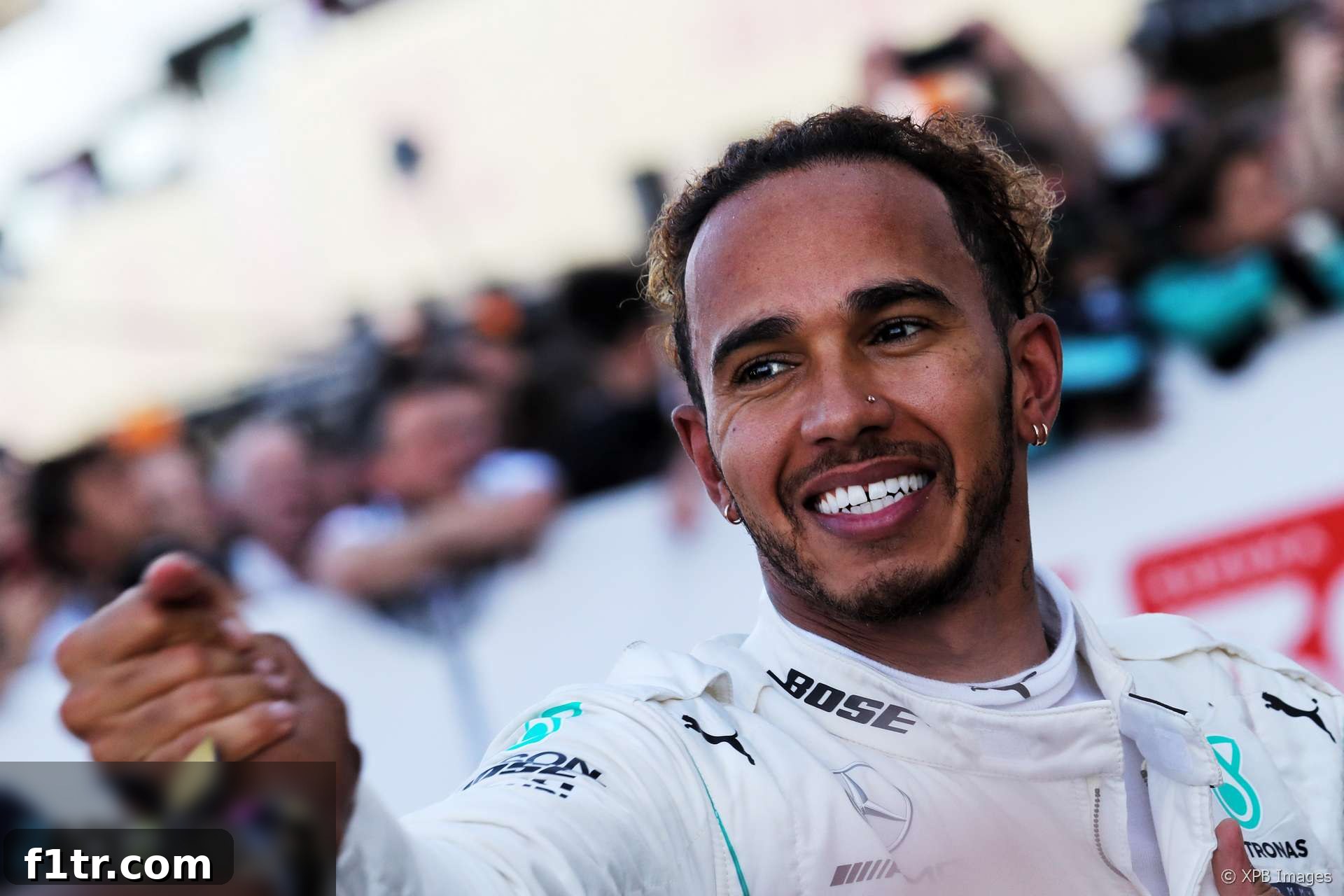
Lewis Hamilton Dominates 2018 Japanese Grand Prix: A Decisive Step Towards Fifth World Title
The 2018 Formula 1 World Championship took a decisive turn at the Suzuka International Racing Course, as Lewis Hamilton secured a commanding victory at the Japanese Grand Prix. This monumental triumph, coupled with Valtteri Bottas’s strong second-place finish, marked Mercedes’ second consecutive one-two, effectively sealing the fate of the drivers’ and constructors’ titles. What had once been a closely contested battle, promising a thrilling conclusion in the final races, now firmly swung in Mercedes’ favor, leaving Ferrari and Sebastian Vettel grappling with dwindling hopes and mounting frustration.
From the outset of the Japanese Grand Prix weekend, Mercedes demonstrated unparalleled pace and strategic acumen. Their dominance was absolute, leaving their rivals struggling to keep up. In stark contrast, Sebastian Vettel and Ferrari’s campaign was plagued by a series of missteps and unfortunate incidents, culminating in a race that saw their championship aspirations all but extinguished. The increasing desperation within the Ferrari camp became palpable as the weekend progressed, highlighting the immense pressure to deliver against Mercedes’ relentless pursuit of perfection.
Ferrari’s Fortunes Falter: Vettel’s Suzuka Nightmare Begins
Qualifying Blunders and Strategic Miscalculations
Sebastian Vettel’s challenging weekend began in the crucial qualifying session. A critical error in Q3, where both he and Kimi Raikkonen were sent out on intermediate tyres on a drying track, proved to be a significant miscalculation by the Ferrari strategists. Their attempt to second-guess the capricious Suzuka weather backfired spectacularly, costing them valuable track time on the appropriate slick tyres. Following this strategic blunder, Vettel compounded the team’s woes by making two costly mistakes on what became his only clear lap. These errors relegated him to a disheartening ninth place on the grid, a position from which he would have to fight tooth and nail to salvage his championship hopes. While he gained one position to eighth due to a three-place grid penalty for Esteban Ocon – who was penalized for accelerating above the minimum speed during a red flag period due to a radio communication mix-up – the damage to his starting position had already been done, placing him at a significant disadvantage against his championship rival.
Prior to the Suzuka weekend, there had been much speculation regarding Ferrari’s perceived performance advantage, particularly concerning their engine. Rumors circulated about the FIA introducing a second sensor to monitor their power unit, coinciding suspiciously with a supposed drop in engine power. However, these theories were debunked, as it was confirmed that the sensor had been present on the car much earlier in the season. Indeed, as the opening laps of the Japanese Grand Prix race proved, Vettel’s Ferrari was certainly not lacking in power. He demonstrated impressive straight-line speed, effortlessly carving past the Honda-spec-three-powered Toro Rossos on the run to Turn 1, and then pulling alongside Romain Grosjean on the sweeping section from the hairpin to Spoon Curve. His super-soft tyres provided a decisive traction advantage over the soft-tyred Haas, allowing him to make early gains.
Verstappen vs. Ferrari: A Double Collision Course
The early stages of the race were marked by intense battles, none more controversial than the series of incidents involving Max Verstappen and the Ferraris. The first altercation saw Kimi Raikkonen, leveraging the raw power of his Ferrari, put Max Verstappen on the defensive as they approached the chicane. Under pressure, the Red Bull driver locked a wheel, ran wide off the track, and then controversially rejoined the circuit at the apex of the following corner. This maneuver was clearly executed in a manner calculated to cause maximum inconvenience to Raikkonen, forcing the Ferrari driver into a compromising position.
Unsurprisingly, Verstappen quickly assigned blame for the ensuing collision to his rival. “I braked a little bit too late into the chicane, so I did everything I could to get back onto the track, and I think I did it in a safe way because I was not crazy-fast onto the track,” Verstappen explained. “But Kimi chose the wrong line in the chicane. He could have also just waited for me to come back on the track.” This perspective, however, overlooked Verstappen’s own responsibility. He could just as easily have rejoined the track in a safer manner, potentially without even relinquishing his third position. The stewards, after reviewing the incident, sided against Verstappen, handing him a five-second penalty for the clash – a decision he vehemently criticized as “really ridiculous.”
Verstappen’s penalty inadvertently offered Sebastian Vettel a golden opportunity, a gift-wrapped third place. Vettel expertly swept past his delayed teammate, Kimi Raikkonen, and was perfectly positioned to capitalize on Verstappen’s impending penalty. However, Vettel, never one to passively await a handout, was determined to reclaim the position on track, and a Safety Car period soon presented him with the chance.
Following the Safety Car restart, Vettel launched a powerful attack. He gained a strong run out of the hairpin and charged down the inside of Verstappen at Spoon Curve. He managed to get far enough alongside that the initial contact was front wing to front wheel. Whether Vettel could have successfully navigated the corner without relying on the Red Bull for support remains a point of contention. Nevertheless, further contact ensued, with Vettel’s front-right wheel making contact with Verstappen’s left-rear. This second impact sent Vettel into a spin, mercifully without flipping Verstappen’s car. The Red Bull driver continued without losing a position, while Vettel plummeted to the back of the field, his car carrying significant front-wing damage.
“He drove into the side of my car,” was Verstappen’s succinct assessment. He further added, “In that corner you can’t overtake,” a peculiar statement from a driver whose career has been defined by audacious passes in unexpected places. Vettel, understandably frustrated, accused Verstappen of failing to give him sufficient room. Realistically, this was a textbook racing incident – a high-stakes, low-percentage move by Vettel, driven by the urgency of his championship situation. While a risk worth taking in the context of the title fight, it ultimately condemned him to a lengthy and arduous slog through the field, culminating in a meager sixth-place finish. This incident proved to be a critical blow, effectively reducing his championship aspirations to a mere mathematical possibility and all but guaranteeing him a second-place finish in the drivers’ standings.
Hamilton’s Untouchable Dominance: A Masterclass in Suzuka
While the drama unfolded behind him, Lewis Hamilton’s performance at the front of the pack was a demonstration of absolute control and unmatched pace. He was never seriously challenged for the lead, consistently extending his advantage over his teammate, Valtteri Bottas. By lap 22, Hamilton had built a comfortable five-second buffer, affording Mercedes the strategic luxury of pitting Bottas first. This tactical decision ensured that even an unexpected Safety Car deployment would not cost Hamilton his hard-earned lead, underscoring Mercedes’ meticulous planning and strategic depth.
The only fleeting moment of concern for Hamilton came when he reported minor glitches with his power unit. However, these issues were quickly resolved by his engineering team, allowing him to motor home unchallenged, crossing the finish line with a dominant 13-second margin over Bottas. This impressive victory marked his ninth win of the season and his fourth triumph at the iconic Suzuka circuit, further solidifying his claim to what seemed an inevitable fifth world title.
The gap to Bottas was also influenced by tyre strategy. Bottas, having started the race on super-softs, was able to switch to the more durable and preferable soft compound tyre for his final stint. Mercedes, in contrast, starting on softs, was forced to move to mediums for Hamilton’s final stint, opting not to risk the fragile super-softs for such a long run. Bottas struggled significantly more on his tyres than Hamilton, allowing Verstappen to make inroads. A late Virtual Safety Car period further compounded Bottas’s woes, momentarily bringing Verstappen within striking distance. However, the superior straight-line speed of the Mercedes ultimately ensured that Verstappen, despite his valiant efforts, never truly looked likely to capitalize on the opportunity and seize second place from Bottas.
Midfield Mayhem and Standout Performances
Amidst the championship battle at the front, the midfield delivered its own share of drama and impressive drives. Daniel Ricciardo, starting a lowly 15th due to yet another Renault power unit problem, produced a stellar recovery drive to finish in an unexpected fourth place. His remarkable progress was significantly aided by a contentious collision between Charles Leclerc and Kevin Magnussen, which ultimately necessitated a Safety Car period, bunching up the field and giving Ricciardo an opportunity to gain ground.
The Controversial Magnussen-Leclerc Incident
The incident unfolded dramatically on the very first lap. Magnussen initially overtook Leclerc at the challenging 130R corner. Leclerc immediately attempted to retaliate on the pit straight, but Magnussen, reacting late, moved to cover his line. Leclerc, trying to swerve back to the left, unfortunately collided squarely with the rear of the Haas at a point on the track where speeds exceed 300 kph. The sheer velocity of the impact, occurring directly under the start line gantry, raised serious safety concerns; the potential consequences had Leclerc’s car been launched upwards are unthinkable. Leclerc left no doubt about his feelings, lambasting Magnussen’s driving as “stupid.” Yet, in a decision that sparked widespread debate, the stewards once again ruled that the Haas driver had committed no wrongdoing. This marked his fourth consecutive investigation for a driving infringement that resulted in no action being taken, adding to the controversy surrounding his aggressive driving style. The incident, however, ended Magnussen’s race, as he sustained a puncture that led to floor damage, forcing his retirement. Leclerc also failed to see the chequered flag, later slithering off the track on rapidly deteriorating tyres before parking his car.
Battles for the Final Points
Pierre Gasly initially led the “best of the rest” class after a strong start but was forced to run his power unit in a more conservative setting due to persistent calibration problems. Toro Rosso’s strategy involved stretching both their drivers’ first stints long enough to switch to soft tyres, a move that unfortunately cost both Gasly and Brendon Hartley valuable track position. Romain Grosjean and the Force India duo of Sergio Perez and Esteban Ocon capitalised on this, jumping Gasly when he eventually pitted.
Sergio Perez, showcasing his renowned skill for tyre management, opted for soft tyres for his final stint. He expertly utilized their performance advantage to pass Grosjean’s medium-shod Haas after a Virtual Safety Car restart. The move left the startled Grosjean convinced that his rival must have jumped the restart, highlighting Perez’s opportunistic and precise driving. Esteban Ocon followed his teammate in ninth, undoubtedly ruing the grid penalty that had dropped him behind Perez earlier in the weekend. Gasly managed to hold onto the final points-scoring position for Honda, a fitting tribute at their home race, until Carlos Sainz Jnr’s Renault passed him with just three laps remaining. Marcus Ericsson, in the sole remaining Sauber, finished 12th, his only truly distinguishing moment coming when he controversially rammed his teammate during the Safety Car restart.
Brendon Hartley’s race was compromised from the outset by a dreadful, wheel-spinning start. His woes were further compounded by a difficult strategy, leaving him a distant 13th. The McLaren pair followed, with Fernando Alonso expressing his characteristic displeasure over a mid-race penalty. Alonso was penalized after seemingly using contact with Lance Stroll as an excuse to cut the chicane to an egregious extent. However, it appeared Alonso was merely counting the days until his departure from the sport, unable to resist another opportunity to critique Formula 1’s shortcomings, lamenting the state of the sport.
Vettel’s Championship Dream Fades: A Crown Awaits Hamilton
As the race neared its conclusion, Kimi Raikkonen’s lap times began to tail off dramatically. They took a significant hit after the Virtual Safety Car period, which Ferrari had hoped to utilize as an opportunity to bring him into the pits. However, the VSC ended prematurely, just before he could reach the pit lane entrance, thwarting their plans. As Sebastian Vettel closed in on his teammate during the final laps, speculation mounted that Ferrari might issue a team order, instructing Raikkonen to cede fifth place to Vettel. Such a move would have granted Vettel an additional two crucial points, potentially keeping his title hopes marginally alive. After all, Vettel himself had strenuously defended Mercedes’ use of team orders in the previous race.
Yet, Ferrari remained silent. No message was relayed to Raikkonen instructing him to move aside. Another option could have been to pit Raikkonen for fresh tyres, which would have naturally surrendered the position to his teammate without the need for an explicit instruction. This, too, did not happen. The conspicuous absence of any such team intervention spoke volumes. If Ferrari or Vettel still genuinely believed the championship was winnable, every conceivable measure would have been taken to maximize his points. The fact that he was not afforded fifth place was a clear indication that the towel had been thrown in. With a daunting 65-point deficit to overcome in just four remaining races, the challenge was virtually insurmountable. For all intents and purposes, it might as well have been 67 points, as the mathematical improbability rendered the distinction academic.
Barring some extraordinary and unforeseen misfortune for Mercedes and Lewis Hamilton, the 2018 Formula 1 World Championship crown was now firmly within his grasp. Suzuka had not just delivered a thrilling race; it had delivered the definitive moment of the season, marking the undeniable path to Lewis Hamilton’s fifth world title.
2018 Japanese Grand Prix
- 2018 Japanese Grand Prix team radio highlights
- 2018 Japanese Grand Prix Star Performers
- Mercedes take first back-to-back one-twos since 2016
- Top ten pictures from the 2018 Japanese Grand Prix
- Hamilton on cusp of fifth title as Vettel throws in the towel
Browse all 2018 Japanese Grand Prix articles
F1 race reviews
- Antonelli lucks in for second win and becomes youngest F1 championship leader
- Emotional Antonelli grabs first Formula 1 victory in Chinese Grand Prix
- Russell sees off Ferrari threat to lead Mercedes one-two in Melbourne
- Norris clinches F1 title by two points as Verstappen wins finale at Yas Marina
- McLaren strategy blunder in Losail hands Verstappen crucial win and shot at title
Read all F1 race reviews