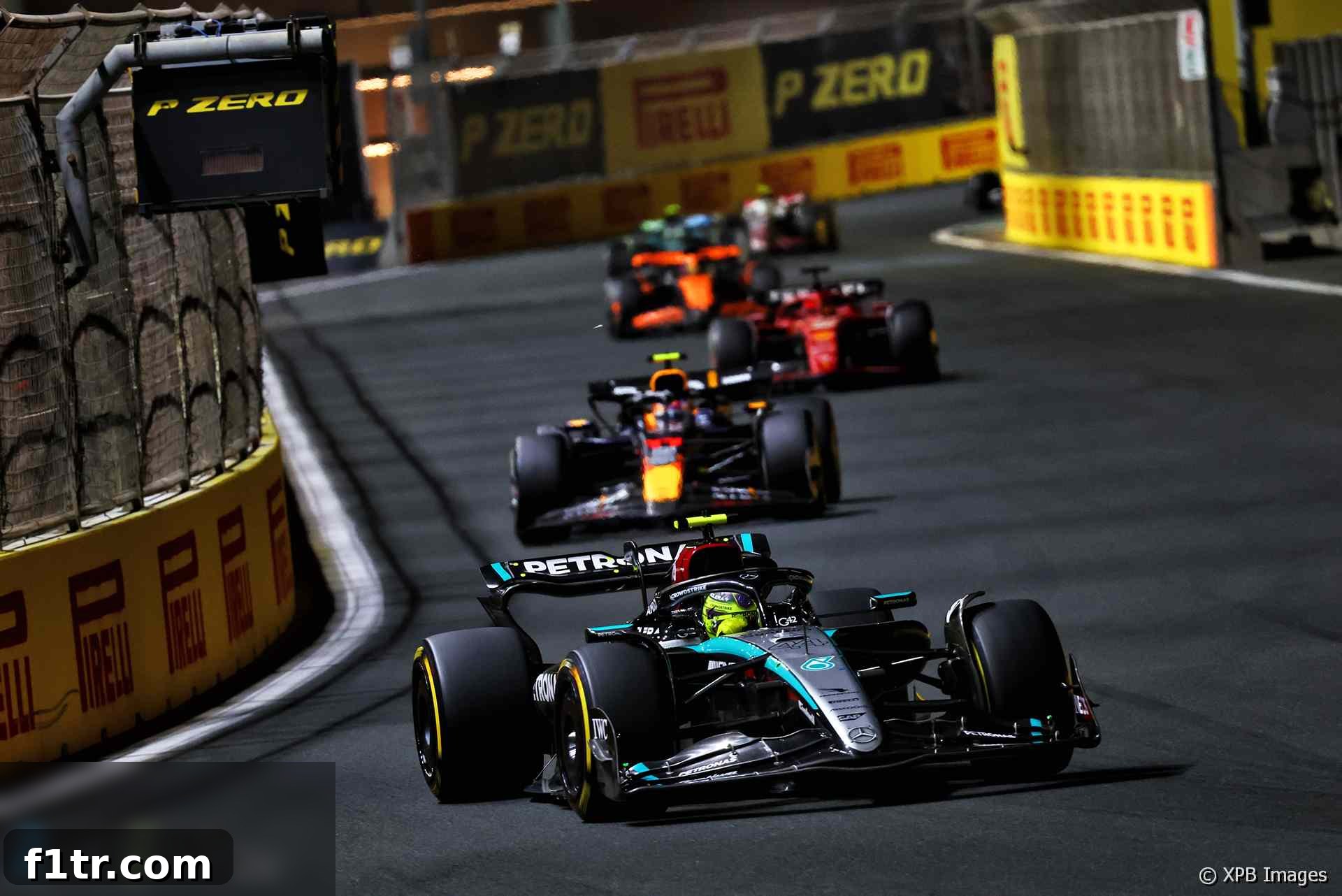
Lewis Hamilton Laments Mercedes W15’s High-Speed Deficit at Saudi Arabian Grand Prix
Seven-time Formula 1 World Champion Lewis Hamilton expressed profound frustration over the performance of his Mercedes W15 car at the recent Saudi Arabian Grand Prix. The British driver finished a disappointing ninth, highlighting a critical weakness in the car’s high-speed cornering capabilities that left him feeling “miles off” his rivals on the demanding Jeddah Corniche Circuit.
The sentiment from the Mercedes garage following the race in Jeddah was one of clear disappointment, especially given the high hopes surrounding the extensively revised W15 for the 2024 season. Hamilton’s comments underscore a recurring theme for the Brackley-based squad, which has been striving to return to title-contending form after two challenging years. The fast, flowing nature of the Jeddah track proved to be a brutal mirror reflecting the current deficiencies in Mercedes’ latest challenger, pushing the team to reassess its fundamental design philosophy.
The Critical High-Speed Performance Gap of the W15
Speaking to Sky Sports after a gruelling race under the lights of Jeddah, Hamilton articulated the stark contrast in performance he experienced compared to his competitors. “The car is relatively good in the low-speed and not so bad in the medium,” he explained, painting a picture of a car that possesses some strengths. However, the crucial revelation followed: “But in the high-speed we are miles off.” This critical deficit, he added, made him feel as though he was “in a different category” when navigating the circuit’s fastest sections alongside drivers from top teams like Red Bull, Ferrari, and McLaren.
The Jeddah Corniche Circuit is renowned for its thrilling combination of speed and precision. Its layout, featuring numerous high-speed corners and long, sweeping bends that demand absolute confidence and stability, places an immense premium on aerodynamic efficiency and car balance at blistering pace. For Hamilton to feel such a significant gap in these crucial areas is a worrying indicator for Mercedes. In the hyper-competitive world of Formula 1, even tenths of a second can separate victory from obscurity, and being “miles off” suggests a fundamental conceptual issue rather than mere fine-tuning or driver preference.
This challenge is particularly pronounced when battling against front-running teams. Red Bull’s RB20, for instance, has demonstrated exceptional stability and downforce through high-speed sections, allowing Max Verstappen and Sergio Perez to extract maximum performance with apparent ease. Similarly, Ferrari and McLaren, while perhaps not consistently challenging Red Bull, have shown superior high-speed balance and agility compared to the W15. This disparity means Hamilton is often left defending or unable to attack effectively in the very parts of the track where lap time is most decisively gained or lost, directly impacting his ability to fight for higher positions.
A Familiar Narrative: Three Years of Frustration for Hamilton
For Hamilton, the current situation evokes a painful sense of déjà vu. Mercedes entered the 2024 season with a fresh design philosophy, hoping to rectify the core issues that plagued their W13 and W14 challengers in 2022 and 2023. These previous iterations struggled significantly with aerodynamic instability and a narrow operating window, often manifesting as severe porpoising and inconsistent performance across different track conditions. The W15 was touted as a significant departure from these troubled designs, yet the underlying problems, particularly concerning high-speed grip and stability, appear to persist.
“It’s frustrating, for sure, to be three years in a row in almost the same position,” Hamilton candidly admitted. “It’s definitely tough.” This raw honesty underscores the immense pressure on the team and on Hamilton himself, as he navigates what could be his final season with Mercedes. The feeling of being stuck in a perpetual cycle of underperformance, despite the monumental efforts of the engineers and designers back at the factory in Brackley, is clearly taking its toll on the decorated driver and the entire team.
Hamilton’s insight suggests that while the team is working tirelessly, the changes made to the W15 might not have been radical enough to bridge the gap to the front-runners. “I know we’ll get our heads down and we’ll keep working away. I know everyone back at the factory is pushing as hard as they can,” he affirmed, acknowledging the dedication within the team. However, he swiftly followed this with a crucial observation: “But we’ve definitely got to make some big changes. We haven’t made big enough changes, perhaps. You look at the three teams ahead of us, they still have different concepts to where we are in some areas. So we’ve got some performance to add, that’s for sure.”
This statement is a critical indictment of Mercedes’ current design philosophy. While other teams have converged on certain aerodynamic concepts that optimize performance under the current ground-effect regulations, Hamilton implies that Mercedes might be clinging to elements that are fundamentally flawed or have reached their developmental ceiling. To truly compete with the likes of Red Bull, Ferrari, and McLaren, a more significant paradigm shift might be required, rather than incremental evolution. The challenge lies not just in finding more performance, but in identifying and adopting a truly competitive conceptual direction that can unlock the W15’s full potential.
Strategic Gambit: A Calculated Risk in Jeddah’s Early Stages
During the Saudi Arabian Grand Prix, Mercedes opted for a bold, albeit ultimately unsuccessful, strategic move with Lewis Hamilton. When an early Safety Car period was triggered by Lance Stroll’s crash, many drivers, including Hamilton’s teammate George Russell, immediately pitted for fresh hard tyres to complete the race. However, Mercedes decided to keep Hamilton out on track, hoping for a subsequent Safety Car or red flag that would allow him to pit ‘for free’ later in the race, effectively gaining track position and a significant advantage over those who had already stopped. This decision briefly elevated him to third place, sparking interest and debate in the pit lane.
“I think it was worth trying something different,” Hamilton stated, defending the team’s call. “Splitting the cars and trying different strategies and ultimately that’s always the goal, to do something a little bit different, particularly when we’re in the position we’re in.” This approach highlights Mercedes’ understanding that they cannot simply beat their rivals on raw pace alone. Given their performance deficit, they need to employ innovative, high-risk strategies to create opportunities and climb up the order, turning potential mid-field finishes into top-tier results.
Despite Hamilton’s best efforts to prolong the life of his initial set of hard tyres, diligently managing their wear and maintaining a respectable pace, no further Safety Car intervention materialized throughout the remainder of the race. This meant he had to make a regular pit stop significantly later than his competitors, losing valuable track position and ultimately relegating him to ninth place. “I was fighting as hard as I could to go long, and I was hoping for a Safety Car or something, but it was just unfortunate that nothing came out,” he concluded. While the strategy did not pay off on this occasion, it underscores Mercedes’ proactive and aggressive mindset in a challenging competitive landscape, always seeking an edge where pure performance is lacking.
The Road Ahead: What’s Next for Mercedes F1’s W15 Development?
The candid feedback from Jeddah, particularly Hamilton’s pointed comments regarding the need for “big changes,” will undoubtedly intensify the pressure on the Mercedes technical team, led by figures like Toto Wolff and James Allison. The call for significant conceptual shifts suggests that minor upgrades and iterative development might no longer suffice. The team must conduct a thorough and honest evaluation of their W15 concept and potentially consider more fundamental shifts in design philosophy to address the persistent high-speed performance deficit and unlock the car’s true potential.
The upcoming races in the 2024 Formula 1 season will be crucial for Mercedes. Their ability to diagnose and rectify these deep-seated issues will determine not only their performance this year but also their long-term competitiveness in the evolving era of ground-effect regulations. For Lewis Hamilton, who has committed to a new chapter in his career beyond Mercedes, the desire to leave the Silver Arrows with a renewed sense of direction and potential, and to contribute to setting them on a path back to championship contention, is palpable. The quest for significant performance gains, especially in high-speed sections, remains the paramount objective for the Silver Arrows as they navigate what continues to be a challenging period of self-reassessment and intense development.
Further Reading: 2024 Saudi Arabian Grand Prix Insights
- Bearman’s 2024 Jeddah debut performance makes him ‘feel like an absolute idiot’
- Vowles being patient with Sargeant but expects to see “progress”
- “So I’ve got nothing to worry about?” – The best unheard team radio from Jeddah
- “Shock” of poor start to season showed need for change at Alpine – Famin
- “My tyres are dying”: Stroll’s short-lived struggle until he hit the wall
Browse all 2024 Saudi Arabian Grand Prix articles