The 2020 Formula 1 Italian Grand Prix at Monza delivered an unforgettable blend of high-octane drama, unexpected twists, and a pivotal moment that reshaped the race’s outcome: a severe penalty dealt to then-championship leader Lewis Hamilton. This incident, which stripped the Briton of a likely victory, has been brought into sharper focus by one of the very officials involved in the decision. Garry Connelly, a seasoned steward, recently offered an unprecedented glimpse into the moments following the penalty, revealing how Hamilton personally confronted the stewards to understand the reasoning behind the crucial call.
The circumstances leading to the penalty were a testament to the unforgiving nature of Formula 1 regulations. A mid-race Safety Car period, prompted by a crash, necessitated the closure of the pit lane for safety reasons. It was during this critical phase that Hamilton, inadvertently or through a communication lapse, entered the closed pit lane to change tyres – a clear violation of the rules. This infraction triggered one of the sport’s most stringent sanctions: a 10-second stop-and-go penalty, effectively shattering his hopes of clinching a win at the iconic Temple of Speed.
Advert | Become a Supporter & go ad-free
Connelly, speaking at the FIA International Stewards Programme, meticulously detailed the sequence of events. “Lewis Hamilton drove into the pit lane when the pit entry was closed,” Connelly explained, highlighting the undeniable nature of the transgression. He further elaborated on the clear warning systems in place: “The warning light panels – two of them on the entrance to the pit lane – clearly displayed the cross to show the pit lane was closed, then we referenced the appropriate regulation.” This statement underscores the objective basis for the stewards’ decision, emphasizing that the visual warnings were unequivocally presented to the drivers.
Formula 1’s regulatory framework leaves little room for ambiguity in such situations. The rules explicitly mandate a 10-second stop-and-go penalty for any driver found to have entered a closed pit lane. This strict guideline meant that the stewards, despite their personal sentiments, were bound by the letter of the law. Connelly confirmed this, stating that the officials “had no choice” but to impose the penalty on Hamilton. This highlights a fascinating aspect of F1 stewarding: while officials are expected to make fair and informed judgments, certain rules are prescriptive, removing discretionary power.
It’s an irony that the very stewards tasked with upholding the rules often find themselves in a predicament regarding mandatory penalties. Connelly openly admitted, “This is something that most of us don’t like. We don’t like mandatory penalties.” He further revealed a broader consensus among F1 stewards: “Almost all the chairmen of the FIA stewards in F1 and most of the other stewards in F1 disagree with mandatory penalties.” This sentiment stems from a desire for greater flexibility and the ability to consider extenuating circumstances, rather than being forced to apply a blanket punishment. However, the existence of such rigid rules is often at the behest of the teams themselves, who advocate for consistency and predictability in officiating, even if it means sacrificing some degree of nuance.
The repercussions of this decision were immediate and dramatic, altering the course of the 2020 Italian Grand Prix entirely. As Connelly observed, “This required a stop-and-go penalty for Lewis Hamilton. The world champion – potentially – was leading the race at the time [and] went, basically, to the back of the field. That was a very interesting situation.” From leading comfortably, Hamilton suddenly found himself at the tail end of the grid, facing an almost insurmountable challenge. This single penalty transformed a race that seemed destined for a familiar Mercedes victory into an open contest, paving the way for one of Formula 1’s most surprising winners in recent memory.
The race took another turn shortly after, when Charles Leclerc suffered a significant crash at Parabolica, leading to a red flag and a temporary suspension of proceedings. This unexpected pause presented Hamilton with a rare opportunity, and what unfolded next was truly remarkable. To Connelly’s evident surprise, the reigning world champion, still in his racing attire, made an unscheduled visit to the stewards’ room.
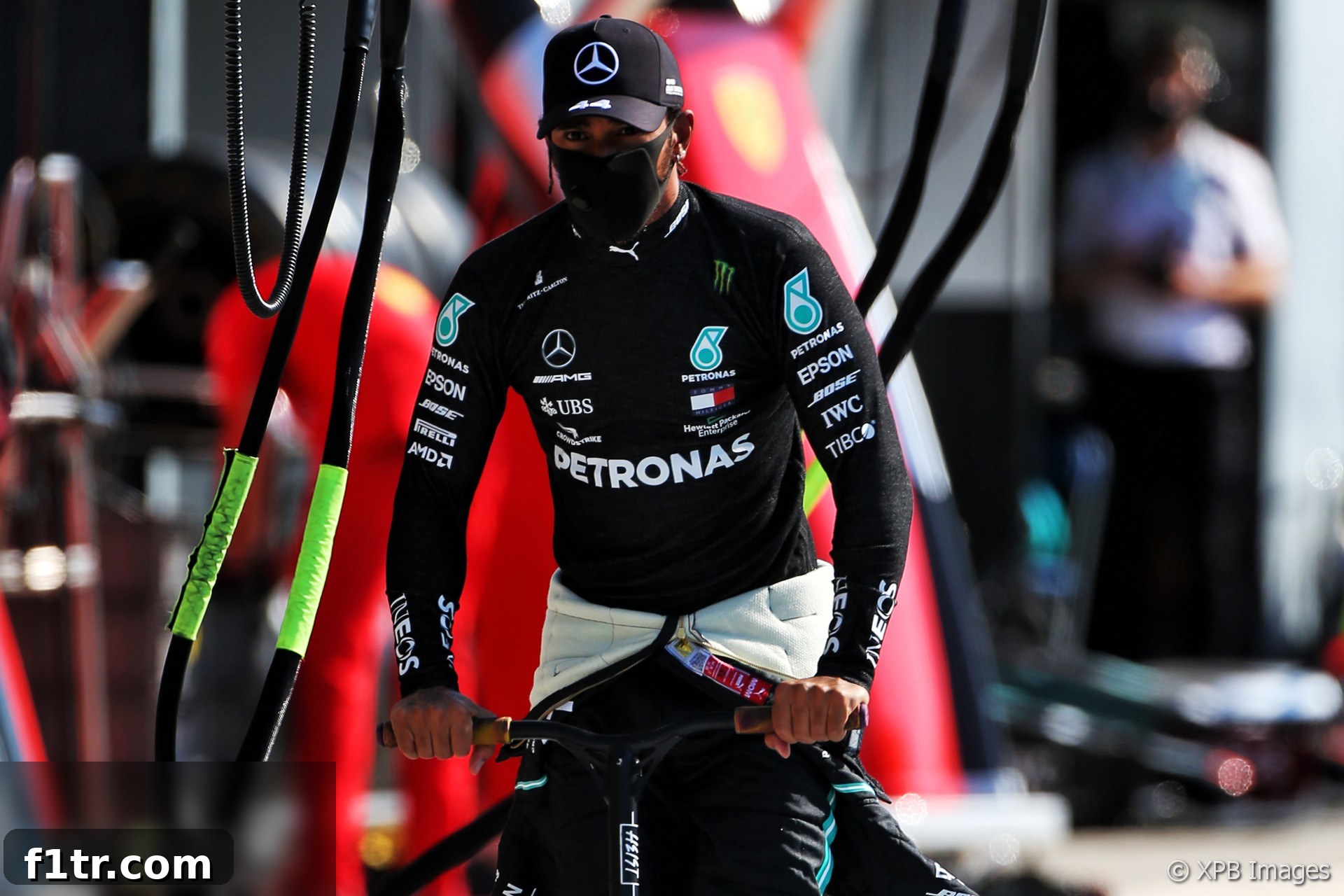
“Lewis hopped on his scooter during the stoppage of the race, scooted down the pit lane, and came up and paid us a visit in the stewards room,” Connelly recounted. This unprecedented moment showcased Hamilton’s determination to understand the judgment against him, rather than simply accepting it from afar. His professionalism was also noted: “Wearing his mask, which was great – we all put our masks on when he came into our stewards’ room.” This small detail highlighted the respect and adherence to protocols even in a moment of intense personal frustration and high-stakes racing.
Advert | Become a RaceFans supporter andgo ad-free
The interaction between Hamilton and the stewards was characterized by a mutual respect. “Lewis was extremely polite,” Connelly emphasized. Hamilton’s opening line was direct yet courteous: “Guys, can you tell me why I’ve been penalised?” The stewards responded clearly: “Yes, because you entered the pit lane when it was closed.” Hamilton, seeking definitive proof, then asked, “Can you show me?” This request for visual evidence is crucial in modern sports, where data and replays can provide irrefutable clarity.
The stewards readily obliged. “So we said, ‘Of course’. And we showed him the video replay,” Connelly explained. The most compelling evidence came from Hamilton’s own perspective: “We showed him from his onboard camera. And there right in front of him was the warning light for the first panel, and then again, the second panel.” This direct, undeniable proof left no room for doubt. Seeing the infraction from his own cockpit view provided the ultimate confirmation, bridging the gap between rule enforcement and driver understanding. It demonstrated the integrity of the stewarding process and the technological capabilities that support it.
Confronted with the clear evidence, Hamilton’s response was one of acceptance, albeit with a lingering question. “He said, ‘Oh, okay. I accept that,’ he said, ‘but why such a harsh penalty?’” This question perfectly encapsulates the dilemma of mandatory penalties. While accepting the factual basis of the penalty, Hamilton naturally questioned its severity, understanding the profound impact it would have on his race. The stewards, in turn, reiterated the non-negotiable nature of the rule: “We explained to him, ‘Unfortunately Lewis, it’s a mandatory penalty. And we don’t have any choice but to impose this penalty on you.’”
Despite the inherent disappointment, Hamilton’s conduct throughout the encounter was exemplary. “And whilst he was not absolutely delighted with this, Lewis accepted it, and was extremely polite, as I’ve always found him, and left the room and went back.” This interaction serves as a powerful testament to Hamilton’s professionalism and sportsmanship, even in moments of intense pressure and perceived injustice. His ability to engage respectfully with officials, accept difficult decisions, and move forward is a hallmark of a true champion, reinforcing his reputation beyond his on-track achievements.
Connelly used this extraordinary experience as a prime example of effective communication in sports officiating. It illustrated how transparency and clear explanation can help legitimize even the most controversial or impactful decisions. “No doubt he had a few comments to his team about why they didn’t warn him on the radio,” Connelly speculated, hinting at the potential internal discussions within the Mercedes camp. However, the key takeaway for the steward was the power of direct engagement: “But I think that’s a perfect example that, no matter how painful the decision, it was accepted by Lewis, and it was accepted by his team.”
Advert | Become a RaceFans supporter andgo ad-free
This incident transcends a mere rule infringement; it offers a profound insight into the mechanics of Formula 1, the intricacies of its regulations, and the professionalism expected from all its participants – from world champions to race stewards. The clarity and openness demonstrated by the stewards in presenting their case, coupled with Hamilton’s mature acceptance, solidified the decision’s legitimacy in the eyes of the primary affected party and, by extension, the wider audience. “So it just goes to show that if you can explain something, you can make a difficult decision acceptable to those to whom it applies, and to the wider audience,” Connelly concluded, emphasizing the enduring lesson from that dramatic day at Monza.
The 2020 Italian Grand Prix ultimately saw Pierre Gasly claim a stunning maiden F1 victory, a direct consequence of Hamilton’s penalty, proving how one moment of regulatory enforcement can rewrite sporting history. While Hamilton’s championship campaign was ultimately unaffected – he went on to secure his seventh world title that year – the incident at Monza remains a significant footnote, symbolizing the absolute adherence to rules that defines Formula 1. It underscored that even the greatest drivers are not immune to the sport’s strictures, reinforcing the notion of fair play and equal application of the rules across the grid, regardless of reputation or standing.
2020 F1 season
- Grosjean to make F1 test return tomorrow for first time since Bahrain horror crash
- Pictures: Wrecked chassis from Grosjean’s Bahrain fireball crash to go on display
- Bottas vs Rosberg: Hamilton’s Mercedes team mates compared after 78 races each
- F1 revenues fell by $877 million in Covid-struck 2020 season
- Hamilton and Mercedes finally announce new deal for 2021 season
Browse all 2020 F1 season articles