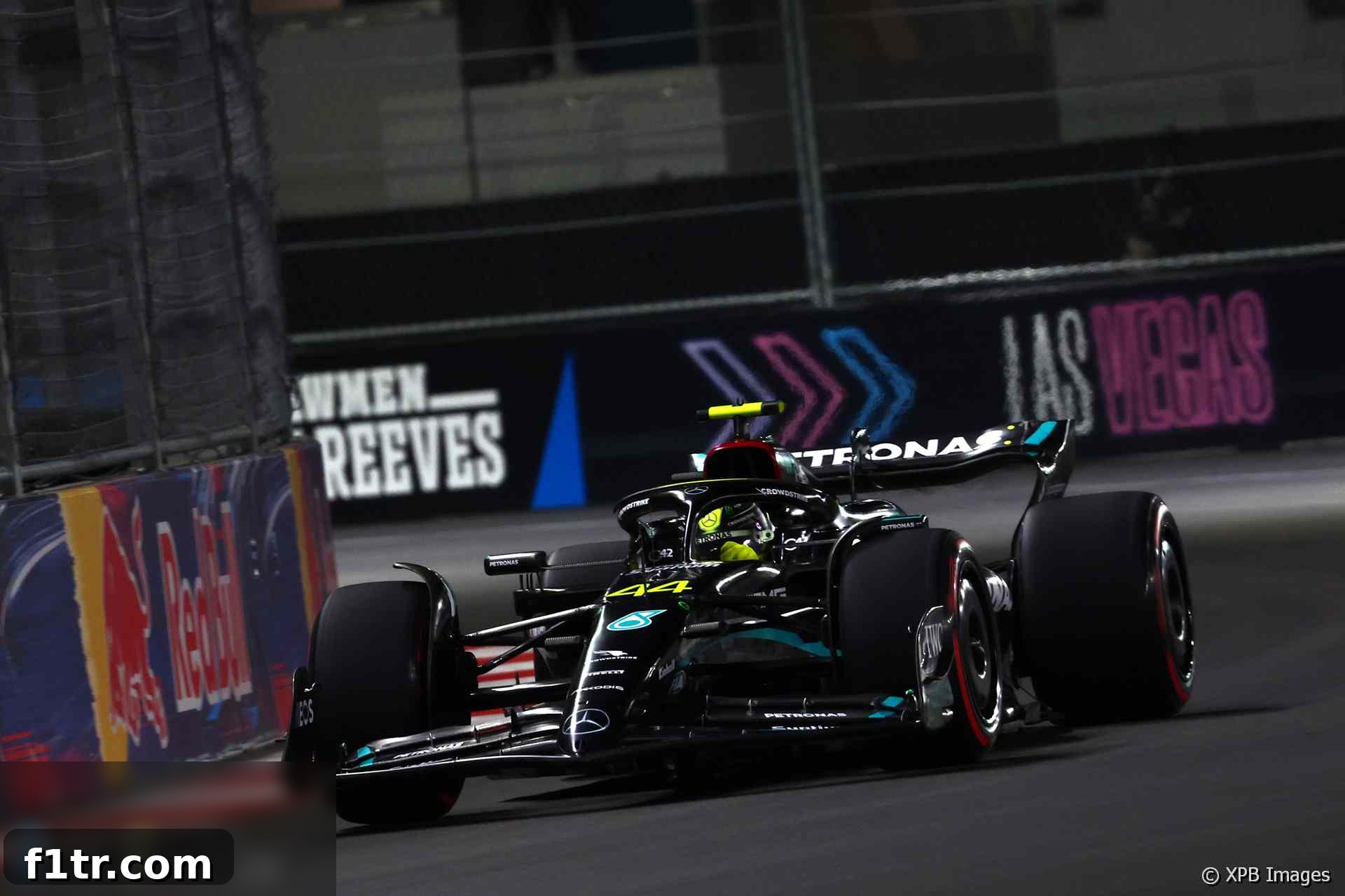
Seven-time Formula 1 world champion Lewis Hamilton offered a nuanced perspective following his inaugural run on the much-anticipated Las Vegas Strip Circuit. While relishing the high-speed thrill of the new urban track, the Mercedes driver voiced significant apprehension regarding the potential for exhilarating overtaking maneuvers during Saturday’s main event.
Advert | Become a Supporter & go ad-free
The Formula 1 circus descended upon Las Vegas with immense fanfare, marking a highly anticipated return to the iconic city. The first official practice session commenced on Wednesday night, promising an exciting glimpse into the capabilities of the 3.8-mile street circuit. However, the initial session was abruptly curtailed after a trackside valve cover became dislodged, causing substantial damage to at least two cars and raising immediate safety concerns. This unforeseen incident led to a two-and-a-half-hour delay, pushing the resumption of practice into the early hours of Thursday morning, testing the patience of teams, drivers, and the eager audience.
Despite the bumpy start, the extended 90-minute second practice session proved crucial for drivers to acclimatize to the unique characteristics of the Las Vegas layout. As widely anticipated, initial grip levels on the newly laid asphalt were exceptionally low, presenting a formidable challenge. Yet, over the course of the session, conditions steadily improved, allowing drivers to push harder and gain valuable data. Hamilton, known for his adaptability and precision, expressed genuine enthusiasm after finally getting a proper run on what he described as a “massively challenging” course.
“It’s incredibly fast and it’s a lot of fun,” enthused the British racing icon. “I had so much fun today. The sheer speed you carry down the straights and through some of the sweeping sections is quite breathtaking for a street circuit.” Hamilton highlighted the resilience of the event organizers, adding, “I’m so glad that we did get to run again. Obviously, it’s not great in P1 what happened, but they did a great job to fix it, and [it was] an interesting session, to say the least.” His comments underscore the delicate balance between the thrill of a new circuit and the imperative of ensuring driver safety and fair competition.
However, the unique confluence of environmental and track design factors at the Las Vegas Strip Circuit presented immediate technical hurdles, particularly concerning tire management. Drivers across the grid, including Hamilton, reported significant issues with tire graining. This phenomenon, where the tire surface begins to shed small rubber fragments due to excessive sliding, compromises grip and dramatically shortens tire life. The specific conditions contributing to this included the surprisingly low ambient and track temperatures for a desert climate, the choice of a low-downforce aerodynamic setup necessary for the circuit’s prodigious straights, and the relative scarcity of high-speed corners that would typically generate more consistent tire temperature and load.
Hamilton elaborated on the tire conundrum, offering insights into the delicate balance teams must strike. “We’re at really low downforce, so you’re sliding through a lot of the low-speed corners and also the high-speed corners,” he explained. “You don’t have a huge amount of load because you need the straight-line speed. And then the temperatures, I’m sure, are having a big effect on it.” This compromise between straight-line velocity and cornering grip is a perpetual challenge in Formula 1, but it is magnified on a circuit like Las Vegas, which features an astonishing two-kilometer straight along the iconic Strip, demanding maximum aerodynamic efficiency for speed at the expense of stability in tighter sections.
While the initial sentiment among many drivers and pundits was that the circuit’s immense straights, particularly the colossal run down the Las Vegas Strip, would inevitably foster a multitude of overtaking opportunities, Hamilton expressed considerable skepticism. His doubt stems from a combination of the very factors that make the track fast: low grip and minimized aerodynamic tow. Overtaking in Formula 1 typically relies on a car being able to close the gap significantly in the slipstream (the “tow”) of the car ahead on a straight, and then out-brake into a corner.
“Even though they’ve got the long straights, there’s not really a lot of places to overtake, because the grip is so low,” Hamilton stated, highlighting the primary deterrent. The lack of sufficient grip means that even with a speed advantage, drivers may struggle to confidently place their cars and execute a pass without risking a lock-up or running wide. Furthermore, he noted, “And the tow is not huge, a bit like Monza when you’re behind people, because you got the small wing, there’s not a lot of drag.” This comparison to Monza, another low-downforce, high-speed circuit often referred to as the “Temple of Speed,” is telling. On tracks where teams run minimal rear wing to achieve maximum straight-line velocity, the amount of aerodynamic drag for the following car to exploit in a slipstream is inherently reduced, diminishing the potency of the tow effect. This combination of low grip and a less effective tow could severely limit the much-anticipated wheel-to-wheel action, transforming the long straights into less of a passing zone and more of a high-speed procession.
Given these unique challenges, Hamilton stressed the paramount importance of specific strategic elements for the upcoming race. “So it’s kind of interesting. In qualifying I think position will be really important and then obviously degradation is going to be key,” he observed. A strong qualifying performance will be vital to secure a favorable starting grid position, as making up places on track might prove exceptionally difficult. The limited overtaking opportunities mean that starting further back could severely compromise a driver’s race, regardless of their car’s ultimate pace.
Furthermore, tire degradation, exacerbated by the low temperatures and graining issues, will play a critical role in shaping race strategies. Teams will need to meticulously manage tire wear, potentially leading to varied pit stop strategies and a greater emphasis on in-lap and out-lap performance. The ability to preserve tire life while maintaining competitive pace will likely dictate who has an advantage in the latter stages of the race. Despite his concerns about the practicalities of racing dynamics, Hamilton concluded his assessment with a note of personal enjoyment, reaffirming his love for the sheer driving experience: “But I had a blast.” This sentiment encapsulates the dichotomy of the Las Vegas Grand Prix – a spectacular event with a challenging, potentially complex racing landscape.
The Las Vegas Strip Circuit, with its blend of iconic cityscape, blistering speeds, and unique technical challenges, clearly offers a distinct experience within the Formula 1 calendar. While the initial practice sessions have unveiled potential hurdles for dramatic on-track battles, particularly regarding overtaking, the sheer spectacle and the demands placed on drivers and engineers promise an unpredictable race. The coming days will reveal whether teams can unlock the secrets of this demanding urban environment, and if Lewis Hamilton’s concerns about overtaking will be validated or overcome by the raw excitement of Formula 1 racing under the glittering lights of Las Vegas.
Advert | Become a RaceFans supporter andgo ad-free
2023 Las Vegas Grand Prix
- Tost blames track inspection oversight for Sainz’s damage in Las Vegas
- Hard to repeat “rare” combination of factors behind Vegas shunt – Norris
- Las Vegas Grand Prix “got a lot more hate than it deserved” – Sargeant
- Williams’ “incredible” Vegas qualifying made us “poor” in race – Vowles
- Piastri is first rookie to take two fastest laps in a season since Hamilton
Browse all 2023 Las Vegas Grand Prix articles