The Shanghai International Circuit played host to a captivating qualifying session for the Chinese Grand Prix, offering a wealth of data for analysis and sparking significant discussion across the Formula 1 paddock. As teams navigated the unique challenges of the track and the pressure of a single-hour practice followed by immediate qualifying, several compelling narratives emerged, shaping expectations for the upcoming race. This detailed breakdown explores the key performance indicators, driver battles, and notable trends from what proved to be an enthralling qualifying spectacle, providing a comprehensive look at the foundation for the weekend’s main event.
Among the most scrutinized performances was that of Liam Lawson, who unfortunately qualified at the back of the grid for both the sprint and main races in Shanghai. While this marked a tough weekend for the promising young driver, the broader context offers some perspective. Interestingly, another driver often tipped for a future Red Bull seat, and indeed, one with less experience than Lawson, also found himself out-qualified by his teammate. This highlights the immense pressure and razor-thin margins that define competition at the pinnacle of motorsport, especially for those striving to prove their worth within Red Bull’s highly competitive driver development pipeline. Lawson’s struggles underscore the steep learning curve and the immediate demand for peak performance in Formula 1, particularly on a circuit that demands absolute precision and unwavering confidence from drivers.
Here’s an in-depth look at the critical data points and insights gleaned from the Chinese Grand Prix qualifying sessions, revealing the intricate dance of speed, strategy, and skill.
Change from Practice to Qualifying: Mastering the Shanghai Challenge
The transition from free practice to qualifying is often a telling indicator of a team’s understanding of their car and the circuit, showcasing their ability to adapt and optimize under pressure. Yesterday’s sprint race qualifying had already hinted that Red Bull, despite their inherent pace, were operating far below their ultimate potential during the sole, crucial one-hour practice session. This strategic approach is common, allowing top teams to gather vital data without revealing their full hand too early. However, other teams initially struggled to make the necessary improvements between the practice run and the intense pressure of the main qualifying sessions.
Today, several teams rectified those earlier issues with remarkable efficiency and strategic insight. McLaren, in particular, demonstrated their prowess, securing a well-deserved pole position for the main race—a feat many believed they should also have achieved during the sprint qualifying. Their ability to extract maximum performance from their MCL38 when it mattered most speaks volumes about their operational efficiency, driver feedback loop, and their rapid understanding of the Pirelli tire characteristics. Similarly, Sauber showed significant progress, with Nico Hulkenberg appearing firmly on course to reach the coveted top 10 in Q3. While ultimately missing out in the final runs, his strong performance underscored a notable step forward for the Swiss-German outfit, indicating improved car balance and potential for strong race pace. This adaptation from practice to qualifying is a critical factor in Formula 1, where minimal track time demands quick learning and precise adjustments to unlock a car’s full speed potential.
The ability of teams to quickly adapt their car setup and driver approach from a single practice session to the high-stakes environment of qualifying is paramount, particularly on a technical circuit like Shanghai with its demanding mix of high-speed corners, long straights, and a challenging pit entry. Optimal tire management, understanding the track’s evolution, and the confidence to push the limits are key determinants of success, and the teams that excelled in this aspect reaped the rewards, setting themselves up for a competitive Grand Prix.
Gaps Between Team Mates: The Ultimate Intra-Team Showdown
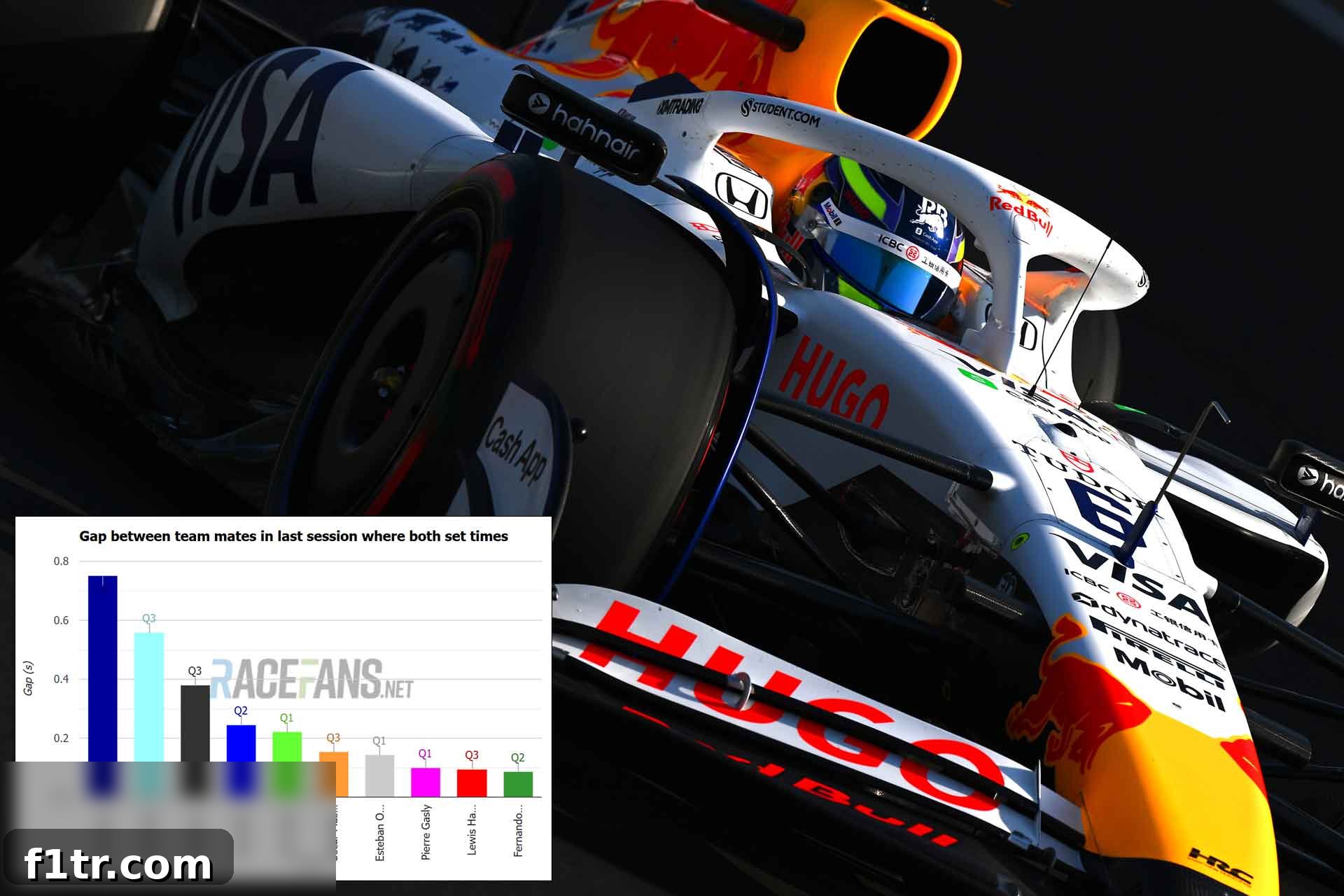
The gap between teammates in qualifying serves as a brutally honest assessment of a driver’s raw pace, adaptation skills, and overall performance. It’s a fundamental metric for evaluating talent, often shaping career trajectories and influencing team strategies. This year, across three qualifying sessions (two grand prix and one sprint race), Liam Lawson has consistently recorded the largest deficit to his teammate. In Shanghai, he found himself a substantial 0.75 seconds adrift of Max Verstappen – a stark contrast to many other teams where the difference between drivers was often no more than 0.15 seconds. This considerable gap highlights the monumental challenge of stepping into an F1 car and being directly compared against a multiple world champion and arguably one of the greatest talents in the sport’s history.
While Lawson faces an incredibly high benchmark in Verstappen, who boasts a decade of Formula 1 experience and an unparalleled understanding of Red Bull machinery, closing this gap is a critical area for improvement. For young drivers, consistency and minimizing this performance disparity are crucial for securing a permanent seat and demonstrating their potential. Elsewhere on the grid, a significant upset occurred as Isack Hadjar, in only his second Grand Prix start and on a track entirely new to him, managed to out-qualify his much more experienced teammate, Yuki Tsunoda. This achievement is particularly noteworthy, signaling Hadjar’s rapid learning capability and innate talent, while simultaneously raising questions about Tsunoda’s consistency in this specific session. The dynamic nature of these intra-team battles keeps both drivers and fans on edge.
These teammate comparisons are not just about raw speed; they reflect confidence in the car, a deep understanding of the setup, and the crucial ability to extract peak performance under immense pressure. A consistent deficit can quickly erode a driver’s standing within the team and impact their long-term career prospects, while outperforming a more seasoned teammate can dramatically boost a rookie’s profile and accelerate their journey up the ranks. The data from Shanghai provides compelling evidence of both the immense challenges faced by some aspiring talents and the surprising breakthroughs achieved by others, painting a vivid picture of the relentless competition that defines Formula 1.
Team Mate Battles Sequences: Streaks Broken and Resilience Displayed
Qualifying streaks, both positive and negative, are a powerful testament to a driver’s sustained performance, consistency, or ongoing struggles within the intense Formula 1 environment. Yuki Tsunoda arrived in China boasting an impressive record, holding the second-highest streak of out-qualifying his teammate among all current drivers. He had remained unbeaten in the previous nine Grand Prix qualifying sessions, a remarkable run that saw him consistently outperform a varied roster of teammates including Daniel Ricciardo, Liam Lawson, and most recently, Isack Hadjar. This streak highlighted Tsunoda’s significant maturation and increasing consistency as an F1 driver, demonstrating his commendable ability to adapt to different car characteristics and overcome diverse teammate challenges.
However, all streaks must eventually come to an end, and for Tsunoda, that moment arrived in Shanghai. Isack Hadjar, the promising rookie, brought Tsunoda’s impressive run to a halt. This was partly due to a crucial mistake made by Tsunoda at Turn 13 during his decisive qualifying lap. Yet, it’s vital to note that Hadjar had been matching Tsunoda’s pace effectively up until that point in the session, a fact that was also evident in the data from yesterday’s sprint race qualifying. Hadjar’s performance suggests a raw speed and rapid learning curve that could make him a formidable contender in the future, proving his potential to make a significant impact.
Elsewhere on the grid, other significant streaks were either broken or continued, adding layers to the captivating driver narratives. Oscar Piastri delivered a strong performance to out-qualify his highly-rated teammate, Lando Norris, for the first time in eight races. This achievement marks a significant milestone for Piastri, signaling his growing confidence and enhanced ability to extract peak performance from the McLaren MCL38. Similarly, Lewis Hamilton managed to out-qualify his teammate for the first time in seven Grand Prix weekends, a welcome return to form for the multi-time world champion amidst what has been a challenging season for Mercedes. These instances highlight the relentless competition within teams and the immense psychological boost that comes from gaining an edge over a direct rival.
Still maintaining the most impressive streak for Grand Prix qualifying, Fernando Alonso continues to demonstrate his unparalleled experience and consistent speed. Despite his teammate Lance Stroll managing to beat him in sprint race qualifying this weekend, Alonso’s dominant run in the main Grand Prix qualifying sessions remains unbroken, a testament to his enduring brilliance and meticulous approach to race weekends. These team-mate battles provide a fascinating subplot to every Grand Prix, revealing underlying performance trends and driver narratives that captivate fans worldwide.
| Driver | Consecutive Qualifying Wins (vs Teammate) |
|---|---|
| Fernando Alonso | 14 |
| Max Verstappen | 9 |
| George Russell | 8 |
| Pierre Gasly | 5 |
| Alexander Albon | 4 |
| Driver | Consecutive Qualifying Losses (vs Teammate) |
|---|---|
| Lance Stroll | 14 |
| Liam Lawson | 10 |
| Jack Doohan | 3 |
The tables above vividly illustrate the current pecking order within teams based on recent qualifying performance. Alonso and Verstappen stand out as paragons of consistency, showcasing their ability to continuously outperform their teammates, while drivers like Stroll and Lawson are under increasing pressure to reverse their streaks and demonstrate improved pace. These numbers not only reflect individual performance but also provide crucial insights into car characteristics, driver comfort levels with the machinery, and the ever-present psychological aspect of Formula 1 qualifying, where every millisecond counts.
Q3 Appearances: The Elite Club of Consistent Performers
Reaching Q3, the final segment of Formula 1 qualifying, is a benchmark of consistent top-tier performance. It signifies that a driver and their car package are operating at a level capable of contending for pole position or at least securing a starting spot within the coveted top ten. The most frequent visitors to this elite final session continued their impressive runs during the Chinese Grand Prix qualifying, underlining their sustained competitiveness and highlighting their importance to their respective teams. George Russell, for instance, extended his remarkable streak, now having reached Q3 for an astounding 13 consecutive Grand Prix weekends. This consistency is invaluable for Mercedes, as Russell reliably puts the car in a strong starting position, maximizing their points potential even when the car might not be at its absolute best.
Other familiar faces also maintained their presence in the final shootout, underscoring their enduring talent and the strength of their cars. Lando Norris and Oscar Piastri’s joint appearance in Q3 for McLaren further emphasizes the team’s strong form and the consistent pace of both their highly capable drivers. Max Verstappen, as expected, also extended his Q3 streak, continuing his dominant run at the very front of the grid, a testament to his unparalleled skill and the Red Bull RB20’s exceptional performance. However, not all streaks can last forever. Carlos Sainz Jnr’s impressive four-race run of Q3 appearances, which began with his debut for Williams, unfortunately came to an end in Shanghai. This highlights the intensely competitive nature of the midfield and the slight fluctuations in performance that can make all the difference between making and missing the cut for the final session.
| Driver | Consecutive Q3 Appearances |
|---|---|
| George Russell | 13 |
| Lando Norris | 9 |
| Oscar Piastri | 6 |
| Max Verstappen | 5 |
These Q3 streaks are more than just statistics; they represent a driver’s unwavering ability to perform under extreme pressure, extracting the maximum from their machinery lap after lap. For teams, having drivers who consistently make Q3 is crucial for accumulating constructors’ points and maintaining their standing in the championship battle. The Chinese Grand Prix qualifying provided another compelling snapshot of who’s consistently hitting the mark and who’s facing renewed challenges in the ever-evolving landscape of Formula 1.
The qualifying session for the Chinese Grand Prix was a microcosm of Formula 1’s enduring appeal: a compelling blend of raw speed, strategic brilliance, and intense driver battles. From Liam Lawson’s steep learning curve against a generational talent to the breaking of long-standing teammate streaks, and the consistent excellence of established front-runners, Shanghai delivered a fascinating prelude to what promises to be an exhilarating race. The comprehensive data from qualifying provides crucial insights into car performance, driver confidence, and the dynamic landscape of the 2025 season, setting the stage for a dramatic contest where every position will be fiercely fought and every strategic decision will be pivotal.
2025 Chinese Grand Prix – Further Insights and Race Analysis
For more in-depth analysis and post-race reflections on the thrilling action from the Shanghai International Circuit, explore our comprehensive coverage of the 2025 Chinese Grand Prix:
- Norris names China and Canada as biggest missed opportunities this year
- Red Bull reassure Verstappen over ‘when we’ll have a winning car again’ in meeting
- Mercedes explain impact of Antonelli’s floor damage on his Chinese GP performance
- “I gave a lot of lap time away in that first stint”: Verstappen’s full Chinese GP radio
- Stats: Chinese Grand Prix saw most disqualifications in an F1 race for 21 years
Browse all 2025 Chinese Grand Prix articles