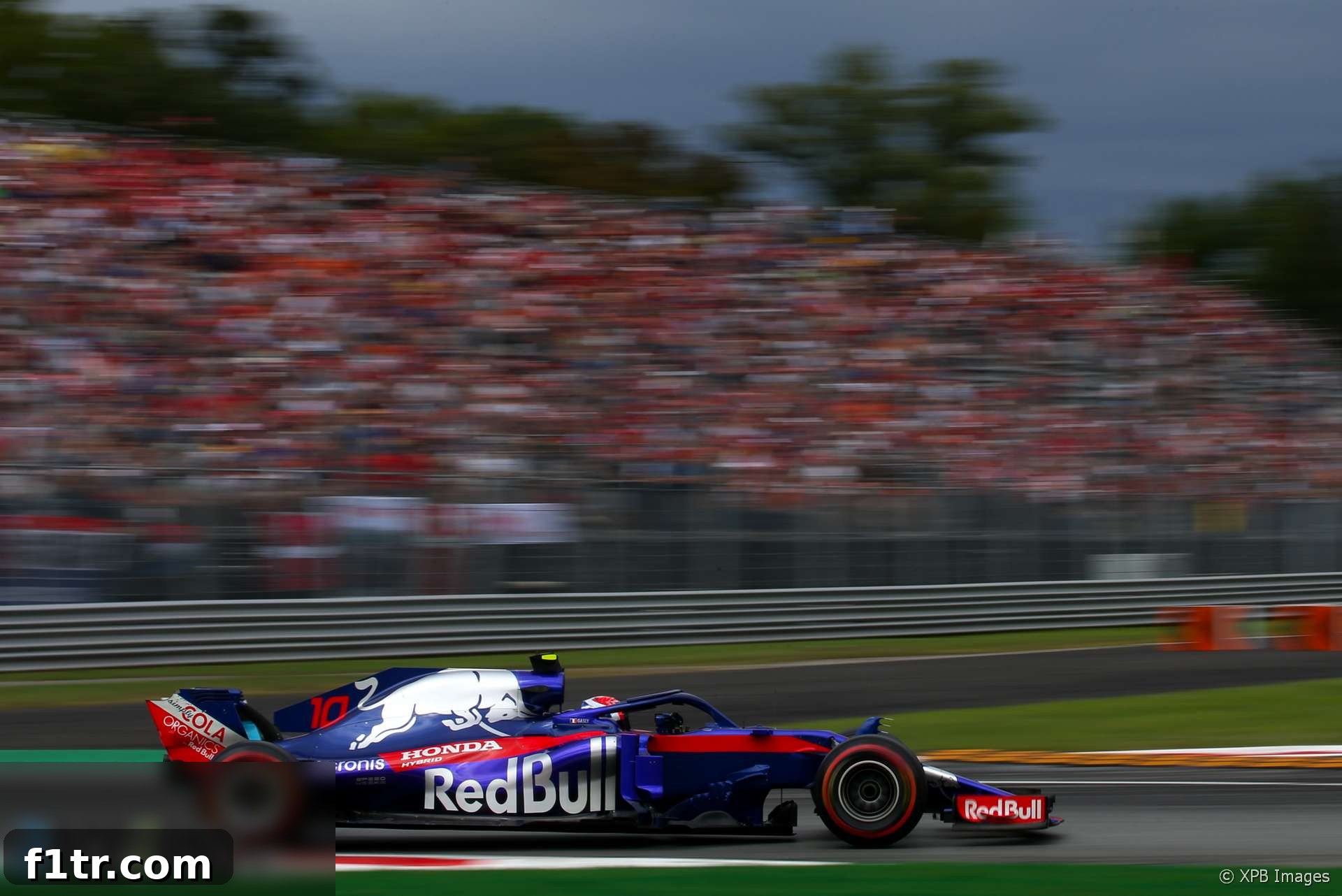
Gasly Accuses Alonso of “Unfair” Driving After Italian Grand Prix Contact
The 2018 Formula 1 Italian Grand Prix, a race celebrated for its high-speed thrills and unpredictable drama, was marred by a contentious incident in its early stages. Pierre Gasly, then driving for Toro Rosso, openly accused two-time world champion Fernando Alonso of “unfair” driving following contact between their cars in the frenetic first chicane. This clash, occurring just laps into the race restart after an early Safety Car period, ignited a fresh debate over racing etiquette, driver aggression, and the thin line between hard racing and overstepping boundaries in the cutthroat world of Formula 1.
The incident not only compromised Gasly’s race but also cast a shadow over Alonso’s final full season in the sport, leading to speculation about his changed approach on track. As the motorsport world dissected the event, Gasly’s strong remarks highlighted the intense pressure and high stakes involved in every battle, even for positions outside the points.
The Monza Melee: Gasly’s Grievance
The pivotal moment unfolded at the legendary Autodromo Nazionale Monza, a circuit renowned for its high speeds and challenging chicanes. Following an early Safety Car deployment, the field bunched up, setting the stage for aggressive moves on the restart. Pierre Gasly, navigating his Toro Rosso STR13, found himself side-by-side with Fernando Alonso’s McLaren MCL33 as they approached Turn 1, the Rettifilo chicane.
Initial Contact and Compromised Performance
Gasly recounted the incident with clear frustration, detailing how he attempted to overtake Alonso on the outside of the first corner. According to the young Frenchman, Alonso, instead of yielding the required racing room, “pushed me completely out of the track.” Gasly elaborated, explaining his efforts to remain on the tarmac: “I tried to stay on track as much as I could but he just didn’t leave me the space so I had to jump over the kerb.” The contact didn’t end there. Gasly further claimed, “then he also touched me and completely damaged all the right side of my floor.” This seemingly innocuous touch had far-reaching consequences for Gasly’s race performance.
The Aftermath: A Damaged Race
The immediate impact of the collision was devastating for Gasly. The damage to the right side of his car’s floor, a critical aerodynamic component, severely compromised its performance. Modern Formula 1 cars are incredibly sensitive to aerodynamic integrity, and even minor damage can drastically affect downforce and balance. Gasly vividly described the struggle: “From there on, I think it was lap eight or something, my car was completely broken and I was sliding everywhere.” What could have been a strong showing for the Toro Rosso driver quickly turned into an uphill battle for survival on track. Despite his best efforts to manage the crippled car, Gasly ultimately crossed the finish line in a disappointing 15th position. Fernando Alonso, who was involved in the incident, retired from the race shortly after due to an unrelated electrical problem, preventing any direct comparison of their race-long performance post-contact.
Alonso’s Aggression: A Farewell Season Mindset?
One of the most intriguing aspects of Gasly’s accusation was his theory regarding Fernando Alonso’s driving style. Gasly suggested that Alonso’s impending departure from Formula 1 at the end of the 2018 season might have influenced his aggression on track, leading him to drive with fewer inhibitions.
A Shift in Approach
“I think for sure his outlook is a bit different because he knows he’s not going to be in Formula One anymore next year so it looks like he is even more aggressive than he used to be,” Gasly remarked. This observation from a fellow competitor sheds light on the psychological dimension of racing. A driver, knowing their time in the pinnacle of motorsport is coming to an end, might feel liberated from the usual pressures of championship points, team expectations, and career longevity. This freedom could manifest as a more daring, no-holds-barred approach to on-track battles, pushing the limits of what is considered fair racing.
The Honda Factor
Adding another layer of complexity to the incident, Gasly explicitly linked Alonso’s perceived animosity to the Honda power unit. Toro Rosso, Gasly’s team at the time, was powered by Honda engines – the very same engines that had caused McLaren, Alonso’s team, years of frustration and poor performance earlier in the hybrid era. Gasly stated, “I know he doesn’t like us because we have the Honda engine but nevertheless.” This comment highlights the lingering tension and rivalry that can extend beyond just individual drivers to the teams and engine manufacturers they represent. The turbulent McLaren-Honda partnership, which ended in 2017, left a significant mark on the sport, and Gasly’s comment suggests that the sentiment might have influenced Alonso’s interactions with Honda-powered cars, even those from a different team. While this could be seen as an attempt to find a reason for Alonso’s actions, it also underscores the deep-seated rivalries that often define F1.
Stewards’ Scrutiny: The FIA’s Stance
In the immediate aftermath of any significant on-track incident in Formula 1, attention inevitably turns to the race stewards and the governing body, the FIA. Their role is to ensure fair play and adherence to the sporting regulations, with the power to investigate, penalize, or dismiss incidents based on evidence and established rules.
The “One Car Space” Rule
Central to Gasly’s argument was the universally understood “one car space” rule in motorsport. This fundamental principle dictates that when two cars are side-by-side through a corner, the driver on the inside must leave at least a car’s width for the car on the outside. Gasly firmly believed Alonso violated this rule: “For me what he did was unfair and we know that if you are alongside you need to give the space of one car and today he didn’t.” This rule is crucial for promoting safe and fair wheel-to-wheel racing, preventing drivers from simply squeezing competitors off the track. The enforcement of this rule often leads to intense debate, as different angles and perspectives can lead to varying interpretations of an incident.
Post-Race Review
When questioned by RaceFans about the incident, FIA Race Director Charlie Whiting, a revered figure responsible for overseeing race operations, indicated that the incident had not been immediately brought to the attention of the race control during the Grand Prix. “It wasn’t brought to our attention,” Whiting stated, but assured that he would “have a look later” at the footage and circumstances. This common practice in Formula 1 allows race control to focus on immediate safety concerns and critical race management during the event, with a more thorough review of less urgent incidents often conducted post-race. While Gasly expressed his willingness to confront Alonso directly, stating, “I’m not the kind of guy to make a big story out of things. If I have something to say I’ll tell him face-to-face,” the FIA’s independent review would determine if any formal action, such as a penalty or reprimand, was warranted.
Contextualizing the Incident: Drivers, Teams, and Regulations
The clash between Pierre Gasly and Fernando Alonso at Monza was not just an isolated event; it was a snapshot of complex dynamics involving driver personalities, team ambitions, and the ever-present pressures of Formula 1. Understanding the broader context helps in appreciating the significance of such incidents.
Pierre Gasly: A Rising Talent’s Frustration
At the time of the incident, Pierre Gasly was in his first full season with Toro Rosso, striving to prove his capabilities and establish himself as a future star. After a strong showing early in the season, including a notable fourth-place finish in Bahrain, Gasly was keen to deliver consistent performances. Incidents like the one with Alonso, which severely compromised his race through no fault of his own (from his perspective), were not only frustrating for his personal results but also hindered his and the team’s progress. His candid remarks reflected a young driver’s determination to stand his ground and ensure fair play, essential for building a reputation in the paddock.
Fernando Alonso: A Legend’s Final F1 Chapter
Fernando Alonso, a two-time world champion and one of Formula 1’s most revered yet controversial figures, was in his final full season before his initial departure from the sport. Known for his fierce competitiveness, aggressive driving style, and sometimes outspoken nature, Alonso’s career was marked by both brilliant victories and intense rivalries. As he neared the end of his F1 tenure, he was also actively pursuing other motorsport challenges, notably the FIA World Endurance Championship and the Indy 500. This multi-series involvement and the knowledge of his impending F1 exit could indeed have altered his approach to racing, perhaps making him less concerned about the political or long-term implications of aggressive maneuvers, as Gasly suggested.
The Toro Rosso-McLaren-Honda Dynamic
The underlying tension regarding the Honda engine, as highlighted by Gasly, connects the incident to a larger narrative in Formula 1. McLaren’s ill-fated partnership with Honda from 2015 to 2017 was notoriously difficult, marked by chronic unreliability and a significant performance deficit. This period saw McLaren, and particularly Alonso, voice immense frustration, often publicly. In 2018, while McLaren switched to Renault engines, Toro Rosso became Honda’s new works team. Honda had shown signs of improvement with Toro Rosso, which naturally would have been a point of contention or even resentment for McLaren, given their struggles. This backdrop might have fueled the intensity of the Gasly-Alonso interaction, adding a layer of inter-team and inter-engine supplier rivalry to a direct on-track battle.
The Unwritten Rules of Racing and Driver Conduct
Beyond the formal regulations, Formula 1 operates with a set of unwritten rules and expectations regarding driver conduct. While aggression is a celebrated trait, there’s a delicate balance between being assertive and being reckless or unfair. Incidents like the one between Gasly and Alonso constantly test these boundaries. Drivers must trust each other to race hard but fairly, especially in high-speed, high-stakes environments like Monza. Breaches of this trust can lead to prolonged tensions, affecting not only individual races but also future on-track interactions. The stewards’ role is therefore not just about applying rules but also about upholding the spirit of racing and ensuring driver safety and fair competition.
Conclusion
The clash between Pierre Gasly and Fernando Alonso at the 2018 Italian Grand Prix served as a potent reminder of the raw intensity and often personal nature of Formula 1 racing. Gasly’s accusations of “unfair” driving, coupled with his theory about Alonso’s approaching F1 exit influencing his aggression, sparked significant discussion. While the FIA race director Charlie Whiting confirmed a post-race review, the incident left Gasly’s car damaged and his race compromised, fueling his frustration.
This episode, set against the backdrop of Alonso’s illustrious career winding down and the complex dynamics of engine supplier relationships, underscored the myriad factors that contribute to on-track drama. It highlighted the fine line between aggressive, hard racing and maneuvers that cross into unfair territory, a balance that drivers and stewards constantly navigate in the pursuit of both victory and sporting integrity.
2018 F1 season
- F1 feared “death knell” for Drive to Survive after Ferrari and Mercedes snub
- McLaren staff told us we were “totally crazy” to take Honda engines in 2018 – Tost
- ‘It doesn’t matter if we start last’: How Red Bull’s junior team aided Honda’s leap forward
- Honda’s jet division helped F1 engineers solve power unit problem
- McLaren Racing losses rise after Honda split
Browse all 2018 F1 season articles