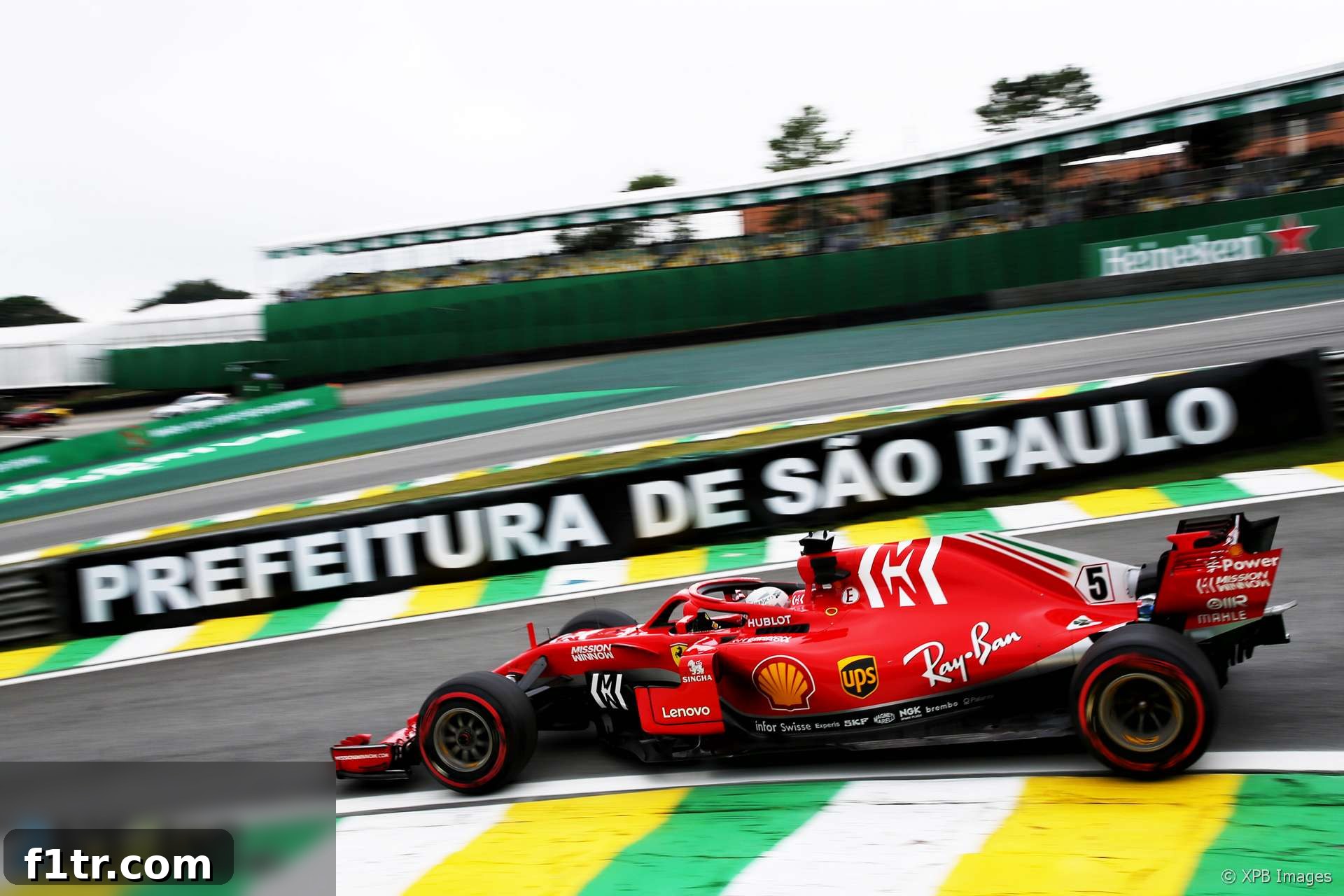
The debate surrounding Formula 1’s stringent weighbridge rules recently flared up following an incident involving Sebastian Vettel during qualifying, yet the sport’s governing body, the FIA, has firmly stated that no changes will be made to these long-standing regulations. This decision comes despite vocal complaints from drivers and teams, highlighting the FIA’s commitment to maintaining regulatory consistency and holding competitors accountable for understanding and adapting to the existing framework.
Advert | Become a Supporter & go ad-free
The specific incident that sparked this latest round of discussion occurred during a rain-affected Q2 session last weekend. Ferrari driver Sebastian Vettel was randomly selected for a weighbridge check, a standard procedure designed to ensure cars comply with minimum weight regulations. However, under the pressure of changing weather conditions and tight timings, Vettel’s patience apparently wore thin. Instead of waiting for the FIA officials to complete the process of pushing his car onto and off the scales, he drove away from the weighbridge under his own power, causing damage to the delicate equipment in the process. This breach of protocol resulted in a reprimand and a significant financial penalty for the four-time world champion, bringing the meticulous nature of F1 regulations under renewed scrutiny.
Vettel openly admitted his frustration, explaining that he was particularly annoyed at being called to the weighbridge when he had just entered the pits during a rain shower, prior to setting a competitive lap time. This sentiment was echoed by other drivers, notably Daniel Ricciardo, who publicly suggested that the FIA should consider modifying the rules. Ricciardo proposed an amendment where drivers who have not yet set a lap time during a qualifying session should be exempt from mandatory weighbridge checks, arguing that such interruptions can unfairly compromise their session, especially in volatile conditions where every second on track counts.
However, the FIA’s Race Director, Charlie Whiting, has dismissed these calls for rule changes, reiterating the organisation’s confidence in the current system. Whiting firmly believes that the existing method, where drivers are randomly selected for weighing during qualifying, serves its purpose effectively and does not warrant alteration. His stance underscores the FIA’s view that teams and drivers must incorporate the possibility of such checks into their strategic planning, rather than expecting the rules to adapt to individual circumstances or tactical decisions.
Whiting explained his position, stating, “I think all it’s done is reminded the teams that if they choose to do something like that then they run a risk. Two risks, really, in this case.” He elaborated that these risks involve, firstly, the inherent unpredictability of the time spent doing an out-lap or an exploratory lap, which can vary significantly depending on track conditions or traffic. Secondly, and critically, teams must account for the additional minute or so required for a potential weighbridge stop. This means that when formulating their qualifying strategy, especially in fluid conditions like those experienced in Q2, teams are expected to factor in this potential delay. Failing to do so, according to Whiting, is a strategic miscalculation on the team’s part, not a flaw in the regulations.
The FIA race director further highlighted that Sebastian Vettel’s particular predicament was partly a consequence of Ferrari’s “unusual” tactical approach in Q2. In that session, both Ferrari drivers initially ventured out on a particular type of tyre for exploratory laps to assess the track’s rapidly changing conditions, then immediately pitted to switch to a different compound. This double-pit strategy, while legitimate, introduced an additional layer of risk, as Whiting pointed out. “What annoyed Sebastian obviously was being stopped. Ferrari did something slightly unusual. They went out one on type of tyre to explore the track as it were, came in, and there’s a risk.” This unconventional timing of a pit stop, combined with the random selection for weighing, created the unfortunate confluence of events for Vettel.
Whiting maintained that the randomness of the weighbridge selection process is fundamental to its fairness and effectiveness. “There will always a risk that you’re going to be stopped. They know that and they should factor that in. This is what I’m always telling the teams. It should be something that they say ‘if we do this, how long it will take, we might get stopped so we have to add a minute’. It’s something they should always factor in.” He clarified that the system is programmed to randomly select cars, for instance, “the first car, second car, third car” that enters the pit lane after a certain period or under specific conditions. This algorithmic approach ensures impartiality, removing any possibility of bias in selecting which cars are checked.
He also touched upon the practical application of this randomness, noting that Jo Bauer, the FIA technical delegate, “seldom tries to stop the first car that comes in because in a short qualifying session like that the first car could be a car coming in with a mechanical problem having just done a half a lap.” This shows a degree of practical consideration within the random system, aiming to avoid penalizing drivers already facing issues. However, Whiting concluded that the specific scenario of “two cars come in for strategic reasons after one lap is unusual. It’s just the way it goes.” This statement reinforces the idea that while the system has some flexibility, it cannot accommodate every unique strategic choice a team might make, and teams bear the responsibility for anticipating potential impacts.
The incident was indeed unprecedented for the stewards, as Whiting openly admitted the rarity of such a scenario. “A driver losing his temper and breaking the scales, it’s not something that we’ve come across, frankly.” This admission highlights the unusual nature of Vettel’s reaction and the subsequent disciplinary action, setting a new benchmark for what constitutes an unacceptable breach of conduct around the weighbridge. The FIA’s firm response sends a clear message across the paddock: while the pressures of Formula 1 are immense, regulations must be respected, and any deviation, especially one leading to damage or obstruction, will be met with appropriate penalties. The integrity of the sport and the authority of its officials are paramount, and this incident serves as a stark reminder to all competitors about the importance of adhering to every facet of the rules, regardless of the heat of the moment or strategic implications.
Advert | Become a RaceFans supporter andgo ad-free
Related Articles from the 2018 F1 season
Delve deeper into the events and storylines from the 2018 Formula 1 season with these insightful articles, offering context and analysis on key moments and decisions.
- F1 feared “death knell” for Drive to Survive after Ferrari and Mercedes snub
- McLaren staff told us we were “totally crazy” to take Honda engines in 2018 – Tost
- ‘It doesn’t matter if we start last’: How Red Bull’s junior team aided Honda’s leap forward
- Honda’s jet division helped F1 engineers solve power unit problem
- McLaren Racing losses rise after Honda split
Browse all 2018 F1 season articles