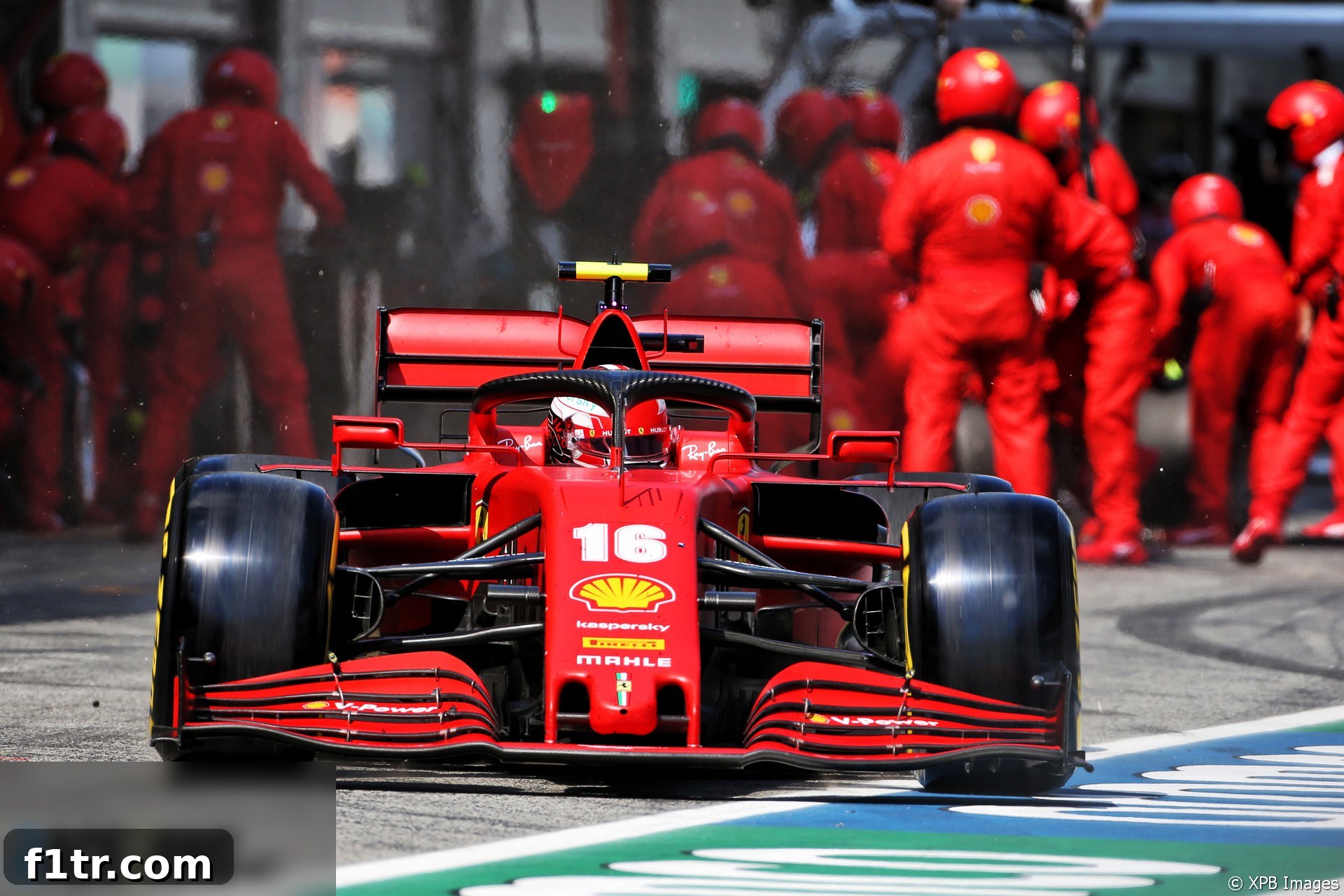
Leclerc’s Spanish Grand Prix Hopes Dashed by Electrical Failure, Ferrari Claims Podium Potential
The 2020 Spanish Grand Prix proved to be a challenging event for Scuderia Ferrari, particularly for Charles Leclerc, whose promising race was cut short by an unforeseen electrical problem. Despite a meticulously planned one-stop strategy that Ferrari believed would have secured him a strong fourth-place finish, Leclerc was forced to retire from the race, adding another layer of frustration to a difficult season for the Italian team. This incident highlighted the delicate balance between strategic brilliance and mechanical reliability in the demanding world of Formula 1.
Leclerc was circulating in 11th position, having already completed his solitary scheduled pit stop of the race, when his Ferrari SF1000’s power unit unexpectedly shut down. The critical failure occurred as he approached the turn 14/15 chicane, causing his car to spin uncontrollably. Although he managed to guide the stricken vehicle back to the pits, the issue was terminal, forcing his definitive retirement just a few laps later. The sudden loss of power was a bitter blow, especially as the team had high hopes for his strategic gamble.
Ferrari’s Bold One-Stop Strategy and the Near Miss
According to Ferrari’s internal analysis, Leclerc’s race was unfolding precisely as planned, with the team confident that their aggressive one-stop strategy would yield significant dividends. Their projections indicated that Leclerc was on course to finish comfortably between the two Racing Point drivers, Sergio Perez and Lance Stroll. Perez, who also opted for a one-stop strategy, eventually secured fourth place, while Stroll, on a two-stop approach, finished fifth. Crucially, Perez’s five-second time penalty incurred during the race would have elevated Leclerc to a well-deserved fourth had he completed the Grand Prix.
Inaki Rueda, Ferrari’s head of racing strategy, elaborated on the meticulous planning behind Leclerc’s race. “Charles demonstrated exceptional tyre management during his first stint, enabling him to extend it to lap 29,” Rueda explained. “This put him perfectly within the window to switch to a one-stop strategy, especially as he had a fresh set of medium tyres at his disposal. Once Pierre Gasly, who had been ahead of him, made his pit stop, Charles found himself with clear track ahead, which allowed him to truly unleash his pace and push the car.”
Rueda continued, emphasizing the team’s strategic foresight: “At that juncture, observing Charles’s consistent and strong pace, we instructed him to push for at least lap 28. We understood this was a critical target for our strategy change to be effective, and he delivered flawlessly. Charles quickly dispatched Daniil Kvyat and then set his sights on Lando Norris. He was significantly quicker than Norris at that point in the race, and we were convinced that several drivers ahead would need to make a second pit stop, while others would struggle immensely to maintain their pace until the end.”
The Disappointment of a Control Unit Failure
The confidence within the Ferrari garage was palpable, as their strategy seemed to be playing out perfectly. Rueda highlighted the uniqueness of their approach: “Indeed, only Sergio Perez opted for the same one-stop strategy as us. And given the time penalty he subsequently received, it was entirely reasonable to anticipate Charles finishing in a strong fourth position. Unfortunately, a sudden control unit failure brought an abrupt and disheartening end to that objective, robbing us of what would have been a significant points haul.” This technical malfunction underscored the persistent reliability challenges that plagued Ferrari throughout the 2020 season, frustrating both drivers and the team’s strategic efforts.
Leclerc’s retirement was a particularly bitter pill, as a fourth-place finish would have provided a much-needed boost in the championship standings and offered a glimmer of hope amidst a difficult campaign. The points lost due to an electrical component failure were particularly impactful, showcasing how finely balanced success and failure can be in Formula 1.
Sebastian Vettel’s Contrasting Race and Ferrari’s Season Overview
While Charles Leclerc’s race ended prematurely, his teammate Sebastian Vettel managed to complete the Grand Prix, finishing a respectable seventh. Vettel also employed a single pit stop strategy, demonstrating that the one-stop approach was viable for the SF1000, albeit with varying degrees of success depending on track position and individual driver performance. Vettel’s ability to extract points from a challenging weekend offered some consolation for the team, but it did little to overshadow the lingering disappointment of Leclerc’s DNF and the missed opportunity for a higher finish.
The 2020 Formula 1 season was notoriously tough for Ferrari, marked by a lack of pace compared to their rivals and persistent technical hurdles. Leclerc’s Spanish Grand Prix incident was emblematic of these struggles, where promising strategic calls and determined driving were often undone by mechanical frailties. The team continually worked to address these issues, striving to improve both performance and reliability as the season progressed.
Leclerc’s performance in the Spanish Grand Prix, prior to his retirement, demonstrated his exceptional talent for tyre management and his ability to execute a complex race strategy under pressure. Ferrari’s strategic team, led by Inaki Rueda, had crafted a plan that, on paper, should have placed Leclerc at the forefront of the midfield battle, potentially even challenging for a podium if circumstances had been different. The incident served as a stark reminder that in Formula 1, success is a confluence of driver skill, strategic acumen, and flawless mechanical execution, with the absence of any one element proving detrimental.
This frustrating outcome at the Circuit de Barcelona-Catalunya was a significant blow for Charles Leclerc and Ferrari, highlighting the ongoing quest for reliability that is as crucial as outright pace in the pinnacle of motorsport. The team’s focus immediately shifted to diagnosing the control unit failure and ensuring such an incident would not recur, as they continued their battle to regain competitiveness in a challenging season.
Related 2020 F1 Season Articles
- Grosjean to make F1 test return tomorrow for first time since Bahrain horror crash
- Pictures: Wrecked chassis from Grosjean’s Bahrain fireball crash to go on display
- Bottas vs Rosberg: Hamilton’s Mercedes team mates compared after 78 races each
- F1 revenues fell by $877 million in Covid-struck 2020 season
- Hamilton and Mercedes finally announce new deal for 2021 season
Browse all 2020 F1 season articles