Mastering Baku: Formula 1 Rear Wing Innovations for High-Speed Efficiency
The Baku City Circuit stands as a formidable challenge on the Formula 1 calendar, far removed from the typical characteristics of a high-downforce street circuit like Monaco. While it features numerous slow and technical sections that demand precision and grip, its defining feature is undeniably the colossal 2.2-kilometer main straight. This unique dichotomy forces Formula 1 teams to adopt a highly specialized approach to car setup, where the relentless pursuit of top speed often dictates aerodynamic compromises. Unlike tracks where maximum downforce is the sole objective, Baku places a premium on minimizing drag to unleash blistering straight-line performance, even if it means sacrificing some cornering grip in the tighter, twisty parts of the circuit.
This intricate balance between downforce and drag is predominantly managed through the design and setup of the car’s rear wing. For the Azerbaijan Grand Prix, nearly every team engineers a track-specific rear wing, a bespoke aerodynamic device meticulously crafted to cut through the air with minimal resistance while still providing sufficient downforce for the circuit’s more demanding corners. These specialized wings, often new or significantly modified for Baku, represent distinct aerodynamic philosophies, which can generally be categorized into three primary approaches, each with its unique merits and engineering rationale.
Understanding F1 Rear Wing Aerodynamics: The Downforce-Drag Conundrum
The rear wing on a Formula 1 car is perhaps one of the most visible and tightly regulated aerodynamic components. Its fundamental purpose is to generate downforce, effectively pushing the car into the track surface. This added vertical force enhances mechanical grip, allowing cars to carry higher speeds through corners and brake later, ultimately improving lap times. However, downforce comes at a significant cost: aerodynamic drag. Drag is the resistance a car experiences as it moves through the air, and it directly hinders top speed on straights. The rear wing, being a large and powerful element, is a major contributor to both downforce and drag, making its design a critical factor in a car’s overall performance profile for any given circuit.
The regulations governing F1 rear wings are stringent, limiting parameters such as the number of aerofoil profiles (typically two elements: a main plane and a flap), geometry, and flexibility. For the 2019 season, these regulations saw a notable change, with the rear wing being enlarged compared to the previous year. The main section, often referred to as the two-element aerofoil, measures 101cm wide. In addition to this, a 5cm allowance is provided for each rear wing endplate, an area teams exploit to shape the final sections of the wing tip. These two primary profiles can extend up to 35cm from front to rear (chord) and reach a maximum depth of 22cm.
This dimensional envelope allows for the creation of a powerful rear wing. Downforce generation is primarily influenced by several key parameters: the wing’s width, known as its span; the angle at which the wing is presented to the airflow, termed the angle of attack (from leading edge to trailing edge); and the measurement between the front and rear edges, called the chord. Any modification to these parameters, within the defined geometrical box, directly alters the wing’s downforce levels, ranging from maximum grip to reduced resistance for high-speed tracks.
The Battle Against Drag: Minimizing Aerodynamic Resistance
While engine power is a crucial determinant of a car’s top speed, it’s a variable over which teams have little influence on a track-by-track basis. Consequently, aerodynamic setup, particularly the rear wing, becomes the primary tool for balancing cornering speed against straight-line performance. Aerodynamic drag manifests in various forms, but for the narrow aspect ratio rear wings of F1 cars, a significant portion comes from induced drag. This specific type of drag is created by wing tip vortices – spiralling airflows that form at the wing tips where the high-pressure air above the wing rolls over into the lower-pressure regions beside and below the wing. These vortices are often visible as vapour trails curling off the wing tips on damp days, visually demonstrating the energy being wasted.
Reducing this induced drag is paramount for boosting top speed, and teams employ diverse strategies to achieve this, as evidenced by the array of specialized wings seen at Baku. These designs are accurately termed ‘low-drag wings’ rather than ‘low-downforce wings,’ because the primary objective is to minimize drag while retaining as much useful downforce as possible. These innovative designs can be broadly classified into three categories, each reflecting a distinct aerodynamic philosophy and offering a different compromise in the eternal quest for performance:
Advert | Become a Supporter & go ad-free
1. Flat Wings: The Direct Approach to Drag Reduction
The most straightforward method to reduce drag generated by the rear wing is to simply make it smaller and shallower in side profile. This approach involves decreasing both the chord (front-to-rear measurement) and the angle of attack across the wing’s span. A shallower, less aggressively angled wing generates less downforce, and crucially, significantly less drag, thereby allowing the car to achieve higher straight-line speeds.
Red Bull Racing has historically been a strong proponent and expert of this design philosophy. Their rear wings for high-speed tracks are frequently characterized by an extremely flattened, almost “tea-tray” like shape. Furthermore, Red Bull often opts to shorten the overall chord of the wing to further diminish both downforce and drag. While effective, a shallower wing presents certain challenges, particularly concerning the packaging of the Drag Reduction System (DRS) pod within a reduced area. This often necessitates a unique DRS pod and mounting pylon design tailored specifically for this low-drag rear wing configuration.
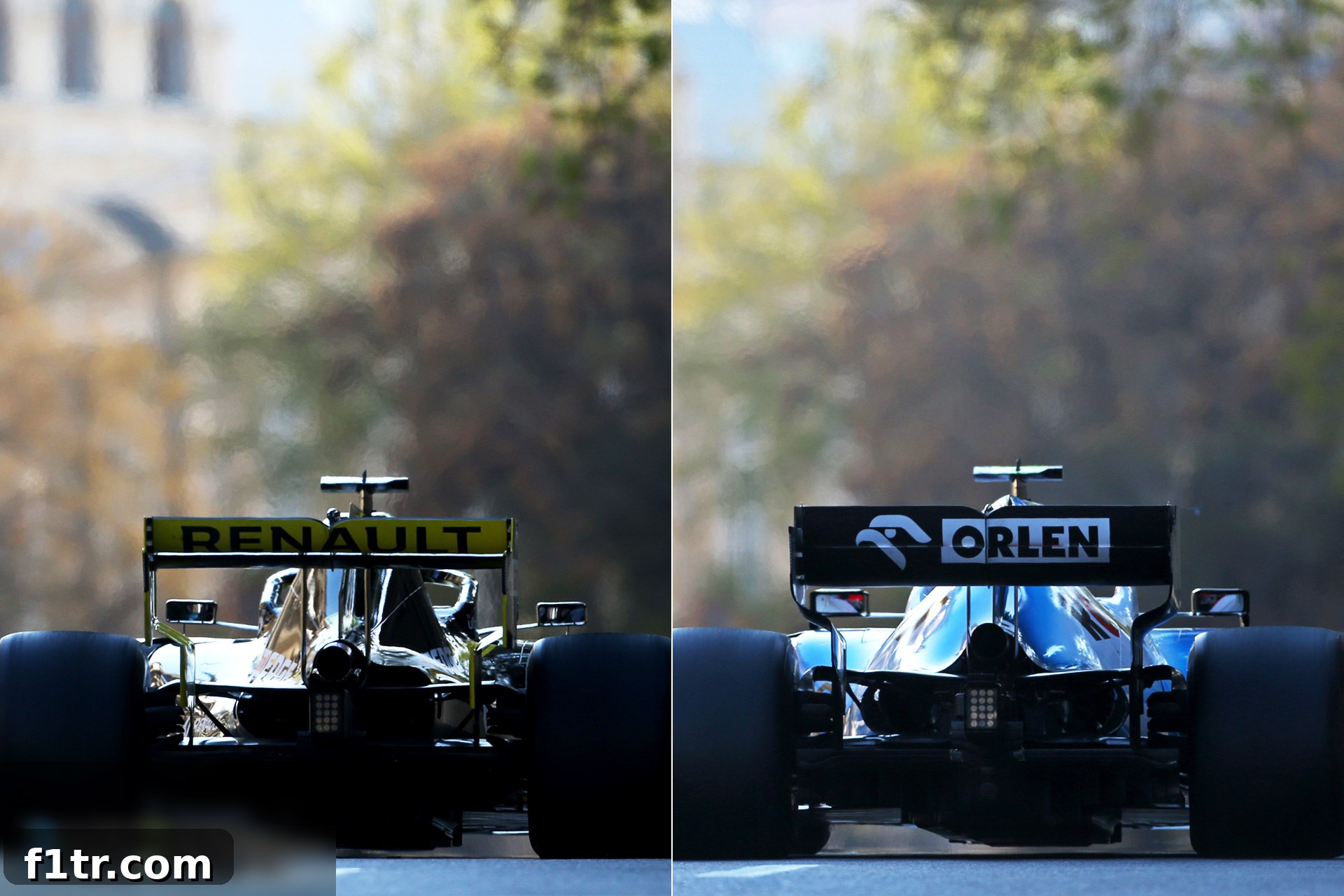
For the Azerbaijan Grand Prix, Renault adopted a similar strategy. Their rear wing showcased a markedly shallower profile fitted between the endplates, with minimal variation in its side profile across the span. To accommodate this smaller wing and optimize its efficiency, Renault implemented several other subtle yet impactful changes. The outer 5cm allowance for the endplate, which typically features five smaller aerofoil profiles to manage airflow, was reduced to just four for Baku. Additionally, the crease in the endplate, usually populated with angled flaps to assist with the upward flow of air created by the wing, was left open without any such elements, further reducing drag.
However, the initial feedback from the track highlighted the inherent trade-offs. In second practice, Renault found themselves lacking sufficient downforce compared to rivals running larger rear wings. Daniel Ricciardo, who faced challenges with tyre flat-spotting preventing a full race simulation, acknowledged the situation: “We had a look at the competitors and ours certainly look smaller,” he admitted. “I’m convinced now we’ll probably put a bit more on and go from there. I know Nico [Hulkenberg] struggled a bit with the long run and I think more wing will get a bit more temperature and load through the car so hopefully that helps us.” This candid assessment underscores the fine line teams must walk in balancing drag reduction with necessary grip.
2. Spoon Wings: Optimizing Efficiency by Sculpting the Span
Another sophisticated method for achieving a favorable balance between drag and downforce involves strategically reducing the power of the tip vortices. This is accomplished by ‘slackening off’ or lessening the aerodynamic load near the wing tips. Teams achieve this by reducing the angle of attack and/or the chord length specifically in the outboard sections of the wing, leading to a distinctive curved or stepped frontal profile. This design is commonly referred to as a “spoon wing” due to its characteristic shape.
At the Baku circuit, several prominent teams, including Ferrari, McLaren, Toro Rosso, and Alfa Romeo, were observed utilizing these types of wings. The profile of these wings is not uniform across their span; instead, it constantly changes from the outboard tip towards the center. This continuous or stepped variation is engineered to meticulously optimize the downforce-to-drag ratio. Each team, however, develops unique geometries to precisely meet their specific aerodynamic needs and car characteristics at the circuit.
For instance, McLaren’s spoon wing at Baku featured a more abrupt, pronounced step in the transition from a deeper, more aggressive profile towards the shallower outboard sections. This contrasts with other teams, which tended to opt for a more progressive, continuous change in their span-wise profile. These subtle differences highlight the meticulous nature of F1 aerodynamics, where even slight variations in geometry can yield significant performance distinctions tailored to each car’s unique airflow characteristics and target setup.
3. Raised Centre Wings: Balancing Load Across the Span
A third prominent strategy to manage aerodynamic load and reduce drag from the rear wing involves raising the leading edge of the wing in its central section. This effectively ‘unloads’ the middle portion of the wing, reducing its contribution to downforce and, more importantly, to drag, particularly across the crucial main plane. A similar number of teams adopted this approach as those utilizing the spoon design, with Mercedes, Haas, Racing Point, and Williams being notable adherents.
Williams, in particular, showcased a somewhat mixed approach with their Baku rear wing. Their design incorporated a slight flattening of the wing tip profile in conjunction with the raised center, creating a distinct ‘W’-shaped leading edge. This hybrid approach aims to capture the benefits of both drag reduction strategies, though not to the extreme ‘W’ profiles sometimes seen in Formula 1’s past, which were designed for even more aggressive load distribution.
Mercedes, always at the forefront of aerodynamic innovation, integrated an additional, intriguing feature into their rear wing: a serrated trailing edge on the main plane. This design choice, while not directly tied to the overall wing profile selection (flat, spoon, or raised center), addresses a specific aerodynamic challenge. The serrations are engineered to create a series of small, controlled vortices that intentionally pass up and under the flap. Far from creating unwanted turbulence, this is a purposeful design.
Normally, airflow beneath a wing maintains relatively smooth, organized layers, known as laminar flow. However, at a certain point towards the trailing edge of the flap, this laminar flow inevitably breaks up into turbulent flow. While turbulent flow that remains attached to the wing’s surface is generally acceptable, the critical issue arises if this flow then detaches or separates from the wing’s surface entirely. Such separation leads to a wing ‘stalling,’ resulting in a sudden and significant loss of downforce. The transition point between laminar and turbulent flow, especially as the DRS (Drag Reduction System) flap closes, can be somewhat unpredictable.
By introducing the serrated edge, Mercedes forces this transition to turbulent flow to occur in a controlled and predictable manner, rather than letting the airflow dictate it naturally. This engineered transition makes the wing’s aerodynamic behavior more consistent, particularly in regaining downforce quickly and reliably as the DRS flap snaps back into its closed position. Mercedes has deployed similar serrated designs in the past, demonstrating its effectiveness, though it had been approximately two seasons since they were last seen raced on track.
Quotes: Dieter Rencken
Go ad-free for just £1 per month>> Find out more and sign up
The Enduring Quest for Aerodynamic Supremacy
The variety of rear wing designs seen at the Azerbaijan Grand Prix perfectly encapsulates the relentless pursuit of aerodynamic efficiency in Formula 1. Each team’s chosen solution reflects a complex interplay of their car’s inherent characteristics, simulation data, track-specific demands, and their overall aerodynamic philosophy. There is no single “best” solution that universally applies; rather, it is about finding the optimal compromise for a particular circuit and vehicle package.
Whether it’s the outright drag reduction of a flat wing, the optimized span-wise loading of a spoon wing, or the balanced approach of a raised center wing, coupled with intricate details like Mercedes’ serrations, these innovations underscore the critical role aerodynamics plays in defining success on the F1 grid. The challenge of Baku, with its unique blend of high-speed straights and tight corners, continues to push the boundaries of F1 engineering, offering a fascinating glimpse into the cutting-edge technology that underpins the sport.
More F1 Technology Insights
- McLaren, Red Bull and Ferrari bring rear corner updates to Imola
- Ferrari, McLaren and Red Bull bring upgrades again for Saudi Arabian Grand Prix
- McLaren introduce major floor upgrade for Norris’ car at Mexican Grand Prix
- McLaren, Mercedes and Red Bull detail upgrade packages for United States GP
- Red Bull remove engine cover ‘cannons’ in major RB20 update – but they may return
Browse all F1 technology articles