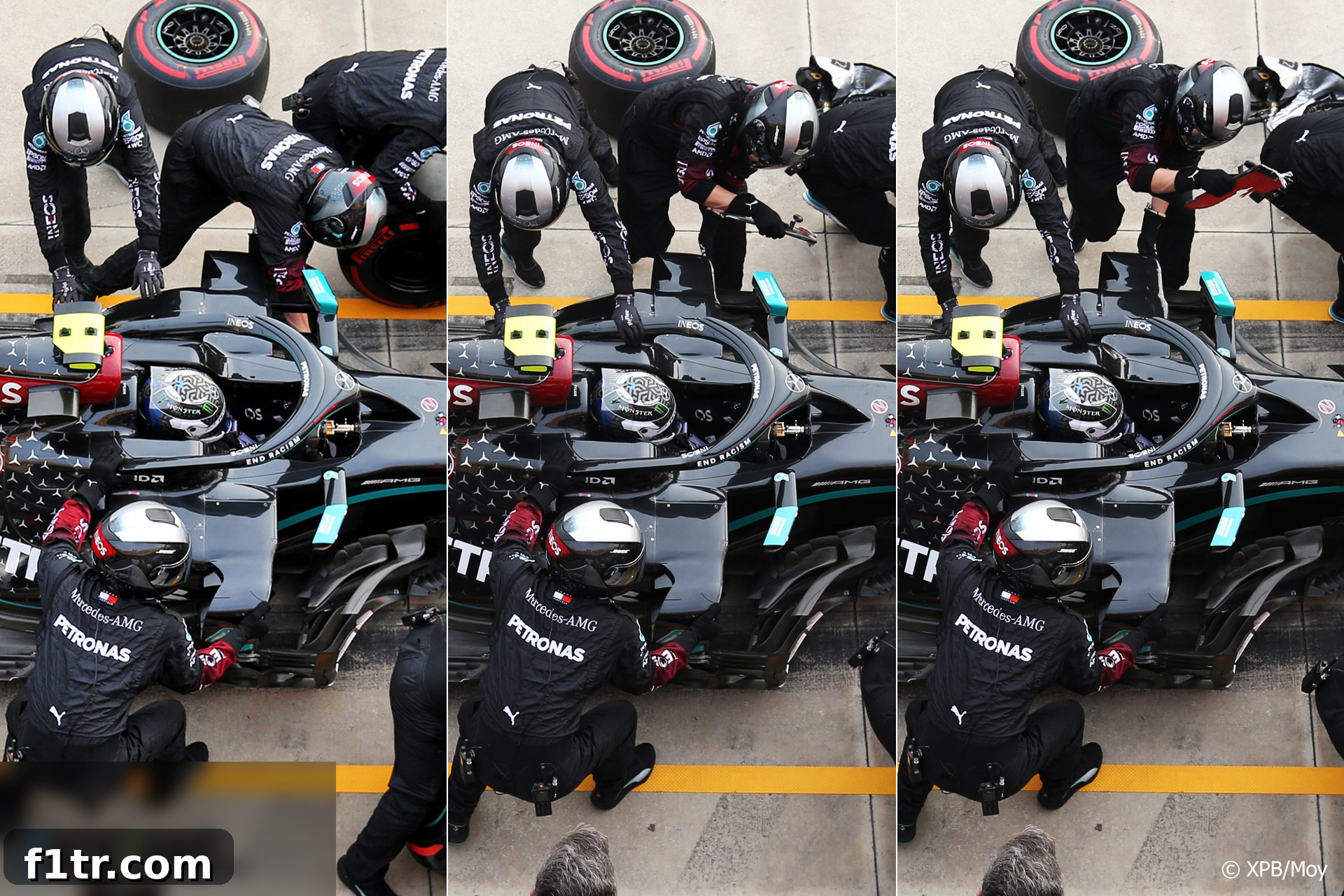
The 2020 Emilia-Romagna Grand Prix at the iconic Imola circuit delivered unexpected drama, particularly for Mercedes driver Valtteri Bottas. An innocuous-looking piece of debris, encountered early in the race, inflicted a crippling aerodynamic blow that cost him an estimated eight-tenths of a second per lap, a monumental deficit in the razor-thin margins of Formula 1.
Mercedes, the dominant force of that season, found themselves grappling with an unusual challenge as their state-of-the-art sensors relayed alarming data about Bottas’s car performance. The scale of the performance drop was so significant that the team initially questioned the accuracy of their telemetry, a testament to the unforeseen impact of the incident.
Trackside Operations Director Andrew Shovlin detailed the team’s initial perplexity regarding the substantial loss of performance. “We were seeing a big drop in performance,” Shovlin explained. “But the issue is the scale of the drop in terms of lap time was seven or eight tenths of a second. We weren’t really believing the sensors because we were looking at how Valtteri was not pushing particularly hard and able to do reasonable lap times when we needed to build a bit of a gap.” This highlights the inherent difficulty in precisely quantifying the effect of damage, especially when its impact might vary non-linearly across different sections of the circuit or in various cornering phases.
Advert | Become a Supporter & go ad-free
The incident unfolded on the second lap of the race at the Tosa corner. Following an earlier collision between Sebastian Vettel’s Ferrari and Kevin Magnussen’s Haas, fragments of carbon fibre were scattered across the track. Bottas, navigating the high-speed circuit, inadvertently ran over a piece of Vettel’s car. Critically, this fragment lodged itself firmly within his car’s intricate bargeboard assembly, a crucial aerodynamic component designed to manage airflow around the front wheels and channel it efficiently towards the rear of the car.
The bargeboard’s primary function is to optimize airflow, reducing drag and generating downforce. With a foreign object disrupting this carefully calibrated system, the car’s aerodynamic balance was severely compromised. This interference meant Bottas’s Mercedes W11, typically a paragon of engineering efficiency, was no longer performing as designed. Drivers rely on consistent, predictable airflow to maintain grip and stability, particularly through high-speed corners. The lodged debris distorted this flow, leading to an unpredictable loss of downforce and a significant reduction in cornering speed and overall straight-line efficiency.
Shovlin elaborated on the nuanced nature of such damage. “It’s very difficult to put an absolute lap time loss on these because they can often affect the car in a quite non-linear way around the circuit or different behaviour in different directions at corners. But early on we couldn’t quite believe how big it was and we didn’t know what it was.” This statement underscores the complexity of diagnosing aerodynamic damage in real-time. Without a clear visual, the team could only interpret the data, which pointed to a catastrophic performance deficit that felt almost unfathomable given the context of Bottas’s driving.
Mercedes faced a significant challenge in removing the debris. Compounding the issue of diagnosis was the sheer difficulty of spotting the small, red fragment against the predominantly black livery of Bottas’s Mercedes. From the pit wall, and even with high-definition cameras, the piece remained hidden. This made any immediate intervention impossible during Bottas’s first pit stop, forcing him to continue battling with a compromised car for a substantial portion of the race.
“When you look at the size of the bit and the fact that it’s red, you can’t believe that we couldn’t see it on the cameras. But it was lodged in, and where it was the black area was visible. And because the whole car’s black there we couldn’t see that,” Shovlin revealed. This explanation highlights a critical operational blind spot. Had the team been able to identify the debris’s location, a more effective strategy for its removal during the initial tire change might have been devised. Unfortunately for Bottas, this visual obfuscation meant the performance handicap persisted until his second pit stop, much later in the race.
Advert | Become a RaceFans supporter andgo ad-free
The Finnish driver confirmed he saw the debris on the track, making a split-second decision that, while preventing an immediate catastrophe, ultimately led to his race-long struggle. Instead of risking a puncture by hitting the debris with a tire, Bottas chose to drive directly over it. Shovlin confirmed this was the correct, albeit unfortunate, choice. “He definitely made the right decision to go straight over it,” Shovlin asserted. “Taking that onto a tire would very likely cause an instant puncture. So that was a good call. But through no fault of his own, it basically held him back for the whole afternoon.” A tire puncture would have meant an immediate pit stop, likely dropping him to the back of the field, and potentially a safety car deployment, further disrupting the race.
The sustained loss of performance profoundly compromised Bottas’s race strategy and ultimately his final position. His teammate, Lewis Hamilton, capitalized on this unforeseen circumstance. While Bottas struggled with his ill-handling car, Hamilton was able to extend his first stint significantly, running longer on his initial set of tires. This allowed him to build a substantial gap over Bottas, a classic “overcut” scenario where a driver pits later and uses their fresh tires to post faster lap times, emerging ahead of a competitor who pitted earlier.
Hamilton’s strategic extension was perfectly executed, giving him enough time in hand to make his eventual pit stop and rejoin the track comfortably ahead of Bottas. The timing of a Virtual Safety Car (VSC) deployment further solidified Hamilton’s advantage, granting him an even more comfortable margin. The VSC, triggered by a separate incident, effectively neutralized the race, allowing Hamilton to pit with minimal time loss compared to green flag conditions.
Shovlin reflected on the criticality of Hamilton’s extended stint and the VSC’s role. Had the VSC not been deployed, the battle between the two Mercedes drivers, and potentially Max Verstappen, would have been “extremely close” when Hamilton rejoined the track. “There were times when Lewis just had the gap, but he had the gap by half a second or so,” Shovlin noted. “The problem is you’re dropping him out on hard tires that have got a warm-up curve, and that means that they are down by a second or a second and a half. And while he looked like he could build it, we didn’t really want to sort of have him dropping into that fight with Valtteri and Max on cold tires, if we could actually get the gap.” This highlights the razor-edge decision-making involved in F1 strategy, where a slight miscalculation or an unexpected variable can drastically alter outcomes. The VSC, in this instance, removed that element of risk for Hamilton, allowing him to secure the lead with ease.
The events at Imola served as a stark reminder of how a seemingly minor incident can have profound consequences in the highly competitive world of Formula 1. Valtteri Bottas, through no fault of his own, saw his race victory hopes dashed by a piece of carbon fibre, ultimately costing him crucial points in the championship standings. The meticulous post-race retrieval of the debris by Mercedes underscores the team’s commitment to understanding every variable, no matter how small, that can affect performance. This incident highlights not only the fragility of modern F1 machinery but also the strategic brilliance required to adapt and exploit unexpected circumstances.
Advert | Become a RaceFans supporter andgo ad-free
2020 Emilia-Romagna Grand Prix: Further Insights and Analysis
For more in-depth coverage and analysis of the dramatic 2020 Emilia-Romagna Grand Prix, explore these related articles:
- Gasly says potential lost podium at Imola was his most painful retirement yet
- An F1 marshal explains why Stroll’s Imola near-miss raises safety concerns
- McLaren must seek “smallest gains” in qualifying to fight for third
- Pirelli begins probe into Verstappen tyre failure
- 2020 Emilia-Romagna Grand Prix Star Performers
Browse all 2020 Emilia-Romagna Grand Prix articles for comprehensive race details and post-event analysis.