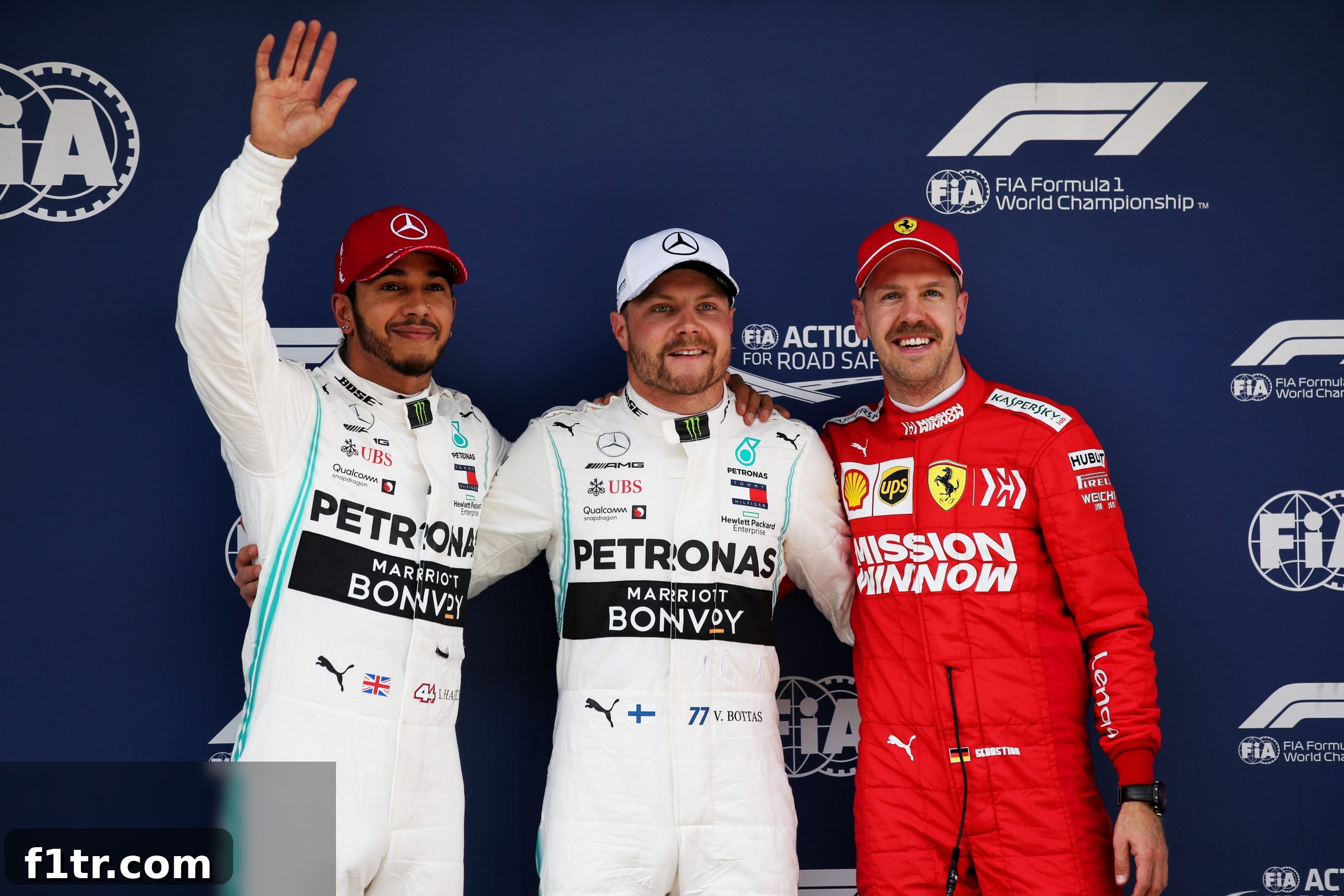
The stage was set for a monumental qualifying session at the 2019 Chinese Grand Prix, a pivotal event marking Formula 1’s historic 1000th race. With anticipation building, the spotlight shone brightly on the reigning champions, Mercedes, and their fierce rivals, Ferrari, as drivers battled for grid supremacy on the challenging Shanghai International Circuit. Ultimately, it was Valtteri Bottas who seized pole position, narrowly edging out his illustrious teammate, Lewis Hamilton, by an astonishingly slim margin of just two-hundredths of a second. This thrilling performance placed the Mercedes pair at the front of the grid, with the Ferraris of Sebastian Vettel and Charles Leclerc poised directly behind them, setting the scene for what promised to be an electrifying race.
Q1: Early Drama and Unexpected Exits
Advert | Become a Supporter & go ad-free
The opening segment of qualifying, Q1, began with an immediate dose of drama even before the cars hit the track. Alexander Albon, driving for Toro Rosso, suffered a significant setback after a heavy shunt during the final practice session. The damage sustained by his car proved too extensive for his crew to repair within the tight timeframe, tragically ruling him out of Q1 and consigning him to a back-row start without even completing a lap. This unfortunate incident highlighted the unforgiving nature of Formula 1, where a single mistake can have profound consequences on a driver’s weekend.
Albon’s pre-qualifying exit was soon joined by another tale of woe, this time for Antonio Giovinazzi of Alfa Romeo. The Italian driver continued to be plagued by technical gremlins, suffering further issues with his car that prevented him from setting a representative lap time. This came after a similarly frustrating first practice session where he also failed to register a time. Despite the frantic efforts of the Alfa Romeo team, who worked tirelessly against the clock, they ultimately had to concede defeat as the session wound down, leaving Giovinazzi unable to participate and join Albon at the rear of the grid.
These two early eliminations inadvertently offered a glimmer of hope to the struggling Williams team. With two rivals effectively out of contention, George Russell and Robert Kubica were presented with the rare opportunity to qualify higher than their customary last row positions. While both cars had shown a fractional improvement in pace during final practice, they still remained a significant margin off the next slowest competitors, typically around a second. Kubica, who reported persistent oversteer issues on his initial run, once again found himself marginally slower than his teammate, underscoring the team’s ongoing battle to find performance.
In the frantic final minutes of Q1, drivers pushed to their limits to avoid elimination. Lance Stroll’s last-ditch effort in his Racing Point wasn’t quite enough to lift him out of the bottom five, securing the 16th spot on the grid. Meanwhile, McLaren rookie Lando Norris demonstrated impressive composure, snatching the final coveted spot in Q2 by a mere 0.15 seconds, a testament to the incredibly tight competition in the midfield.
At the sharp end, Valtteri Bottas made a commanding start, comfortably topping the Q1 timings with a significant advantage of almost half a second over his teammate, Lewis Hamilton. However, not all front-runners had a smooth session. Charles Leclerc expressed frustration after encountering traffic during his first flying lap, forcing the young Ferrari driver to undertake an additional run and use another precious set of tyres, a decision that could have strategic implications later in qualifying.
Drivers eliminated in Q1
| 16 | Lance Stroll | Racing Point-Mercedes | 1’34.292 |
| 17 | George Russell | Williams-Mercedes | 1’35.253 |
| 18 | Robert Kubica | Williams-Mercedes | 1’35.281 |
| 19 | Antonio Giovinazzi | Alfa Romeo-Ferrari | No time |
| 20 | Alexander Albon | Toro Rosso-Honda | No time |
Advert | Become a RaceFans supporter andgo ad-free
Q2: Strategic Gambles and Bitter Disappointment
Q2 introduced a critical strategic element, as the leading teams made their tyre choices for the start of the race. The Mercedes and Ferrari drivers, along with Red Bull’s star performer Max Verstappen, all opted to begin Q2 on the medium compound tyres. This bold decision was made with the clear intention of setting their fastest times on these more durable tyres, thereby securing a strategic advantage for Sunday’s Grand Prix. Should they successfully qualify for Q3 on mediums, they would be mandated to start the race on them, allowing for a longer first stint compared to rivals on softs. This gamble paid off initially, as this elite group duly claimed the top five times, with Bottas once again leading the charge.
Conversely, Pierre Gasly, the sole Red Bull driver on soft tyres, found himself struggling to match the pace. Despite the theoretical advantage of the softer compound, he was initially unable to beat his teammate Verstappen’s time, who was on the harder mediums, ending up a disheartening half-second adrift. Given his prior struggles and the tyre usage in Q1, Gasly opted against making a second run, a decision also mirrored by Leclerc, who was keen to preserve his tyre allocation after his extra effort in Q1. This highlighted the fine balance between outright pace and tyre management in qualifying.
The other front-runners, including Lewis Hamilton, did undertake second runs. Some chose to switch to soft tyres but then backed off to ensure they wouldn’t have to start the race on them, merely using the run for track evolution or a practice start. Hamilton, however, went out again on mediums, improving his time and ultimately heading the session by just under a tenth of a second, demonstrating Mercedes’ confidence in their pace on the harder compound.
The session also saw some notable casualties. Kimi Raikkonen, the veteran Finn from Alfa Romeo, reported a sudden loss of power down the back straight on his crucial final run. This devastating technical issue proved costly, as he agonizingly missed the cut for Q3 by a mere two-tenths of a second. This marked a rare occurrence for Raikkonen, being his first Q3 miss since 2016, a testament to his consistent performance. Equally frustrated was Daniil Kvyat of Toro Rosso, whose “clean” lap failed to secure him a spot in the final top 10 by an incredibly slim margin of just two-hundredths of a second, underscoring the brutal competitiveness of the midfield.
The McLaren drivers, Carlos Sainz Jnr and Lando Norris, never quite looked like challenging for a Q3 spot. Despite their best efforts, there was a substantial gap between them and the top ten, confirming their focus would be on race pace and strategy from the middle of the pack.
Drivers eliminated in Q2
| 11 | Daniil Kvyat | Toro Rosso-Honda | 1’33.236 |
| 12 | Sergio Perez | Racing Point-Mercedes | 1’33.299 |
| 13 | Kimi Raikkonen | Alfa Romeo-Ferrari | 1’33.419 |
| 14 | Carlos Sainz Jnr | McLaren-Renault | 1’33.523 |
| 15 | Lando Norris | McLaren-Renault | 1’33.967 |
Advert | Become a RaceFans supporter andgo ad-free
Q3: The Mercedes Duel for Pole Position
The final and most anticipated segment of qualifying, Q3, commenced with an electrifying showdown for pole position. Valtteri Bottas launched his first flying lap with immediate aggression and precision, quickly chipping away tenths of a second from his teammate, Lewis Hamilton, through the initial sectors. However, Hamilton, a master of the Shanghai circuit, clawed back almost all of that advantage in the final sector, leaving Bottas ahead by an infinitesimal seven-thousandths of a second at the line – a margin that truly highlighted the intensity of their internal battle.
As the Mercedes pair stretched their legs, demonstrating their superior pace, the Ferraris found themselves unable to keep pace with the silver arrows. Sebastian Vettel was a significant four-tenths adrift, unable to match the blistering times of Bottas and Hamilton. Interestingly, Max Verstappen managed to split the two red cars with his impressive first run, showcasing the Red Bull’s raw speed when conditions allowed, hinting at a potential challenge to the front row.
Returning to the track for his final, decisive lap, Hamilton was audibly questioning his engineer, asking “where am I down in the middle sector?” This internal struggle highlighted the minute differences that separate pole position from a close second. In the first sector of his final attempt, Hamilton valiantly clawed back some time against Bottas. Yet, through the critical middle sector, he found himself down once more. As he crossed the finish line, he was unable to improve upon his initial time, signaling Bottas’s provisional pole. Not content to rest, Bottas then delivered a phenomenal final lap, trimming an additional 16 thousandths of a second off his own time, emphatically securing pole position with a flawless performance.
Both Ferrari drivers managed to find some crucial time on their respective final runs. Charles Leclerc briefly jumped up to third place, threatening his teammate’s position, before Sebastian Vettel responded with a stronger lap to reclaim third, establishing their positions as the “best of the rest” behind the dominant Mercedes.
However, the climax of Q3 took a dramatic turn for Red Bull. A visibly frustrated Max Verstappen found himself in an impossible situation on his final attempt. Caught in traffic and unable to create sufficient space to properly begin his flying lap, he inadvertently hindered his own teammate, Pierre Gasly, who was also looking to improve. Both drivers crossed the start/finish line too late to commence their final timed runs, resulting in a chaotic and deeply disappointing end to their qualifying session. This costly misjudgment saw the Red Bull pair end up fifth and sixth respectively, leaving them with a strategic disadvantage for Sunday’s race.
Completing a symmetrical top 10 were the Renault and Haas teams. Daniel Ricciardo and Nico Hulkenberg of Renault, along with Kevin Magnussen and Romain Grosjean of Haas, secured their spots, opting not to set a final timed lap in the dying moments of Q3, indicating either contentment with their positions or a lack of pace to significantly improve further.
Top ten in Q3
| 1 | Valtteri Bottas | Mercedes | 1’31.547 |
| 2 | Lewis Hamilton | Mercedes | 1’31.570 |
| 3 | Sebastian Vettel | Ferrari | 1’31.848 |
| 4 | Charles Leclerc | Ferrari | 1’31.865 |
| 5 | Max Verstappen | Red Bull-Honda | 1’32.089 |
| 6 | Pierre Gasly | Red Bull-Honda | 1’32.930 |
| 7 | Daniel Ricciardo | Renault | 1’32.958 |
| 8 | Nico Hulkenberg | Renault | 1’32.962 |
| 9 | Kevin Magnussen | Haas-Ferrari | No time |
| 10 | Romain Grosjean | Haas-Ferrari | No time |
The qualifying session for the 1000th Formula 1 race delivered on its promise of drama and intense competition. Valtteri Bottas’s sensational performance to claim pole position by the narrowest of margins over Lewis Hamilton solidified Mercedes’ dominance. However, Ferrari’s strategic choices and the surprising pace of Verstappen, despite Red Bull’s Q3 missteps, ensured that Sunday’s Grand Prix would be far from a foregone conclusion. With strategic tyre advantages in play and the constant threat from behind, the race at the Chinese Grand Prix promises to be a thrilling spectacle, determining who will stand atop the podium in this landmark event.
Go ad-free for just £1 per month>> Find out more and sign up
2019 Chinese Grand Prix
- Top ten pictures from the 2019 Chinese Grand Prix
- 2019 Chinese Grand Prix Star Performers
- Hamilton cruises to sixth China win as Ferrari tactics backfire
- Third consecutive one-two gives Mercedes chance to break record
- Paddock Diary: Chinese Grand Prix day four
Browse all 2019 Chinese Grand Prix articles