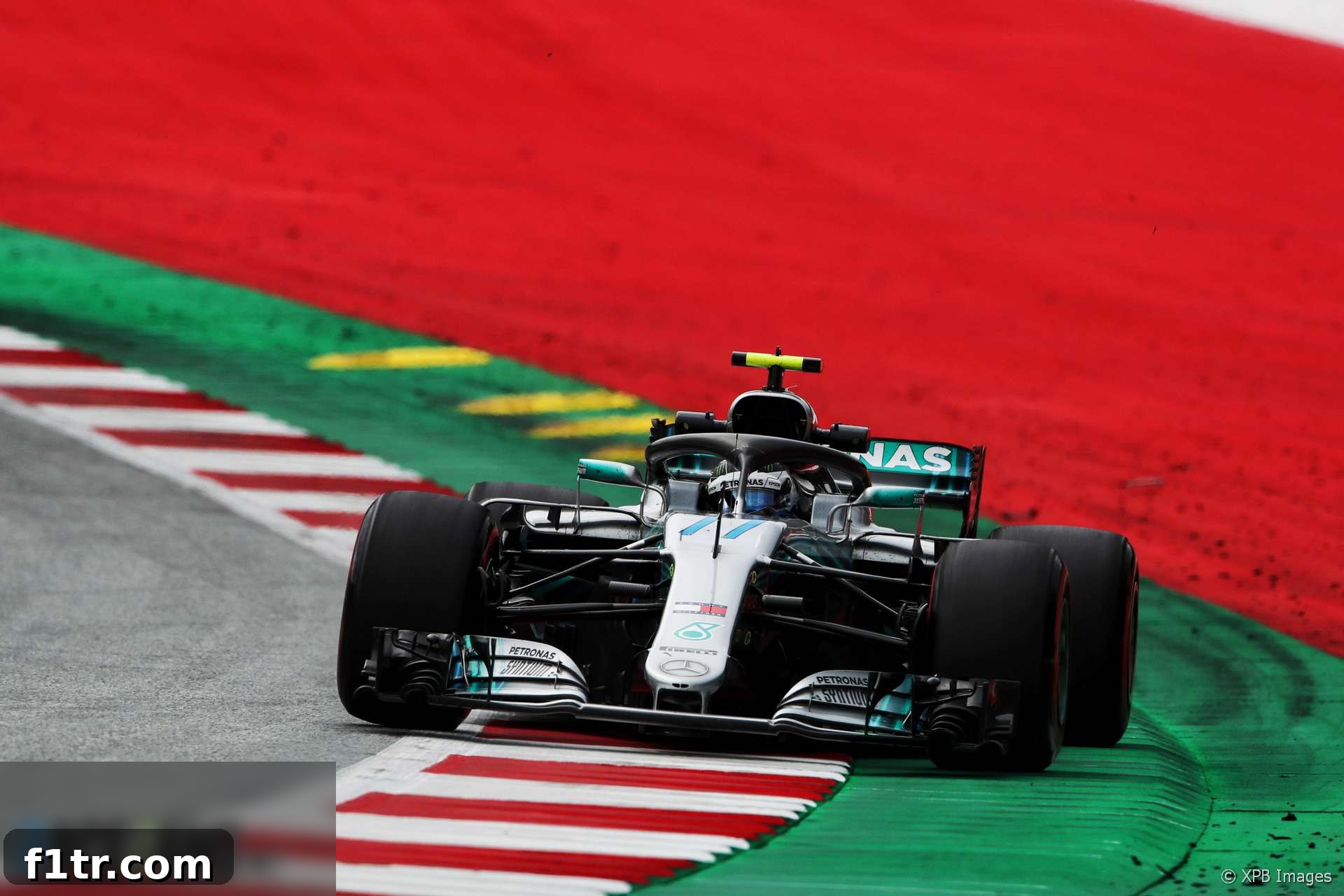
2018 Austrian Grand Prix Qualifying: Bottas Snatches Pole Amidst Fierce Rivalries
The exhilarating qualifying session for the 2018 Austrian Grand Prix at the iconic Red Bull Ring delivered a nail-biting spectacle, culminating in Valtteri Bottas securing his first pole position of the season. Displaying the enhanced performance of Mercedes’ upgraded W09, Bottas narrowly edged out his formidable teammate Lewis Hamilton in a truly captivating finish. This hard-fought victory underscored the fierce intra-team rivalry at Mercedes and set the stage for a thrilling race.
Meanwhile, Sebastian Vettel and Ferrari had to settle for a competitive third place, highlighting the ongoing championship battle. However, the drama wasn’t confined to the top teams, as an acrimonious dispute erupted within the Red Bull garage, with their drivers engaging in heated radio exchanges over track priority – a clear sign of the intense pressures and high stakes involved in Formula 1 qualifying.
The picturesque Red Bull Ring, known for its short lap and undulating layout, consistently tests drivers and engineers alike. Its unique characteristics often lead to unexpected results and strategic gambles, making qualifying a crucial part of the weekend. The upgrades brought by Mercedes to their W09 chassis were under intense scrutiny, and their performance in qualifying certainly turned heads.
Q1: Traffic Troubles and Early Eliminations
The opening phase of qualifying, Q1, immediately presented a fascinating strategic divergence between the front-running teams. Mercedes, with Lewis Hamilton and Valtteri Bottas, opted for the faster ultra-soft compound tyres from the outset. Their aggressive approach paid dividends as they quickly established themselves at the top of the timing sheets, demonstrating the immediate pace advantage of the softer rubber. Hamilton, in particular, embarked on an extensive eight-lap run on his initial set of tyres, extracting maximum performance and gathering crucial data.
In contrast, the Ferrari duo chose a more conservative path, preferring the super-soft tyres. Despite the harder compound, Sebastian Vettel and Kimi Raikkonen comfortably navigated their way into Q2, showcasing the inherent speed of their SF71H. Raikkonen proved to be the marginally quicker of the two, securing third place and briefly separating himself from Vettel, who found Romain Grosjean and Max Verstappen slotting in between the Scuderia cars.
As the session neared its conclusion, the Red Bull Ring’s compact layout became a significant factor. Traffic quickly escalated into a major headache for numerous drivers scrambling to put in a final flying lap. The short nature of the circuit meant cars were constantly encountering slower vehicles, disrupting hot laps and leading to frustrating scenarios. Among those who suffered most acutely was Sergio Perez, who found himself navigating a gauntlet of slower cars during his critical final run. For the first time in the 2018 season, his efforts were insufficient, resulting in a surprising Q1 elimination for the Force India driver.
Fernando Alonso, ever the vocal competitor, famously relayed to McLaren over team radio, “traffic is the only thing you need to tell me,” underscoring the severity of the issue as he skillfully guided his MCL33 into the next stage of qualifying. His teammate, Stoffel Vandoorne, however, was not so fortunate and faced an early exit.
Amidst the chaos, rookie sensation Charles Leclerc once again showcased his burgeoning talent. Despite a dramatic moment where he clipped a kerb, sending a piece of his Sauber flying and causing a momentary skid off track at Turn Four, Leclerc impressively recovered to secure his place in Q2. He decisively outpaced his teammate Marcus Ericsson by half a second, marking another Q1 elimination for Ericsson.
The field of eliminated drivers in Q1 was completed by Brendon Hartley of Toro Rosso and Sergey Sirotkin from Williams, making it a diverse mix of five different teams bowing out early. The final spot in Q2 was secured by Lance Stroll in a thrilling last-gasp effort, beating Vandoorne by an astonishingly slim margin of just seven thousandths of a second.
Drivers Eliminated in Q1:
| 16 | Stoffel Vandoorne | McLaren-Renault | 1’05.271 |
| 17 | Sergio Perez | Force India-Mercedes | 1’05.279 |
| 18 | Sergey Sirotkin | Williams-Mercedes | 1’05.322 |
| 19 | Brendon Hartley | Toro Rosso-Honda | 1’05.366 |
| 20 | Marcus Ericsson | Sauber-Ferrari | 1’05.479 |
Q2: Strategic Gambles and Haas’s Strong Pace
As qualifying progressed to Q2, the tyre strategies became even more critical and intriguing. Ferrari, recognizing the need for outright pace, swapped to the ultra-soft compound. However, even on the theoretically quicker red-banded rubber, they found themselves unable to match the Mercedes, who had now transitioned to the super-soft tyres. This move by Mercedes was a clear declaration of confidence in their car’s speed and a strategic play to start the race on the more durable super-softs, offering greater flexibility for race day.
Red Bull also opted for the super-soft tyres, aiming to replicate Mercedes’ strategic advantage. While Max Verstappen managed to extract enough speed from them to comfortably place his car in its customary fifth-place position, his teammate Daniel Ricciardo faced significant challenges. Complaining of a noticeable lack of front grip, Ricciardo initially ended up in ninth after his first set of runs, putting him precariously close to the cut-off zone.
Under immense pressure, Ricciardo made a crucial decision. He resisted the temptation to switch to a fresh set of ultra-softs for his final run, sticking instead with the super-softs. This high-stakes gamble paid off. His last-ditch effort saw him improve his time, moving up to eighth place and securing his Q3 spot by a comfortable four-tenths of a second. This strategic choice highlighted the confidence in his ability and the team’s assessment of the tyre degradation. Interestingly, Ricciardo found himself behind both Haas drivers, Romain Grosjean and Kevin Magnussen, who continued to display an impressive turn of pace, consistently challenging the established front-runners. They were joined in the top 10 by the two Renault drivers, indicating a strong midfield performance.
The battle for the final Q3 spots was incredibly tight. Esteban Ocon narrowly missed out, finishing just two-tenths of a second shy of the top ten in his Force India. He was fractionally quicker than Pierre Gasly of Toro Rosso. Charles Leclerc, after his impressive Q1 performance, secured 13th place. However, he was set to drop five grid places due to a pre-existing penalty, making his Q2 performance even more significant in terms of potential starting position.
Meanwhile, Fernando Alonso concluded his final flying lap in characteristic dramatic fashion, clipping the exit kerb hard. Despite his spectacular flourish, his effort was only enough for 14th place, reflecting McLaren’s ongoing struggles with outright pace during the 2018 season. Lance Stroll rounded out the eliminated drivers in Q2, unable to repeat his last-gasp heroics from Q1.
Drivers Eliminated in Q2:
| 11 | Esteban Ocon | Force India-Mercedes | 1’04.845 |
| 12 | Pierre Gasly | Toro Rosso-Honda | 1’04.874 |
| 13 | Charles Leclerc | Sauber-Ferrari | 1’04.979 |
| 14 | Fernando Alonso | McLaren-Renault | 1’05.058 |
| 15 | Lance Stroll | Williams-Mercedes | 1’05.286 |
Q3: Bottas’s Masterclass and Red Bull Discord
The final, decisive phase of qualifying, Q3, commenced with an immediate statement of intent from Valtteri Bottas. The Finn unleashed a stunning initial lap in his Mercedes W09, demonstrating perfect harmony with the newly upgraded machine. While his teammate Lewis Hamilton encountered a minor stumble at Turn Three, Bottas capitalized, going over half a second faster to provisionally lead the times. This early pace set the benchmark and put immediate pressure on his rivals.
Hamilton’s initial misstep allowed Kimi Raikkonen to momentarily claim a coveted spot on the front row. The Iceman, expertly navigating a gap in the traffic, showcased Ferrari’s potential, at least initially. However, Sebastian Vettel struggled more on his first Q3 attempt, managing only seventh place. Astonishingly, he found himself beaten not only by both Red Bull drivers but also by Romain Grosjean, whose Haas continued its impressive form by taking fourth ahead of the two RB14s.
Beneath the surface of the on-track action, an intriguing and somewhat disruptive subplot unfolded within the Red Bull Racing camp. Both Max Verstappen and Daniel Ricciardo were heard in tense radio exchanges with their race engineers throughout the session. Ricciardo vocally objected to the repeated instruction to run in front of Verstappen each time they left the pits, perceiving it as an unfair disadvantage affecting his ability to get a clean run and optimal slipstream. This simmering disagreement over team strategy and driver priority was a significant point of contention, and the argument visibly continued even after the chequered flag had fallen, highlighting underlying tensions within the team.
In the end, despite the internal discord, Verstappen managed to improve his time, moving ahead of Grosjean. Ricciardo, however, concluded the session behind the Haas driver, a result that further fueled his frustration and the public discussion about Red Bull’s qualifying strategy.
As the clock ticked down, the final runs brought unparalleled excitement. Valtteri Bottas, demonstrating remarkable consistency and focus, eked out even more time from his W09, lowering the track record to an incredible 1’03.130. Not to be outdone, Lewis Hamilton produced a colossal improvement on his final lap, coming tantalizingly close – just two-hundredths of a second – to snatching pole away from his teammate. Yet, it wasn’t quite enough, and he had to settle for a hard-fought second spot.
Sebastian Vettel mirrored his championship rival’s late surge, delivering a strong final effort to jump up to third place. This secured an all-Ferrari second row, a testament to their fighting spirit. However, the final gap of three-tenths of a second between Vettel’s best effort and the two dominant Mercedes cars served as a clear indicator: the aerodynamic updates on the Mercedes W09 had undeniably paid off around the high-speed Red Bull Ring, giving them a noticeable advantage over their primary competitors in qualifying.
Top Ten in Q3:
| 1 | Valtteri Bottas | Mercedes | 1’03.130 |
| 2 | Lewis Hamilton | Mercedes | 1’03.149 |
| 3 | Sebastian Vettel | Ferrari | 1’03.464 |
| 4 | Kimi Raikkonen | Ferrari | 1’03.660 |
| 5 | Max Verstappen | Red Bull-TAG Heuer | 1’03.840 |
| 6 | Romain Grosjean | Haas-Ferrari | 1’03.892 |
| 7 | Daniel Ricciardo | Red Bull-TAG Heuer | 1’03.996 |
| 8 | Kevin Magnussen | Haas-Ferrari | 1’04.051 |
| 9 | Carlos Sainz Jnr | Renault | 1’04.725 |
| 10 | Nico Hulkenberg | Renault | 1’05.019 |
The 2018 Austrian Grand Prix qualifying session was a masterclass in strategic execution, raw speed, and high drama. Valtteri Bottas’s superb pole position, backed by the potent Mercedes W09 upgrades, highlighted the team’s relentless pursuit of performance. The Red Bull Ring witnessed thrilling battles up and down the grid, from the intense fight for pole to the challenging traffic management and the surprising strength of midfield teams like Haas and Renault. With Mercedes starting from the front row and Ferrari close behind, all eyes now turn to race day, promising another gripping chapter in the 2018 Formula 1 season.
2018 Austrian Grand Prix
- 2018 Austrian Grand Prix Star Performers
- Four wins, no poles: Verstappen equals an unusual record
- Top ten pictures from the 2018 Austrian Grand Prix
- Error-free Verstappen hands Red Bull a home win
- Why the Red Bull Ring showed Paul Ricard how to run a race
Browse all 2018 Austrian Grand Prix articles