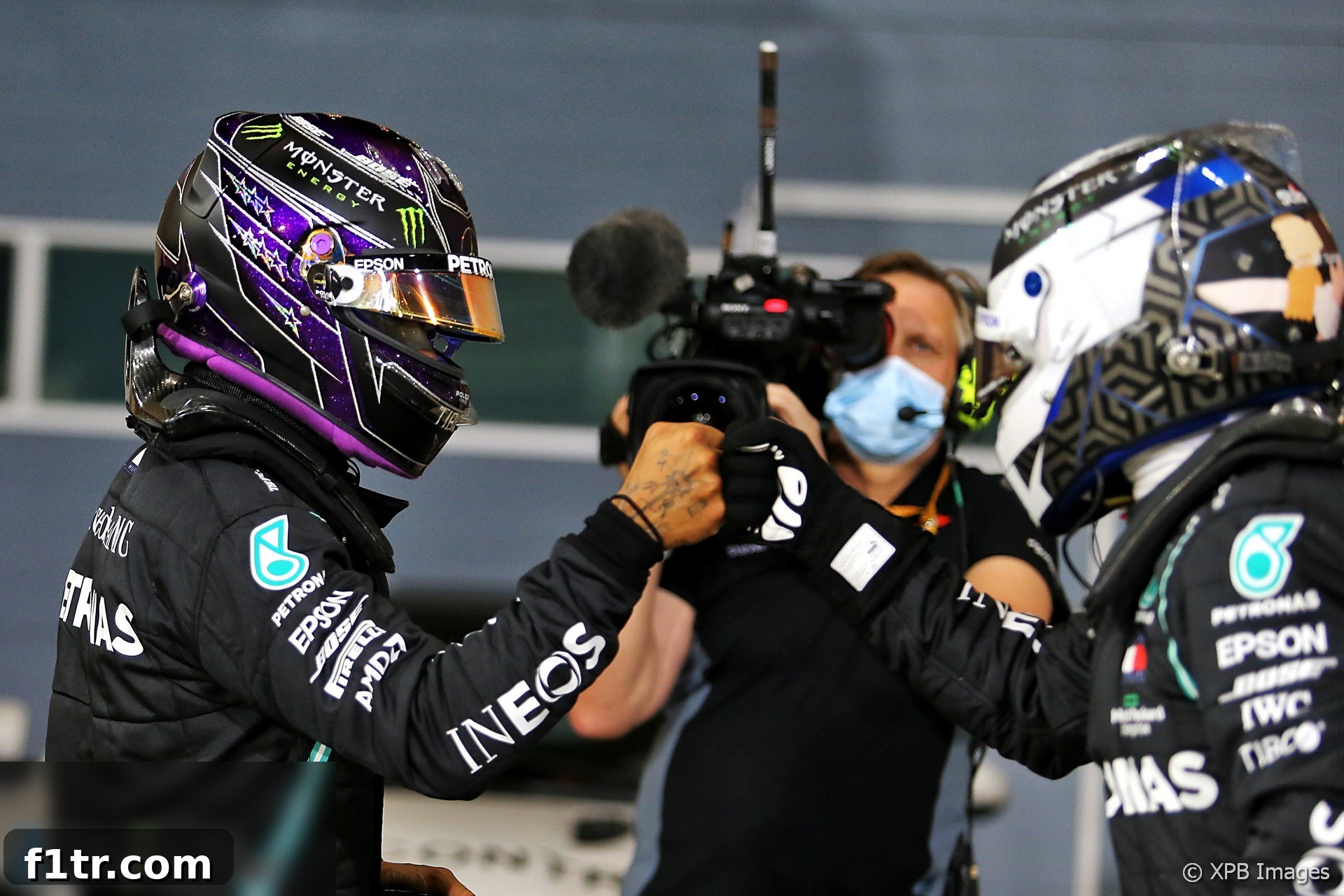
The scorching sands of the Bahrain International Circuit provided a dramatic backdrop for the qualifying session of the Bahrain Grand Prix, a crucible where fractions of a second often define destiny. While Mercedes-AMG Petronas once again asserted its formidable dominance by locking out the front row, the gap between its two star drivers left one of them grappling with an unfamiliar sense of bewilderment. Valtteri Bottas, known for his calm demeanor and meticulous approach, openly admitted his struggle to comprehend why he was significantly off his team mate’s pace.
Despite what he described as a “clean lap” during the decisive Q3 run, Bottas found himself almost three-tenths of a second adrift of Lewis Hamilton. In the cutthroat world of Formula 1, where championships are won and lost by margins that are imperceptible to the naked eye, three-tenths is not merely a deficit; it’s a chasm. This sizable gap fueled a palpable sense of frustration and introspection for the Finnish driver, who expressed his profound confusion in post-qualifying interviews.
Bottas’s Puzzling Performance: The Search for Answers
When pressed to explain Hamilton’s comfortable advantage, Bottas’s response encapsulated his internal struggle: “I don’t really know. It felt good, that’s the problem. It feels good and you feel like you’re extracting everything from the car, but the lap time is not there. That’s the most confusing part. But I can’t really say much at the moment.” This statement reveals the intricate dance between driver perception and objective data in elite motorsport. A driver’s feel for the car, the sensation of nailing every apex and smoothly transitioning through corners, doesn’t always translate directly to the stopwatch. For Bottas, this disconnect was particularly jarring, leading to a frustrating quest for explanations.
The pursuit of perfection in Formula 1 qualifying is an relentless endeavor, where drivers meticulously analyze every single corner, every brake application, and every throttle input. Bottas emphasized the absence of any glaring errors in his final run. “There were no mistakes in the last lap, I thought it was really good. It was like small things here and there, there was no one clear corner,” he elaborated. This further deepened the mystery. Had there been a lock-up, a wide exit, or a missed gear, the reason for the lost time would be evident. Instead, Bottas was left to ponder a collection of “small things” – minute imperfections accumulated across 15 corners, collectively costing him a substantial chunk of time against his teammate.
Such marginal differences underscore the incredibly high level of competition at the pinnacle of motorsport. To an outsider, a few milliseconds here and there might seem negligible, but for a Formula 1 driver, these are the battlegrounds where victories and pole positions are forged. Bottas’s inability to pinpoint a single, significant error suggests that Hamilton was simply operating at an even higher, almost imperceptible, level of optimization, or that his car’s setup was simply more in tune with the track conditions on Saturday afternoon.
Ruling Out Underlying Issues: Chassis Confidence
Despite the pace deficit, Bottas remained steadfast in his belief regarding the fundamental health of his Mercedes W11 chassis. “I don’t think there’s any underlying issue really with the performance of the car,” he asserted, dismissing concerns about any inherent mechanical disadvantage. “I think it’s there and the long runs were good so I’m looking forward to tomorrow.” This confidence in the car’s overall capability is crucial for a driver’s morale and performance. If Bottas suspected a structural or fundamental flaw, it would undoubtedly gnaw at his mind, impacting his approach to both qualifying and the race.
His reference to strong “long runs” in practice sessions provides a glimmer of optimism for race day. Often, a car setup optimized for single-lap qualifying pace might compromise its long-run performance and tire degradation. Conversely, a setup geared towards race consistency might not extract the ultimate one-lap speed. Bottas’s confidence in his car’s race pace suggests that his focus might have been more on Sunday’s challenge, or that his chosen setup might ultimately prove beneficial over a full Grand Prix distance.
The Divergence in Setups: A Mercedes Strategy?
The most plausible explanation offered by Bottas for the significant time difference revolved around differing car setups. “I was quite surprised when I saw the gap,” he admitted, echoing the sentiment of many observers. “I think we ended up with quite different set-ups with Lewis. We’ll see if that makes any difference tomorrow.” This statement opens the door to a fascinating aspect of modern Formula 1: the freedom, or strategic decision, for teammates to pursue distinct car configurations.
In an ideal scenario, two drivers within the same team would converge on a similar setup, maximizing their collective understanding of the car and track. However, it’s not uncommon for drivers to have unique preferences, leading to slight variations in wing angles, suspension stiffness, differential settings, or brake bias. These minor adjustments, when aggregated, can significantly alter how the car behaves, especially when pushing the limits on a qualifying lap. A setup that gives one driver confidence and unlocks speed might feel unstable or slow to another.
Bottas confirmed that such divergence isn’t a rarity within the Mercedes garage: “In times it’s been nearly identical, there’s been times it’s different.” This suggests a team philosophy that allows drivers a certain degree of autonomy in tailoring the car to their specific driving style, rather than enforcing a rigid, identical setup. While this can provide a wider pool of data and potentially hedge against sub-optimal choices for one car, it also means that on any given weekend, one driver’s gamble on a particular setup might pay off more handsomely than the other’s.
The implications of such setup differences are profound, especially heading into the race. A high-downforce setup, for instance, might provide superior grip in corners, ideal for qualifying, but could lead to increased drag on the straights and higher tire degradation over a race stint. Conversely, a lower-downforce setup might offer better straight-line speed for overtaking and potentially conserve tires, but at the cost of ultimate cornering pace. Bottas’s belief in his long-run performance could indicate that his setup was indeed optimized more for the grueling demands of the Grand Prix rather than a single flying lap.
The Psychological Edge and Race Day Implications
While Bottas maintains a stoic exterior, the psychological impact of being consistently outqualified by a teammate, particularly one of Hamilton’s caliber, cannot be understated. Every fraction of a second lost in qualifying contributes to the narrative of internal team dynamics and championship aspirations. For a driver aiming to challenge for the title, minimizing the gap to a teammate is paramount, not just for grid position but for mental fortitude.
The Bahrain Grand Prix circuit, with its long straights and challenging corners, offers various strategic avenues. The stark difference in qualifying pace raises questions about how Bottas’s car will perform against Hamilton’s and other competitors over 57 laps. Will his presumed race-focused setup grant him an advantage in tire management or enable better overtaking opportunities? Or will Hamilton’s superior qualifying pace translate into an unassailable lead from the outset?
The stage is now set for a fascinating tactical battle. Bottas’s mission will be to understand precisely where the time was lost and, more importantly, to demonstrate that his chosen setup, or perhaps a more measured approach to qualifying, will pay dividends when it truly matters on Sunday. The three-tenths gap from Saturday is a reminder of the relentless pursuit of perfection in Formula 1 and the often-mystifying nature of ultimate pace.
As the sun sets over Sakhir for the main event, all eyes will be on the Mercedes duo. Will Bottas unravel the puzzle of his qualifying deficit and convert his long-run confidence into a strong race performance, challenging Hamilton for victory? Or will Hamilton’s qualifying mastery translate into another dominant display? The answers will unfold under the floodlights, revealing the true impact of those differing setups and the intricate balance between driver feel and raw lap time.
2020 Bahrain Grand Prix Related Articles
- Grosjean reunited with helmet which saved him from huge fire in 2020 Bahrain crash
- Pictures: Wrecked chassis from Grosjean’s Bahrain fireball crash to go on display
- Grosjean reveals extent of burns to right hand
- ‘I put both my hands in the fire’: Grosjean describes his 28 seconds trapped in an inferno
- “Thank you for saving my life” Grosjean tells crash scene marshals
Browse all 2020 Bahrain Grand Prix articles