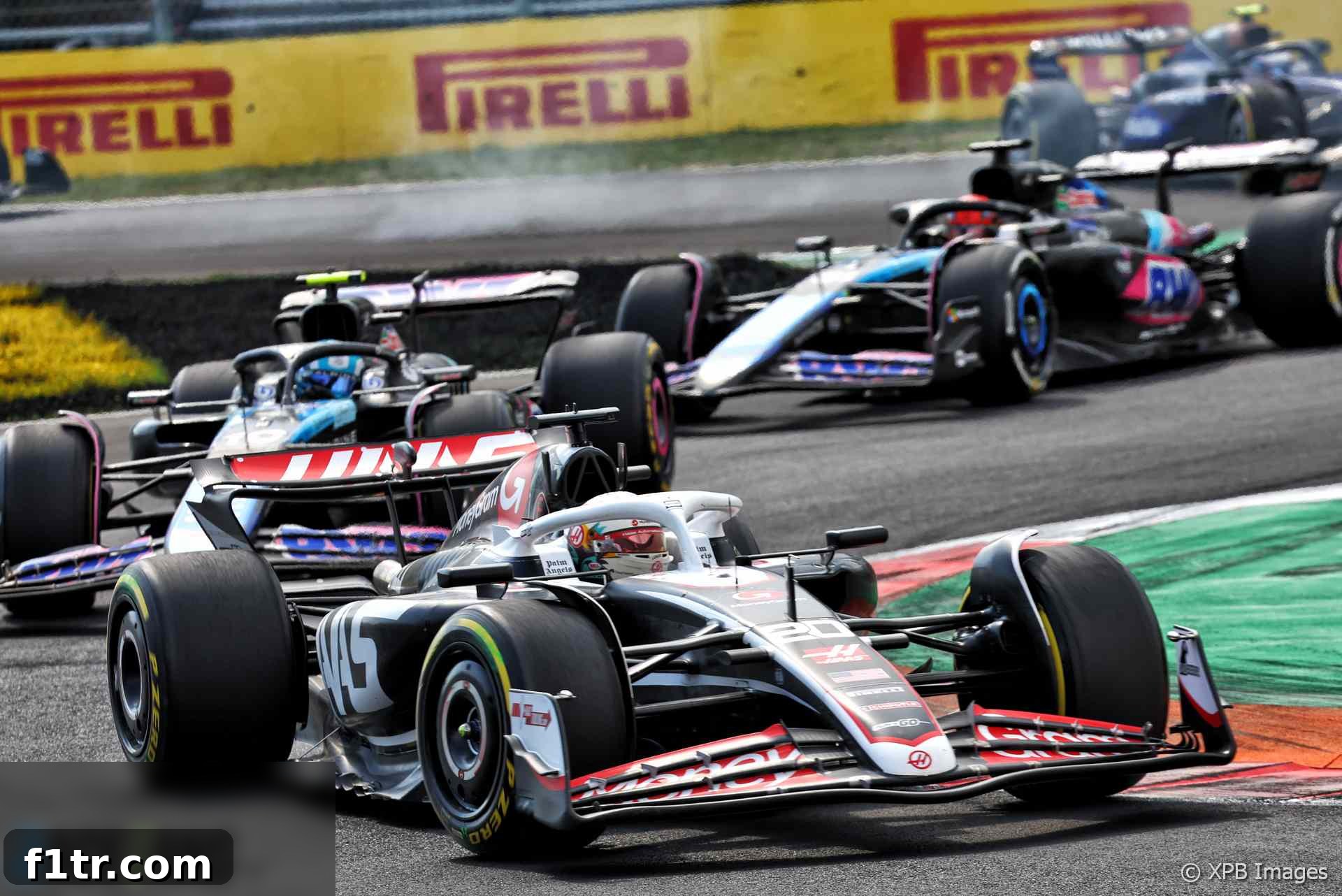
Kevin Magnussen, the Danish racing driver, recently voiced strong criticism regarding the stewards’ decision to impose a penalty on him following his collision with Pierre Gasly at the Italian Grand Prix. This incident, which Magnussen deemed a mere racing skirmish, ultimately led to him accumulating the maximum 12 penalty points on his superlicence, resulting in an unprecedented race ban for the upcoming Azerbaijan Grand Prix. His outspoken remarks have ignited further debate within the Formula 1 community about the consistency and interpretation of stewarding decisions, particularly concerning what constitutes a “racing incident” versus a punishable offense.
Advert | Become a Supporter & go ad-free
The Haas driver’s accumulation of 12 penalty points, a threshold rarely reached by a single driver in a championship season, has automatically triggered a ban from the next round of the Formula 1 calendar. This means Magnussen will be unable to compete in the Azerbaijan Grand Prix, a significant setback for both him and his team. The ban underscores the stringent nature of the F1 superlicence penalty point system, designed to ensure driver safety and deter overly aggressive or dangerous driving. However, Magnussen’s perspective suggests a disconnect between the stewards’ interpretation and what drivers perceive as acceptable on-track behavior during intense racing scenarios.
Before the official confirmation of his ban, Magnussen passionately expressed his disbelief that the incident with Gasly at Monza’s Roggia chicane warranted any penalty whatsoever. His comments highlighted a growing frustration among some drivers regarding what they feel are overly punitive measures for situations that, in their view, are inherent to competitive motorsport and should be viewed as natural outcomes of wheel-to-wheel action.
“Me and Gasly had slight contact,” Magnussen elaborated in an interview with Sky Sports following the race. “There was no damage on either car, no significant consequence in the race itself; we simply had a brief touch and missed the corner. And, so what? We were clearly in a racing situation, pushing the limits as Formula 1 drivers do. I genuinely don’t understand why we feel the need to be handing out penalties like this for what was, in essence, hard racing.” His remarks encapsulate a widely discussed sentiment: that the spirit of racing is sometimes stifled by overly strict interpretations of the rules, potentially leading to a more cautious, rather than aggressively competitive, style of competition that fans often crave.
Magnussen further intensified his criticism by drawing a direct comparison between his penalty and an incident involving his own teammate, Nico Hülkenberg, and Daniel Ricciardo at the same event. He argued that the collision between Hülkenberg and Ricciardo, which presented a far greater potential for danger and a more significant impact on the race, received a significantly lighter penalty. While Magnussen received a 10-second time penalty for his contact with Gasly, Ricciardo was only given a five-second penalty for his involvement in the Hülkenberg incident, a discrepancy Magnussen found deeply perplexing.
“Nico almost got thrown into the wall at 300 kilometres per hour by Ricciardo,” Magnussen stated, visibly exasperated by the perceived inconsistency. “I’m not suggesting Ricciardo did it on purpose, as these things can happen in the heat of battle, but even so, he received a mere five seconds, while I was slapped with 10 seconds for a far less impactful contact. It simply doesn’t add up logically in my mind, and it makes it very difficult for drivers to understand where the lines are drawn.” This perceived disparity in stewarding decisions is a recurring theme in Magnussen’s critique and a point of contention for many observers of the sport. It raises fundamental questions about the consistency of penalty application and the criteria used by stewards to assess the severity and intent of on-track incidents.
Advert | Become a RaceFans supporter andgo ad-free
A closer look at Magnussen’s superlicence record reveals that nine of his twelve penalty points were accumulated specifically for collisions with other drivers. This pattern, while alarming from a regulatory standpoint and painting a picture of a driver prone to contact, Magnussen insists, stems from the stewards’ lack of understanding regarding the nuances of racing incidents and the fine margins involved in Formula 1. He articulated his continued bewilderment despite multiple discussions with the officials.
“Even though I routinely go and speak to them – and I have spoken to them many times, frankly far too many times over my career – I still cannot grasp what the rules truly are, or how they are consistently applied,” Magnussen lamented, highlighting a perceived lack of clarity and predictability in decision-making. “It frequently feels like they are simply throwing penalties around without a clear, consistent framework that drivers can understand and adapt to. It almost appears as though they actively discourage genuine racing, prioritizing absolute safety and clean lines over aggressive, entertaining competition, and that, to me, is a troubling prospect for the future of the sport.” This sentiment reflects a deeper concern that F1 officiating might be inadvertently sterilizing the racing spectacle, pushing drivers towards a safer, less aggressive, and ultimately less exciting style of competition, which could alienate fans who cherish fierce on-track battles.
Magnussen concluded his impassioned argument by posing a rhetorical question that encapsulates his core grievance and the broader debate: “If this particular incident between myself and Gasly, which resulted in minimal impact and no lasting consequences, cannot be classified as a racing incident, then I am at a complete loss as to what can be. It utterly defies logical sense and makes the sport incredibly difficult to navigate as a driver who simply wants to race hard and fairly.” His struggle to reconcile the stewards’ decisions with his understanding of competitive racing highlights the ongoing tension between enforcing safety regulations and preserving the raw, unpredictable essence of motorsport.
The ramifications of Magnussen’s ban extend directly to the Haas F1 Team, which now faces the immediate and significant challenge of finding a suitable replacement for the Azerbaijan Grand Prix. Team principal Ayao Komatsu officially acknowledged that Magnussen “won’t be racing in Baku,” confirming the team’s acceptance of the penalty while also signaling the start of their contingency planning. As of now, the team has not yet made an official announcement regarding who will step into Magnussen’s cockpit for the crucial race weekend, adding an element of uncertainty to their preparations for the demanding street circuit.
The most prominent and logical candidate for the reserve driver role is Oliver Bearman, Haas’s highly-rated reserve driver and a promising talent in the junior categories. Bearman is contractually due to compete in the Formula 2 championship during the same weekend as the Azerbaijan Grand Prix, creating a scheduling conflict. However, he has a precedent for being released from his F2 commitments to substitute in F1. Earlier this year, Bearman famously replaced Carlos Sainz Jnr at the Saudi Arabian Grand Prix for Ferrari, impressing many with his composed and competitive debut performance, securing points in a challenging situation. This invaluable experience makes him a strong, if logistically complicated, contender to fill Magnussen’s seat. Haas will need to carefully weigh Bearman’s F2 schedule, his prior F1 outing, and his readiness for Baku’s unique challenges against other potential options, as the circuit demands precision, courage, and quick adaptation. The decision will undoubtedly impact Haas’s strategy for the weekend and potentially their constructors’ championship standing, as every point counts in the tightly contested midfield.
The debate ignited by Magnussen’s ban transcends individual incidents; it delves into the very philosophy of Formula 1 stewarding and the direction the sport is taking. The sport has, over the years, grappled with finding the right balance between encouraging thrilling, wheel-to-wheel action and ensuring driver safety, a paramount concern. Drivers like Magnussen and many fans advocate for a more lenient approach to minor contacts and contested positions, viewing them as integral elements of racing that add excitement and drama. Conversely, the FIA and its stewards are tasked with upholding a consistent standard that prevents dangerous driving, maintains fairness across the grid, and avoids setting precedents that could lead to more reckless behavior. The superlicence penalty point system was introduced precisely to provide a quantifiable metric for assessing a driver’s cumulative risk profile and deter repeat offenders, yet its application continues to draw scrutiny and often becomes a focal point of controversy. The Magnussen case serves as a poignant example of this ongoing tension, highlighting the need for clearer, more universally understood guidelines or perhaps a more nuanced, flexible interpretation of incidents that occur at the absolute limit of competition in a fast-paced, high-stakes environment.
As the F1 circus prepares to head to the demanding and unforgiving streets of Baku, the absence of Kevin Magnussen will undoubtedly be felt, both by his team and by fans who appreciate his tenacious racing style. The discussions surrounding his ban and the broader implications for F1 stewarding are unlikely to subside quickly. His outspoken critique has brought to the forefront a persistent issue within Formula 1, challenging the consistency and rationale behind some of the sport’s most critical decisions, and prompting renewed calls for dialogue between drivers, teams, and the governing bodies to ensure the sport remains both safe and spectacularly entertaining.
Miss nothing from RaceFans
Get a daily email with all our latest stories – and nothing else. No marketing, no ads. Sign up here:
Advert | Become a RaceFans supporter andgo ad-free
2024 Italian Grand Prix Coverage and Beyond
Stay updated with all the latest developments from the 2024 Italian Grand Prix and other critical Formula 1 discussions:
- ‘I should have won last year but I did stupid stuff’: Norris out to avenge 2024 defeat
- Verstappen faces post-race investigation along with five other drivers and McLaren
- Red Bull lose constructors’ championship lead for first time in two years
- “Never had so much pain in a car”: How Colapinto impressed Williams on his debut
- F1’s most competitive season for 47 years? Four teams now have three wins each
Browse all 2024 Italian Grand Prix articles