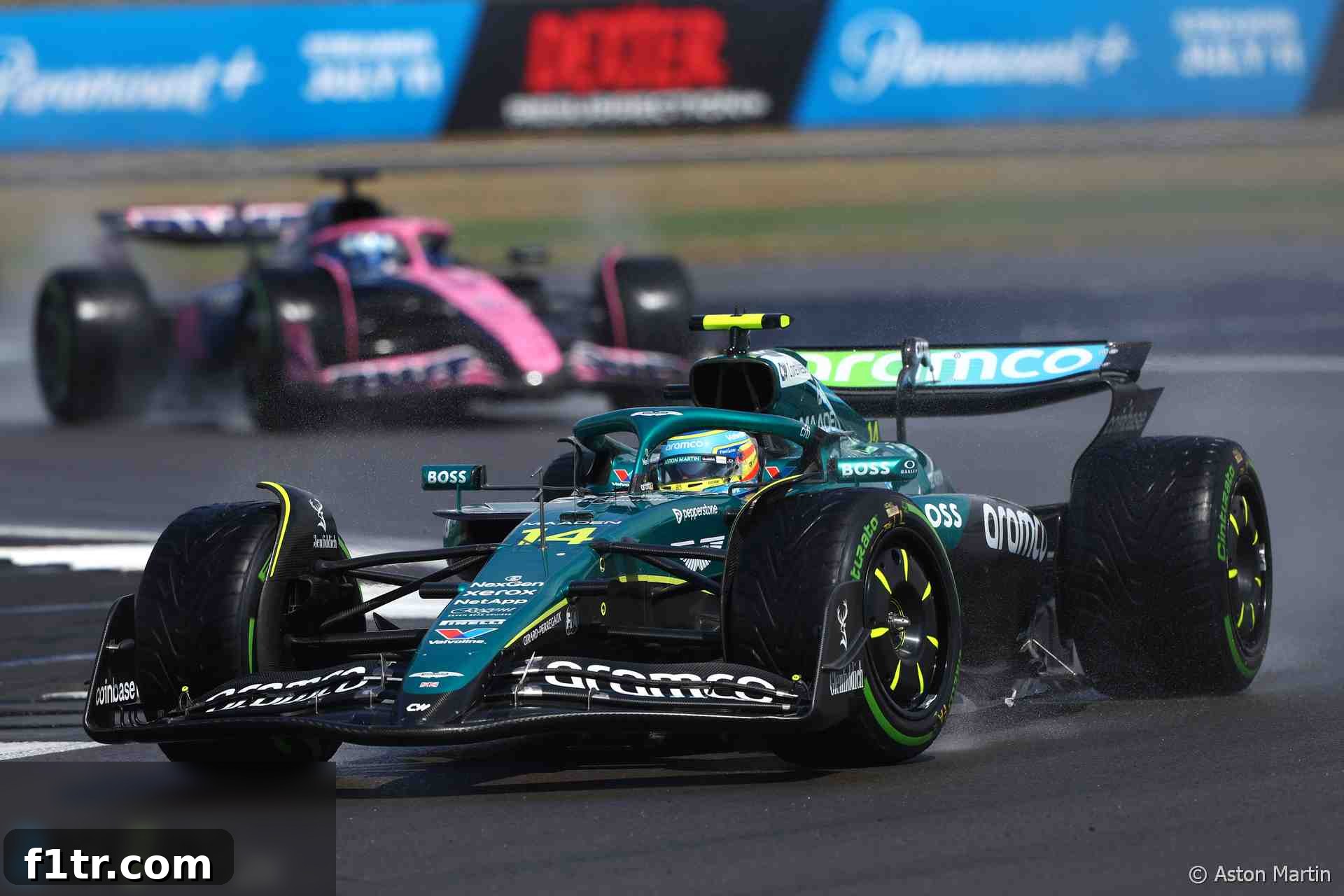
The highly anticipated Fernando Alonso and Aston Martin F1 partnership faced intense scrutiny at the British Grand Prix, a race marked by treacherous, ever-changing weather conditions that tested every team’s strategic prowess. Amidst the chaos and the spray, Alonso’s raw frustration following a crucial strategy call by his team was broadcast live on the world feed, providing a rare glimpse into the high-pressure world of Formula 1 decision-making and its immediate consequences.
The veteran Spaniard, known for his incisive commentary and relentless pursuit of performance, saw his promising position evaporate when an early pit stop saw him plummet from sixth place to tenth. This significant drop immediately raised questions about Aston Martin’s tactical choices, especially when contrasted with the fortunes of his teammate.
Advert | Become a Supporter & go ad-free
While Alonso wrestled with the outcome of his strategy, his teammate Lance Stroll, starting from a much lower position of 12th on the grid, executed a brilliant and unconventional strategy that propelled him dramatically up the order, at one point soaring to fourth. The stark contrast in outcomes between the two Aston Martin drivers highlighted the knife-edge nature of tyre strategy in variable conditions, a common theme in the thrilling spectacle of Grand Prix racing at Silverstone.
Alonso’s Frustration Boils Over: “Crazy how you never get it right with me.”
The radio communication from Fernando Alonso, broadcast globally during the race, perfectly encapsulated his profound disappointment and the competitive fire that still burns within him. “All the people that we lost places [to, do] they have worse tyres or [did] we just lose places for fun?” he demanded of his race engineer, Andrew Vizard. This direct question underscored his disbelief at the perceived strategic misstep that had so swiftly cost him valuable track position and crucial championship points.
The response from the pit wall, confirming that only one competitor had genuinely stayed ahead by extending their stint, while several others had successfully ‘jumped’ him through their own well-timed pit stops, did little to soothe Alonso’s temper. His cutting reply, “Crazy how you never get it right with me,” echoed a sentiment of recurring strategic misfortune, a feeling that any driver in the heat of battle might experience when crucial decisions don’t go their way. It’s a powerful statement that reveals the deep trust and potential frustration dynamics between a driver and their engineering team, particularly when high stakes are involved and every millisecond counts towards their ultimate performance and standing in the Formula 1 season.
The Strategic Masterstroke: How Lance Stroll Climbed the Ranks
Lance Stroll’s performance at the British Grand Prix was a masterclass in opportunistic strategy and tyre management, especially considering the highly unpredictable and rapidly changing conditions at Silverstone. His decision to make two pit stops even before Fernando Alonso’s first was a bold and aggressive move, orchestrated with remarkable precision by the Aston Martin pit wall. The pivotal moment for Stroll came on lap six during a Virtual Safety Car (VSC) period. As the track briefly showed tantalizing signs of drying, he was swiftly called in to swap his intermediate tyres for soft slick tyres. This early gamble, taken while many other competitors hesitated or opted to stay out, allowed him to unlock significant pace and gain crucial time relative to his rivals, who remained on intermediates on what was becoming a drier track surface.
However, the British weather, ever capricious and a defining characteristic of Silverstone, soon turned against the slicks. Just four laps later, on lap 10, conditions deteriorated once more, with rain returning and forcing Stroll back into the pits for another set of intermediate tyres. This second, rapid-fire stop, executed one lap before many other drivers were compelled to follow suit, allowed Stroll to perform a highly effective ‘undercut’ on several competitors. The undercut is a potent F1 strategy where a driver pits earlier than a rival, benefiting from the immediate grip and speed of fresh tyres to set faster lap times, often emerging ahead of the rival once they eventually complete their own pit stop. Stroll’s precise timing and the team’s courageous calls, first to slicks and then back to intermediates, showcased an aggressive and perfectly executed strategic play that paid substantial dividends, catapulting him up the order and demonstrating the team’s ability to react decisively to dynamic race scenarios.
Aston Martin’s Dual Strategy: A Calculated Risk in Formula 1
Aston Martin team principal Andy Cowell later provided a detailed explanation of the rationale behind their divergent strategies for the two drivers. The decision to split their approaches was made even before the race began, largely influenced by their starting grid positions: Fernando Alonso in a strong P7 and Lance Stroll significantly further back in P18. “The way we were looking at it this morning when we were doing the strategy review was that Fernando’s P7, Lance is down at P18, there’s sort of two strategy games to play and so to take a different approach,” Cowell told media, including RaceFans, outlining the strategic thinking.
This approach of splitting strategies is a well-established and often-used tactic in Formula 1, particularly when a team’s drivers are separated by a significant number of grid positions. It allows the team to cover more eventualities, effectively hedge against unpredictable track conditions, and maximize the chances of at least one car securing strong points. In this instance, it meant giving Stroll the freedom to take higher-risk, higher-reward gambles from the back of the pack, potentially capitalizing on chaos, while Alonso’s strategy might have been initially more conservative, aiming to consolidate a strong points finish from a better starting spot. This dual approach aims to optimize the team’s overall performance and ensure a robust points haul, even if one strategy doesn’t fully pan out.
Advert | Become a RaceFans supporter andgo ad-free
Hindsight, as Cowell admitted with a touch of characteristic F1 humor, is always 20/20. Reflecting on the race with the benefit of “hindsight T-shirts on, the Monday morning coaching where we can go ‘Actually, what would the ideal race have been?’”, he candidly conceded that perhaps Alonso could have benefited significantly from mirroring Stroll’s aggressive early strategy. “That was for Fernando to mimic exactly what we did with Lance at that point and maybe that could have done better,” he acknowledged. This open admission highlights the constant learning curve inherent in F1 strategy, where the perfect call is often only clear in retrospect, long after the chequered flag has fallen. It demonstrates the continuous process of analysis and refinement that every top-tier Formula 1 team undertakes to improve their strategic decisions race after race.
Alonso’s Second Setback: Premature Slick Tyre Switch
Fernando Alonso’s challenging race was further compounded by a second strategic miscalculation later in the Grand Prix. After already struggling with the outcome of his initial pit stop, he suffered a further setback when the Aston Martin team opted for an early switch back to slick tyres. Unfortunately, the track conditions had not yet sufficiently dried, making this decision decidedly premature and ill-timed. “We were the first team to go onto the slick tyres, we probably went too soon there,” Cowell later reflected, openly admitting the team’s error and providing valuable insight into their strategic thought process.
The consequence of this early switch was immediate and detrimental to Alonso’s race. The medium slick tyres, operating on a still-wet and cold surface, failed to generate sufficient temperature to function optimally. This critical lack of tyre temperature directly translates to a severe loss of grip, reduced braking efficiency, and a significant drop in overall performance, leaving Alonso struggling for pace and vulnerable to competitors who had wisely remained on intermediate tyres or waited for truly dry conditions. Despite this significant handicap and the frustration of a double strategic misfortune, Alonso’s formidable fighting spirit shone through as he battled his way back, demonstrating his immense skill and unwavering determination to salvage whatever points he could from a strategically complex and profoundly frustrating British Grand Prix weekend, a testament to his enduring talent and resilience in the face of adversity.
Understanding Driver Frustration: The Heat of the Moment in F1
Andy Cowell also offered a compassionate and understanding perspective on Fernando Alonso’s heated radio messages, acknowledging that such expressions are a natural and almost inevitable part of the highly competitive and emotionally charged Formula 1 environment. “I think all of us that have been in this competitive world for a long time know that sometimes in the environment, in the cockpit, you can’t see what’s going on overall and you’re always frustrated when a series of pit stops plays out and you’ve dropped the odd place, you want to know why,” he explained. This insightful perspective underscores the immense pressure drivers are constantly under, with limited real-time information compared to the comprehensive data available on the pit wall, making them reliant on the team’s strategic calls.
From the confined and high-octane environment of the cockpit, a driver relies heavily on their team for strategic guidance and clear communication. When a decision leads to an immediate loss of track position or a perceived disadvantage, it is entirely natural for questions, frustrations, and candid feedback to arise. Cowell further noted, “So we’ve heard every single driver come up with those messages and it feels personal, but it’s not.” This insight highlights the professional nature of the sport, where intense emotions are an intrinsic part of the game, but strategic reviews are consistently conducted objectively post-race to learn, adapt, and improve. It’s a testament to the robust trust dynamic within an F1 team that such candid feedback, however sharp in the moment, is ultimately seen as part of the process of striving for perfection, not a personal attack, fostering an environment of continuous improvement and strategic refinement.
Miss nothing from RaceFans
Get a daily email with all our latest stories – and nothing else. No marketing, no ads. Sign up here:
Advert | Become a RaceFans supporter andgo ad-free
Navigating the Complexities of F1 Strategy at Silverstone
The British Grand Prix at Silverstone frequently delivers thrilling races, often amplified by the inherent unpredictability of its weather and the high-speed nature of its iconic circuit. For Aston Martin, this particular race presented a compelling microcosm of Formula 1’s profound strategic challenges. The decision to split strategies, while ultimately yielding a fantastic and well-executed result for Lance Stroll, simultaneously exposed Fernando Alonso to significant setbacks and frustrating losses of track position. It underscores the extremely fine line between strategic brilliance and miscalculation, a line often dictated by a few critical moments of changing track conditions or a competitor’s unexpected and opportunistic move.
For teams like Aston Martin, every race is a crucial learning experience that contributes to their ongoing development and understanding of strategic nuances. While the immediate aftermath might be filled with both jubilation for one driver and profound frustration for the other, the rigorous post-race analysis is absolutely crucial. Identifying precisely where calls could have been better, thoroughly understanding the data from both cars, and continuously refining their decision-making processes under pressure are all continuous efforts that define success in Formula 1. The transparency of Andy Cowell’s comments suggests a team committed to open communication and continuous improvement, acknowledging that even the most experienced strategists can be caught out by the unique and dynamic demands of a Grand Prix weekend. Fernando Alonso’s fierce competitive spirit, combined with the team’s willingness to learn from every strategic outcome, will undoubtedly shape their approach to future races, as they strive for perfect synergy between driver and pit wall to maximize their championship aspirations.
2025 British Grand Prix
- Tsunoda says the stewards will have “not been nice to me” as penalty points mount up
- ‘I’ve considered Hulkenberg an exceptional talent for a very long time’ – Wheatley
- Alpine is now F1’s highest scoring last-placed team of all time: British GP stats
- Ferrari had no GPS data from Hamilton’s car throughout British Grand Prix
- “The risk for us is a Safety Car”: Why Norris’s win was in danger for six laps
Browse all 2025 British Grand Prix articles