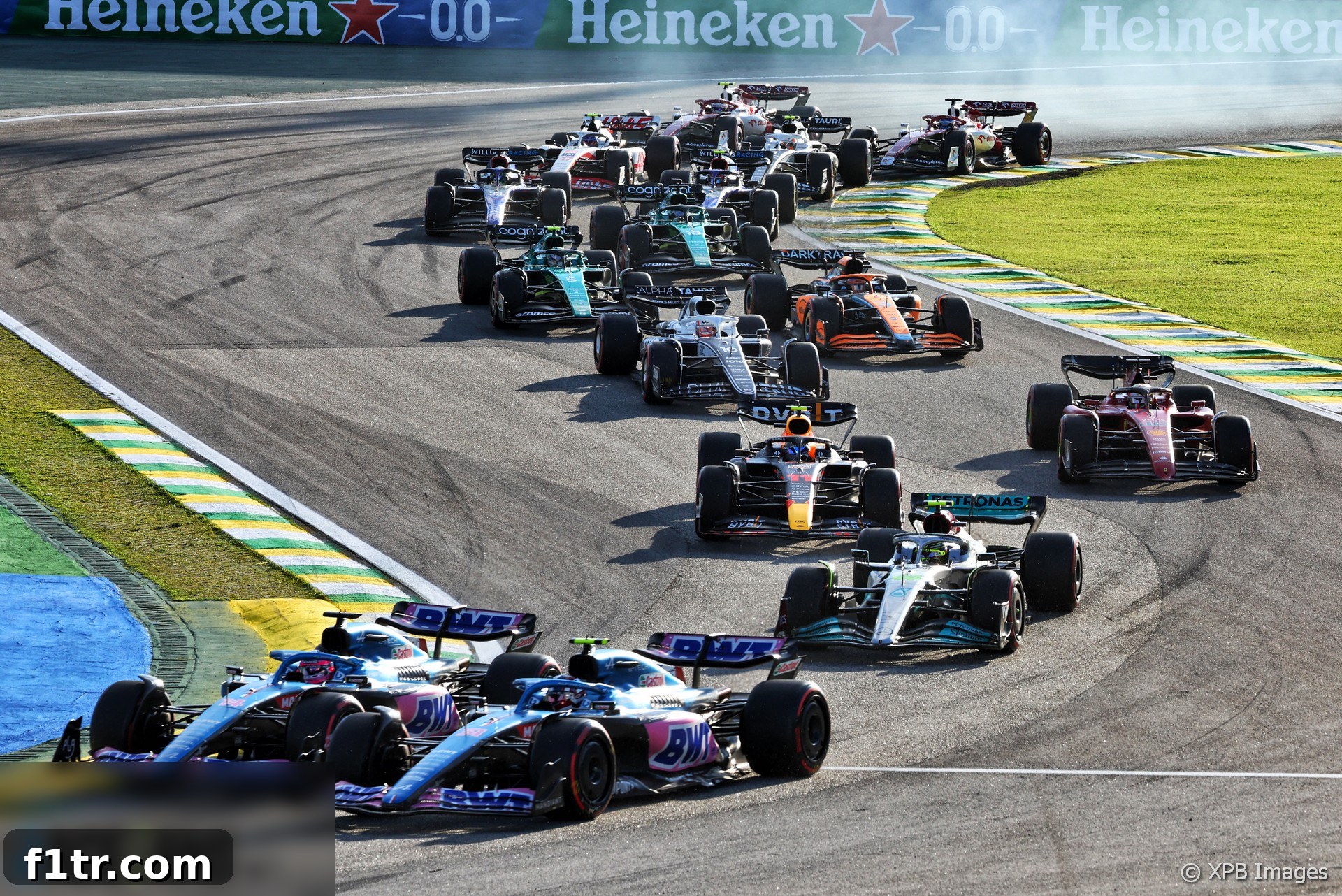
The exhilarating world of Formula 1 racing, often a stage for high-octane competition, occasionally turns into a battleground for intra-team rivalries. One such dramatic chapter unfolded at the 2022 Brazilian Grand Prix sprint race, where the Alpine F1 team found itself embroiled in controversy as its two drivers, Fernando Alonso and Esteban Ocon, clashed on track not once, but twice. These incidents not only cost the team valuable points but also ignited a heated debate about driver conduct and team dynamics, particularly with the constructors’ championship battle against McLaren hanging in the balance.
The drama began almost immediately after the lights went out on the Interlagos circuit. In a frenetic opening lap characteristic of sprint races, Alonso and Ocon found themselves in close quarters. The first incident, which the race stewards ultimately deemed unworthy of investigation, occurred at Turn One. While details of this initial contact were less clear, it set a tense precedent for what was to follow. Formula 1’s stewards often exercise discretion in sprint races, understanding the aggressive nature and short duration, but the subsequent clash left them no choice but to intervene.
The more significant and contentious incident unfolded on the main straight, moments after the first. Following the close quarters at Turn One, the Alpine pair continued their fierce duel through the opening corners. As they navigated the fast, sweeping left-hander of Descida do Lago (Turn 4), Fernando Alonso, the two-time world champion known for his aggressive race craft, attempted an audacious overtake on Esteban Ocon around the outside. This bold move saw Alonso run wide, briefly going onto the kerb and narrowly avoiding a loss of control, a testament to the fine margins at play in top-tier motorsport. Undeterred, Alonso pressed on, seeking to regain position.
The crucial moment arrived as the cars accelerated out of the flat-out curve that leads onto the long main straight. In a desperate attempt to pass his teammate, Alonso clipped Ocon’s right-rear wheel. The consequences were immediate and severe for both Alpine machines. Alonso’s car sustained significant front wing damage, forcing him into an unscheduled pit stop for repairs. This early stop effectively ruined his sprint race, relegating him to the back of the pack and extinguishing any hope of scoring points. Ocon, too, suffered bodywork damage, which compromised his car’s aerodynamic performance for the remainder of the short race, leading him to finish outside the points-scoring positions.
The ramifications of this on-track entanglement were palpable, particularly for the Alpine F1 team, which was locked in a tight battle with McLaren for fourth place in the Constructors’ Championship. Esteban Ocon, speaking after the race, expressed his disappointment, lamenting the “unfortunate for the team, really, what happened” situation. He acknowledged the costly nature of the incident, stating, “We were in a good position, we are now at the back with a lot of work to do tomorrow.” Ocon also recounted his perspective of the main straight incident, explaining, “I was trying to attack the McLaren, took my line into four and Fernando came out of nowhere from the outside, so we touched and from there on, my race was pretty much over.” His words conveyed a sense of resignation, knowing that their internal squabble had gifted points to their closest rivals.
Fernando Alonso, whose final races with Alpine before his move to Aston Martin were proving increasingly tempestuous, shared his frustration. He described how the contact on the first lap “ruined his race,” emphasizing the unforgiving nature of a sprint race where there is little time to recover from setbacks, especially without the intervention of a Safety Car. Despite the setback, Alonso tried to find a silver lining, noting that “on the positive side, the pace was very good today, close to the leaders actually, so we could recover a few places.” Starting the main Grand Prix from P15, he remained optimistic about his chances, believing that with strong pace, scoring points was still a possibility. This determination highlights the veteran’s enduring belief in his abilities, even when faced with adversity.
However, beneath the surface of immediate race analysis, a deeper narrative of simmering tension between the two Alpine drivers emerged. Alonso, famously direct, made it clear he wasn’t interested in discussing the incident with Ocon. He candidly recalled a history of “close incidents” between them throughout the season, citing specific instances like Jeddah and Budapest where he felt Ocon had driven him dangerously close to walls or out of contention. More tellingly, Alonso broadened his critique by referencing Ocon’s past clashes with other drivers, including Sergio Perez during their time as teammates at Force India, and most notably, Ocon’s infamous 2018 collision with Max Verstappen at Interlagos while trying to unlap himself. These historical anecdotes painted a picture of a consistent pattern of aggressive driving from Ocon, at least in Alonso’s eyes.
Alonso’s concluding remark, “There’s one more race and then it’s over, finally,” resonated with a sense of weary relief, underscoring the strained relationship that had developed within the Alpine garage. This highly personal statement, coming from a driver departing the team, highlighted the internal pressures and the fierce, sometimes overly competitive, nature that can fester within a team when two strong personalities are paired together, especially when one is a seasoned veteran and the other is an ambitious rising star.
The impact of this intra-team collision extended far beyond the immediate disappointment of the sprint race. It dealt a significant blow to Alpine’s championship aspirations, providing a clear advantage to McLaren in their battle for P4 in the constructors’ standings. While the exact points lost due to the incident were difficult to quantify precisely, the fact that both cars were taken out of contention for points meant a missed opportunity to consolidate their position against their Woking-based rivals. Such incidents raise uncomfortable questions for team principals and strategists about managing driver aggression and maintaining team cohesion, especially when major championship stakes are involved.
Looking ahead to the main event, the Brazilian Grand Prix, Alpine faced the monumental task of not only repairing damaged cars but also potentially damaged relationships. Both drivers would need to put their differences aside and work collectively to recover lost ground. The situation at Interlagos served as a potent reminder that in Formula 1, the competition is not always just against other teams; sometimes, the greatest challenge lies within the team itself. As Fernando Alonso prepared for one of his last races with Alpine, the Brazilian Grand Prix sprint race delivered a memorable, albeit tumultuous, chapter in his storied career and in the annals of Formula 1 intra-team drama.
2022 Brazilian Grand Prix
- Ferrari’s season of missed chances led to “difficult” criticism for Binotto
- How many victory chances did Hamilton have in his first winless F1 season?
- Red Bull “never envisaged” Brazil team orders situation – Horner
- Red Bull “accept Max’s reasoning” over radio row and condemn online abuse
- Russell’s first grand prix victory means F1 has a dozen winners – for one race only
Browse all 2022 Brazilian Grand Prix articles